dimecres, 31 de maig del 2023

ELSNER, Józef (1769-1854) - Te Deum (1815)

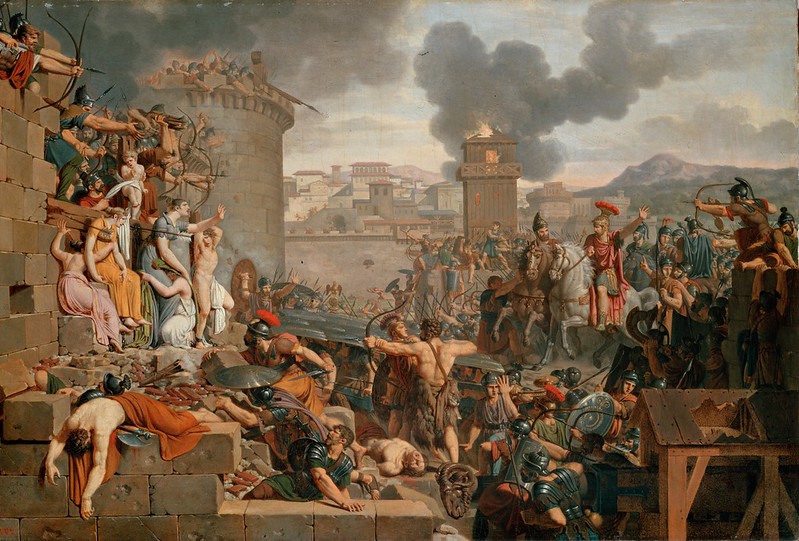
Armand-Charles Caraffe (1762-1822) - Metellus Raising the Siege


Józef Elsner (1769-1854) - Te Deum, Op.11 (1815)
Performers: Agnieszkа Tοmаszewska (soprano); Joаnna Dοbrаkοwska (alto); Kаrοl Kοzłοwski (tenor); Adаm Pаlkа (bass); Capella Clаrοmontаna; Cаntores Minores Wrаtislаvienses; Jаrοsłаw Jаsiurа (conductor)

---


Polish composer and teacher of German origin. As a schoolboy he sang in the church choir of Grodków. His interest in music developed while he was a pupil at the Dominican school, then at the Jesuit Gymnasium in Breslau (now Wrocław) (1781-88), where he sang the solo soprano part in Graun’s Der Tod Jesu. He also sang in the opera chorus, played the violin in chamber music and began to compose, chiefly religious music (now lost). At the University of Breslau he read theology and medicine; in 1789 he went to Vienna to study medicine, but gave it up for music. In 1791-92 he was violinist and conductor of the opera orchestra in Brno and from 1792 to 1799 in Lemberg (now L'viv), where he conducted the theatre orchestra, composed symphonies and chamber music and began to work on operas; at first he used German librettos, but after 1796 turned to Polish texts, especially in collaboration with Wojciech Bogusławski, organizer of the Polish National Theatre. He also arranged weekly concerts for a musical society. In 1799 Elsner settled permanently in Warsaw, where for 25 years he was in charge of the Opera, enriching its repertory with his own works and training many eminent singers. All his life he was very active as a teacher; he founded and organized several music schools on different levels and was the author of a number of works and textbooks. From 1817 to 1821 he taught at the School of Elementary Music and Art, from 1821 to 1826 at the Conservatory and from 1826 to 1831 at the Main School of Music, where he was professor of composition and rector. He taught many composers, above all Chopin. From 1802 until 1806 Elsner ran a music engraving shop in Warsaw, from which he issued several publications, notably 24 numbers of the periodical Wybór pięknych dzieł muzycznych i pieśni polskich (‘Selected beauties of music and Polish songs’). In 1805 he was nominated a member of the Warsaw Society of Friends of Science and in 1805-06, together with E.T.A. Hoffmann, he ran the music club, where Beethoven’s symphonies were among the works performed. He also founded the Society of the Friends of Religious and National Music (1814). From 1811 to 1819 he was correspondent of the Allgemeine musikalische Zeitung, and from 1802 to 1825 contributed many reviews and articles to the Polish press. He was an honorary member of the music society of the Leipzig University Paulinerkirche as well as of many music societies in Poland, and was also a freemason. For his services to music he was awarded the Order of St Stanisław in 1823, and three commemorative medals were struck in his honour. Elsner was twice married, the second time to one of his pupils, Karolina Drozdowska (1784-1852), a leading soprano at the Warsaw Opera.

dilluns, 29 de maig del 2023

JACKSON, William (1730-1803) - Sonata for Harpsichord with accompaniment (c.1773)

John Downman (1750-1824) - Portrait of William Jackson, of Exeter, the composer (1781)


William Jackson of Exeter (1730-1803) - Sonata (IV) for Harpsichord with accompaniment (c.1773)
Performers: Ars Musicae, Mallorca 

---


English composer, essayist, organist and painter. The son of a grocer, he was given a liberal private education and studied with musicians at Exeter Cathedral and other visiting musicians in the city. After receiving some musical instruction from John Silvester, organist of Exeter Cathedral, Jackson was sent in 1748 to London, to become a pupil of John Travers, organist to the Chapel Royal. In 1767 Jackson wrote the music for an adaptation of Milton's Lycidas, which was produced at Covent Garden on 4 November of the same year, on the occasion of the death of Prince Edward, Duke of York and Albany, brother to George III. While in London, he was a visitor at the meetings of the Madrigal Society. On his return to Exeter Jackson devoted himself to teaching music until Michaelmas 1777, when he was appointed subchanter, organist, lay vicar, and master of choristers to the cathedral, in succession to Richard Langdon. Jackson's pupils included George Baker, William Bennet and John Davy. He was survived by his wife (née Bartlett), two sons and a daughter; the sons pursued successful careers in diplomatic service. A monument was erected to him in the vestry of St Stephen’s, Exeter, where he is buried. Throughout his life Jackson was active as a composer in a variety of media, though the largest proportion of work published in his lifetime was secular vocal music. 

diumenge, 28 de maig del 2023

TSCHORTSCH, Johann Georg (c.1680-1737) - Requiem Concertantibus

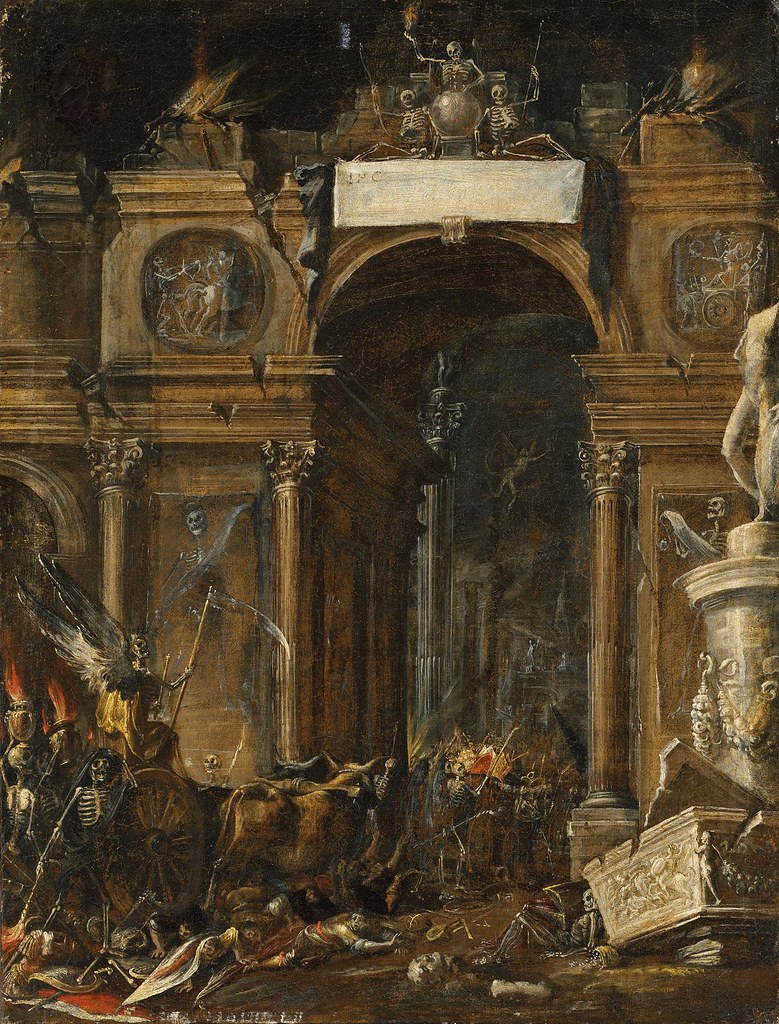
Francois de Nome (c.1593-c.1644) - The triumphant entry of Death into a city with classical ruins


Johann Georg Tschortsch (c.1680-1737) - Requiem (c-moll) Concertantibus 4. Vocibus (1731)
Performers: Jörg Wаschinski (soprano); William Purеfoy (alto); Bernhard Schnеidеr (tenor); Rаlf Ernst (bass);
Kammerchor Des Fеrdinаndеums; Aurа Musicаle Budаpеst; Josеf Wеtzingеr (conductor)

---


Austrian composer. Almost nothing is known about his early years and his extant music is the most valuable source about his outstanding skills. He came from a family of musicians who held the office of parish organist in the Tyrolean town of Schwaz for several generations. He probably received early music lessons as a choirboy in Innsbruck. Also there he probably attended the Jesuit high school where his name is mentioned in the school performances. In 1704 he was ordained a priest and he spent the following years with his family in Schwaz and as chaplain to Count Fieger at Friedberg Castle near his hometown. In 1729 he was finally awarded the Fugger benefit at the Schwaz parish church, a post he held until his death on March 26, 1737. As a composer, he wrote at least three collections of church music printed in Augsburg. His extensive compositional skills are first and foremost based on his unusual talent; his great knowledge and the sovereignty of its use is of course also deduced from his musical ambience. His work as a choirboy in the Innsbruck court orchestra must have given him fundamental experience, where he not only got to know the variety of church music genres and forms, but also received continuous music lessons and thus experienced practice and theory in an ideal way and at a high level. As an example of his mastery, his music can be currently found in archives and libraries in Austria, Germany, Switzerland, Hungary, the Czech Republic, Slovakia, Croatia, England and the USA.

divendres, 26 de maig del 2023

TRICKLIR, Jean-Balthasar (1750-1813) - Concerto pour le violoncel (1783)

English School (mid-19th century) - A portrait of a gentleman in an interior holding a cello


Jean-Balthasar Tricklir (1750-1813) - Concerto pour le violoncel, Oeuvre Premier (1783)
Performers: Alexаnder Rudіn (cello); Musicа Vivа

---


French cellist and composer of German descent. Although as a child he was destined for the priesthood, he decided on a career in music, being sent to Mannheim in 1765, where he continued his musical studies until about 1768. In 1776 he made his debut at the Concerts spirituels in Paris, following which he toured Italy. In 1782 he was made chamber composer to the Elector of Mainz, but he left a year later for a position at the Saxon court in Dresden, where he remained most of his life. He was well regarded by his contemporaries as a music theorist and composer; he was praised in Correspondance des amateurs musiciens (19 November 1803) and J.-B.S. Bréval’s Traité du violoncelle (Paris, 1804). His works were published in Germany and France and his fourth concerto was performed in Paris at the Concert Spirituel by J.-L. Duport, who later published his own edited version of the work. In his unpublished treatise, Le microcosme musical (1785), he described a device for preventing the effects of atmospheric changes on the tuning of string instruments; discussion of the device appeared in Cramer’s Magazin der Musik. Tricklir also taught the cello, and his pupils included Dominique Bideau. Tricklir’s compositions display an interesting combination of French and German performing practices. His French training is revealed in his carefully crafted bowings and use of natural harmonics, the latter being explored particularly in the ‘nouveau’ concertos. His music consists of 16 cello concertos, three violin and six cello sonatas, a sinfonia concertante, and several quartets.

dimecres, 24 de maig del 2023

SCHNABEL, Joseph Ignaz (1767-1831) - Quintetto concertante in C-Dur

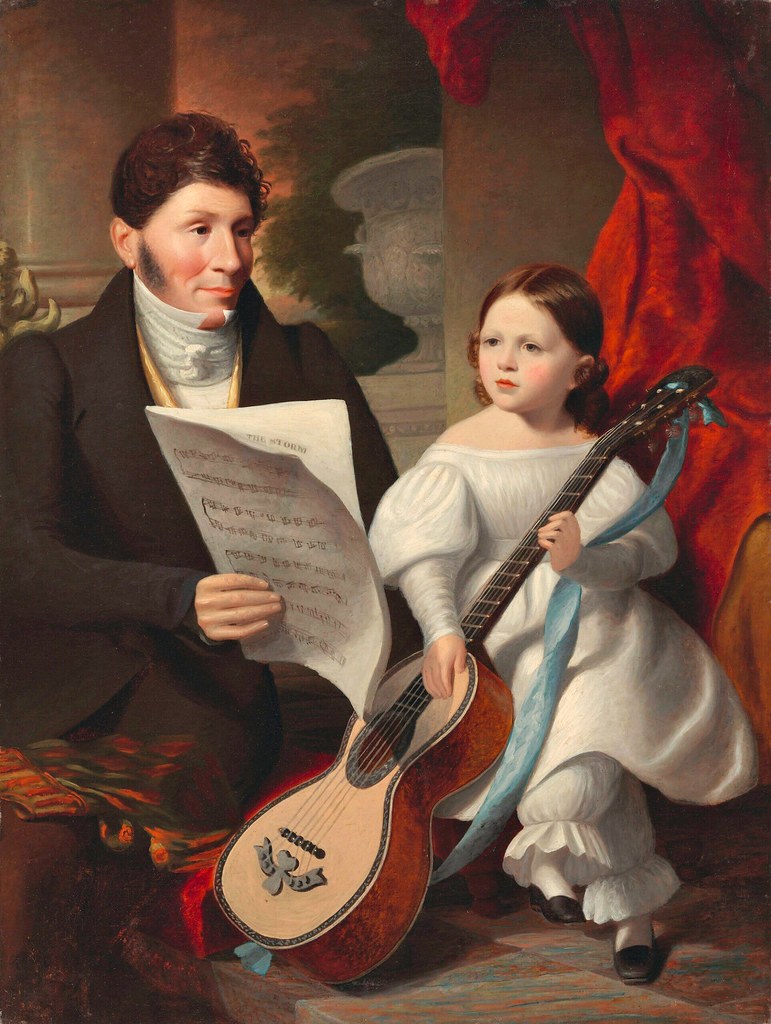
American school - The music master (c.1835)


Joseph Ignaz Schnabel (1767-1831) - Quintetto concertante in C-Dur, IJS 1
Performers: Siegfried Behrend (1933-1990, guitar); Zagreb String Quartet

---


German church musician and composer. The son of a Kantor, he attended the Gymnasium in Breslau and sang in the Vincentiuskirche, then training as a teacher. He later attracted attention for the musical attainments of his pupils as a rural schoolmaster in Paritz where he taught from 1790. In 1797 he was appointed organist of St Clara in Breslau and during the same period violinist in the orchestra of the Vincentius kirche and the theatre orchestra, which he also often conducted. His later appointments included Kapellmeister of the cathedral (1805), director of the Richter winter concerts (1806) and the Montags- und Freitagsgesellschaft (1810), director of music at the university (1812), teacher at the Catholic seminary and director of the Royal Institute of Church Music, which he helped to found. At a time when sacred music was at a low ebb in south Germany, before the impact of the Cecilian Movement, Schnabel did much to rejuvenate and improve it through his many compositions and performances. In the secular arena, where he was equally active as a composer, he made an outstanding contribution to Breslau’s musical life, introducing not only earlier Classical symphonies and choral works (including Haydn’s Creation in 1800) but those of contemporaries such as Spohr and Romberg. His achievements were widely known, for example by Beethoven, whose ‘Exaudi Domine’ Schnabel had copied for cathedral performance. Schnabel’s significance for the musical life of Breslau, the music of the Catholic cathedral and musical education of Schlesia is detailed by Hoffmann. His own music includes eight masses, six vespers and litanies, 22 graduals, offertories, hymns and stations, as well as many songs and sacred and secular partsongs and choruses, some for male quartet, military marches and pieces for wind, a clarinet concerto and a quintet for guitar and string quartet. Still performed is his ‘Transeamus usque Bethlehem’ for choir and orchestra. A large amount remains in manuscript (see Guckel for complete listing). Other musically active members of Schnabel’s family include his brother Michael Schnabel (1775-1842), a piano manufacturer whose instruments were valued by virtuosos such as Liszt and Hummel, and whose sons Julius and Carl (later a composer) continued his business; and his sons Joseph (1791/4-?), an organist and composer, and August (1795-1863), a conductor and music educator who succeeded his father at the Catholic seminary in Breslau.