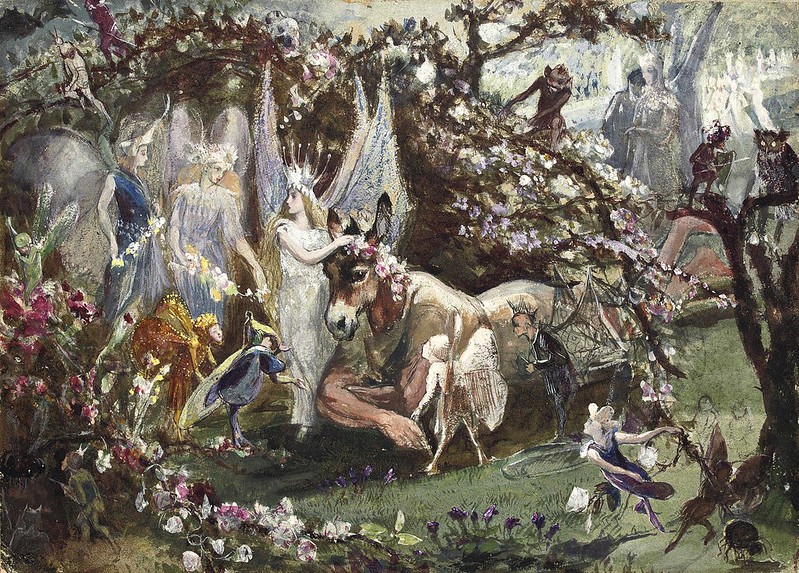
Obra de John Anster Fitzgerald (1819-1906), pintor anglès (1)
Francesco Anzoletti (1819-1862) - Sonata Brillante, Op.1
Léon Chic (1819-1916) - Solo sur la Tyrolienne
Antonio Juanas (1755-1819) - Regina caeli laetare
Sophie Gail (1775-1819) - Romance 'N'est-ce pas d'elle'
Juan Maria Guelbenzu (1819-1886) - Mamita (habanera)
Nicolas Roze (1745-1819) - Voici le printemps
Adolph Gutmann (1819-1882) - Bolero, Op.35
Vatroslav Lisinski (1819-1854) - Uvertira za operu 'Porin'
Joseph Philbrick Webster (1819-1875) - Lorena
Charles Oberthur (1819-1895) - Fantasie uber Hansel und Gretel
Jérôme Savari (1819-1870) - Fantasie sur des motifs du Freischutz
Louis-Luc Loiseau de Persuis (1769-1819) - Regiment's march
Isaac Baker Woodbury (1819-1858) - O Love Divine
Jean Baptiste Rochefort (1746-1819) - La mort du capitaine Cook - Tambourin
- 200è aniversari de compositors a qui difícilment escoltarem -
Parlem de Pintura...
John Anster Fitzgerald (Lambeth, 19 de setembre de 1819 - London, 1906) va ser un pintor anglès. Fill del poeta William Thomas Fitzgerald, es va educar de forma autodidacta abans d'exposar, el 1845 i per primera vegada, a la Royal Academy of Arts. Com a pintor, i fruit potser d'aquesta manca d'acadèmia, es va especialitzar en temàtica fantàstica la qual al seu temps era una raresa. En aquest sentit, va ser autor de pintures i il·lustracions amb elements fantàstic com fades, éssers mitològics o animals inventats. A finals de la dècada de 1850 va treballar per la Illustrated London News exposant també en aquell temps a la British Institution, la Society of British Artists i la Royal Watercolour Society. De caràcter introvertit, va viure relativament aïllat del món artístic del seu temps fet que va redundar en la singularitat global de la seva obra. La seva filla Florence Harriet Fitzgerald va ser pintora i escultora. John Anster Fitzgerald, casat en segons núpcies amb la pintora Walter Follen Bishop (1856-1936), va morir a Londres el 1906.
Parlem de Música...

His father, a clergyman and an enthusiastic pianist, gave him his first instruction in music; he then went to Leipzig to study theology and music at the university and the Thomasschule. There he made friends with Lortzing, Mendelssohn and Schumann. On the death of his father (1837), he decided to concentrate entirely on music. Though engaged in Bernburg (1841) as Kapellmeister, he soon left for Zürich, distinguishing himself there as an outstanding and immensely popular choirmaster. He was appointed director of nearly all of its numerous choral societies in succession, often winning prizes for them. In 1852 he became conductor at the opera house in Brunswick, which had been designated a national theatre in 1818. He was appointed director of the Hofkapelle in 1855. Faithful to his first love, choral conducting, he developed an international reputation and was invited to conduct in many capital cities of Europe. A spectacular reception awaited him on his tour of the USA (1872). Overworked and in poor health, he retired to Wiesbaden in 1882. Abt's works run to more than 600 opus numbers comprising over 3000 individual items. Vocal music was his main interest, especially male choral music, whose impoverished repertory he strove to enrich. His style is popular, his melodies simple and fresh, with a pleasing and varied accompaniment, so that some – like Wenn die Schwalben heimwärts ziehn and Die stille Wasserrose – are easily mistaken for genuine folksong. His son Alfred (b Brunswick, 25 May 1855; d Geneva, 29 April 1878) was a Kapellmeister in Rudolstadt, Kiel and Rostock.
---
Francesco Anzoletti (1819-1862) va ser un pianista i compositor italià.
Studium am Mailänder Konservatorium (1834–37); war 1839–44 Organist und Musikdirektor in Borgo Valsugana (Trient), 1844/45 in Arco und ab 1846 schließlich in Trient/Südtirol tätig. Sein vielseitiges Œuvre fand durch zahlreiche Drucke große Verbreitung. Sein Bruder.
---
Girolamo Alexandro Biaggi (1819-1897) va ser un compositor italià.
Dal 1829 al 1839 studiò violino e composizione al conservatorio di Milano con i maestri A. Rolla e N. Vaccai; contemporaneamente lavorava per la casa editrice Lucca di Milano come correttore e riduttore per pianoforte di partiture. Dal 1847 fondò e diresse a Milano il giornale L'Italia musicale,edito dalla stessa casa editrice Lucca. Nel 1848 il B. prese parte ai moti delle cinque giornate, combattendo valorosamente; fu poi nominato segretario del governo provvisorio di Milano. Profugo in Piemonte dopo l'armistizio Salasco, entrò impiegato della consulta lombarda a Torino; in seguito si recò a Parigi, dove conobbe personalità del mondo culturale e frequentò G. Rossini. Dopo il 1860, unificatasi nel nuovo Regno l'Italia, tornò in patria e svolse attività di maestro concertatore e direttore d'orchestra, ma soprattutto di collaboratore musicale (con lo pseudonimo Ippolito d'Albano), di notevole autorità, a vari giornali e riviste: Gazzetta d'Italia, Gazzetta del popolo, Nuova Antologia, Gazzetta musicale di Milano e L'Indipendente (Napoli). Nel 1863 si stabili a Firenze, dove era stato invitato a insegnare nell'Istituto musicale storia ed estetica musicale (succedendo a D. Picchianti) e dove fu anche critico della Nazione dal 1866 al 1895. A Firenze morì il 21 marzo 1897.
---
Antoine François Cajon (1766-1819) va ser un compositor francès.
---
Bernat Calvó Puig i Capdevila (1819-1880) va ser un compositor català.

En la seva infància, i vistes les seves condicions naturals per a la música, va entrar com a infant de cor a la catedral de Vic, on el mestre de capella Francesc Bonamich i Colomer li ensenyà solfeig; al cap d'un temps fou admès com a alumne intern a l'escolania de la seu. Amb onze anys començà a rebre ensenyaments d'orgue i piano de l'organista titular de la catedral, Josep Gallés (1758-1836), estudis que compaginava amb els de direcció amb el mestre Bonamich. El delicat estat de salut de Josep Gallés feu que Puig comencés a substituir-lo progressivament fins al traspàs del vell músic, que permeté a Puig d'ocupar la plaça d'aquest amb només setze anys, i s'hi va estrenar interpretant una composició pròpia. Dos anys més tard, el 1838, es traslladà a Barcelona, on pogué ampliar la seva formació estudiant composició amb Josep Rosés, mestre de capella de Santa Maria del Pi, i amb l'organista d'aquest mateix temple, Joan Quintana, a qui succeí en la plaça en el 1842, i fins al 1844. També va ser organista de Santa Maria del Mar. Succeí Francesc Andreví com a mestre de capella i director de l'Escolania de l'església de la Mercè i també va fer de mestre de capella de l'església de Sant Miquel Arcàngel. Des del 1848 va ser mestre i director de música de la Societat Filharmònica de Barcelona, amb què interpretà diverses obres. Com pertocava a les obligacions d'un mestre de capella, compongué moltes peces de música sacra, unes 600, que inclouen 67 misses, dos oratoris i moltes altres obres; i en el camp de la música profana va ser autor d'òpera i sarsueles, música simfònica, de cambra i per a teclat; l'any 1879 va fer un catàleg que contenia 683 composicions. Les seves obres es conserven en diverses biblioteques i arxius, i l'Arxiu Provincial dels Caputxins de Catalunya rebé el "Fons Bernat Calvó Puig". Tingué un negoci de venda i lloguer de pianos. Ultra la crítica musical, que exercí en periòdics com El Áncora (on a vegades signà "Píndaro") i altres, va ser mestre de gran nombre de futurs músics d'anomenada, com Càndid Candi, Primitiu Pardàs, Jaume Biscarri, Marià Vallès i Josep Marraco (fill)), Josep Reventós i Truch. Com a complement de les seves classes, publicà un tractat de solfeig. Va ser membre de la Reial Acadèmia de Belles Arts de San Fernando. Es va casar amb Susanna Buscó, nascuda a l'Alsàcia.
---
Fabio Campana (1819-1882) va ser un professor i compositor italià.
He studied at the Liceo Musicale of Bologna, and his first opera was produced at Livorno while he was still a student. According to Fétis, the productions of his early operas in Italy were not very successful. In 1850 he moved to London, where he became well known as a singing teacher and composer of Italian songs. His opera Almina was given on 26 May 1860 at Her Majesty’s Theatre with the soprano Marietta Piccolomini; his Esmeralda, after its première at St Petersburg in 1869, was produced in London (Covent Garden) in 1870 with Patti in the title role.
---
Léon Chic (1819-1916) va ser un compositor francès.
---
Oscar Comettant (1819-1898) va ser un compositor francès.

He entered the Paris Conservatoire in 1839, studying composition with Carafa, and from 1844 was a popular salon pianist and composer. After living in the USA from 1852 to 1855 Comettant became known in Paris as a writer. His periodical articles, informative, polemical and attractive to read, were published in Le musée des familles, La gazette musicale, La mélomanie, Le ménestrel, La France musicale, L’art musical, Le luth français, L’almanach musical and Le siècle, whose music critic he was for many years. He wrote books on various subjects: on behalf of the French government he made a number of foreign tours (for example to Australia and Scandinavia) to study indigenous musics, and the results of his research form a large part of his published output. Among the principal works are Histoire d’un inventeur au XIXe siècle: A. Sax (1860), Musique et musiciens (1862: articles reprinted from L’art musical including essays on Glinka and Kastner), La musique, les musiciens et les instruments de musique chez les différents peuples du monde, archives complètes de tous les documents qui se rattachent à l’Exposition internationale de 1867 (1869) and Les musiciens, les philosophes et les gaîtés de la musique en chiffres (1870). In 1871 he and his wife, who was a singer, together founded the Institut Musical, a music school for women. Comettant’s compositions include piano music, songs, chamber music and choral pieces, among them a suitably populist Marche des travailleurs in 1848, dedicated to the Orphéon de Paris, for which he won a prize.
---
Francisco Eduardo Costa (1819-1850) va ser un pianista i compositor portuguès.

He made his début at the age of ten in Oporto, playing Jacob Cramer’s Sixth Concerto, and became a teacher at the Lisbon Conservatory at the age of 16. In 1840 he returned to Oporto to take up the conductorship of the orchestra of the Teatro de S João, and also became organist and mestre de capela at Oporto Cathedral. He wrote five masses, four Tantum ergo, two Te Deum, and a Stabat mater for three sopranos and organ (P-Ln), all in the prevailing Italian style.
---
John William Dadmun (1819-1890) va ser un compositor anglès.

Dadmun was pastor at the Methodist Episcopal Church, South Hadley Falls, Holyoke, Massachusetts, 1845–46. He also served as prison chaplain at Deer Isle, off the coast of Maine. His works include: The Eolian Harp (Boston, Massachusetts: J. P. Magee, 1860), The Melodeon (Boston, Massachusetts: J. P. Magee, 1862), Army and Navy Melodies: A Collection of Hymns and Tunes, Religious and Patriotic (Boston, Massachusetts: J. P. Magee, 1862), The Masonic Choir (Boston, Massachusetts: Ditson & Company, 1864) and The Timbrel (editor) (Boston, Massachusetts: J. P. Magee, 1866).
---
Georges Granges de Fontenelle (1769-1819) va ser un compositor francès.
Il vient assez jeune à Paris pour suivre les cours d'harmonie avec son compatriote Jean-Baptiste Rey (1734-1810). Il prend des cours de composition avec Antonio Sacchini (1730-1786). Il se fait connaître avec sa cantate Circé sur un texte de Jean-Baptiste Rousseau. Le 5 Mai 1800 il créé Hécube, opéra en 4 actes (puis en 3) sur un livret de Jean-Baptiste Gabriel Marie de Milcent. Cette œuvre tient la scène 8 années durant avec 42 représentations. Le 10 août 1813, l'Académie de musique créé son opéra Médée sur un livret de Milcent, qu'elle détient depuis 1802. L'oeuvre n'a pas un grand succès.
---
José do Espirito Santo de Oliveira (1755-1819) va ser un compositor portuguès.
---
Domingo de Olleta Mombiela (1819-1895) va ser un organista i compositor espanyol.
Entrà d'infant en el Col·legí de la Seu el 1827, on i va romandre fins a l'any 1835, es distingí molt aviat per les seves felices disposicions musicals, i el mestre de la Seu, Pedro L. Gil li donà lliçons d'harmonia i contrapunt. El 1858, prèvies unes brillants oposicions, fou nomenat mestre de capella de la Seu, havent rebut les sagrades ordres el 1853. Entre les seves obres destaquen el grandiós Rèquiem, el Miserere, a tota orquestra; els Cánticos al Corazón de Jasús, i la Missa en do, anomenada La Valeriana. Fou acadèmic de l'Reial Acadèmia de Belles Arts de San Fernando, i de número San Luis de Saragossa i de mèrit de l'aragonesa Amigos del País. Va patir hemiplegia del costat dreta durant quaranta anys i dirigia amb el braç esquerra. Les seves restes foren depositades en la capella Sant Domènec del Val (Dominguito del Val), de la Catedral de Sant Salvador de Saragossa.
---
Pierre Louis Deffes (1819-1900) va ser un compositor francès.

Louis Deffès naît le 25 juillet 1819, dans l'appartement familial, no 54 rue Peyrolières, à Toulouse. Il est le fils de Jean Deffès, tailleur d'habits, et de Julie Alboui. Il apprend la musique à la maîtrise de la Daurade, mais il est placé en apprentissage après d'un marchand drapier de la rue Sainte-Ursule et doit arrêter la musique. En 1838, il suit les cours de M. Ladousse, qui l'encourage à suivre les cours du conservatoire de Paris. Le 15 octobre 1839, il prend la diligence pour Paris. Il y est l'élève de Théodore Mozin en classe de clavier, de François Bazin en classe d'harmonie, de Berton et de Fromental Halévy en classe de composition musicale. En 1843, il y reçoit un accessit de contrepoint et de fugue. Pour subvenir à ses besoins, il donne des cours de musique, joue de l'alto pour le théâtre du Gymnase-Dramatique et le théâtre des Folies-Dramatiques. En 1844, recevant un poème de Lucien Mengaud, il le met en musique, et compose la célèbre La Tolosenca, exécutée pour la première fois le 30 avril 1845 au théâtre du Capitole. C'est cette Toulousaine, la moindre de ses œuvres, qui lui assure la célébrité. En 1847, en composant la cantate L'Ange et Tobie sur un poème de Léon Halévy, il devient le premier Toulousain Prix de Rome en composition musicale. Ses autres œuvres, y compris Jessica, son grand succès de 1898, ou les Noces de Fernande sont bien oubliées. Louis Deffès est directeur du conservatoire de Toulouse de 1883 à son décès, le 28 mai 1900. À ses obsèques, les chœurs du conservatoire font entendre sa dernière composition, le Pie Jesu. Il est enterré au cimetière de Terre-Cabade à Toulouse.
---
Ellen Dickson (1819-1878) va ser una compositora anglesa.
---
François Guillaume Ducray-Duminil (1761-1819) va ser un poeta i compositor francès.
Ducray-Duminil fut, à partir de 1790, rédacteur de la partie littéraire des Petites Affiches et montra dans ses articles de critique une grande bienveillance. Membre du Caveau moderne et de plusieurs sociétés de belles-lettres, il fit des poésies fugitives et des chansons. Il travailla aussi pour le théâtre, mais sans succès. Le genre dans lequel il se fit une réputation est celui du roman destiné à la jeunesse où il eut pendant longtemps un succès populaire. Préoccupé du côté moral de ses œuvres, il arrive par une suite de péripéties ingénieuses à faire triompher l’innocence et la vertu. On lui reproche de n’avoir pas soigné son style et d’être même souvent incorrect. Il recherchait surtout la clarté, qualité essentielle pour le jeune public auquel il s’adressait. L’invention ne lui manquait pas, et les aventures intéressantes, combinées avec habileté, expliquent la longue vogue de ses écrits. Les auteurs dramatiques y ont largement puisé. Faisant partie des derniers écrivains diffusés par le colportage, il est considéré comme le premier inventeur du roman populaire français.
---
Carl Evers (1819-1875) va ser un pianista i compositor alemany.

Mit sechs Jahren erhielt Evers Klavierunterricht durch Jacob Schmitt und trat bereits mit zwölf Jahren öffentlich in Hamburg auf. Eine erste Konzertreise führte ihn 1834 durch Schleswig-Holstein, Dänemark und Schweden. 1837 nahm er Kompositionsunterricht bei Ziegler in Hannover und Krebs in Hamburg und 1838 bei Felix Mendelssohn Bartholdy in Leipzig. In Paris kam er 1839 mit Frédéric Chopin und Daniel-François-Esprit Auber in Berührung und war dort als Pianist und Komponist erfolgreich tätig. Evers ließ sich 1841 in Wien nieder und eröffnete 1858 in Graz eine Musikalienhandlung, kehrte jedoch als Klavierlehrer 1872 nach Wien zurück. Carl Evers komponierte über hundert Werke, unter anderem vier Klaviersonaten, Chansons d'amour, Etüden, Salonstücke, Tänze und Lieder.
---
Alexandre (Alessandro) Frixer, dit Fridzeri (1741-1819) va ser un violinista i compositor italià.
Violoniste, compositeur et virtuose sur la mandoline, naquit à Vérone, le 16 janvier 1741. A peine âgé d'un an, il perdit la vue, qu'il n'a point recouvrée depuis lors. Dès ses premières années, il montra du goût pour la musique ; à huit ans, il fabriquait de petits instruments qui lui servaient à montrer son aptitude pour la musique. Cinq maîtres différents lui enseignèrent à jouer du violon, mais toutes leurs leçons réunies ne lui composèrent pas un cours d'études de plus de huit ou neuf mois. A onze ans, il se fit sa première mandoline sur laquelle il acquit seul le rare talent qui le distingua par la suite. Il apprit seul aussi depuis lors à jouer de la flûte, de la viole d'amour, de l'orgue, du cor et de plusieurs autres instruments. Il ne reçut jamais de leçons d'harmonie ni de contrepoint, et les compositions qu'on a de lui ont été écrites d'instinct. En parlant de lui dans sa vieillesse, il disait qu'à vingt ans il était musicien, architecte et poète, mais que son goût pour la musique l'emporta sur celui des autres arts. Pendant trois ans, il fut organiste de la chapelle dite la Madona del Monte Berico, à Vicence, où il avait été élevé. A vingt-quatre ans, il quitta la maison paternelle pour voyager avec un de ses amis, malgré la situation pénible où le plaçait sa cécité. Les concertos de Tartini, et quelques morceaux de Ferrari et de Pugnani composaient tout son répertoire ; il y avait ajouté quelques morceaux de sa composition. Partout il eut des succès, tant sur le violon que sur la mandoline. Arrivé à Paris, il se fit entendre au concert spirituel et y débuta par un concerto de Gaviniès. Après deux années de séjour dans cette ville, il parcourut le nord de la France, la Belgique et l'Allemagne du Rhin ; donnant partout des concerts et se faisant applaudir. En remontant le Rhin, il était arrivé à Strasbourg ; cette ville lui plut, et il y demeura dix-huit mois. Il y composa deux opéras en trois actes qui ne furent point représentés, puis il retourna à Paris, et y arriva en 1771. Ce fut alors qu'il fit graver ses premières compositions, qui consistaient en six quatuors pour deux violons, alto et basse, et six sonates pour la mandoline. L'année suivante, il donna à la Comédie italienne les Deux Miliciens, opéra comique en un acte, qui commença sa réputation de compositeur d'une manière brillante, parce qu'on y trouvait un sentiment juste de la scène, de l'élégance dans la mélodie, enfin, une harmonie naturelle. Après ce succès, il partit pour le midi de la France, où les amateurs des villes les plus importantes lui firent un accueil distingué. De retour à Paris, il imagina un bureau typographique pour écrire la musique, en construisit lui-même le modèle, et s'en servit pour la composition de son opéra intitulé : les Souliers mordorés qui fut représenté en 1776, et qui a toujours été considéré en France comme le meilleur ouvrage de l'auteur. Au moment où il venait d'obtenir ce nouveau succès, le comte de Châteaugiron proposa à Fridzeri de l'accompagner dans une de ses terres, en Bretagne ; l'artiste accepta et passa douze ans dans cette retraite. Cependant il fit quelques voyages à Paris dans cet intervalle, et dans l'un d'eux il donna l'opéra comique intitulé : Lucette, qui ne réussit pas, bien que le compositeur ait toujours considéré cet ouvrage comme supérieur aux Souliers mordorés, et aux Deux Miliciens. Pour se consoler de cet échec, il fit graver, avant de retourner en Bretagne, deux concertos de violon qui avaient été entendus avec plaisir au Concert Spirituel. La révolution survint et obligea le comte de Châteaugiron à sortir de France. Privé tout à coup, par cet événement, de ressources sur lesquelles il avait cru pouvoir compter jusqu'à la fin de ses jours, Fridzeri se vit contraint de recommencer ses voyages. D'abord il s'arrêta à Nantes, et y fonda une académie philharmonique ; mais les terribles drames de la guerre de la Vendée obligèrent le malheureux artiste à se réfugier à Paris, en 1794. Le Lycée des arts, qui venait d'y être établi, le reçut au nombre de ses membres. Il y joua plusieurs fois des concertos de violon et des morceaux concertants sur la mandoline. Peu de temps après, il fonda une nouvelle académie philharmonique, l'établit d'abord au Palais-Royal, puis la transporta au magasin de l'Opéra, rue Saint-Nicaise. La mauvaise fortune, qui l'avait poursuivi pendant la plus grande partie de sa vie, lui fit encore en cette occasion choisir ce local ; car il y était à peine établi depuis dix-huit mois, lorsque l'explosion de la machine infernale du 3 nivôse an IX (décembre 1801) eut lieu précisément dans la rue Saint-Nicaise, et anéantit le peu que Fridzeri possédait. Heureusement cet artiste était doué d'une de ces âmes courageuses que l'adversité ne saurait abattre, et quoique âgé de plus de soixante ans, il reprit le cours de ses voyages avec ses deux filles qui étaient bonnes musiciennes, qui chantaient bien, et dont l'aînée était d'une certaine habileté sur le violon. Aimable vieillard, Fridzeri sut intéresser en sa faveur les habitants de la Belgique au milieu desquels il se rendit ; on l'accueillit à Anvers ; il s'y fixa comme professeur, et y établit un commerce de musique et d'instruments. Il est mort dans cette ville, en 1819. Pendant son dernier séjour à Paris, Fridzeri avait écrit pour l'Opéra un ouvrage intitulé : les Thermopyles ; cet opéra fut reçu pour être joué, mais il n'a jamais été représenté. L'auteur en a fait graver une scène avec accompagnement de piano. Il a aussi publié dans le même temps un œuvre de duos pour deux violons, une symphonie concertante pour deux violons, alto et orchestre, un deuxième livre de six quatuors pour deux violons, alto et basse, et un recueil de six romances avec accompagnement de piano.
---
Giovanni Battista Gaiani [Gajani] (1757-1819) va ser un organista i compositor italià.
He studied with Zanotti, Vignali, Martini and Mattei. Admitted to membership in the Accademia Filarmonica of Bologna as organist and then as composer in 1781–2, he was elected Principe in 1793, 1802, 1807 and 1815. He was organist and maestro di cappella at various Bolognese churches, including S Maria della Morte; in 1802 he played the harpsichord for the opera at the Teatro Comunale. Competent, but conservative and provincial, he was a composer of the late 18th-century Bolognese school derived from Padre Martini. The only trace of him outside Bologna is one sacred piece in the Cappella Lauretana in Loreto.
---
Sophie Gail (1775-1819) va ser una compositora francesa.

Her first songs appeared from 1790 in the song magazines of Louis de La Chervardière and Antoine Bailleux. At the age of 18 she married the philologist Jean Baptiste Gail, but they separated some years later. She then studied singing with Bernardo Mengozzi, and made a successful tour of southern France and Spain. She studied musical theory with Fétis and, later, with Perne and Neukomm. Between 1808 and 1810 her salon attracted the most fashionable singers in Paris. She wrote a number of songs and romances, and four one-act operas which were produced by the Opéra-Comique at the Théâtre Feydeau. The first and most successful of these, Les deux jaloux (1813), was followed by Mlle de Launay à la Bastille (1813), Angéla, ou L'atelier de Jean Cousin (with Adrien Boieldieu, 1814) and La sérénade (1818). The last contains accomplished music, but its libretto, adapted from J.-F. Regnard's 1694 comedy of the same title, was considered scandalous, even 50 years later, by Félix Clément in his Dictionnaire lyrique (1867–9). He claimed that it offended ‘moeurs dramatiques’ and that even the opera's beautiful music was not enough to salvage it. Gail sang in London in 1816, and in 1818 toured Germany and Austria with Angelica Catalani. She died prematurely of a chest ailment.
Sophie Gail enjoyed a high reputation both as singer and accompanist, and her songs, which cultivate a vein of plaintive, amorous sentiment fashionable in post-Revolutionary France, are original and carefully wrought. The most popular of them, Celui qui sut toucher mon coeur, was used as a theme for instrumental variations by at least five different composers. Her son, Jean François Gail (1795–1845), wrote songs and music criticism.
---
Francesco Galeazzi (1758-1819) va ser un teòric, violinista i compositor italià.
He was trained in Turin, a leading centre of violin playing in the 18th century; later he moved to Rome where (according to Fétis) he was active as a violin teacher, a composer of instrumental music, and musical director of the Teatro Valle for 15 years. Galeazzi published his six duets op.1 (1781) in Ascoli Piceno, where he married and spent his later years. The two volumes of Galeazzi's treatise, Elementi teorico-pratici di musica, were published in Rome in 1791 and 1796, the second volume dedicated to his patron in Ascoli, Tommaso Balucanti. The title-page of the second edition of vol.i (Ascoli, 1817; dedicated to another patron, Giovanni Vitale) identifies Galeazzi as a teacher of the violin and mathematics; his many scientific interests are well documented. Few of Galeazzi's compositions are extant; besides two sonatas, six duets and 12 trios, opp.11 and 15, a violin solo, fragments of two violin concertos and the introduction to op.15 no.4 appear as examples in his treatise. A setting of the Seven Last Words, dated 1812, has also recently been found.
---
Ernst Ludwig Gerber (1746-1819) va ser un organista i compositor alemany.

He was the son of the composer and Bach pupil Heinrich Nikolaus Gerber, who was also his first teacher of the organ and music theory. In 1765 Gerber began to study law at Leipzig University and then worked as an assistant in a solicitor’s office. He also appeared as a cellist at public concerts and at the theatre. Unsatisfactory professional circumstances caused him to return to Sondershausen, where he practised as a lawyer and taught the children of the Prince of Schwarzburg-Sondershausen. In 1775 he succeeded his father as court organist and at the same time acted as accountant to the management of the prince's estate, and later became secretary to the court. He held these posts until his death.
---
William Howard Glover (1819-1875) va ser un cantant, director i compositor anglès.
The son of the actress Julia Glover, he entered the English Opera House's orchestra at the age of 15. He had lessons from the company's conductor, William Wagstaff, and completed his studies on the Continent. After his return to London he helped to found the Musical and Dramatic Society, Soho. With John Braham he toured in Scotland, and later formed a provincial opera company at Manchester and Liverpool, with which he conducted and occasionally sang. He later conducted in London, where he was also music critic of the Morning Post (c1850–65). He wrote some appreciative reviews of Berlioz’s 1852 London concerts, and in 1853 reported his observation that it was organized opposition which had destroyed the London chances of Benvenuto Cellini. His cantata Tam O’Shanter was successfully performed in London on 4 July 1855 by Berlioz, who described its style as ‘very piquant but difficult’ (letter to Théodore Ritter, 3 July 1855). Glover’s other works include an opera, Ruy Blas (1861), several operettas, overtures, piano music and songs. In 1868 he went to the USA, and spent the last years of his life as conductor at Niblo’s Garden, New York.
---
Lambert François Godecharle (1751-1819) va ser un cantant i compositor flamenc.
Flemish singer and composer, brother of Eugène Godecharle and fifth son of Jacques-Antoine. According to Fétis, he was a chorister at the royal chapel and studied composition with De Croes. He was employed at the royal chapel from 1778 as a bass singer, and held the post until the chapel was dissolved in 1794. He was also a musician at the church of St Nicolas, where he succeeded his father as maître de musique. He was nominated a member of the Institut des Pays-Bas in 1817 (Fétis). He composed several sacred works; vander Linden noted their italianate, theatrical style and their elaborate rhythmic treatment, figuration and instrumental writing.
---
Frantisek Gregora (1819-1887) va ser un professor i compositor txec.

He began studying at the teachers' institute in České Budějovice in 1835 but the following year went to Vienna; having failed to gain admittance to the conservatory there, he became a pupil of Josef Drechsler. Later he studied composition with Gottfried Preyer at the conservatory (1844-8), and also the trombone and double bass. He excelled at the latter: among his many compositions there are 17 concertos for this instrument. After the 1848 Revolution he fled from Vienna to Bohemia and became choirmaster in Vodňany (1849-51); he held the same post in Písek (1851–87), where he also taught at both the Gymnasium and the teacher-training college (1852-83) and founded the choral society Otavan. Together with Smetana he applied unsuccessfully for the directorship of the Prague Conservatory after Kittl's retirement in 1866. His harmony manual, Nauka o harmonii hudební na základě fundamentálního basu (Prague, 1876), was one of the foremost Czech textbooks of its time. His compositions include songs, partsongs and much church music, predominantly with Czech texts, as well as works for the double bass.
---
Juan Maria Guelbenzu (1819-1886) va ser un pianista i compositor espanyol.
De familia de vinateros, estudia primero en Pamplona y luego en el Conservatorio de Madrid, donde gana el premio de piano. Se traslada con una beca a París, donde conoce íntimamente a Chopin, Thalberg y Liszt. En 1841 sustituye a Pedro Albéniz como organista en la Capilla Real de Madrid y más tarde se convertirá en profesor de piano de la infanta Isabel "La Chata" y de sus hermanas. Tuvo un papel importante en los conciertos que se celebraron en Palacio en estos años. Implicado en el desarrollo del sinfonismo español y en la promoción de la música alemana, el 13 de noviembre de 1844 toca con Franz Liszt un concierto a cuatro manos en el Teatro del Príncipe, actual Teatro Español de Madrid. También entrará en contacto con el compositor Mijaíl Glinka en su paso por la capital española, tal y como testimonia su biblioteca, que contiene un gran fondo de composiciones del músico ruso. Funda en 1863 la Sociedad de Cuartetos de Madrid junto a Jesús de Monasterio, de la que sería su pianista habitual. También desarrolla una destacable carrera como compositor, insertado en el movimiento renovador que se inicia en el romanticismo y termina en el nacionalismo musical español. Utiliza con asiduidad el zorcico y la jota como formas musicales cultas, destacando entre sus obras piezas intimistas para piano, como En la cuna (Canto para mi hijo) o Romanza sin palabras. Miembro de la sección de Música de la Real Academia de Bellas Artes de San Fernando, el rey Alfonso XII le concedió la gran cruz de la Orden de Isabel la Católica, y el rey de Portugal le nombró caballero de la Orden de Nuestra Señora de la Concepción de Villaviciosa. Su archivo musical se conserva completo en la Biblioteca Nacional de Madrid.
---
Adolph Gutmann (1819-1882) va ser un pianista i compositor alemany.
Gutmann was born in Heidelberg. He came to Paris in 1834, at the age of 15, to study with Chopin, becoming one of the composer's favourites.[2] He performed in concert with Chopin, Charles-Valentin Alkan and Pierre-Joseph Zimmerman, Alkan's transcription of part of Beethoven's Seventh Symphony at a concert of 1838. Gutmann was also the dedicatee of Chopin's Scherzo, Op. 39, published in 1839. Gutmann acted as copyist for a number of Chopin's works, and acted as a courier to take Chopin's letters to his family in Warsaw. Gutmann's own set of Etudes (his Op. 12) is dedicated to Chopin. He was present at Chopin's death bed and preserved the glass from which Chopin took his last drink of water. Both he and Alkan were bequeathed the notes that Chopin had compiled in preparation for a piano teaching method. Gutmann died in La Spezia. Inspired by the style of his master, Gutmann is the author of several nocturnes, and twelve studies, studies characteristics that seem to announce the coming of Impressionism (two of his studies are called Sea, and The Storm, and are respective replicas of the study No. 1, Op. 25, by Chopin, and the Révolutionnaire). All his works have been quite popular in their time; but faded thereafter.
---
Karl Haack (1755-1819) va ser un violinista i compositor alemany.

Haack war Schüler von Franz Benda und seinerseits Lehrer von bekannten Violinisten und späteren Konzert- und Kapellmeistern: Carl Moeser, Karl August Seidler und Ludwig Maurer. Haack gehörte schon in jungen Jahren dem Kammermusik-Ensemble des Kronprinzen von Preußen und späteren Königs Friedrich Wilhelm II an. Bei einem Aufenthalt in Paris entstanden die Sonaten opus 5 und 6. 1782 wurde Haack zum Konzertmeister der kronprinzlichen Kapelle ernannt. Bei der Vereinigung der kronprinzlichen und der königlichen Kapelle nach dem Regierungsantritt Friedrich Wilhelms II im Jahr 1786 wurde Haack Erster Violinist und 1796 Konzertmeister der Hofkapelle. Pensioniert wurde Haack 1811 anlässlich der erneuten Umorganisation von Hofkapelle, Opernkapelle und Kapelle des Nationaltheaters. Nachfolger als Erster Violinist und Konzertmeister wurde sein Schüler Karl Möser, auch sein Schüler Carl August Seidler wurde 1816 als Konzertmeister eingestellt. Haack hatte seine primären Aufgaben im Kammerorchester und im königlichen privaten Streichquartett, in dem sich Friedrich Wilhelm auch noch als König am Violoncello beteiligt haben soll. Daneben trat Haack als Dirigent und Solist in zahlreichen Konzerten auf. Als sich allmählich ein städtisches Konzertleben in Berlin entwickelte, spielte Haack u. a. 1783 und 1784 in den nach französischem Vorbild eingerichteten Concerts spirituel sowie als Solist in anderen öffentlichen Konzerten, wobei er auch seine eigenen Violinkonzerte aufführte. Zusammen mit den Kapellmeistern Johann Friedrich Reichardt und Vincenzo Righini verfasste Haack im Namen der ganzen Kapelle im Jahr 1800 das erfolgreiche Gesuch an den König, die Veranstaltung von öffentlichen Wohltätigkeits-Konzerten zugunsten des Witwen- und Waisenfonds der königlichen Kapelle zu gestatten. Der Nachruf 1819 lautete: „Am 28sten starb in seiner Geburtsstadt Potsdam der pensionierte Königl. Concertmeister Carl Haak im 65sten Jahr seines Lebens. Er war ein vortrefflicher Geiger und ein fertiger Klavierspieler, und hat für beide Instrumente treffliche Sachen geschrieben, die auch zum Theil gedruckt sind.“ Mit seiner Ehefrau Friederica Henrietta Hansmann (1753–1823), Tochter des königlichen Inspektors Friedrich Hansmann, hatte Haack fünf Kinder.
---
Charles Halle (1819-1895) va ser un pianista i compositor anglès.

He was born Carl Halle, but added the accent to the ‘e’ later in life allegedly to ensure more accurate pronunciation by the French and English. Hallé's father, Friedrich, was church organist and director of Hagen's mainly amateur orchestra. By the age of four, Carl could play the piano sufficiently well to manage a sonata written by Friedrich. He also learnt to play the organ, the violin and the timpani. Under the patronage of Louis Spohr, he gave a piano recital at the age of nine; thereafter his father limited his public appearances to one a year, in Hagen. He first conducted at the age of 11 when his father was taken ill during Hagen's annual visit from a touring opera company, for which the town's musicians provided an orchestra. The boy took over the direction of Weber's Der Freischütz and Preciosa and Mozart's Die Zauberflöte. In the summer of 1835, when he was 16, Hallé went to Darmstadt to study harmony and counterpoint under Johann Rinck and to receive general musical instruction from Gottfried Weber. In 1836 he moved to Paris, hoping to become a piano pupil of Kalkbrenner, but in fact studied under George Osborne. In Paris, Hallé soon came to know Chopin, Liszt, Berlioz and Wagner. In recitals in the salons, he introduced Beethoven's sonatas to Parisian audiences: he was the first pianist to play the complete series in Paris and, later, in London. His edition of the sonatas was published by Chappell. He also appeared frequently as a chamber music player, with Alard (violin) and Franchomme (cello). During these years he became a passionate devotee of the music of Berlioz, attending the rehearsals and first performances of several of his works, including the Requiem and Roméo et Juliette. In the revolutionary year of 1848 Hallé decided to leave Paris because of diminishing concert audiences and lack of pupils. Since 1841 he had been married to Désirée Smith de Rilieu, formerly of New Orleans, and he took her and their two children (later there were nine) to London, which he had first visited in 1843. But London was crowded with émigré musicians, so he accepted an approach from Manchester to settle there and to revivify musical life. His first action was to establish a series of chamber concerts; and in 1849 he was appointed conductor of the old-established Gentlemen's Concerts with a free hand to reorganize the orchestra. In 1857, when an art treasures exhibition was held in Manchester for six months, this orchestra was much enlarged and, rather than disband it, Hallé decided to engage it for a new series of concerts at his own risk. The first concert was given on 30 January 1858. Very soon the Hallé Concerts became Manchester's leading musical event; Hallé conducted them, often also appearing as piano soloist, for the remaining 37 years of his life. His programmes were adventurous and he engaged leading soloists of the day (see Manchester, §2). He continued to give piano recitals in London every summer, concentrating on the sonatas of Beethoven and Schubert. In 1893 he saw the realization of one of his long-held ambitions for Manchester: the foundation of a music college in the city. He was appointed principal and piano professor at the RMCM, which opened in October of that year. Hallé was knighted in 1888, the year in which he also married the celebrated violinist Wilma Norman-Neruda (his first wife had died in 1866). With Lady Hallé he gave sonata recitals not only in Britain but on tours of Australia and South Africa. They had returned from the latter only a few weeks before Hallé's sudden death from cerebral haemorrhage. He is buried in Weaste Cemetery, Salford.
Carl (Karl) Hennig (1819-1873) va ser un compositor alemany.
---
Paul Henrion (1819-1901) va ser un compositor francès.

After growing up in the popular theatre, he studied the piano with Henri Karr and harmony with P.F. Moncouteau. From 1840 he won some success as a songwriter, notably with the early Un jour. By 1878 he had written about 1200 songs; the titles of the most popular were listed by Fétis. He also wrote quadrilles, polkas etc. for the piano. His first stage piece, Une rencontre dans le Danube (1854, Théâtre Lyrique) was not a great success, but he subsequently wrote a series of operettas and sketches for café-concerts, including L’étudiant de Heidelberg (1869), A la bonne franquette (1877) and Le moulin de Javel (1894). He became president of the Société des Auteurs et Compositeurs, which he helped to found.
---
Carl Friedrich August Hering (1819-1889) va ser un violinista i compositor alemany.
1819 zu Berlin, erhielt von seinem Vater, einem Maler, den ersten Musikunterricht, den er aber erst als Jüngling in der Möser'schen Musikschule bei Hub. Ries fortsetzte. Gleichzeitig studirte er dann als Schüler der Akademie der Künste bei Rungenhagen die Composition. Einer noch höheren Ausbildung beflissen, ging er 1840 zu Lipinski nach Dresden, bei dem er das höhere Violinspiel, und dann zu Tomaschek in Prag, unter dessen Leitung er Clavierspiel und Gesang eifrig studirte. Hierauf liess er sich auf Concertreisen auch in Wien, Olmütz, Brünn, Leipzig, Stettin u. s. w. mit Beifall als Violinist hören, entsagte aber 1844 dem Virtuosenthum und kehrte nach Berlin zurück, wo er 1846 zeitweilig als Accessist in die königl. Kapelle trat. Er gründete 1848 einen »Sonatenverein« behufs Pflege der Kammermusik, der bis 1851 bestand, worauf er eine Musikschule für Violine, Clavier, Gesang und Theorie der Musik ins Leben rief, welche er, mittlerweile zum königl. Musikdirektor ernannt, bis 1867 leitete. Seine zahlreichen Compositionen bewegen sich in allen Gattungen der Musik und bestehen in Sinfonien, Ouvertüren, Blasequintetten, Streichquartetten, Violin und Claviersachen, zum grossen Theil instructiver Art, ferner in Messen, Psalmen, Gesängen und Liedern. Sein zum Armeemarsch (No. 146) erhobener Wrangel-Marsch ist in seltener Art populär geworden. Endlich gab er auch eine Elementar-Violinschule mit beigefügten Etuden, sowie die didaktischen Schriften »Methodischer Leitfaden für Violin-Lehrer« (Leipzig, 1857) und »Ueber Rud. Kreutzer's Etuden, Anweisung für Violin-Lehrer« (Leipzig, 1858) heraus.
---
Hippolyte Héro (1819-c.1860) va ser un compositor belga.
---
Justin Holland (1819-1887) va ser un guitarrista i compositor americà.

At the age of 14 he went to Boston, where he began to study the piano, guitar and flute. He later studied at Oberlin College (1841–3, 1845) and in Mexico before moving to Cleveland, Ohio, where he was a guitar teacher and composer until 1886. Declining health then forced him to retire and move to New Orleans. His numerous pieces for guitar solo include Elfin Waltzes, Maiden’s Prayer, Spanish Fandango and Three Tyrolien Airs. A pioneering African American composer for the guitar, he also wrote duets for guitar, pieces for guitar and piano, arrangements of operatic airs for guitar and violin or flute, and many songs with guitar accompaniment, and he published the book Choral Reform (c1845). His instruction books, Holland’s Comprehensive Method for the Guitar (1874) and Holland’s Modern Method for the Guitar (1876), were widely acclaimed in Europe and the USA.
---
Julius Hopp (1819-1885) va ser un compositor austríac.
He was the son of the actor and dramatist Friedrich Hopp (1789-1869). He first appeared as a composer in 1836 at the Theater an der Wien with music to his father’s play Die Bekanntschaft im Paradeisgartel. He wrote three more scores for the Theater an der Wien in 1837–8, but there followed a long gap before other scores by him were heard in Vienna. In 1858 he established a regular connection with the Theater in der Josefstadt, furnishing some two dozen scores in six or seven years; he composed regularly for the Theater an der Wien from 1863 to 1868, and occasionally in the mid- and late 1870s. In the mid-1860s he wrote for the Carl, Strampfer and Fürst theatres, and in 1879–80 produced a final flurry of scores for the Josefstadt. The most important of Hopp’s achievements is the series of 16 Offenbach translations and adaptations he made, mostly for the Theater an der Wien but some for the Carltheater, between 1865 and his death (one, Tulipatan – after L’île de Tulipatan – was not staged until 1888). These Offenbach versions include, in descending order of their success, La belle Hélène (as Die schöne Helena, 1865), Barbe-bleue (as Blaubart, 1866), La Grande-Duchesse de Gérolstein (as Die Grossherzogin von Gerolstein, 1867), Le voyage dans la lune (as Die Reise in den Mond, 1876) and Madame l’archiduc (as Madame Herzog, 1875). Among Hopp’s successful original works (for a number of which he wrote both words and music) are the operettas Ein Deutschmeister (1, K. Elmar; Vienna, Fürst’s Singspiel-Halle, 1864) and Das Donauweibchen und der Ritter vom Kahlenberg (3, Hopp and P. Krone; Vienna, An der Wien, 14 April 1866), and a series of burlesques and parodies including Fäustling und Margarethl (1864), Der Freischütz (1867) and Hammlet (1874), for all of which he wrote both words and music. He provided Suppé with the libretto for Der Teufel auf Erden (1878), and he also arranged and published potpourris, quadrilles, etc.
---
Antonio Juanas (1755-1819) va ser un compositor espanyol.
By 1780 he was maestro de capilla at Alcalá de Henares, and in that year he applied for a similar post at Avila Cathedral and also obtained references for a post at El Burgo de Osma. By the early 1790s he had moved to Mexico City, where he was maestro de capilla from at least 1793. The following year, according to Catalyne (Grove6), he was cited by the Inquisition for translating a subversive French song and favouring the ideals of the French Republic. He left Mexico for Spain on 18 February 1819.
Juanas was one of the most prolific composers of his time in the New World, and unusual in devoting himself almost entirely to Latin texts. His only examples of the vernacular villancico are De Teresa el corazón (1780, for the contest at Avila) and El clarín de la fama (1802, for a procession in Mexico City Cathedral). Juanas’s music, much of which awaits careful study, is harmonically less daring than that of his predecessors Matheo Tollis de la Roca and Ignacio Jerusalem, and less flamboyant than theirs in figuration and vocal display. It progresses mostly in steady, unperturbed harmonic rhythms, and displays a competent craftsmanship.
---
Otto Kade (1819-1900) va ser un musicòleg, organista i compositor alemany.

He attended the Dresden Kreuzschule and was awarded a scholarship to study harmony and counterpoint with Julius Otto and Moritz Hauptmann, and the piano and organ with Johann Schneider. In 1846 he went to Italy for further study, particularly of early vocal music, and on his return in 1848 founded the Dresden Cecilian Society for the promotion of early church music. In 1853 he became director of music at the Dreikönigskirche in Neustadt, and in 1860 succeeded Julius Schäffer as music director at the court of the Grand Duke of Mecklenburg-Schwerin, where he encouraged and promoted the performance of early works, in line with his research. He also taught at the Gymnasium in Schwerin from 1866 until his retirement in 1893. He was awarded an honorary doctorate by Leipzig University in 1884. Kade was prolific both as a writer and as an editor of music. Many of his writings appeared first as articles in Monatshefte für Musikgeschichte, the publication of the Gesellschaft für Musikforschung founded at Kade’s instigation by Robert Eitner. They include historical and biographical studies, many of which deal with aspects of Lutheran church music in the 16th century, representing an intimate knowledge and a perceptive understanding of a wide range of musical sources. His interest in this subject resulted in a number of works, including Der neu aufgefundene Luthercodex vom Jahre 1530 (Dresden, 1871), which includes valuable information on early Lutheran church practice, and Die ältere Passionskomposition bis zum Jahre 1631 (Gütersloh, 1893), which quotes extensively from the works of Obrecht, Walter and Scandello. Among Kade’s most significant contributions to music history was his supplementary volume to Ambros’s Geschichte der Musik, containing examples from celebrated Renaissance works and representing the fruits of many years’ research. His work on important music collections resulted in several publications, including Die Musikalien-Sammlung des … Mecklenburg-Schweriner Fürstenhauses (Schwerin, 1893–9). He ranks with Ambros, Chrysander and Eitner as one of the leading musical scholars of the second half of the 19th century. Kade’s son Reinhard (b Dresden, 25 Sept 1859; d Dresden, 16 June 1936) taught at the Dresden Gymnasium and collaborated with Eitner in compiling the catalogue of the music collection in the Dresden Royal Library. His research concentrated on local music history, mainly that of Dresden and Freiberg, and resulted in the publication of a number of articles in Monatshefte für Musikgeschichte, Vierteljahrsschrift für Musikwissenschaft and various local periodicals.
---
Johann Nepomuk Kafka (1819-1886) va ser un pianista i compositor bohemi.
He won considerable popularity as a composer of light piano pieces, among them nocturnes, idylls, impromptus and rhapsodies, of which about 200 were published. He is remembered chiefly as the owner of a number of Beethoven manuscripts, including the autographs of the piano sonatas opp.28 and 53 and various sketch miscellanies and leaves. The most important manuscript from his collection (the ‘Kafka’ Sketchbook), which contains sketches and autographs of many of Beethoven's earliest works, was acquired by the British Museum in 1875 (part of Add.29801). Another miscellany of sketches in the British Library (Add.29997) contains material for works written between 1799 and 1826; it was purchased from Kafka in 1876.
---
Jean-Baptiste Katto (1819-1898) va ser un compositor belga.
---
Carl Khym (1770-1819) va ser un oboïsta i compositor bohemi.
He spent most of his life in Vienna as an oboe virtuoso and composer. On the title-page of his Sextuor op.9 he called himself ‘Employé de sa majesté’. His known works include duets for clarinets (opp.1–2, 1798), flutes (op.6, 1800) and oboes (op.11 no.1, 1819), dances for keyboard, variations for keyboard and for strings (including a set on Mozart’s ‘Ein Mädchen oder Weibchen’ from Die Zauberflöte for violin and viola, 1800), and the Sextuor for flute, clarinet, violin, two violas and cello (1803). He also arranged several of Beethoven’s chamber works for string quintet and published songs from Dittersdorf’s Das rote Käppchen in vocal score.
---
Louis Lee (1819-1896) va ser un pianista, violoncel·lista i compositor alemany.
Sedan Lee gjort längre konsertresor genom Tyskland samt under någon tid uppehållit sig i Paris, slog han sig ned i Hamburg, där han verkade som musiklärare och kvartettspelare. Han komponerade symfonier, ouvertyrer och kammarmusik med mera samt skrev variationer, divertissement, ronder och fantasier med mera för sitt instrument jämte en violoncellskola. Europas konstnärer (1887) innehåller följande omdöme om hans instrumentala framförande: "Hans ton på violoncellen är hvarken stor eller stark, men han eger en betydande teknik. Som pianist spelar han utan noter stora orkesterverk med den största fullstämmighet." Han var bror till Sebastian Lee.
---
Ludwig Liebe (1819-1900) va ser un compositor alemany.
---
Vatroslav Lisinski (1819-1854) va ser un compositor croat.

Lisinski was the leading composer of early Romanticism in Croatia. Having left school in 1837, after also studying music privately with J. Sojka and J.K. Wisner von Morgenstern, he graduated in arts and law and began work as an unpaid clerk. His first compositions were enthusiastically received, and he rapidly progressed from minor works to an opera, Ljubav i zloba (‘Love and Malice’, 1845). This was the first opera in modern Croatian and South Slavonic music, and its performance was recognized as a significant event by the Revue et gazette musicale (19 April 1846) and the Wiener allgemeine Theaterzeitung (8 May 1846). Lisinski now decided to concentrate wholly on music, and left for Prague to study at the conservatory; but finding that he was over the age limit, he was obliged to take private lessons with J.B. Kittl and K.F. Pitsch. The music of this period (solo songs, an overture Bellona, part of his second opera Porin) testifies to his rapid development. With his return to Zagreb, the most difficult phase of his life began. Legalizing his name as Vatroslav Lisinski, he set about, in the exceptionally hard circumstances of the years after 1848, making his way as a professional musician, working as teacher, composer and conductor. Having failed to live by giving piano lessons and on occasional donations, and being at same time subjected to political oppression, he was forced by 1853 to abandon music and, disillusioned, to accept a post as a clerk. He wrote his own funeral march, Jeder Mensch muss sterben (lost) shortly before his death from dropsy at the age of 34. Lisinski may be described as a typical early Romantic. Born into the musical life of Croatia at the time of the national revival of the years before 1848, he expertly reflected the enthusiasm and sense of energy of those days as well as their lyrical overtones. In 11 years of activity between 1841 and 1852, he wrote 145 original works. To a large extent, these follow the general characteristics of early Romanticism; but in some of them, he was the first to draw on Czech and Croatian folk melody, and should thus be considered not only the founder of nationalistic Croatian music but a predecessor in this respect of Smetana and Dvořák. Parts of Porin also show that he tried to make use of broader Slavonic characteristics (as for instance, in Sveslav’s Act 4 aria ‘Strogi oče na nebesi’: ‘Our father’, which suggests an awareness of Glinka). In his use of leitmotif for Porin himself, he seems to be on the threshold of music-drama. By his advanced harmonic sense and his sensitive use of the orchestra (both as Romantic full orchestra in Bellona and as chamber ensemble in Der Abend), Lisinski was able to create several works that are in no way inferior to similar achievements in the rest of Europe. Dominating his contemporaries so completely as he did, Lisinski did not at first effectively influence the general development of Croatian music; since World War I, however, he has been recognized as the founder of modern Croatian and South Slavonic music.
---
Louis-Luc Loiseau de Persuis (1769-1819) va ser un compositor francès.

Fils d'un maître de musique de la cathédrale de Metz, naquit en celte ville, le 21 mai 1769. Il avait terminé ses études musicales, et il était devenu violoniste assez habile, lorsque l'amour qu'il avait conçu pour une actrice du théâtre de Metz l'attacha à ses pas. Il la suivit dans le midi de la France, et fut attaché pendant quelque temps à Avignon, en qualité de professeur de violon. En 1787, il se rendit à Paris et fit entendre avec succès, au Concert spirituel, l'oratorio intitulé le Passage de la mer Rouge. Entré comme premier violon au théâtre Montansier, en 1790, il en sortit trois ans après pour passer à celui de l'Opéra ; mais il resta alors peu de temps à ce théâtre, ayant eu d'assez vives discussions avec Rey, qui en était premier chef d'orchestre. Rentré à l'Opéra, en 1804, comme chef du chant, il commença dès lors à donner des preuves de capacité qui le firent appeler, en 1805, au jury de lecture et au comité d'administration. Après la mort de Rey, en 1810, Persuis fut choisi pour lui succéder dans la place de chef d'orchestre : il y fit preuve d'un talent remarquable ; mais il ne se fit point aimer des artistes qu'il dirigeait, car non-seulement il portait jusqu'à l'excès la fermeté nécessaire dans un pareil emploi, mais une humeur atrabilaire, qui s'irritait au moindre obstacle opposé à sa volonté. Nommé inspecteur général de la musique de l'Opéra, en 1814, lorsque Choron fut appelé à la direction de ce spectacle, il fut presque toujours en lutte avec cet administrateur. Une circonstance inattendue vint encore augmenter la haine que ces deux artistes éprouvaient l'un pour l'autre : Persuis avait fait représenter, en 1812, son opéra de la Jérusalem délivréee, qui n'avait pas eu le succès qu'on en attendait. En 1815, il obtint de M. de Pradel, ministre de la maison du roi, un ordre pour la remise de cet ouvrage; informé de l'avis officiel qu'il devait recevoir à ce sujet, Choron se hâta de faire détruire les décorations de la Jérusalem pour les employer comme matériaux dans d'autres pièces. C'est, je crois, le seul trait de malveillance qu'on puisse citer dans la vie de Choron : il lui coûta la direction de l'Opéra, car Persuis, résolu de se venger, fit agir ses protecteurs à la cour, et supplanta son adversaire dans l'administration de ce grand spectacle. Devenu directeur de l'Opéra le 1er avril 1817, il se montra digne de la confiance qu'on avait eue en ses talents, car jamais le premier théâtre de la France ne fut dans une situation plus florissante que sous son administration. Malheureusement, il ne tarda point à ressentir les atteintes d'une maladie de poitrine, dont il mourut le 20 décembre 1819, à l'âge de cinquante ans et quelques mois. A l'époque de l'organisation du Conservatoire de musique, il y était entré comme professeur de première classe ; mais enveloppé dans la disgrâce de Lesueur, son ami, il fut compris dans la réforme de 1802, et ne pardonna jamais à l'administration qui l'avait exclu. Entré dans la chapelle du premier consul, dans la même année, il eut le titre de maître de musique de la chapelle du roi, en 1814, obtint ensuite la survivance de Lesueur, comme surintendant de cette chapelle, et fut surintendant honoraire depuis 1816 jusqu'à sa mort. Le 5 décembre 1819, le roi Louis XVIII, en le créant chevalier de l'ordre de Saint-Michel, lui accorda une pension dont la moitié était réversible sur la tète de sa femme ; mais il ne jouit pas longtemps de ces avantages, car il expira peu de jours après.
---
William Henry Longhurst (1819-1904) va ser un organista i compositor anglès.
He was born in Lambeth in 1819, son of James Longhurst, an organ-builder. In 1821 his father started business in Canterbury, and Longhurst began his seventy years' service for the cathedral there when he was admitted as a chorister in January 1828. He had lessons from the cathedral organist, Highmore Skeats, and afterwards from Skeats's successor, Thomas Evance Jones. In 1836 he was appointed under-master of the choristers, assistant organist and lay clerk. He was the thirteenth successful candidate for the fellowship diploma of the College of Organists, founded in 1864. In 1873 he succeeded Jones as organist of Canterbury Cathedral, and held the post until 1898. His services were recognised by the dean and chapter in granting him, on his retirement, his full stipend, together with the use of his house in the cathedral precincts. The degree of DMus was conferred on him by the Archbishop of Canterbury in 1875. He died in Harbledown, Canterbury, on 17 June 1904.
---
Carl Albert Löschhorn (1819-1905) va ser un pianista i compositor alemany.
He was a pupil of Ludwig Berger from 1837, and later studied at the Royal Institute for Church Music in Berlin, where his teachers included A.E. Grell and A.W. Bach; he became a piano teacher at the institute in 1851 and professor in 1858. From 1846 Loeschhorn, together with the brothers Adolf and Julius Stahlknecht, formed a trio which gained fame within Germany and toured Russia in 1853. Loeschhorn was widely known as a composer of salon pieces, studies and sonatas for piano, as well as chamber music, and for his publication of Wegweiser in der Pianoforte-Literatur (with J. Weiss; Berlin, 1862, 2/1877) and Führer durch die Klavier-Literatur (Berlin, 1886, 2/1895).
---
Antonio Mazzolani (1819-1900) va ser un compositor italià.
---
Philippe-Jacques Meyer (1737-1819) va ser un compositor francès.
He originally studied theology but soon devoted himself to the harp. He became a pupil of Christian Hochbrucker in Paris, then the centre of harp playing; his first solo appearance at the Concert Spirituel was in 1761 and he performed there for three more years, often playing his own compositions. He established himself as a teacher and published a harp method in 1763 (Essai sur la vraie manière de jouer de la harpe op.1). After marrying in his homeland he was again active in Paris after 1765 as a teacher and composer. He introduced the new pedal harp to England during his first visit there in 1772. For the next eight years he travelled between London, Paris and Strasbourg until he settled in London in 1784. Meyer’s harp method is important as the first historical survey of harps and as one of the earliest specialist tutors. In it he discussed both the old hook harp and the new pedal harp, gave the correct tuning of both, dealt with the positioning of the hands, elaborated on agréments and recommended the arpeggio; the wording is expressly for beginners and laymen. He published many works for solo harp and harp with other instruments in Paris and London. The setting of Apollon et Daphné, 1782, attributed to him by Sainsbury, is by the Bohemian stage composer Anton Mayer (b Libicz, c1750; d after 1793). Meyer’s sons, Philippe-Jacques Meyer jr (d London, 1841) and Frédéric-Charles Meyer, were harpists, teachers and composers in England. Each published light music for the harp such as lessons, arrangements of songs, variations, divertimentos and sonatas; Frédéric-Charles also wrote a harp method (A New Treatise on the Art of Playing upon the Double Movement Harp, c1825). It is doubtful whether the harpists Johann Bernhard Meyer and Johann Baptist Meyer were related to Philippe-Jacques Meyer, although both were active in Paris and London and both published harp compositions and methods.
---
Florian Stanislaw Miladowski (1819-1889) va ser un pianista i compositor polonès.
He was the son of Fabian Miładowski, a music teacher who gave him his first piano instruction. He was famous as a prodigy and gave concerts at the age of ten. Later he studied piano with F. Thiebe in Vilnius. Further study followed at the Gesellschaft der Musikfreunde in Vienna with Joseph Fischhof (counterpoint), Franz Hauser (singing), Simon Sechter and A. Hölzl (composition). After a short stay in Berlin, where he befriended Mendelssohn, and a visit to France, he returned to his own country, where he taught music and conducted the then celebrated orchestra of Benedykt Count Tyszkiewicz at the Czerwony Dwór (Red Manor), near Kaunas. He next moved to Vilnius, where he taught music. In 1854 he and Moniuszko founded the Society of St Cecilia, the aim of which was the cultivation of church music. He then spent some time at his estate in Macki, near Minsk, but in 1862 left for France, where he worked in Strasbourg, Metz, Nancy and Bordeaux. Miładowski composed a number of orchestral works, some chamber music (a string quartet and three piano trios) and pieces for piano (three sonatas, lyrical miniatures and dances). He also wrote an operetta Konkurenci (‘The Rivals’), to a libretto by M. Łapicki and W. Syrokomla (Minsk, 12 Feb 1861), and numerous religious works. During the period 1857-60 he also published reviews and articles in Ruch muzyczny.
---
Edwin George Monk (1819-1900) va ser un organista i compositor anglès.

After studying in London with Hullah, Henry Phillips and Macfarren, he became organist and music master at St Columba’s College, Stackallan, in 1844. In 1847 he settled in Oxford, where he helped to found the University Motet and Madrigal Society and became its first conductor. He graduated BMus in 1848 and proceeded DMus in 1856. In 1847 he was one of the four founder members of staff at Radley College where he developed a fine tradition of choral worship. He was appointed organist of York Minster in 1859, retiring in 1883. One of the original members of the Musical Association (1874), he was also an amateur astronomer (elected FRAS, 1871) and a Bible scholar, and compiled the librettos for Macfarren’s oratorios St John the Baptist, The Resurrection and Joseph. Monk's most enduring influence, as editor and composer, was in Anglican psalmody. Several of his chants are still in regular use. His other compositions include several concert works for chorus, a Unison Service in A, some 40 hymn tunes and five anthems.
---
Hugh Montgomerie, 12th Earl of Eglinton (1739-1819) va ser un polític i compositor escocès.

Montgomerie was styled Lord Montgomerie from 1769, and sat as a Member of Parliament for Ayrshire off and on from 1780 to 1796. That year he became Lord Lieutenant of Ayrshire, which post he held until his death. In 1798, having previously succeeded to the earldom through his third cousin, he was elected a representative peer and moved to the House of Lords. On 15 February 1806, he was created Baron Ardrossan in the Peerage of the United Kingdom, enabling him to sit the Lords in his own right. He was made a Knight of the Thistle in 1814. As large ships were unable to reach Glasgow due to silting of the River Clyde, Montgomerie promoted and partially funded the Glasgow, Paisley and Ardrossan Canal. However funds ran out and the canal was only constructed from Glasgow to Johnstone via Paisley. The Glasgow terminus of the canal was at Port Eglinton. Though the wharf is now filled in, the neighbouring Eglinton Street still bears his name. Preparatory work on the canal from the new harbour created at Ardrossan was used as the basis for Glasgow Street, which is the main thoroughfare of the town. Montgomerie was an amateur composer and cellist. His best known work is the dance tune "Ayrshire Lasses", and other composers dedicated works to him, including Thomas Arne.
---
Friedrich Müller (1819-1854) va ser un compositor austríac.
Studierte u. a. in Wien Komposition am Konservatorium der GdM, ließ 16-jährig bereits mehrere Lieder drucken und schrieb im Jahr darauf die Musik zum bei T. Haslinger gedruckten Singspiel Salerl, die schöne Wienerin, das irrtümlich auch A. Müller sen. zugeschrieben wurde. Seine große romantische Oper Percival und Griselda erlebte 1838 privat in Hietzing (heute Wien XIII), 1840–45 in Agram, Laibach, Linz, Budapest und Sondershausen/D erfolgreiche Aufführungen. In Linz wirkte er damals auch als Theaterkapellmeister und führte dort u. a. seine Opern Bature (1851) und Fiesco (1852) auf.
---
Charles Oberthur (1819-1895) va ser un arpista i compositor alemany.

The son of a maker of strings for musical instruments, he was educated in Munich, studying the harp with Elisa Brauchle and composition with George V. Röder, music director at the Munich court. In the autumn of 1837 Charlotte Birch-Pfeiffer engaged him as harpist for the Zürich theatre, where he remained until 1839. He then made a concert tour of Switzerland and Germany, after which he was a chamber musician at the court of the Duke of Nassau in Wiesbaden; he composed two operas, Floris von Namur and Der Berggeist des Harzes, which were performed at the Wiesbaden court. From 1842 to 1844 he was solo harpist at the court theatre in Mannheim, where a dispute with Vinzenz Lachner culminated in Oberthür's giving up his position. English friends in Mannheim urged Oberthür to go to London, where he received support from Moscheles and in 1844 performed with success. He settled there in 1848, meanwhile giving concerts on the Continent and staying at Frankfurt in 1847–8. He was an unrivalled virtuoso, and his concerts were always well received. In London he became solo harpist at the Italian Opera but cancelled his contract to devote himself to composition and teaching. He became harp professor at the London Academy of Music, founded in 1861, and was widely known as a teacher; his method, Harfenschule für doppelte und einfache Bewegung op.36 (later published as Universal Method for the Harp), is still used by teachers. A prolific composer, he wrote 351 works with opus numbers and more than 100 unnumbered works. His compositions, which reflect his experience as a concert performer, include many transcriptions for harp, about 30 collections (mainly for harp), trios, quartets, about 40 piano works and 27 duos for harp and piano, as well as many vocal and orchestral works.
---
Giuseppe Palione (1781-1819) va ser un compositor italià.
---
Jules Etienne Pasdeloup (1819-1887) va ser un director i compositor francès.

He won premiers prix for solfège (1832) and piano (1834) at the Paris Conservatoire. The death of his father, François Pasdeloup, who was a conductor at the Opéra-Comique, forced him to earn a living, and at the age of 14 he was already giving music lessons. He was a lecturer in solfège at the Conservatoire from 1841 and in the piano from 1847 to 1850, and in 1855 he became professor of choral music; he subsequently abandoned official teaching posts. In the wake of the political events of 1848 Pasdeloup was appointed régisseur of the Château de Saint Cloud, a post which enabled him to meet the most distinguished personalities of the Second Empire and to be a kind of impresario for the regime. He was then engaged by Nieuverkerke, superintendent of fine arts, to organize concerts at the Louvre, and later by Haussmann to set up a series of concerts at the Hôtel de Ville. He was also asked to arrange musical soirées in the apartments of Princess Mathilde. The Société des Jeunes Artistes was Pasdeloup’s first major success as a conductor. It is said that after offering a scherzo he had composed to Habeneck, who refused it without so much as looking at it, he decided to form a symphonic society to perform the music of young composers who had been reduced to composing for the stage or not at all. Pasdeloup contacted his pupils from the Conservatoire and started sessions in orchestral technique. In December 1852 the statutes of the society were laid down, and the first concert was given in the Salle Herz on 20 February 1853. In 1856 Auber, the director of the Conservatoire, became patron of the society, which then became known as the Société des Jeunes Artistes du Conservatoire Impérial de Musique. This offered it such benefits as free use of rehearsal rooms and instruments. During its nine years’ existence the society gave the first performances of numerous works, including symphonies by Gounod and Saint-Saëns, and performances of Schumann’s Symphony no.1 (performed 1857, ten years before it was given at the Société des Concerts du Conservatoire) and the Wedding March from Wagner’s Lohengrin. But after nine years its deficit, until then borne by Pasdeloup, rose to 77,000 francs. Pasdeloup decided on a change of plan, and in 1861 hired the Cirque Napoléon for six Concerts Populaires de Musique Classique. The hall seated almost 5000, and the orchestra numbered 110. The aim of these concerts was to bring classical music to a culturally deprived public, which until then had not been permitted to enter the Société des Concerts du Conservatoire. The first of these concerts was given on 27 October. After three concerts, public support was so great that Pasdeloup was able to book the Cirque Napoléon for a year. Until the war of 1870 the Concerts Populaires were an unquestionable artistic and financial success. All the famous soloists of the day played at these Sunday concerts. The works of the five ‘greats’ – Beethoven, Haydn, Mozart, Weber and Mendelssohn – were played frequently, but Pasdeloup also gave an important place to contemporary French composers and performed works of the German symphonists then unknown in France. The names of Schumann and especially Wagner provoked hostile reactions which grew with the rising nationalism in the 1870s and assumed such political significance that these composers’ works had to be excluded from the programmes. Pasdeloup shared the directorship of the Paris Orphéon with Bazin. In 1868 he founded the Société des Oratorios, which gave the first Paris performance of the first part of Bach’s St Matthew Passion at the Panthéon. He also joined the Théâtre Lyrique in 1868 and produced Rienzi there the following year. The Théâtre Lyrique collapsed at the beginning of 1870, a few months before war broke out. But the war did not interrupt the Concerts Populaires for long; Pasdeloup, who fought bravely with the National Guard, resumed his concerts during the siege, only to have them interrupted again during the Commune until October 1871. It was at this time that the rivalry began which eventually overcame Pasdeloup. First, the Société Nationale (1871) and later the Concert National (1873) were conducted by Colonne, who gave six concerts at the Odéon before moving to the Châtelet in 1874. For some time Pasdeloup’s popularity withstood the undeniable technical superiority of Colonne; in 1878 he requested and obtained a grant of 20,000 francs. But the arrival of Charles Lamoureux, who inaugurated the Nouveaux-Concerts in 1881, proved the death-blow to the Concerts Populaires; Pasdeloup tried in vain to save his institution by increasing his appeals for financial aid and for new ideas, and was forced to abandon the struggle in 1884. His friends organized a farewell festival which raised 100,000 francs and assured him a comfortable retirement. He was asked to start a musical season at Monaco, but this, too, was a failure. In October 1886 he tried once again to establish his concerts at the Cirque Napoléon; he succeeded in giving five concerts and a festival devoted to the music of Franck before he died.
---
Carl Ferdinand Pohl (1819-1887) va ser un organista i compositor alemany.
He came from a musical family, his grandfather having been a maker of glass harmonicas, his father (d 1869) chamber musician to the Duke of Hesse-Darmstadt, and his mother a daughter of the composer Bečvařovský. He was trained as an engraver, but in 1841 he settled in Vienna and after studying under Sechter became in 1849 organist of the new Protestant church in the Gumpendorf suburb. His compositions, of which at least 14 collections of songs and keyboard pieces were printed, date mostly from these years. In 1855 he resigned his post for reasons of health and devoted himself thereafter to teaching and writing. In 1862 he published a pamphlet on the history of the glass harmonica. From 1863 to 1866 he lived in London, occupied in research at the British Museum on Haydn and Mozart; the result was Mozart und Haydn in London, a work whose accurate detail makes it still very useful. In 1866, through the influence of Jahn, Köchel and others, Pohl was appointed archivist and librarian to the Gesellschaft der Musikfreunde in Vienna. As custodian of the society's large collections he produced monographs describing their history and extent, and collaborated with Haberl and A. Lagerberg in Eitner's Bibliographie der Musik-Sammelwerke (1877). Pohl was also an active music critic and opposed many of Hanslick's views. By far his most important work was the biography of Haydn, which he undertook at the instigation of Jahn, and whose final volume was completed after his death. Although it contains errors and omissions, Pohl's work has nevertheless remained the basis for all serious Haydn biographies since its publication.
Wilhelm Pranz (1819-1870) va ser un director i compositor alemany.
---
Louis-Augustin Richer (1740-1819) va ser un cantant i compositor francès.

After being a page in the royal chapel from 1748 to 1756 he became maître de musique to dukes of Chartres and Bourbon in 1757. In 1780 he acquired the reversion of the post of maître de musique to the Enfants de France in succession to La Garde. His talents as a singer were noted at an early age, and when the Conservatoire was founded, he carried out the duties of professor of singing there. His first appearance at the Concert Spirituel in 1752 was very well received, and he continued to perform at the concerts of that organization until 1780. He composed cantatillas and romances.
---
Vincenzo Robaudi (1819-1882) va ser un cantant i compositor italià.
---
Jean Baptiste Rochefort (1746-1819) va ser un director i compositor francès.
He was a choirboy at Notre Dame in Paris. In 1775 he joined the orchestra of the Paris Opéra as a double bass player, but left in 1780 to take charge of the French opera at the Landgrave of Hesse’s court in Kassel. In 1785 he returned to the Opéra orchestra and shortly afterwards was appointed second conductor; he remained in the service of this institution until 1815. Apart from some chamber music, he composed mainly for the theatre, contributing additional music to other composers’ works, arranging a pasticcio Descente d’Orphée aux Enfers (1798) and a parody of Anfossi’s L’incognita perseguitata as L’inconnue persécutée (1776). His own works suggest his efficiency in meeting the demands of the ballet-masters rather than any pronounced individuality, although there are moments of originality in some of his major works, and his command of the orchestra is evident. The ballet-héroïque Bacchus et Ariane (1791, Paris) calls for a serpent, an instrument seldom explicitly named in scores of the period. His later works include several pieces of revolutionary sentiment, among them an (unfulfilled) ‘prophétie’, La descente en Angleterre, in which he attempted to depict in music the characteristics of the English and French peoples.
---
Nicolas Roze (1745-1819) va ser un compositor francès.

At the age of seven he was admitted as a chorister to the collegiate church at Beaune. Shortly thereafter he began composition lessons with Jean-Marie Rousseau in Dijon and by the age of ten had made sufficient progress for a motet of his to be performed with full orchestra in the Beaune church. A year later he was appointed successor to a certain Richer in the Pages of the King's Music, but he chose to complete his studies at the Collège de Beaune and the seminary of Autun; he composed several pieces for the seminary diocese. After leaving the seminary Roze became music master at the Beaune church, on 5 February 1768; in 1769 he composed a mass with full orchestra, which he took to Paris to show Dauvergne, superintendent of the King's Music. Dauvergne then engaged him to compose a motet for the Concert Spirituel. From 1770 to 1775 he was music master to the cathedral of St Maurice in Angers, and then returned to Paris as music master at the church of the Sts Innocents, where the sous-maître Le Sueur was one of his pupils. He held that position until 1 November 1779, after which he devoted himself to teaching harmony and accompaniment. Laborde published a summary of Roze's unpublished Système d'harmonie in his Essai sur la musique. Roze wrote several motets for the Concert Spirituel between 1775 and 1779, but apparently wrote no more important compositions until 1802 when a mass with full orchestra was performed at the church of St Gervais. He also wrote in 1802 a Te Deum and a motet for the coronation of Napoleon. The motet finale, Vivat Rex, was a popular ceremonial piece in the early years of the 19th century. On Langlé's death in 1807 Roze was appointed librarian to the Paris Conservatoire, a position he held until his death. He was responsible for the reorganization of the cataloguing system, and for many acquisitions, including all his own manuscripts
---
Carl Santner (1819-1885) va ser un compositor austríac.
Carl Santner war in Salzburg Kapellknabe. Er erhielt Musik- und Kompositionsunterricht bei Joachim Fuetsch, einem Leopold-Mozart- und Michael-Haydn-Schüler. Nach dem Schulabschluss in Linz schlug er die Beamtenlaufbahn ein. 1857 wurde er Verwalter der Justizanstalt in Garsten (OÖ); dort begegnete er Robert Führer, der 1859/60 in Garsten inhaftiert war, und vertiefte bei ihm seine Kompositionstechnik. 1866 wurde er Leiter der Jugendstrafanstalt in Suben (OÖ). In beiden Einrichtungen organisierte er Musikunterricht und führte mit den Häftlingen u. a. Messen von Joseph Haydn und W. A. Mozart auf. Zugleich entfaltete er eine intensive eigene kompositorische und musikdidaktische Tätigkeit. 1870 wurde er aus Krankheitsgründen pensioniert und kehrte nach Salzburg zurück. Dort wirkte er in den folgenden fünfzehn Jahren als Chorleiter am St.-Peters-Stift, als Sekretär des Mozarteums und als Präses des Cäcilienvereins. Von Santners Chorwerken erschienen über 100 im Druck. Viele gehörten jahrzehntelang zum festen Repertoire der Gesangvereine im deutschen Sprachgebiet. Seine späteren geistlichen Werke sind dem Stilideal des Cäcilianismus verpflichtet. Große Verbreitung erlangten sein Handbuch der Tonsetzkunst (1866) und seine Beiträge zur Violintechnik. Seine musikpädagogischen Erfahrungen im Strafvollzug legte er in dem Aufsatz Die Musik als psychologisches Erziehungs- und Heilmittel (1864) nieder. Santners Feierliches Auferstehungslied „Der Heiland erstand“ ist bis heute regional bekannt und beliebt (Gotteslob Diözesanausgabe Regensburg Nr. 791).
---
Christian Gottlob Saupe (1763-1819) va ser un organista i compositor alemany.
He was a friend of Daniel Gottlob Türk and was probably his pupil. In 1782 he moved from Dresden to Glauchau, where the counts of Schönburg appointed him court and municipal organist (unlike his predecessors, however, he had no political function within the community); he held this office until his death. Saupe performed on Glauchau’s Silbermann organ and was reputedly an excellent virtuoso. He composed two large-scale sacred works, some liturgical pieces, songs and keyboard sonatas in a highly personal style with considerable melodic invention and feeling for form. He carefully selected and admirably interpreted the texts to his lieder, which in some respects foreshadow Schubert; his historical romance Das Razberger Mädchen influenced Loewe’s ballad style. His piano works are in the idiom of Mozart and Clementi, but contain bold harmonic progressions and other effects of an individual character which point towards Beethoven.
Jérôme Savari (1819-1870) va ser un saxofonista i compositor francès.
Savari performed as a clarinetist on the boat “La Belle Poule” for twenty-two years and subsequently learned to play the soprano saxophone with Adolphe Sax, the Belgian inventor of the saxophone who created a saxophone program at the Paris Conservatory in 1857. Savari was the director of the Military Band of the 34ème de Ligne. A friend of Adolphe Sax, his works for the saxophone are among the first for this instrument. In addition to three fantasies for alto saxophone and piano, Savari wrote a series of ensembles which go from duo to octet. Most of his music is likely lost; however, many of his works for saxophone were published by Adolphe Sax between 1861 and 1862 in a collection of saxophone works that is part of the standard repertoire. Savari’s identity has often been conflated with that of the nineteenth-century French bassoonist Jean-Paul Savary. A distinction between the two musicians was clarified in research by Serge Bertocchi in his thorough research for the article Looking for Savari published in Les Cahiers du Saxophone no. 2.
---
Stanislas Spindler (1763-1819) va ser un cantant i compositor alemany.
Although baptized Stanislaus, he took the additional name Franz, often using it in place of his baptismal name. Some compositions that he signed ‘Franz’ have erroneously been ascribed to his brother Franz Xaver (1758–1822), a priest. Another brother, Felix Mathias (b 1756), was active as a singer in Augsburg. Spindler was probably educated first as a choirboy in the Premonstratensian abbey of Steingaden and later in Augsburg. According to Reichard, his career began in 1782. His Singspiel Die Reue vor der Tat had its première in Frankfurt in 1783; he was in Innsbruck in 1785–6, and in summer 1786 appeared with Emanuel Schikaneder’s troupe in Augsburg, where his Singspiel Balders Tod was performed. According to his obituary (AMZ), he was a pupil of Dittersdorf, and he was probably a member of the Prince-Bishop of Breslau’s Kapelle at Johannisberg (Jánský Vrch), near Jayernig (Javorník), in Silesia, which Dittersdorf directed. In 1796–7 Spindler sang Tamino, Count Almaviva and Don Giovanni in Breslau (now Wrocław). His Singspiel Der Wundermann was staged in Vienna in 1799, and in the same year his offertory In Deo speravit was performed in Baden, near Vienna, in the presence of Emperor Franz II. As a theatrical director, Spindler travelled around Germany for several years before going to Strasbourg in 1807. He became maître de chapelle of Strasbourg Cathedral in 1808, and there wrote further sacred works, including the motet Domine salvum fac imperatorem nostrum Napoleonem, which was performed on the visits of the empresses Marie Josephine and Marie Louise. Latterly he gained a high reputation as a teacher. Contemporary reviews emphasize Spindler’s skill in tone-painting, commenting that his style of sacred music approached Haydn’s (see e.g. AMZ, xvi, 1814, col.839). Spohr, who met him in 1816, describes him as an excellent and modest artist and adds his own voice to the general praise for the Requiem and Das Waisenhaus. Spindler’s compositions were believed lost until 1997, when a large number of manuscripts, including nine autographs, were discovered by Robert Münster; the extent, diversity and contemporary popularity of his output may now perhaps encourage a revival. A portrait of Spindler is preserved in the manuscripts department of the Bayerische Staatsbibliothek, Munich (cgm. 5265/2).
---
Johann Wilhelm Stadler (1747-1819) va ser un compositor alemany.
The son of a teacher, he received his musical instruction first from his grandfather and later from a Kantor in Heilsbronn near Ansbach. He began his study of theology in Erlangen in 1770, and went on to obtain a master’s degree; for a time he was a pupil of Johann Balthasar Kehl, whom he succeeded as municipal Kantor in Bayreuth (1778) and tutor (in 1805 headmaster) at the college there. The culmination of his musical activity was probably the series of choral and orchestral concerts given there under his direction. He had to give up his position as Kantor in 1815 and subsequently taught at the Gymnasium, retiring in November 1818. In 1817 the University of Erlangen awarded him the doctorate of philosophy. Stadler’s ‘musical genius, attested to by his many beautiful vocal pieces’ and his ‘excellent musical library’ were praised as early as 1788 in Meusel’s Museum für Künstler. According to the obituary notice written in his honour by the board of the Bayreuth Gymnasium, he was a ‘learned connoisseur of music’ who had trained ‘a considerable number of excellent vocal artists in several areas of Germany’. Among his compositions the setting of Klopstock’s funeral song Auferstehn, ja auferstehn wirst du was long popular in Bavaria. A few songs are extant in anthologies, among them a setting of Spiegel’s Die Sehnsucht (in Musen Almanach für 1782) also attributed to Maximilian Stadler, but his many cantatas, choral pieces and the oratorio Die Kreuzfahrer are lost.
---
Ludwig Graf Stainlein (1819-1867) va ser un violoncel·lista i compositor alemany.
Ludwig von Stainlein besuchte zunächst die Schule in Pest, nach dem Tod des Vaters die von dem katholischen Priester Benedict von Holland geleitete Erziehungsanstalt Hollandeum, in München, wo er unter seinem Lehrer Ignaz Sigl († 1863) bereits eine Vorliebe für das Violoncello entwickelte. 1837 bis 1842 diente Graf Stainlein als Offizier im Mährischen Kürassier-Regiment „Graf Wallmoden“ Nr. 10. Dann ging er zur musikalischen Ausbildung nach Paris. Er spielte begeistert Violoncello und komponierte auch selbst Musikstücke; mit Felix Mendelssohn Bartholdy († 1847) verband ihn eine innige Freundschaft. 1848 lernte er im belgischen Angleur die Bankierstochter Valerie Nagelmackers kennen, die er am 31. Oktober 1849 heiratete. Ihr Neffe war der spätere Eisenbahnunternehmer Georges Nagelmackers (1845–1905). Das Ehepaar siedelte sich in Wien an, wo mehrere Kompositionen Stainleins zur Aufführung kamen. Krankheitshalber hielt sich Ludwig von Stainlein dann zwei Jahre lang in Baden-Baden auf, wo u. a. König Wilhelm I. von Württemberg und Prinz Friedrich von Preußen seine Konzerte besuchten. In Paris lernte er Giacomo Meyerbeer kennen, der ihn in seiner musikalischen Arbeit ermutigte. In Nizza erkrankte der Adlige ernsthaft und kehrte in seine ungarische Heimat zurück. Hier zog er sich die Cholera zu und man rechnete mit seinem Tod. Auf dem vermeintlichen Sterbebett konvertierte er zum katholischen Glauben und ließ sich am 5. Juli 1858 die Sterbesakramente erteilen, worauf eine unverhoffte und plötzliche Genesung eintrat. Nach seiner Gesundung besuchte Ludwig von Stainlein Aachen und Köln, Ende 1860 kam er nach München, wo er sich wegen seiner Schulzeit heimisch fühlte. Um sich dauerhaft hier niederzulassen, erwarb er einen Bauplatz vor dem Siegestor und ließ sich eine Villa errichten, die 1866 bezugsfertig sein sollte. Zwischenzeitlich hielt er sich 1864 in Rom, im Winter 1865 in Würzburg und 1866 wieder in Rom auf. Dort schloss er Freundschaft mit Franz Liszt, der in den geistlichen Stand getreten war. Camillo Sivori, mit Stainlein schon aus Baden-Baden bekannt, brachte hier mehrere von dessen Werken zur Aufführung. Liszt, verschiedene Kardinäle und andere Honoratioren der römischen Gesellschaft gehörten zu den Besuchern der Konzerte. Diese Zeit wird als Höhepunkt von Graf Stainleins Musikschaffen angesehen. Da Ende 1866 das Münchner Haus noch nicht völlig fertig war, begab sich der Graf mit seiner Familie nach Angleur, auf das Schloss Nagelmackers, dem Familienschloss seiner Gattin. Hier starb Ludwig von Stainlein am 22. November 1867, nach längerer Krankheit. Er wünschte in Rom begraben zu werden, was mit Bewilligung von Papst Pius IX. geschah. Bayern, die in der päpstlichen Armee dienten, überführten seinen Sarg dorthin und Stainlein wurde im Mai 1868, in der Basilika Santa Sabina beigesetzt. Zu seinen Kompositionen gehören u. a. drei Orchesterfantasien, ein Klaviertrio und zwei Streichquartette. Am bekanntesten ist Stainleins Serenade für vier Violoncelli (1856), die bis in die Gegenwart verlegt wird. 1854 hatte Stainlein aus dem Nachlass Niccolò Paganinis ein Violoncello von Antonio Stradivari erworben, auf dem er zumeist spielte. 1862 vermittelte er, in München, dem befreundeten Komponisten Max Bruch ein Treffen mit dem Lyriker Emanuel Geibel, um dessen Dichtung Die Loreley als Oper vertonen zu dürfen.
---
Elizabeth Stirling (1819-1895) va ser una organista i compositora anglesa.

She studied the organ and piano with W.B. Wilson and Edward Holmes, and harmony with J.A. Hamilton and G.A. Macfarren. In November 1839, she was elected organist of All Saints, Poplar, a post she retained until September 1858, when she gained a similar one at St Andrew Undershaft, by competition. This she resigned in 1880. In 1856 she submitted an exercise (Psalm cxxx, for five voices and orchestra) for the Oxford BMus; though accepted, it was not performed, since at that time women were not eligible for degrees. She published some original pedal fugues and slow movements, other pieces for the organ and organ arrangements from the works of Handel and Bach, songs, duets, and many partsongs for four voices, of which a favourite was All among the Barley. In 1863 she married the organist F.A. Bridge (1841–1917). Her opera Bleakmoor for Copseleigh (unpublished) was in the repertory of their chamber opera company.
---
Anton Träg (1819-1860) va ser un violoncel·lista i compositor austríac.
Anton Träg studierte von 1834 bis 1841 bei Joseph Merk am Konservatorium der Gesellschaft der Musikfreunde in Wien. Anschließend ging er nach Prag und unterrichtete von Februar 1845 bis Mai 1852 am dortigen Konservatorium. Er trat als Solist auf und war auch Mitglied eines Streichquartetts. Ab 1851 war er im Wiener Hofopernorchester (Wiener Philharmoniker) tätig. Träg verstarb 1860 im 9. Wiener Gemeindebezirk Alsergrund an Tuberkulose.
---
Ernst Tschirch (1819-1854) va ser un director i compositor alemany.
Tschirch war von 1849 bis 1851 Kapellmeister des neuen Stadttheaters in Stettin. Er schrieb mehrere Opern, von denen keine zur Aufführung gelangte. Sein Nachlass wird in der Staatsbibliothek zu Berlin verwahrt. Seine Brüder Wilhelm und Rudolf waren ebenfalls Musiker.
---
Samuel Parkman Tuckerman (1819-1890) va ser un compositor americà.
He was born in Boston to Edward Francis Tuckerman (1775-1843), a merchant, and Sophia May (1784-1870), a prosperous and distinguished Boston family. His siblings were Edward Tuckerman (1817-1886), the botanist and Amherst professor, Frederick Goddard Tuckerman (1821-1873), the poet, Sophia May (Tuckerman) Eckley, and Hannah Parkman Tuckerman. He attended Chauncy Hall School in Boston. He studied with Charles Zeuner, and was then for several years organist at St. Paul's Church, Boston. He went to England in 1849, and the degree of Mus. Doc. was conferred on him by the Archbishop of Canterbury in 1853. In the preceding year he had received a diploma from the Academy of St. Cecilia in Rome. While studying with Zeuner, he published The Episcopal Harp (1844) and The National Lyre (1848), the latter with Silas A. Bancroft and Henry K. Oliver. As a composer he gave his attention chiefly to sacred music, principally services, hymns, and anthems for the Episcopal Church service. He compiled Cathedral Chants (London, 1852) and Trinity Collection of Church Music (1864). After returning to the United States he lectured on sacred music, and gave performances of church music of the period from the 4th to the 19th centuries. He went again to England in 1856, and a third time in 1868, returning in 1879.
---
Pierre Jean Vacher (1772-1819) va ser un violinista i compositor francès.
---
Pierre Emmanuel Verheyen (1750-1819) va ser un cantant i compositor flamenc.
As a choirboy at St Baaf Cathedral, Ghent, he took his music lessons with the organist J.J. Boutmy. Later he studied composition with Ignaz Vitzthumb, a director of the Théâtre de La Monnaie, Brussels, and with F.-J. Krafft, the music director at St Baaf Cathedral, Ghent. As a singer, he was employed at churches in Bruges and Ghent and by several lyric theatres; he was also a conductor in Maastricht. His first compositions, which are church music, date from the year 1778; in 1786 he was appointed compositeur ordinaire to Prince Ferdinand Lobkowitz, the Bishop of Ghent. Having lost his voice, Verheyen obtained an administrative post under the French regime and was appointed organist at the Temple de la Raison in 1793 and later at the Ursuline Convent. He was one of the founders of the Société des Beaux-Arts in Ghent. Verheyen admired Haydn and composed a Requiem in his memory; he imitated Haydn's style in his piano sonatas, which are in a single movement. He left an extensive output, which for the most part remains unpublished and awaits rediscovery.
---
Edouard Vicq (1819-1886) va ser un compositor francès.
---
Heinrich Josef Vincent (1819-1901) va ser un compositor austríac.
Vincent studierte erst Rechtswissenschaften, widmete sich später aber ganz der Musik. Ab 1872 war er Gesangslehrer und Chorleiter des Gesangvereins in Czernowitz. Ab 1878 lebte er in Wien. Er setzte sich für eine Reform der Musiktheorie und der Notenschrift ein.
---
Joseph Philbrick Webster (1819-1875) va ser un compositor americà.
He graduated from the Pembroke Academy, New Hampshire, in 1840, and studied music with Lowell Mason in Boston (1840-43). For a year he toured New York and New Jersey giving concerts of popular songs. In 1844 he moved to Connecticut where he managed a singing troupe, the Euphonians, and composed many of their most successful songs. His first published song was There’s a change in the things I love (Boston, 1844). In 1851 he settled in Madison, Indiana, where he was successful as a piano salesman, teacher, impresario and composer. His opposition to local slavery practices forced him to move to Chicago (1855-6), then to Racine, Wisconsin (1856-7), and Elkhorn (from 1859). Webster published more than 400 songs, including sentimental ballads, patriotic songs and hymn tunes. His music, simple and restricted in style, is representative of mid-19th-century American popular song. The pieces are strophic. Their harmonies are mostly I–IV–V–I progressions; major keys predominate and modulations are rare. The lyrics are often effusively sentimental and morbid. Webster’s most popular works were the ballad Lorena (1857) and the hymn The sweet by and by (1868). He wrote two cantatas, The Great Rebellion (1866) and The Beatitudes (1873), and some of his songs appeared in collections entitled Patriotic Glee Book (Chicago, 1863) and Signet Ring (Chicago, 1868).
George Ebenezer Williams (1783-1819) va ser un organista i compositor anglès.

Organist and Master of the Choristers at Westminster Abbey from 1814-1819. He was buried in the south cloister on 24th April 1819 aged 35 but has no monument or inscribed gravestone. He was born in London in 1783 and was a chorister at St Paul's cathedral. At age 12 he was already writing chants and later was the author of various songs and books on pianoforte. He was an assistant to Dr Samuel Arnold, Abbey organist, and later taught a future organist James Turle. His wife was Eliza and their daughter Isabella was born in 1817 and baptised at St Margaret's Westminster.
---
Alois Joseph Anton Balthasar Wolf (1775-1819) va ser un guitarrista i compositor austríac.
The first native Viennese to achieve prominence as a guitarist, he was essentially an amateur, since his profession was that of an imperial court accountant. Wolf married the pianist Anna Mrasek in 1802, and gave concerts with her until her death in 1809. His last public guitar concert in Vienna was on 15 March 1810 (reviewed in AMZ, xii, 476), when he played the ‘double’ (two-necked) guitar. Shortly afterwards the more skilful Italian guitarist Mauro Giuliani seems to have eclipsed Wolf (Hanslick, i, 257), hastening the latter's departure from Vienna in 1812. Wolf gave concerts in the eastern reaches of the Austrian Empire until his death. About two dozen pieces by him were published in Vienna (c1800-12), comprising variations, dances, potpourris etc. for solo guitar, and duets for guitar and piano, some composed jointly with Anna Mrasek.
---
Isaac Baker Woodbury (1819-1858) va ser un escriptor i compositor americà.
He studied music in Boston, London and Paris. On his return he worked as a private teacher, church organist and choral conductor. His first musical publications were tune books compiled in collaboration with his cousin Benjamin F. Baker, with whom he also formed the National Musical Convention, a training school for teachers. During the 1840s and 50s Woodbury travelled extensively as a choral conductor and baritone soloist. He was organist at Marlborough Chapel, Boston (1843–4), and from 1846 to 1848 was corresponding editor of the World of Music. He was organist at Rutgers Street Church, New York (1850–51); he also edited the American Monthly Musical Review (1850–53) and the New York Musical Pioneer (1855–8). His health began to fail in the 1850s and he spent his final years struggling against tuberculosis; he visited Europe and the Mediterranean in 1851–2 and 1857–8 and Florida in 1856–7, and died on a second trip to Florida in 1858. Woodbury produced nearly 700 compositions and publications. His sacred music was published principally in 15 tune books, and includes Anglican chants, hymn tunes and ensemble music for soloists or chorus. The bland devotional style of this music closely resembles that of Lowell Mason. His ‘Montgomery’ was the first American hymn tune to be printed in Hymns Ancient and Modern. Woodbury published 14 secular tune books containing glees, choruses and school music; his four secular cantatas (among the earliest of their kind in the USA), three oratorios and one musical drama also appeared in these tune books. The texts are highly sentimental and the plots of the dramatic works are weak. Woodbury attempted to improve the prevailing standards of taste, while insisting that the making and enjoying of music was appropriate for every person. He wrote seven instrumental tutors and one in harmony and composition in addition to the theoretical introductions to his tune books.
---
Jean Georges Wunderlich (1755-1819) va ser un flautista i compositor alemany.
He was the son of an oboist in service to the Margrave of Ansbach. He studied the flute with his father and at the age of 20 went to Paris to study with Félix Rault, a flautist at the Concert Spirituel. Wunderlich appeared as a soloist as early as 1776. He was a member of the Concert Spirituel orchestra from 1778 to 1783, performed a solo concerto there on 7 June 1778 and appeared regularly as a soloist in 1779. He joined the Opéra orchestra in 1781 as second flautist and rose to principal in 1787, by which time he had entered the king’s service. At the end of the century he was one of the most famous flautists in France. In 1795, on the founding of the Paris Conservatoire, he became a professor of flute, teaching such celebrated flautists as Berbiguier, Camus and Tulou. Wunderlich continued to play in the Opéra orchestra until 1813 (when he was succeeded by Tulou) and remained at the Conservatoire for three more years. His flute method (actually a completion of sketches left by Hugot) was influential on the Continent throughout the 19th century.
---
Josef Rudolf Zavrtal (1819-1893) va ser un compositor bohemi.
He studied the trumpet and trombone at the Prague Conservatory from 1831 to 1837, and after two years in the Austrian army he became bandmaster of the 6th Cuirassiers in 1839. From 1845 he was bandmaster of the 53rd Infantry Regiment, and was in active service in Hungary and Italy; he agitated successfully in 1846 for the founding of a pension fund for Austrian bandmasters. The next year his two-act Singspiel Die Alpenhirtin (libretto by P. Protics) was performed at Temesvár, and in 1874 at Trieste as Là pastorella. In 1850 he became director of music to the Austrian navy and marine at Trieste, where he founded the Società Musicale. He entered the Archduke Maximilian's service in 1857 and, after his master became Emperor of Mexico, served from 1864 as court Kapellmeister and director of military music; he returned to Europe in 1867 when the Austro-Mexican corps was disbanded. He settled in England the following year and became bandmaster of the King's Own (Royal Lancaster) Regiment; for 19 years from 1871 he directed the Royal Engineers' wind and string bands at Chatham until he retired to Polepy in 1890. He was decorated by Franz Joseph, Napoleon III and the Shah of Persia, and Maximilian conferred on him a knighthood of the Order of S María of Guadeloupe. In addition to his opera he wrote marches, quadrilles and polkas for band and full orchestra, some chamber music and songs.
---