dimecres, 3 de gener del 2024

SCHNEIDER, Friedrich (1786-1853) - Academische Ouverture (1829)

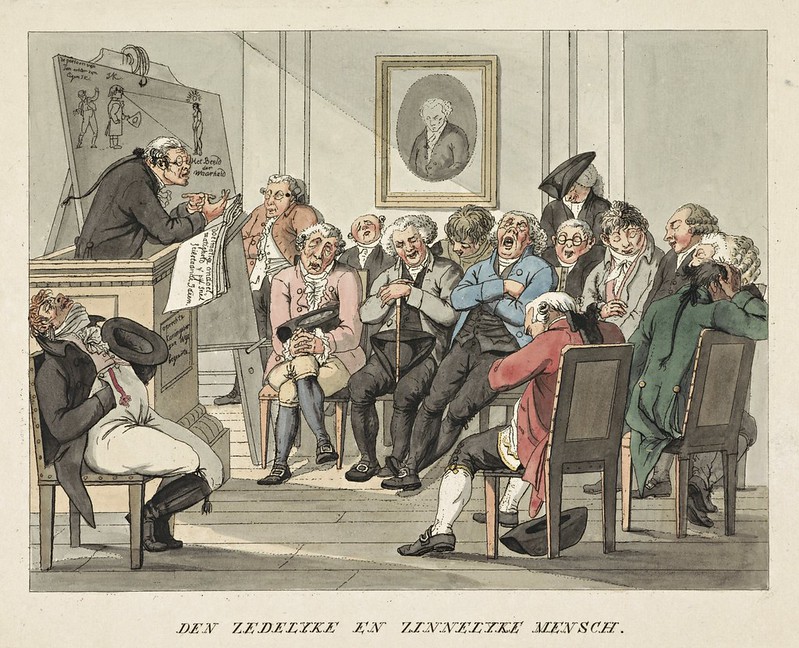
Jacob Ernst Marcus (1774-1826) - Wijsgeer houdt een redevoering voor een slapend publiek


Friedrich Schneider (1786-1853) - Academische Ouverture in D-Dur, Op.84 (1829)
Performers: Anhaltische Philharmonie Dessau; Markus L. Frank (conductor)

---


German composer, organist, conductor and teacher. He learnt the piano from his father, Johann Gottlob Schneider (1753-1840), and then at the Zittau Gymnasium with Johann Schönfelder and Unger. In 1804 he published his first works, a set of three piano sonatas, and in the following year he entered the University of Leipzig to continue his musical studies; here he came into contact with August Eberhard Müller, Johann Gottfried Schicht and Johann Friedrich Rochlitz. In 1806 he became singing teacher at the Ratsfreischule, in 1807 organist of the Universitätskirche, in 1810 director of the Secondaschen Opera Company, in 1812 organist of the Thomaskirche, in 1816 conductor of the Singakademie, and in 1817 musical director of the city theatre. His performance of Beethoven’s Fifth Piano Concerto in Leipzig on 28 November 1811 is believed to have been the work’s première. In 1820 he became Hofkapellmeister at Anhalt-Dessau, where he contributed much to improve musical life: he founded a Singakademie, a schoolmasters’ choral society, a Liedertafel and a music school, which was successful for about 15 years and had a number of excellent pupils, among them Robert Franz and Robert Volkmann. Between 1820 and 1851 he directed more than 80 German music and singing festivals, most of which included a performance of one of his oratorios. He belonged to numerous musical societies and received honorary doctorates from the universities of Halle and Leipzig in 1830. The highpoint of his wide-ranging compositional activity while at Leipzig came with his oratorio Das Weltgericht, first performed on 6 March 1820 at the Gewandhaus and widely performed thereafter. As a composer, he wrote seven operas, four masses, six oratorios, 25 cantatas, 23 symphonies, seven piano concertos, sonatas for violin, flute, and cello, and a great many shorter instrumental pieces, some of them for piano, some for organ. He also left numerous solo songs and part songs. His brothers Johann Schneider (1789-1864) and Gottlieb Schneider (1797-1856) were also organists and composers. His son Theodor Schneider (1827-1909) was a cellist and conductor.

dilluns, 1 de gener del 2024

PFEIFFER, Johann (1697-1761) - Sonata für Traverso

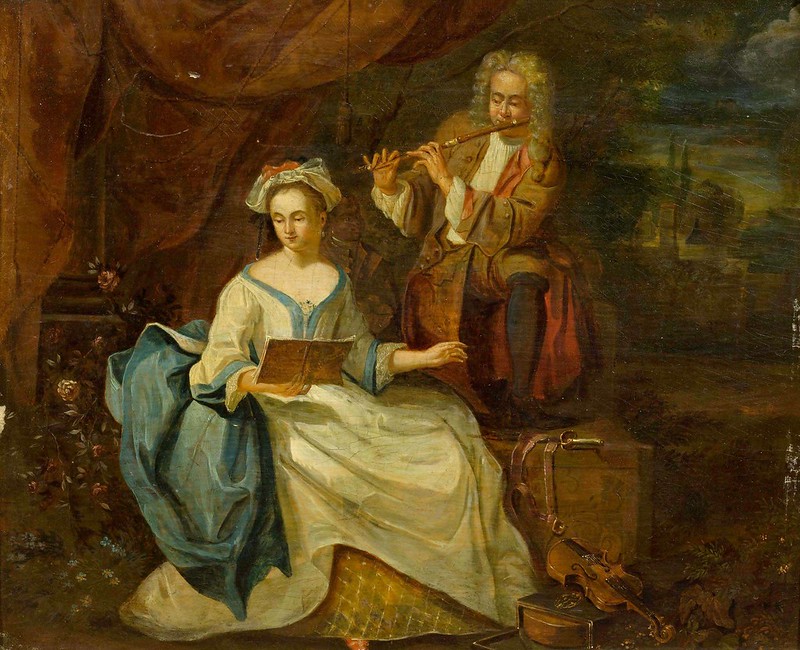
Circle of Nicolas Lancret (1690-1743) - A couple playing music


Johann Pfeiffer (1697-1761) - Sonata (G-Dur) à Traversiero Primo, Traversiero Secondo (violine) e Violoncello
Performers: Sabine Dreier (traverso); Ulla Schneider (violine); Tilmann Stiehler (violoncello); Irene Hegen (cembalo)

---


German composer and violinist. He studied at the university of Halle and Leipzig. He spent six months as director of music for Count Heinrich XI von Reuss at Schleiz before entering the Weimar court orchestra as a violinist in 1720. In 1726 he was made Konzertmeister, a post apparently left vacant since J.S. Bach's departure in 1717. From 1734 he served as Kapellmeister in Bayreuth, and also was music teacher to Margravine Wilhelmine, sister of Friedrich II the Great. On 20 September 1752 he married the widowed Dorothea Hagin, by whom he had two sons, Friederich Pfeiffer (1754-1816), a lawyer by profession and an able violinist, and Johann Heinrich Pfeiffer, who died in infancy. In 1752 or 1753 Pfeiffer was awarded the honorary title of ‘Hofrat’ (privy councillor), and his salary was increased; by the time of his death it stood at 1375 Reichsthaler. As a composer, he wrote 3 symphonies, 18 concertos for Violin and Strings, 9 concertos for Violino Picolo and Orchestra, 2 concertos for Lute and Strings, a Flute Concerto, chamber music and vocal pieces.

diumenge, 31 de desembre del 2023

OEHLSCHLAGEL, Jan Lohelius (1724-1788) - Missa Pastoralis Solemnis (1761)

Januarius Zick (1730-1797) - The Adoration of the Shepherds (c.1765)


Jan Lohelius Oehlschlägel (1724-1788) - Missa Pastoralis Solemnis ex D (1761)
Performers: Ivana Kvasnickova (soprano); Virginie Walterová (alto); Richard Sporka (tenor); Marc Niubo (bass); Ceskeho Rozhlasu Orchestra; Cantores Pragenses; Josef Hercl (1928-2005, conductor)

---


Bohemian composer, choirmaster, organist and organ builder. He was a pupil of Jana Jiřího Weidiga, the choirmaster of Duchcov, and later in Prague he studied with Josef Anton Sehling. In 1737 he received financial support by Emanuel Filibert von Waldstein of Duchov and he was addmited to the Jesuit monastery of Bohosudov where he was appointed as organist in a time he was finishing his studies of philosophy and theology. In August 1747 he entered the Premonstratensian Order and definitively took his monastic name of Jan Lohelius, under which most of his music was written. He was appointed as choirmaster of the monastic churches at Milevsko (1749-50) and at Strahov (1756). He also spent 15 years rebuilding the Strahov church organ, making it one of the best and largest in Bohemia at the time (Mozart tested and admired it in 1787). As a composer, he mainly wrote sacred music in a pre-Classical and early Classical style close to his fellows Antonio Boroni and F.X. Brixi. He died in Prague in February 1788.

divendres, 29 de desembre del 2023

CANNABICH, Christian (1731-1798) - Simphonia a 14. Stromenti (1778)

Dirk Langendijk (1748-1805) - De inneming van een stad door Franse troepen


Christian Cannabich (1731-1798) - Simphonia (C-Dur) a 14. Stromenti (1778)
Performers: Freiburger orchester; Gottfried von der Goltz (conductor)

---


German composer, violinist, and Kapellmeister. Son of Matthias Franciscus Cannabich (c.1690-1773), the private music tutor for the Elector of the Palatinate, he began his formal study of violin under Johann Stamitz and at the Jesuit Gymnasium and Music Seminar in Mannheim. At the age of 12 he was appointed as a scholar with the Mannheim orchestra, receiving full employment in the violin section in 1746. In 1750 Elector Carl Theodor sent Cannabich to Rome to study under Niccolò Jommelli, after which he followed his teacher to Stuttgart as a violinist. In 1756 he returned to Italy, this time to Milan, where he took lessons from Giovanni Battista Sammartini. Upon the death of Stamitz, Cannabich returned to Mannheim where he was appointed first violin, later becoming Konzertmeister. He became a friend of the Duke of Zweibrücken, who introduced him to Parisian musical circles in 1764; Cannabich returned to Paris several times over the next years, both to perform at the Concerts spirituels and to publish his music. In 1778 he followed the Electoral court to Munich, where he spent the remainder of his life and career. Cannabich was one of the most important composers of the second generation in Mannheim. He composed prolifically, in particular for ballets that were created by choreographer Étienne Lauchery during the 1760s. He was admired internationally, particularly by Wolfgang Amadeus Mozart, with whom he was a close friend. His musical style has clear-cut themes, harmonic progressions, and formal structures that are all hallmarks of the Classical style of the period. His ballets are particularly adept for dancing, while his duodramas such as Elektra of 1777 show a dramatic flair in his music. He wrote well over 200 works, including at least 75 symphonies (and perhaps as many as 90), 40 ballets, two operas, two duodramas, 18 duets (flute/violin or violin/viola), 30 violin sonatas, 16 concertos or sinfonia concertantes, 12 string quartets, six piano trios, six flute quartets, and a number of works for the keyboard.

dimecres, 27 de desembre del 2023

ROSIER, Natalis Carolus (1640-1725) - Sonata für trompete

Philips Wouwerman (1619-1668) - Riding School


Natalis Carolus Rosier (1640-1725) - Sonata für trompete in C-Dur
Performers: Helmut Hunger (1929-2011, trumpet); The Angelicum Orchestra; Alberto Zedda (1928-2017, conductor)
Further info: Art of the Trumpet

---


Flemish composer and violinist. His first years are unknown. From about 1664 he was a violinist at the court of the Elector Maximilian Heinrich in Bonn and later became vice-Kapellmeister there. From 1675 he lived principally in Cologne, but from about 1683 to 1699 he also worked in the Netherlands, where he was highly regarded as a violinist and numbered Carolus Hacquart among his colleagues. On a title-page of 1691 he is described as vice-Kapellmeister at the court at Cologne. In 1697 he participated in a collegium musicum in Amsterdam together with Nicolas Desrosier, Hendrik Anders and others. In 1699 he was Kapellmeister of Cologne Cathedral and in 1701 was appointed to a similar post by the city council; he kept both posts until his death in 1725. As a composer, he mainly published sacred works, among them, 'Motetta, sive cantiones sacrae' (1668) and at least 12 masses and 18 motets (c.1705-1713). He was also praised as a composer of instrumental music, mainly by his collection of '14 sonate' for several instruments (1697). His daughter Maria Anna married the composer Willem de Fesch.