diumenge, 12 de novembre del 2023

LANG, Johann Georg (1722-1798) - Missa solemnis in D

Johann Georg Trautmann (1713-1769) - Nächtliche Feuersbrunst (c.1765)


Johann Georg Lang (1722-1798) - Missa solemnis in D
Performers: Suzanne Cаlаbra (soprano); Elke Burkеrt (alto); Axel Reichardt (tenor); Tobias Schаrfеnbеrgеr (bass); Trierer Kammerchor; SWR-Rundfunk-Orchester Kaiserslautern; Manfred Mаy (conductor)

---


Bohemian composer, keyboardist and violinist. His first training was in Prague, where he studied keyboard and violin. In 1746 he was hired by the Prince-Archbishop of Augsburg as a musician, and in 1749 he was sent to Italy, where he studied under Francesco Durante and Girolamo Abos in Naples. Returning three years later, he was appointed Konzertmeister in 1758, and in 1768 the new ruler, Archbishop Clemens Wenzeslaus, Elector of Trier, moved his court to the summer palace at Ehrenbreitstein. Even toward the end of his life when the court abandoned their residences, Lang remained in Ehrenbreitstein near Trier. Known mainly for his instrumental works, Lang’s compositions are characterized by good periodic structure and broad melodies. These include five Masses, a litany, a Te Deum, several Lieder, 38 symphonies, 29 keyboard concertos, 25 horn concertos (and eight other concertos), nine mixed quartets with keyboard, 25 sonatas, 21 works for keyboard, three trios, and duos for violin and cello.

divendres, 10 de novembre del 2023

CUPIS DE RENOUSSARD, François (1732-1808) - Duo Pour deux Violoncelles

Attributed to Filippo Falciatore (1718-1768) - Figures from the Commedia dell'arte dancing


François Cupis de Renoussard (1732-1808) - Duo (VI) Pour deux Violoncelles, oeuvre III (c.1770)
Performers: Michel Tοurnus (cello); Florian Lаurіdοn (cello)

---


French composer and cellist, youngest son of Ferdinand-Joseph Cupis (1684-1757), teacher of violin and 'maître à danser'. Brother of the violinist and composer Jean-Baptiste Cupis de Camargo (1711-1788), the horn player Charles Cupis and the ballerina Marie-Anne de Cupis de Camargo (1710-1770), he apparently had a wild youth. In 1751 when he was a cello student under Martin Berteau at the Collège des Quatre Nations, he was arrested for stealing linen from his father and selling it. In 1759 action was again brought against him (and his elder brother Charles, a horn player and member of the Académie Royale de Musique orchestra, 1746-50) for drunkenness. According to Spectacles de Paris, he was a member of the Concert Spirituel orchestra, 1764-71 and 1774-77, and a member of the Académie Royale de Musique orchestra, 1767-70. In order to marry Marie-Reine Thomé de Beaumont (6 November 1770) he had to sign a renunciation of the theatre and resign his post at the Opéra. Despite his youth rebellious years he became a creditable cellist and composer mainly by his promoting of the cello in France. As a composer, he wrote chamber music and, at least, two cello concertos.

dimecres, 8 de novembre del 2023

WITT, Friedrich (1770-1836) - Concerto in F a Due Corni Principale (1797)

François-Gabriel-Guillaume Lépaulle (1804-1886) - Presumed portrait of future Comte de Plaisance


Friedrich Witt (1770-1836) - Concerto in F a Due Corni Principale, Due Violino, Due Oboe, Due Corni Repieno, Viola e Basso (1797)
Performers: Hermann Bаumаnn (horn); Christoph Kοhlеr (horn); Concerto Amsterdam;
Jaap Schrödеr (1925-2020, conductor)

---


German cellist and composer. Born at Schloß Halbergstetten, he probably received his early training at the court there. In 1789 he was appointed cellist at the court of Oettingen-Wallerstein, where he came into contact with Antonio Rosetti. In 1802 the performance of his oratorio Der leidenede Heiland in Würzburg led to an appointment as Kapellmeister in the city. From 1814, when he resigned that post, to his death he was Kapellmeister at the Würzburg theatre. Witt was not a prolific composer, and his style reflects that of Rosetti. His works include three stage pieces, two oratorios, three Masses, two large odes, 12 symphonies (though the infamous so-called Jena symphony once attributed to Beethoven is a crude forgery), eight concertos, a septet, a quintet, and several wind partitas. 

dilluns, 6 de novembre del 2023

BRÉVAL, Jean Baptiste (1753-1825) - Simphonie concertante (1789)

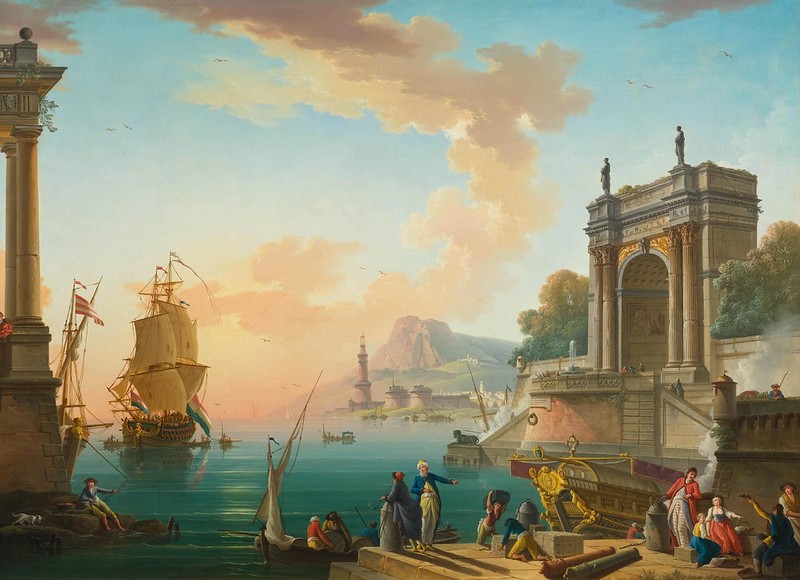
Charles François Lacroix de Marseille (c.1700-c.1780) - Mediterranean harbour (1776)


Jean Baptiste Bréval (1753-1825) - Simphonie concertante Pour une Flute, et un Basson
Avec accompagnement de deux Violons, Alto et Basse (1789)
previously attributed to François Devienne (1759-1803)
Performers: Marc Grаuwеls (flute); Alain de Rеijckеrе (bassoon);
Wаlloon Chamber Orchestra; Bernard Lаbаdie (conductor)

---


French composer and cellist. He studied cello with Jean-Baptiste Cupis and in 1776 he became a member of the Société Académique des Enfants d’Apollon. His debut was in 1778 at a Concert Spirituel performing one of his own sonatas. He subsequently was a member of its orchestra (1781-91), and then played in the orchestra of the Theatre Feydeau (1791-1800). Afterwards he assumed the administration of the Concerts de la rue de Cléry and became a member of the Paris Opéra orchestra, a position from which he retired in 1814. His music was also performed by various Paris concert societies. Bréval’s compositions, written between 1775 and 1805, consist mostly of instrumental music and reflect contemporary Parisian musical taste: graceful melodies are propelled by energetic rhythms and supported by an unobtrusive harmonic structure. He composed a great quantity of instrumental music, including symphonies, cello concertos, string quartets, trios, duos, and sonatas. He also wrote an opera-comique, Ines et Leonore, ou La Soeur jalouse, performed in Versailles on 14 November 1788. His brother Stanislas-Laurent Bréval (1760-?), was a violinist in the service of the Count of Ogny and played in the orchestras of the Paris Opéra and the Concert Spirituel.

diumenge, 5 de novembre del 2023

ARIOSTI, Attilio (1666-1729) - Cantata 'Pur al fin gentil viola'

Studio of Jean-Baptiste Santerre (1651-1717) - Portrait of a young lady, half-length, in a white silk dress, singing


Attilio Ariosti (1666-1729) - Cantata 'Pur al fin gentil viola'
Performers: Charlotte Lehmann (soprano); Günther Weiss (viola d'amore);
Jürgen Wolf (1938-2014, cello); Theodor Klein (harpsichord)

---


Italian composer, singer and instrumentalist. He joined the order of S. Maria de' Servi at the Bologna monastery in 1688, took minor orders in 1689, and received his diaconate in 1692. Abandoning the order, he was in the service of the Duke of Mantua in 1696. With Lotti and Caldara, he collaborated on the opera Tirsi (Venice, 1696). In 1697 he went to Berlin as a court composer and staged the first Italian operas there. From 1703 to 1711 he was in the service of the Vienna court. In 1716 he went to London, where he was a composer with the Royal Academy of Music. Among the operas he brought out there were Coriolano (1723), Artaserse (1724), Dario (1725) and Lucio Vero, imperator di Roma (1727). He also published a volum of six cantatas and six lessons for the viola d'amore (1724), on which he was an accomplished performer. These are usually called the Stockholm Sonatas, as the sole surviving source for most of them is in the Statens Musikbibliotek in Stockholm, Sweden. In all, he composed at least 22 operas, instrumental music, five oratorios, and many cantatas.