dilluns, 8 de març del 2021

MYSLIVECEK, Josef (1731-1781) - Violin Concerto in D (1770)

Anonymous (18th Century) - The Colosseum with an artist sketching at left foreground


Josef Mysliveček (1731-1781) - Violin Concerto in D (1770)
Performers: Ernö Sebestyen (violin); Radio-Symphonie-Orchester Berlin

---


Czech composer. The elder of identical twin brothers, he grew up in Prague in the households of his father and stepfather, both prosperous millers. Although it is believed that Mysliveček’s father arranged musical instruction for his sons before his death in 1749, there is no evidence to confirm speculation that they were taught by Felix Benda, a near neighbour. Reports that the twins attended the Dominican Normalschule at the Church of St Giles (Jiljí) and the Jesuit Gymnasium in the Clementinum are conjectural, but their enrolment in the philosophy faculty at Charles-Ferdinand University (now Charles University) is confirmed in surviving matriculation records. Owing to a lack of academic success, Mysliveček withdrew from the university in March 1753 without graduating. The following May, the twins became apprentice millers; they were admitted into the Prague millers’ guild as journeymen in 1758 and became master millers in 1761. In the early 1760s, Mysliveček abandoned the family business to devote himself to music. Probably he began studies in composition with Franz Habermann, but soon transferred to Josef Seger, organist at the Týn Church in Prague. According to Pelcl, Mysliveček completed six symphonies named after the first six months of the year within six months of study with Seger (no symphonies with evocative titles survive to confirm the legend, however). It seems that he established an excellent reputation as a violinist; nonetheless, there is no evidence to support reports that he was employed as a church violinist. In November 1763, Mysliveček left for Venice to study operatic composition, funded at least partly by his twin brother Jáchym and his long-standing patron Count Vincenz von Waldstein. His studies there with G.B. Pescetti brought quick (and impressive) results in the form of a first opera, Semiramide, performed in Bergamo in 1765 and Alessandria in 1766. The librettos confirm that he was by then referred to as ‘Il Boemo’ by Italians, who had difficulty pronouncing his name.

Mysliveček achieved his first great operatic success in 1767 with 'Il Bellerofonte' at the Teatro S Carlo in Naples. The cast included Caterina Gabrielli, a singer with whom Mysliveček’s name has been linked romantically even though there is no evidence of a love affair either with her or with Lucrezia Aguiari earlier at Parma. From this time onwards Mysliveček lived mainly in Italy, where he travelled continually in order to fulfil operatic commissions, almost always at major houses with excellent casts. In 1771 he was admitted into the Accademia Filarmonica of Bologna after befriending Padre Martini. Mysliveček made at least three trips to northern Europe after establishing himself in Italy. The first, a triumphant return to Prague in 1768, was probably occasioned by his mother’s death in 1767 and the settlement of his father’s estate. His second trip, in 1772, may have been intended to establish his reputation in Vienna. If so, the effort clearly failed, but he did meet Charles Burney in September. Mysliveček ventured north for the last time at the invitation of Maximilian III Joseph, Elector of Bavaria, in 1777-78 (reports of an earlier trip to Munich in 1773 cannot be verified). While in Munich, he witnessed successful productions of his opera Ezio and his oratorio Isacco and sought surgical treatment for what is believed to have been venereal disease, with the result that his nose was burnt off. On his return to Italy in 1778, Mysliveček enjoyed operatic successes in Naples and Venice, but his final decline was signalled by the failure of both of the operas that he prepared for Carnival 1780 ('Armida' for Milan and 'Medonte' for Rome). He died in Rome, in abject poverty; his funeral at the church of S Lorenzo in Lucina was paid for by a mysterious Englishman named Barry, a former pupil.

diumenge, 7 de març del 2021

KURPINSKI, Karol (1785-1857) - Henry VI at the Hunt

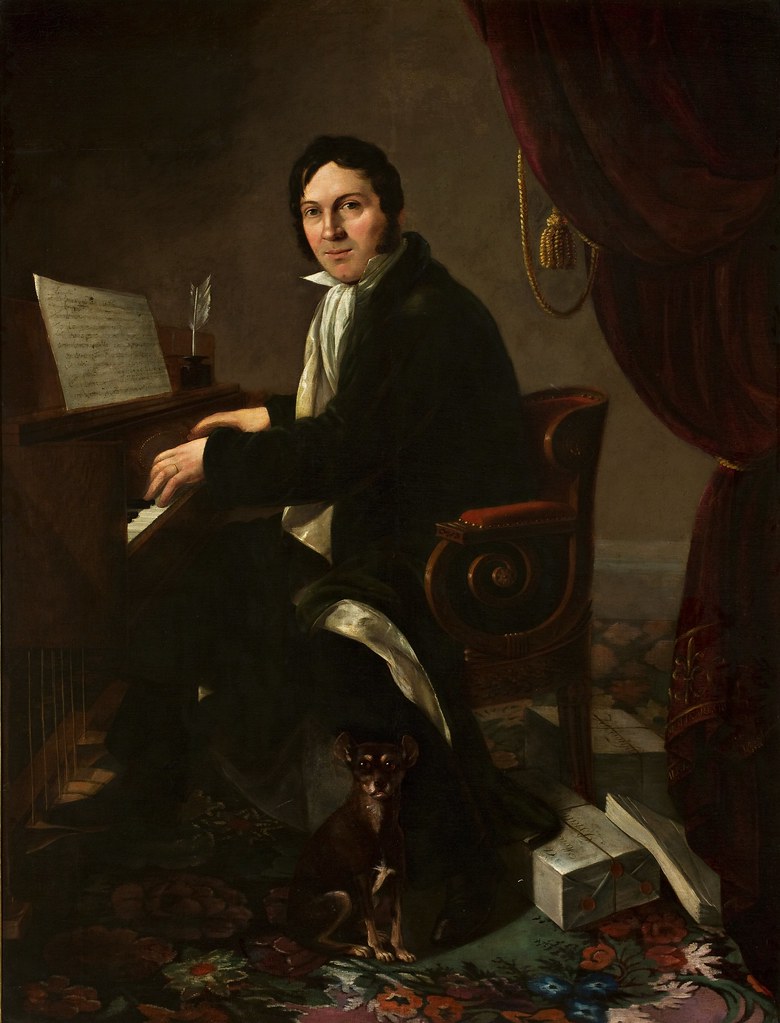
Aleksander Ludwik Molinari (1772-1831) - Portret Karola Kurpińskiego (1825)


Karol Kurpiński (1785-1857) - Henry VI at the Hunt
Performers: Teresa May-Czyzowska (soprano); Romuald Spychalski (1928-2018, tenor); Z. Krzywicki (bass); Witold Malcuzynski (baritone); R. Werlinski (tenor); S. Michonski (bass); J. Stocka (mezzosoprano); Zygmunt Jankowski (bass);
Lódz Opera Orchestra; Lódz Opera Chorus; Zygmund Latoszewski (1902-1995, conductor)

---


Polish composer and conductor. He studied with his father Marcin Kurpiński, an organist at Włoszakowice, and himself became organist at Sarnów nearby in 1797. In 1808 he took a post as tutor to the Rastawiecki family in Lwów, where he heard a number of Italian and German operas, and in 1810 he settled in Warsaw. There he met the dramatist Wojciech Bogusławski, known as the ‘father of Polish theatre’, through whose influence he was appointed deputy conductor at the National Theatre. In 1824 he was appointed principal conductor (on the dismissal of Józef Elsner) and in that capacity he presented a repertory of the highest quality, notably Mozart and Rossini, to Polish audiences. In addition to opera he regularly conducted orchestral concerts in the city; these included the first performances of Chopin's two piano concertos. Kurpiński was also active as a teacher, establishing (1835) the School of Singing and Declamation at the National Theatre as a replacement for the conservatory, which had been closed down after the 1830 insurrection. He also founded and contributed regularly to the journal Tygodnik muzyczny (‘Music Weekly’; later Tygodnik muzyczny i dramatyczny), the main forum for musical debate in Warsaw in the first half of the century. In 1823, just before his appointment as principal conductor at the National Theatre, he embarked on a European tour that took in all the major musical centres. Kurpiński's creative work slackened noticeably following the tour, and it seems possible that he felt his own music to be somewhat anachronistic in relation to the new musical styles of the 1820s. His later life was given over mainly to teaching, and by the time of his death he was largely forgotten. 

Although he composed in many genres, Kurpiński's contribution was mainly to opera. He was the major Polish opera composer before Moniuszko, and his output (most of it composed for the National Theatre in Warsaw) was considerable. Many of his operas received only a few performances before disappearing from the repertory, but some had more lasting success, notably Szarlatan, czyli Wskrzeszenie umarłych (‘The Charlatan, or The Raising of the Dead’), Jadwiga królowa Polska (‘Jadwiga, Queen of Poland’) and Zamek na Czorsztynie, cyli Bojomir i Wanda (‘The Castle of Czorsztyn, or Bojomir and Wanda’). For the most part his stage works were vaudevilles or Singspiele, interleaving songs and choruses with spoken dialogue. Nine of Kurpiński's 26 known stage works survive complete, and there are extracts from a further eight. It is clear from the surviving works that the stylistic profile of his music was distinctly Italian, responsive both to such late 18th-century composers as Cimarosa and Paisiello and to such later masters as Rossini. At the same time Kurpiński laid some of the foundations of a national operatic style by drawing on themes from Polish history and folklore and making use of Polish national dances and folksongs. His most ambitious stage work was probably Jadwiga, a full-scale opera rather than a vaudeville, and similar in its broad design to the historical operas of Spontini. In the 1990s attempts were made to revive some of Kurpiński's operas in Poland, with notable success in the cases of Pałac Lucypera (‘Lucifer's Palace’), Szarlatan and Zabobon.

divendres, 5 de març del 2021

FEYZEAU, Jean-Baptiste (1745-1806) - Sonata IV, Op.I (1764)

Joseph-Antoine Batanchon (1738-1812) - Portrait of a musician, possibly Jean-Baptiste Feyzeau (1745-1806)


Jean-Baptiste Feyzeau (1745-1806) - Sonata IV, Op.I (1764)
World Premiere Recording
Performers: Sibelius + Harpsichord samples (edited by Pau NG)

---


French organist, teacher and composer. Son of luthier Jean Feyzeau and Anne Timbaudy, his young life is unknwon. When he published his opus 1 -Pièces de clavecin en sonates (1764)- he presents himself as a disciple of Franz Ignaz Beck (1734-1809). October 20, 1771 he married Marie-Françoise Bordes and a half year later, he was appointed organist of the Saint-André cathedral with a salary of 600 pounds per year. In 1775 he composed his first comic opera, entitled "Lucette". In 1779 with Jacques Matoulet and a certain Magnouac, he founded the "Société des amateurs de musique de Bordeaux". From 1779 to 1785, he worked as a teacher, mainly organ, fortepiano, harpsichord and sometimes timpani. In 1782 he published his second comic opera, entitled "Suzette ou le préjugé vaincu". In 1786 he joined the masonic lodge of "L'amitié". After 1790, his life is unkown but he probably worked as a teacher until his death in 1806.

dimecres, 3 de març del 2021

AMARAL VIEIRA, José Carlos (b.1952) - Te Deum in stilo barocco (1986)

Johann Jacob Steinmann (1800-1844) - Largo do Paço (1839)


José Carlos Amaral Vieira (b.1952) - Te Deum in stilo barocco (1986)
Performers: Slovak Philharmonic Orchestra and Choir; Mario Kosik (conductor)

---


Brazilian composer, pianist and musicologist. He studied piano with Souza Lima and composition with Artur Hartmann in Brazil. Vieira later studied in France at the Paris Conservatory with Lucette Descaves and Olivier Messiaen; in Germany at the Freiburger Musikhochschule with Carl Seeman and Konrad Lechner; and in the United Kingdom with Louis Kentner. In 1977 he returned to Brazil to embark on the career of a virtuoso performer, while introducing his own compositions in concert programmes. He has achieved international acclaim both as a concert and recording artist, composer, and musicologist, and has appeared throughout the Americas, Europe, and Asia. Among his honors, Vieira has been the recipient of the Arthur Honegger International Composition Award, a Grand Prix International (Fondation de France), Hungary's Liszt Award, and Japan's Min-On Award. He has performed more than 72 recordings, focused on Liszt's work and on his own compositions.

dilluns, 1 de març del 2021

WAGENSEIL, Georg Christoph (1715-1777) - Orgelkonzert C-Dur, Nr.1

Julius Caesar Ibbetson (1759-1817) - Jack in His Glory A Hackney Coach Driven by Drunken Sailors


Georg Christoph Wagenseil (1715-1777) - Orgelkonzert C-Dur, Nr.1
Performers: Stefan Johannes Bleicher (orgel);
Südwestdeutsches Kammerorchester Pforzheim; Vladislav Czarnecki (leitung)

---


Austrian composer, keyboard player and teacher. He can be considered one of the pivotal figures in the development of the Classical style in Vienna with a compositional career that spanned a period from Fux, his teacher, to Haydn and W.A. Mozart, for whom he served as a precursor. Wagenseil’s father and maternal grandfather were functionaries at the Viennese imperial court. In his teens he began to compose keyboard pieces and to receive keyboard instruction with the organist of the Michaelerkirche in Vienna, Adam Weger. His accomplishments brought him to the attention of the court Kapellmeister, Johann Joseph Fux, who recommended him for a court scholarship in 1735; for the next three years he received intensive instruction in keyboard playing, counterpoint and composition from his sponsor and from Matteo Palotta. As a result of an enthusiastic endorsement from Fux, Wagenseil was appointed composer to the court on 6 February 1739, a post he held until his death. He also served as organist from 1741 to 1750 in the private chapel of Empress Elisabeth Christine (widow of Charles VI), and in 1749 became Hofklaviermeister to the imperial archduchesses. To the latter he dedicated four sets of divertimentos, which were engraved and issued as opp.1-4 by Bernardi of Vienna (1753-63). Wagenseil travelled to Venice in 1745 to supervise the production of his first opera, Ariodante, and in 1759-60 he was in Milan for a performance of Demetrio. In the mid-1750s uncommonly generous publication privileges granted by Parisian printers brought about a flood of instrumental compositions, particularly symphonies (see illustration), which raised him to international prominence, and which were undoubtedly responsible for Burney’s high opinion of him. Among those acquainted with his music was the young Mozart, who played one of Wagenseil’s concertos before Maria Theresa in 1762 and several keyboard pieces at the English court in 1764. Haydn was likewise familiar both with numerous instrumental works, as entries in the so-called Quartbuch show, and with Wagenseil’s operas, which found their way to Eisenstadt. Wagenseil was also renowned as a keyboard virtuoso, and elicited the highest praise from contemporaries such as C.F.D. Schubart (who remarked that Wagenseil ‘played with extraordinary expressive power and was capable of improvising a fugue with great thoroughness’). But from about 1765 steadily worsening lameness and an attack of gout which affected his left hand curtailed his activities at court and eventually confined him to his quarters where, according to Burney, who visited him on several occasions, he continued to compose and to teach. Among Wagenseil’s pupils were Leopold Hofmann, J.A. Štěpán, F.X. Dušek, Johann Gallus-Mederitsch, G.A. Matielli, P. le Roy, the brothers Franz and Anton Teyber, and J.B. Schenk. The last, who began instruction in 1774, provided in his autobiography a detailed account of his mentor’s teaching methods which, not surprisingly, were based on Fux (a legacy Schenk was then to transmit to Beethoven later in the century) but which were also remarkable for their time in drawing on Handel and Bach.