dimecres, 29 de juny del 2022

VOGEL, Johann Christoph (1756-1788) - Simphonie Concertante (c.1785)

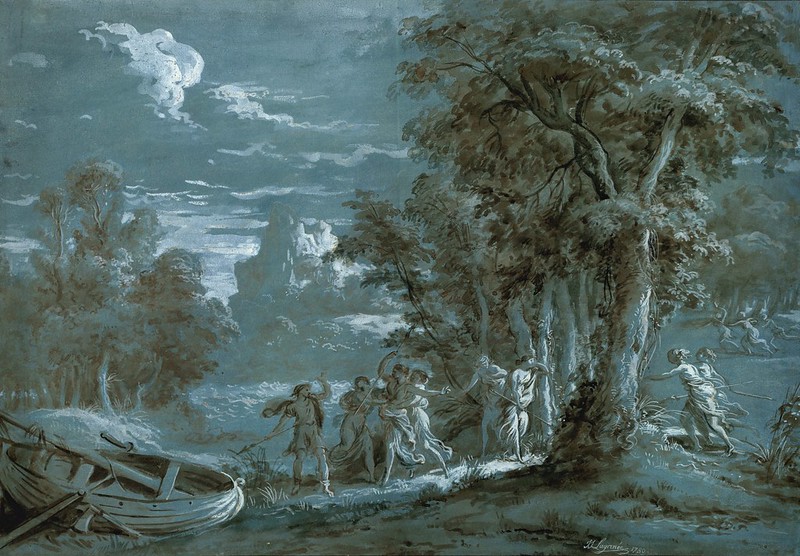
Jean-Jacques Lagrenée (1739-1821) - Landscape with a Scene from Fénelon’s Télémaque (1780)


Johann Christoph Vogel (1756-1788) - Simphonie Concertante (fagott und oboe) C-Dur (c.1785)
Performers: Alfred Hertel (oboe); Cornelia Slepicka (fagott); Maurie Ravel Kammerorchester;
Jean Philippe Rouchon (leitung)
Further info: Sinfonia Concertante

---


German composer, active in France. The son of the violin maker Michael Vogel, and grandfather of Charles-Louis-Adolphe Vogel, he studied with Georg Wilhelm Gruber in Nuremberg and with Joseph Riepel in Regensburg. There is no evidence that he was employed as a musician in the Regensburg Hofkapelle, as some biographers have erroneously stated, confusing him with the oboist Johann Bartholomäus Vogel (?-1782). He moved to Paris in 1776, and entered the service of the Duke of Montmorency and then of the Count of Valentinois as a horn player. He composed a great number of orchestral and chamber works during this period. His oratorio Jephté, performed at the Concert Spirituel in September 1781, received favourable reviews although its harmony was regarded as ‘too complicated and baroque’. Philippe Desriaux, for many years the secretary of Baron von Tschudi, wrote the librettos for both of Vogel’s operas. The first of them, La toison d’or, was written as early as 1781 but was not performed at the Opéra until 5 September 1786. Vogel was an enthusiast for the operas of Gluck, and the work is dedicated to him as ‘législateur de la musique’. Here and there it appears to be a faithful stylistic imitation of Gluck’s two Iphigenia operas, but it displays great mastery in the handling of the orchestra and its arias are particularly lyrical. With 12 performances in all the opera had only limited success since it already seemed old-fashioned and contained no ballet. Around 1786 Vogel began composing his second opera, Démophon. Its posthumous première (at the Opéra on 22 September 1789) was given only after the première of Cherubini’s opera on the same subject. Among the musical qualities of this dramatically powerful work are the variety of recitative forms, the treatment of the woodwind as solo instruments and the harmonic colour of the choruses. The overture, composed in monothematic sonata form, remained popular into the early 19th century, and was incorporated into Gardel’s ballet-pantomime Psyché (1790), which had more than 1000 performances at the Opéra between its première and 1829.

dilluns, 27 de juny del 2022

JACQUET DE LA GUERRE, Elisabeth (1665-1729) - Suite (I) en ré mineur

Aelbert Cuyp (1620-1691) - Rivierlandschap met ruiters


Elisabeth Jacquet de la Guerre (1665-1729) - Suite (I) en ré mineur (1707)
Performers: Thurston Dart (1921-1971, harpsichord)

---


French harpsichordist and composer. She came from a family of master masons and musicians, and from the age of five played the harpsichord and sang at the court of Louis XIV. Noticed by Madame de Montespan, she stayed for three years in her entourage. On 23 September 1684 she left the court to marry the organist Marin de La Guerre. Their son, as precociously gifted as his mother, died at the age of ten. In Paris Elisabeth Jacquet gave lessons and concerts for which she was soon renowned throughout the city. Her first compositions were dramatic works, of which only the libretto of Jeux à l'honneur de la victoiresurvives. Her first publication, Les pièces de clavessin … premier livre, dates from 1687. In 1694 her only tragédie en musique, Céphale et Procris, was performed at the Académie Royale de Musique with little success, but the prologue was revived in 1696 at Strasbourg, where Sébastien de Brossard had founded an academy of music. In 1695 Brossard made copies of her first trio sonatas and those for violin and continuo. Only in 1707 did she publish her six Sonates pour le viollon et pour le clavecin and the Pièces de clavecin qui peuvent se jouer sur le viollon, followed later by her two collections of Cantates françoises sur des sujets tirez de l'Ecriture to texts by Antoine Houdar de Lamotte, and by three secular Cantates françoises. Whereas all her other works were dedicated to Louis XIV, this last was addressed to the Elector of Bavaria, Maximilian II Emanuel. Le raccommodement comique de Pierrot et de Nicole is a duet which went into La ceinture de Vénus, a play by Alain-René Lesage performed at the Foire St Germain in 1715. Elisabeth Jacquet's last work seems to have been a Te Deum sung in August 1721 in the chapel of the Louvre in thanksgiving for the recovery of Louis XV from smallpox. Elisabeth Jacquet was the first woman in France to compose an opera, and she is also remembered for her innovative work in the Italian genres of cantata and sonata, as well as for her music for accompanied keyboard. The Pièces de clavessin of 1687 are remarkable for their balanced structures and their préludes non mesurés. Her sonatas, both manuscript and printed, are conspicuous for their variety, rhythmic vigour and expressive harmony, as well as for certain innovative features in the violin writing. Her 12 sacred cantatas show a fine balance between a style appropriate to the genre and the restraint required by the subject; no other composer of the time handled the genre so consistently. The secular cantatas are characterized by dramatic qualities and a quest for formal freedom. In Le Parnasse françois Titon du Tillet devoted a long and appreciative notice to her, and her portrait is shown in a medallion with the motto ‘I contended for the prize with the great musicians’.

diumenge, 26 de juny del 2022

GURECKY, Václav Matyáš (1705-1743) - Vesperae de Dominica ex C

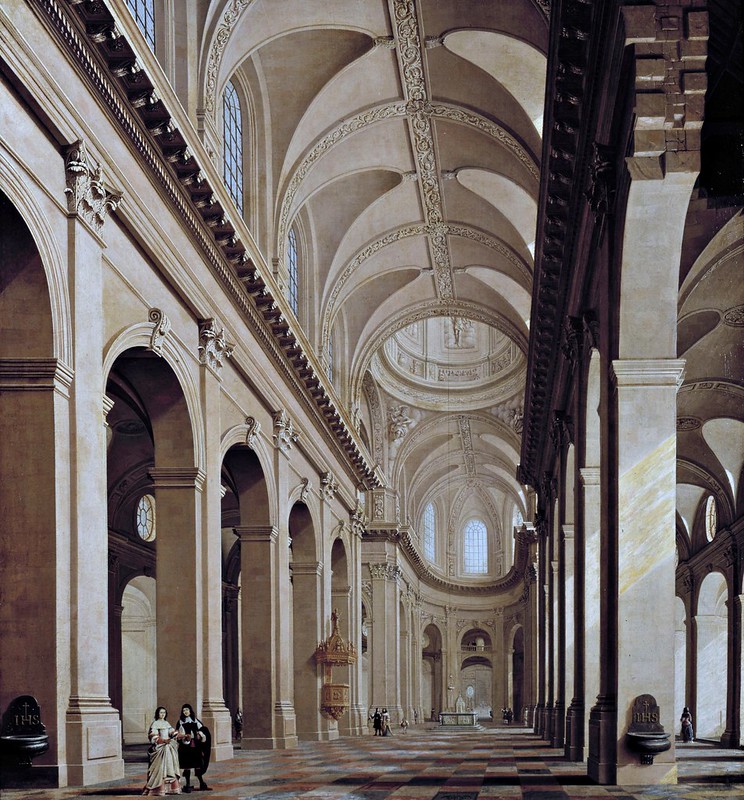
Daniël de Blieck (1610-1673) - Vue idéalisée de l’intérieur de l’église Saint-Sulpice pendant sa construction (1661)


Václav Matyáš Gurecký (1705-1743) - Vesperae de Dominica ex C
Performers: Musica Floreа; Mаrеk Stryncl

---


Moravian composer. His family came from Příbor and were closely related to the mother of the Catholic priest Jan Sarkander, martyred in 1620 in Olomouc and later canonized. Gurecký received his musical and general education at Piarist schools and from 1724 was a tutor in the Piarist music seminary in Kroměříž. In 1729 he married the daughter of the Kroměříž organist Anton Bernkopf. By that time he was presumably already employed by the Olomouc bishop, Cardinal Wolfgang von Schrattenbach (1711–38), who enabled him to study composition with Caldara in Vienna. It is not known why in 1736 Gurecký left the Schrattenbach orchestra and took the post of musical director of Olomouc Cathedral. He worked there until his death in 1743. Gurecký was a very prolific composer of operas, oratorios, church and instrumental music, strongly influenced by Caldara, but little has survived (CZ-Bm, D-WD). From the librettos we know that he composed the operas Antioco (Kroměříž, 31 October 1729) and Griselda (Kroměříž, 31 October 1730) for the bishop's orchestra, both to texts by Zeno. His oratorios, according to the librettos (CZ-Bu, KRa, YU-Ls), were Giacobbe (Brno, 1731), San Francesco di Paolo (Brno, 1734), Gioas re di Giuda (Brno, 1736) and Von der göttlichen Liebe (undated) to texts mostly by the cardinal's secretary, Giovanni Battista Catena; this list is probably not complete. His only well-known church works are the two vesper settings and three masses, Missa obligationis (probably for the solemn introduction of Bishop Jakob Ernst von Liechensten at Olomouc on 30 April 1740), Missa divinae gratiae and Missa a 4 voci (all 1740).

divendres, 24 de juny del 2022

GRONEMAN, Johannes Albertus (1711-1778) - Sonata (G-Dur) à 4 (1757)

Bernard Picard (1673-1733) - Assemblée galante dans un parc jouant de la musique


Johannes Albertus Groneman (1711-1778) - Sonata (G-Dur) à 4 (1757)
Performers: Jed Wentz (traverso); Marion Moonen (traverso); Balázs Máté (violoncello);
Marcelo Bussi (harpsichord)

---


Dutch composer of German birth. On 15 February 1732 he enrolled at the University of Leiden and soon after appeared as a violin virtuoso. By 1736 he had moved to The Hague, where he became carilloneur (1741) and organist (1743) of the city’s principal church. His career was interrupted for a while by mental illness. Works by him were printed in Amsterdam, London and Paris, and include, in various editions, a set of 12 somewhat virtuoso sonatas for violin and continuo op.1 modelled on Tartini, 6 simpler sonatas for two flutes or violins op.2, and 12 minuets for violin or flute and continuo.

dimecres, 22 de juny del 2022

MANFREDINI, Francesco (1684-1762) - Concerto con due Trombe (1711)

Matthijs Naiveu (1647-1726) - Townscape with a stage performance


Francesco Manfredini (1684-1762) - Concerto (in Re maggiore) con due Trombe (1711)
[Historical recording]
Performers: Roger Delmotte (trumpet); Albert Adriano (trumpet); Ensemble Instrumental de Paris;
Louis de Froment (1921-1994, conductor)

---


Italian composer. His father, Domenico, was a trombonist at Pistoia Cathedral from 1684. Francesco studied music at Bologna in his youth, taking violin lessons from Torelli and lessons in counterpoint (at that time virtually synonymous with composition) from Perti. Shortly before 1700 he left for Ferrara, probably because of the dissolution of the S Petronio orchestra in 1696. In Ferrara he became first violinist at the church of the Holy Spirit. On returning to Bologna in 1703 he joined the reconstituted orchestra, initially as an occasional violinist and from 1709 to 1711 as a regular member. In 1704 he was admitted as a player (suonatore) to the Accademia Filarmonica. His first publication, a set of 12 chamber sonatas entitled ‘Concertini’, dates from the same year. There is evidence of a visit, or at least a planned visit, to Venice in February 1707, for the accidental death by drowning of his colleague Giuseppe Aldrovandini occurred as he was on his way to join Manfredini before the latter's departure. In 1711 Manfredini became attached to the court of the music-loving Antoine I Grimaldi, Prince of Monaco, where he was active as a composer and performer of instrumental music. Five children were born to him in the principality between 1712 and 1723. During this period he maintained close contact with, and perhaps sometimes visited, Bologna, where his op.3 concertos were published in 1718 and two oratorios were performed a little later. In 1724 he moved to Pistoia to become maestro di cappella at the cathedral. During his tenure of this post, which lasted until his death, he emerged successful from many disputes with the cathedral chapter and with the musicians under him. 

In Pistoia Manfredini had the opportunity to continue his activity as a composer of oratorios, which were performed at local churches, in addition to writing many sacred works for liturgical use at the cathedral and elsewhere. Although Manfredini was clearly a prolific composer, only his published instrumental music, together with a handful of other instrumental works in manuscript, survives. The loss of his nine known oratorios is especially unfortunate. His idiom is firmly Bolognese in character and resembles that of Torelli, B.G. Laurenti, Perti and other members of the school associated with S Petronio, though his music lacks the stamp of a forceful personality and in that respect is inferior to Torelli's. Venetian influence has been discerned in his use of unison writing, and the op.3 concertos did not go unmarked by Vivaldi, despite their greater debt to Torelli. The ending of both the op.2 Sinfonie da chiesa and the op.3 concertos with a Christmas pastorale (whose Torellian antecedent is only too patent) deserves mention. These so-called ‘sinfonie’, with an optional viola part, are ordinary church sonatas; the ‘solo’ or ‘soli’ cues in the violin parts merely tell the player that his part is momentarily exposed. The best of Manfredini’s instrumental works are the six sonatas published in London in 1764 (but not necessarily composed late in the composer's life). These are worthy examples of the ‘mixed’ type of sonata juxtaposing church and chamber elements that became normal after 1700.