Es mostren els missatges amb l'etiqueta de comentaris Corri S.G.. Mostrar tots els missatges

dilluns, 1 de maig del 2023

CORRI, Sophia Giustina (1775-1847) - Sonata (III) for the harp (1797)

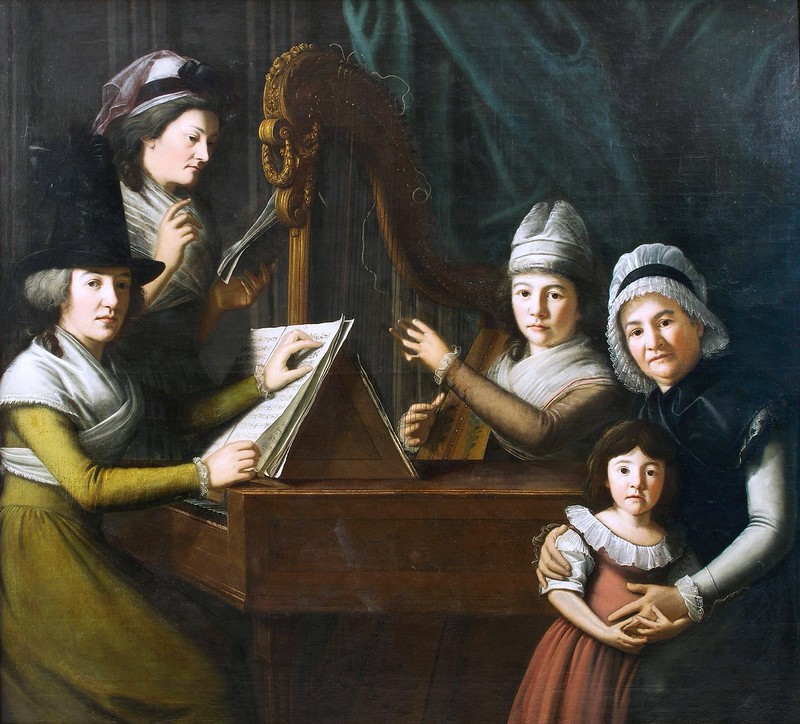
Felix Maria Diogg (1762-1834) - Magdalena Esslinger-Escher im Hard, mit ihren Töchtern Regina, Magdalena, Esther und Anna Maria, 1793.


Sophia Giustina Corri (1775-1847) - Sonata (III, c) for the harp, Op.2 (1797)
Performers: Masumi Nagasawa (harp)

---

Sophia (Giustina) Corri [later Dussek; later Moralt]
(Edinburgh, 1 May 1775 - London, 1847)


English singer and composer of Italian descent, wife of Jan Ladislav Dussek (1760-1812). She was taught the piano by her father, the composer, music publisher and teacher Domenico Corri (1746-1825), and performed in public at an early age. In 1788 the family moved from Edinburgh to London, where she studied singing with Luigi Marchesi, Giuseppe Viganoni and Giambattista Cimador. She made a successful début as a singer at the Salomon concerts in 1791, with Haydn directing from the harpsichord, and thereafter sang regularly in the series, taking part in the first performance of Haydn’s The Storm (24 February 1792). She also played a significant part in the introduction of Mozart’s music to London; she was a soloist in the London première of the Requiem, given at John Ashley’s Lenten Oratorios, Covent Garden, on 20 February 1801. In 1792 she married Dussek, with whom she performed, singing and playing the piano and harp. Their daughter, Olivia Dussek (c.1789-c.1841), was also a pianist, harpist and composer. After Jan Ladislav’s death in 1812 Sophia married the viola player John Alvis Moralt; they lived in Paddington, where she established a music school. She published sonatas, rondos, variations and numerous arrangements for the piano or harp. The popular C minor harp sonata from op.2 appears to have been incorrectly attributed to Jan Ladislav. The 1797 Pleyel edition lists only the composer’s surname, probably deliberately, as the name of Sophia’s famous husband would be expected to generate more sales. However, the title-page of the British edition published at some time between 1796 and 1801 by the family firm, Corri, Dussek & Co., clearly states ‘By Madame Dussek’ and this is unlikely to be incorrect. Sophia’s great-niece, Ghita Auber Corri (c.1869-1937), composed songs and sang in the Carl Rosa Opera Company; she married the playwright Richard Neville Lynn in 1899.

dilluns, 2 de maig del 2016

CORRI, Sophia Giustina (1775-1847) - Harp Sonatas

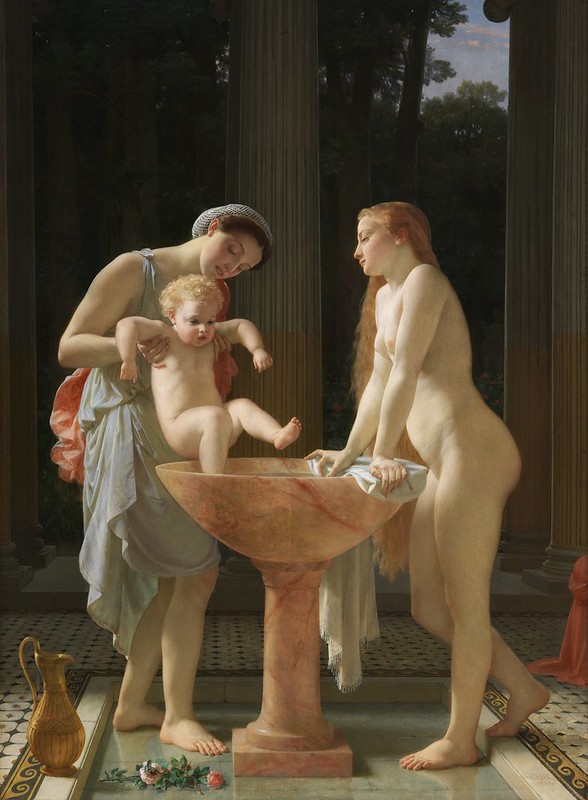
Charles Gleyre - The Bath (1868)
Obra de Charles Gleyre (1806-1874), pintor suís (1)


- Recordatori de Sophia Giustina Corri -
En el dia de la celebració del seu 241è aniversari de naixement


Parlem de Pintura...

Charles Gleyre (Chevilly, 2 de maig de 1806 - Paris, 5 de maig de 1874) va ser un pintor suís, i un dels més importants a París de la dècada del 1850. Tot i néixer a Suïssa ben aviat es va traslladar a França on es va formar inicialment a Lió abans de traslladar-se a París el 1825. Allà va estudiar amb Louis Hersent a l'Escola de Belles Arts i a l'Académie Suisse. El 1829 va viatjar a Roma, on va viure-hi cinc anys, per treballar amb Leópold Robert l'estil de qui va influenciar decisivament l'obra de Gleyre. Des d'allà va viatjar, finançat per un mecenes americà, per Grècia, Egipte i el Pròxim Orient. De tornada a París, va obrir una escola de pintura on, entre molts altres, s'hi van formar artistes posteriorment molt destacats com Whistler, Monet, Renoir, Bazille i Sisley. No obstant, problemes de salut el van obligar a tancar l'escola traslladant-se, en companyia de Sisley, Bazille i Renoir, a Fontainebleau. Com a pintor, tot i explorar la pintura a l'aire lliure i noves tècniques, es va fer molt conegut per les seves obres neoclàssiques si bé amb certs tocs romàntics. Charles Gleyre va morir a París el maig de 1874.

Font: En català: No disponible En castellano: Charles Gleyre (1806-1874) In english: Charles Gleyre (1806-1874) - Altres: Charles Gleyre (1806-1874)


Parlem de Música...

Sophia Giustina Corri [Dussek] (Edinburgh, 1 de maig de 1775 - London, 1847) va ser una cantant i compositora anglesa. Es va formar inicialment amb el seu pare, el compositor, editor i professor Domenico Corri. Amb ell va fer els primers recitals abans d'abandonar la seva ciutat rumb a Londres, on va rebre formació de cant amb Luigi Marchesi, Giuseppe Viganoni i Giambattista Cimador. Va tenir un excel·lent debut com a cantant dels concerts Salomon del 1791, sota la direcció de Joseph Haydn al clavicèmbal. Posteriorment, va seguir col·laborant amb Haydn en altres obres, com The Storm (24 de febrer de 1792). Corri, per la seva banda, va ser una important divulgadora de l'obra de Mozart a Anglaterra sent cantant solista en la primera interpretació del Rèquiem de Mozart a Londres, el 20 de febrer de 1801. Anys abans, el 1792, es va casar amb Jan Ladislav Dussek, amb qui va participar en nombrosos recitals de cant, piano i arpa. Després de la mort de Dussek el 1812, Corri es va casar amb l'intèrpret de viola John Alvis Moralt. Amb ell es va traslladar a Paddington, on van fundar una escola de música. La seva filla, Olivia Dussek, va ser organista i compositora i la seva besnéta, Ghita Auber Corri (c.1870-1937), va ser compositora i cantant. Sophia Giustina Corri va morir a Londres el 1847.

OBRA:

(selective list)

Instrumental:

Kbd:
Sonata, pf/hpd, vn/Ger. fl acc., op.1 (London, c1793);
3 Sonates, hpd/pf, vn acc., op.1 (Paris, n.d.);
Sonata, pf (London, c1805)

Hp:
3 Sonatas, E , F, C (London and Edinburgh, c1795);
3 Sonatas, B , G, c, op.2 (Paris, 1797; London and Edinburgh, ?1798);
6 Sonatinas, C, F, G, B , F, E  (London, 1799), formerly attrib. (2) J.L. Dussek, ed. in MAB, xxii (1956);
Introduction and March (London, 1822);
Variations on God Save the King (London, 1822);
6 bks of Favorite Airs (London);
arrs., some with variations, of more than 30 airs, waltzes, rondos, ovs. and concs., some with fl/vn ad lib

Hp, pf:
A Duett (London, ?1812);
Introduction and Waltz (London, 1822);
Duett … in which is Introduced a Favorite Air [Ah vous dirai-je], with variations and an introduction (London, 1823);
other arrs.

Font: En català: Sophia Giustina Corri (1775-1847) En castellano: Sophia Giustina Corri (1775-1847) In english: Sophia Giustina Corri (1775-1847) - Altres: Sophia Giustina Corri (1775-1847)


Parlem en veu pròpia o en veu d'altri...

According to Sophia’s biography, dated 1823, she was “the only female composer of music of high reputation in the country”. In the golden years of the harp (1750-1850), she was in fact the only important woman composer. (The history of the harp, generally considered a “feminine” instrument, actually features only male names.) Sophia left a body of about 70 compositions, including original pieces, variations (principally of Scottish airs) and arrangements for harp, fortepiano, harp and fortepiano duo, and some rare arrangements for voice and harp or voice and guitar. It is reasonable to assume that Sophia began composing as a child, encouraged by her father. The sonata for fortepiano was presumably composed when she was 15, and the six sonatas for harp op. 2 (books 1 and 2) when she was between 16 and 19. Both volumes are dedicated to a Miss Hadsley, and on the frontispiece rose branches decorate the words “with Scots Airs and Reels, for the Adagios & Rondos”. It should be pointed out, however, that only the second volume includes movements with indications that confirm this rubric. The first volume of sonatas is the only one still in print and performed today, although it was for many years erroneously attributed to Jan Ladslav. The frontispiece of the first edition of 1794 by Corri & Co. claims the works are “by Madame Dussek”, but the Parisian edition by Pleyer of 1797, which simply stated “Dussek”, was more popular, was reprinted by Schott in the 20th century and was made famous by Nicanor Zabaleta. 

The beauty of the music itself led to the attribution to Jan Ladislav rather than to Sophia, who was undoubtedly the author. Already in these first sonatas one can find the typical characteristics of her music: the brilliance and freshness of her writing, the originality of many passages, and a great sense of proportion which insures that no theme—even the least original—wearies the listener. There is no evidence of presumption, vanity or desire for grandeur on the part of Sophia; there instead emerges a desire to sing and make music simply and sincerely, and this humility deserves our admiration. After the early pieces of her youth, there is no trace of other works by Sophia for almost 10 years. Busy as she was at supporting herself, she perhaps had little time for composing, but she took up this activity with renewed energy in 1810. Her second marriage and her teaching gave her greater serenity, assisted her in the search for new publishers, and allowed her to produce around 60 works between 1810 and 1828. These pieces no longer have the rigorous form of the first sonatas and are more experimental, a fact which is comprehensible considering the rapid change in tastes and the evolution of the harp at that time. “A Favourite French Air With Variations” (1818), dedicated to the celebrated harpist Nicolas C. Bochsa who had arrived that same year in London, experiments with harmonics and damping techniques, and ends with an unpublished finale. “Introduction & Waltz” (from 1821) combines the infectious charm of a reel (although it is not a traditional theme) with brilliant glissati. “La Chasse”, dated 1824, explores the enharmonic possibilities of the harp. “C’est l’amour” (1825) winds irresistible variations around a theme of an operatic character.

Booklet notes

Gaudiu i compartiu! 


Informació addicional... 

INTERPRETS: Floraleda Sacchi (harp)
NAXOS: CORRI, S. - Harp Music
CPDL: No disponible
SPOTIFY: CORRI, S. - Harp Music


Tant si us ha agradat, com si no, opineu, és lliure i fàcil!