Es mostren els missatges amb l'etiqueta de comentaris Kuhlau F.. Mostrar tots els missatges

divendres, 11 de setembre del 2026

KUHLAU, Friedrich (1786-1832) - Ouverture a grand orchestre

Peter Copmann (1794-1850) - Portrait of the composer Friedrich Kuhlau (1832)


Friedrich Kuhlau (1786-1832) - Ouverture del’Opera William Schakespeare[!] a grand orchestre
Performers: The Royal Danish Orchestra; Johan Hye-Knudsen (1896-1975, conductor)
Further info: Danish Theatre Music

---


Danish composer of German birth. He was the son of a poor military bandsman and moved with his family to Lüneburg about 1793. In 1796 he lost an eye in a childhood accident, and studied piano during his recovery. Later studied theory and composition with Christian Friedrich Gottlieb Schwencke, Kantor of Hamburg's Catherinenkirche. He gave several piano recitals from 1804 and the same year his earliest known compositions were published. When Hamburg was invaded by Napoleon's troops in 1810 he went to Copenhagen to avoid conscription into Napoleon's army. There he began to earn his living as a piano teacher and composer, and in 1813 was appointed court chamber musician. That year he eventually became a Danish citizen. Following the success of his singspiel, 'The Robber's Castle', he gained a high-paying position as a singing teacher at the Royal Theater in 1816. Kuhlau's works between 1817 and 1820 failed to gain much prominence. His opera, 'The Magic Harp', was said to have failed due to a controversial libretto. In 1821 and 1825, he travelled to Vienna where he befriended Ludwig van Beethoven. Beethoven's influence is evidential in Kuhlau's later works such as his singspiel, 'Elverhøj or Elves' Hill', a work widely regarded as a tribute to the Danish Monarchy and an inspiring piece from the Danish Golden Age. In 1828, he was awarded an honorary professorship. As a result of a fire that swept his house in 1831 he suffered a chest ailment from which he never recovered, and died the following year. Together with Christoph Ernst Friedrich Weyse he was the foremost representative of the late Classical and early Romantic periods in Denmark.

dilluns, 11 de setembre del 2023

KUHLAU, Friedrich (1786-1832) - Incidental Music from 'Elverhøj' (1828)

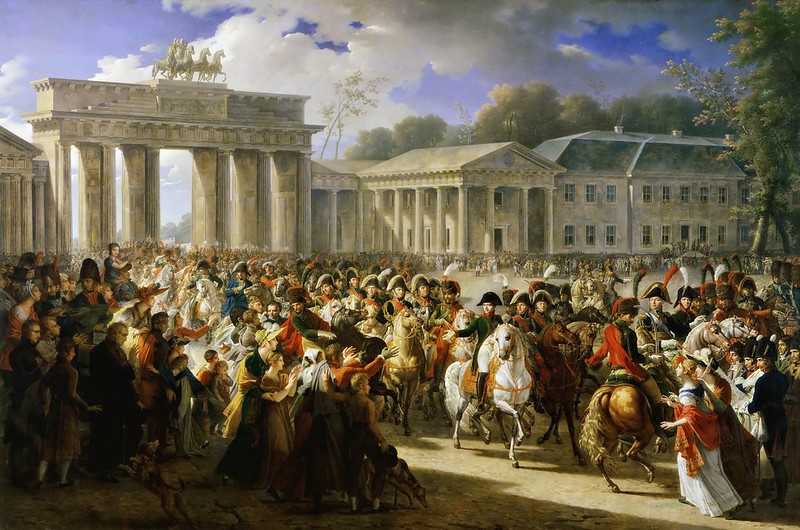
Charles Meynier (1768-1832) - Entrée de Napoléon à Berlin. 27 octobre 1806


Friedrich Kuhlau (1786-1832) - Incidental Music from 'Elverhøj' (1828)
Performers: Royal Danish Orchestra; Johan Hye-Knudsen (1896-1975, conductor)

---


Danish composer of German birth. He was the son of a poor military bandsman and moved with his family to Lüneburg about 1793. In 1796 he lost an eye in a childhood accident, and studied piano during his recovery. Later studied theory and composition with Christian Friedrich Gottlieb Schwencke, Kantor of Hamburg's Catherinenkirche. He gave several piano recitals from 1804 and the same year his earliest known compositions were published. When Hamburg was invaded by Napoleon's troops in 1810 he went to Copenhagen to avoid conscription into Napoleon's army. There he began to earn his living as a piano teacher and composer, and in 1813 was appointed court chamber musician. That year he eventually became a Danish citizen. Following the success of his singspiel, The Robber's Castle, he gained a high-paying position as a singing teacher at the Royal Theater in 1816. Kuhlau's works between 1817 and 1820 failed to gain much prominence. His opera, The Magic Harp, was said to have failed due to a controversial libretto. In 1821 and 1825, he travelled to Vienna where he befriended Ludwig van Beethoven. Beethoven's influence is evidential in Kuhlau's later works such as his singspiel, Elverhøj or Elves' Hill, a work widely regarded as a tribute to the Danish Monarchy and an inspiring piece from the Danish Golden Age. In 1828, he was awarded an honorary professorship. As a result of a fire that swept his house in 1831 he suffered a chest ailment from which he never recovered, and died the following year. Together with Christoph Ernst Friedrich Weyse he was the foremost representative of the late Classical and early Romantic periods in Denmark.

divendres, 7 de juny del 2019

KUHLAU, Friedrich (1786-1832) - Elverhøj (1828)

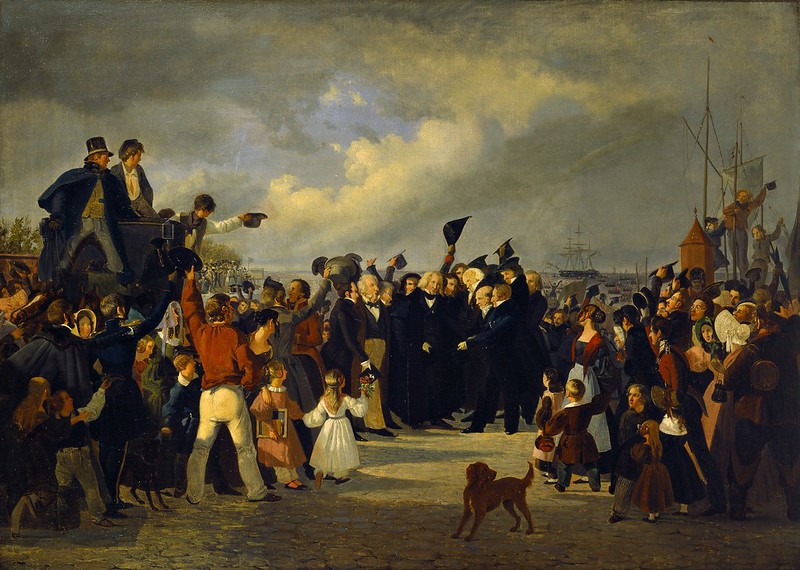
Friedrich Bernhard Westphal (1803-1844) - The Reception of Thorvaldsen on Toldboden in Copenhagen the 17th of September 1838, (c.1840)
Obra de Friedrich Bernhard Westphal (1803-1844), pintor alemany (1)


Parlem de Pintura...

Friedrich Bernhard Westphal (Schleswig, 5 d'octubre de 1803 - København, 24 de desembre de 1844) va ser un pintor alemany. En una data desconeguda es va traslladar a Dinamarca on entre els anys 1821 i 1826 va rebre formació de Carl Andreas August Goos, Hermann Wilhelm Bissen, Harro Harring i Thomas Fearnley a l'Acadèmia Reial de Belles Arts de Copenhagen. El 1828 es va traslladar a Munich, ciutat on va continuar la seva formació abans de viatjar el 1829 a Dresden. Allà va conèixer i col·laborar estretament amb el pintor Joseph Petzl. Precisament amb ell, i després de la invasió francesa de Saxònia el 1830, va tornar a Schleswig. Des d'allà, i entre els anys 1832 i 1837, va viatjar per Noruega realitzant nombrosos paisatges i il·lustracions moltes de les quals per a llibres d'autors com Christian Winther, Heinrich Hertz i Carsten Hauch. Al seu retorn a Dinamarca va procurar, sense èxit, aconseguir una beca per viatjar a Itàlia. Els darrers anys va treballar al servei del Teatre Reial de Copenhagen, ciutat on va morir el desembre de 1844.


Parlem de Música...

Friedrich Kuhlau (Uelzen, 11 de setembre de 1786 - København, 12 de març de 1832) va ser un compositor danès d'ascendència alemanya. A l'entorn del 1793 es va traslladar amb la seva família a Lüneburg, ciutat on el 1796 va perdre l'ull dret en un accident. El 1802, i després d'uns anys de nomadisme familiar, es va instal·lar a Hamburg. Allà va rebre la primera instrucció musical de C.F.G. Schwencke, el Stadtkantor i Musikdirektor d'Hamburg. A partir del 1804 va començar a participar en diversos recitals com a pianista en un any en què també va començar a publicar les seves primeres obres, principalment cançons i peces per a flauta i piano. El 1810, i després de la invasió francesa d'Hamburg, es va traslladar a Copenhagen on ràpidament va entrar a formar part de la vida musical de la ciutat. Allà va treballar com a professor de piano i compositor abans de ser nomenat músic de cambra de la cort. El seu èxit va arribar aviat amb la representació del singspiel Røverborgen el 1814. A partir del 1816 va treballar com a mestre del cor del Det Kongelige Teater, on també va estrenar la seva òpera Trylleharpen el 1817. A partir de la dècada del 1820 la seva popularitat va assolir el seu clímax amb la representació el 1824 de la seva òpera Lulu però especialment amb la seva obra Elverhøj (1828). Els anys següents es va dedicar a viatjar per Europa i Escandinàvia retornant a Copenhagen cap al final de la seva vida on, arruïnat i malalt, va morir el març de 1832.

Friedrich Kuhlau (1786-1832)
Fr. Kuhlau - Em. Baerentzen ft Baerentzen, Emilius Ditlev (1799-1868) (2)

OBRA:

Vocal secular:

Stage:
first performed in Copenhagen, Kongelige Teater, unless otherwise stated
MSS of full scores in DK-Kk unless otherwise stated
Amors Triumph, 1803–4, ov., Hamburg, 3 March 1804, lost
Røverborgen [The Robbers' Castle] (Spl, 3, A. Oehlenschläger, after C.L. Heyne), 26 May 1814, vs (Copenhagen, 1815), ov., S, 3rd ser., ci
Eurydice in Tartarus (lyric-dramatic scene, J. Baggesen), op.47, 17 June 1816 [partly re-used in Lulu], ov., arr. pf duet, S, 1st ser., x
Trylleharpen [The Magic Harp] (Spl, 2, Baggesen), op.27, 30 Jan 1817, autograph; ov. (1820)
Alfred (Spl, 3, A. von Kotzebue, trans. L.C. Sander), 1817, unperf., inc., lost
Aandsprøven, eller Krigseventyret [The Mental Trial, or The War Adventure] (Spl, 2, L. Kruse), 1819, unperf., inc., lost
Elisa, eller Venskab og Kjaerlighed [Elisa, or Friendship and Love] (lyrisk drama, 3, C.J. Boye), op.29, 17 April 1820, vs (Copenhagen, 1820–21)
Lulu (romantische Oper, 3, C.C.F. Güntelberg, after A.J. Liebeskind: Lulu, oder Die Zauberflöte), op.65, 29 Oct 1824, vs (Hamburg, 1825; Copenhagen, 1825)
William Shakespeare (incid music, 4, Boye), op.74, 28 March 1826, vs, S, 1st ser., iii, ov., S, 3rd ser., lvii
Hugo og Adelheid (Spl, 3, Boye), op.107, 29 Oct 1827, vs (Copenhagen, 1838)
Elverhøj [The Elf Hill] (incid music, 5, J.L. Heiberg), op.100, 6 Nov 1828, vs (Copenhagen, 1829), ov., S, 3rd ser., xi, Acts 4–5, S, 3rd ser., ccxli, clxiii
Trillingbrødrene fra Damask [The Triplet Brothers from Damascus] (incid music, 5, Oehlenschläger), op.115, 1 Sept 1830, autograph, vs (Copenhagen, 1831), ov., arr. pf duet, S, 1st ser., xviii

Choral:
An die Freude (F. von Schiller), solo vv, chorus, orch, 1813, frag.;
Kantatino, 2 S, chorus, fl, str, 1814;
12 Comic Canons, 3, male vv (?1821–2);
Die Feier des Wohlwollens (cant., Sander), 2 T, B, pf, op.36, 1814, vs (Hamburg, 1822);
6 Songs, 2 T, 2 B, op.67 (Copenhagen, 1825);
Formaelingskantate [Wedding-Cantata], S, A, T, B, chorus, pf, 1828;
9 Songs, 2 T, 2 B, op.82 (Bonn, 1828);
8 Songs, 2 T, 2 B, op.89 (Bonn, 1828)

1v, pf:
[6] Leichte Stücke (Hamburg, 1806);
Die Blumen, 6 songs (Altona, 1806);
3 Gesänge, op.5b (Altona, 1806);
6 Canzoni, op.9 (1814);
10 Deutsche Lieder, op.11 (1814);
3 Canzonetti, 1813 (1819);
[10] Deutsche Gesänge, op.19 (Hamburg, 1819);
3 Gedichte (L. Gerstenberg), op.21 (1820);
12 Deutsche Lieder, op.23 (Hamburg, 1820);
3 Gesänge, op.72b (Hamburg, 1823);
[2] Gedichte (I. Castelli), op.78 (Hamburg, 1826);
[6] Romanzen und Lieder (F. de la Motte Fouqué), op.106, 1826 (1830);
c30 other songs, pubd individually without op. nos.

Instrumental:

Orch.:
Piano Concerto, C, op.7 (1812), S, 3rd ser., cxxix, cxxxvi
Concertino, F, 2 hn, orch, op.45, 1821–2 (1830)

---

Chbr.:
Piano Quartet no.1, c, op.32 (1821)
Sonata, f, vn, pf, op.33 (Bonn, 1822)
Piano Quartet no.2, A, op.50 (Bonn, 1823)
3 Sonatas, F, a, C, vn, pf, op.79 (Copenhagen, 1826)
Piano Quartet no.3, g, op.108 (1832)
String Quartet, a, op.122 (1841), S, 3rd ser., ccvi

Flute:
Fl, str:
3 Quintets, D, e, A, fl, vn, 2 va, vc, op.51 (Bonn, 1823), no.1, S, 3rd ser., cxliii
Fl, pf:
Variations, on ‘Unter blüheaden Mandelbäumln’ from Weber’s Euryanthe, G, op.63 (1825);
Sonata, E , op.64 (Hamburg, 1825);
Sonata, G, op.69 (Hamburg, 1825);
Sonata, e, op.71 (Bonn, 1826);
3 Sonatas, G, C, g, op.83 (Bonn, 1827);
Sonata, a, op.85 (Mainz, 1827);
Variations, on ‘Pour des filles’ from Onslow's Le colporteur, B , op.94 (1829);
Rondo, on ‘Ah! quand il gèle’ from Le colporteur, e, op.98 (1830);
Variations, on ‘Toujours de mon jeune âge’ from Le colporteur, a, op.99 (1830);
Variations, on ‘Schönes Mädchen’ from Spohr's Jessonda, G, op.101 (Copenhagen, 1830);
Variations, on a Scottish folksong, F, op.104 (1830);
Variations, on an Irish folksong, G, op.105 (1830);
3 Duos, B , e, D, op.110 (Copenhagen, 1830);
Trio, G, 2 fl, pf, op.119 (Bonn, Paris and London, 1832)
Unacc. fl(s) (for solo fl unless otherwise stated): 
[12] Variations and Solos, op.10b (Hamburg, 1807);
3 Duos e, D, G, 2 fl, op.10a (1814);
3 Trios, D, g, F, 3 fl, op.13 (1815);
3 Fantaisies, D, G, C, op.38 (1822);
3 Duos, e, B , D, 2 fl, op.39 (1822);
3 Solos, F, a, G, fl, pf ad lib, op.57 (1824);
6 Divertissements, G, D, B, E , G, c , fl, pf ad lib, op.68 (Copenhagen, 1825);
3 Duos, G, C, e, 2 fl, op.80 (Bonn, 1827);
3 Duos, D, F, g, 2 fl, op.81 (Bonn, 1827);
3 Trios, e, D, E , 3 fl, op.86 (Hamburg, 1827);
3 Duos, A, g, D, 2 fl, op.87 (Mainz, 1827);
Trio, b, 3 fl, op.90 (Mainz, 1828);
3 Fantaisies, g, e, D, fl, pf ad lib, op.95 (Copenhagen, 1829);
3 Duos, D, e, A, 2 fl, op.102 (Copenhagen, 1830);
Quartet, e, 4 fl, op.103 (1830)

Piano four hands:
Sonata, F, op.8b (Hamburg, 1810);
Sonatina, F, op.17 (Copenhagen, 1818);
8 Waltzes, op.24 (1821);
6 Waltzes, op.28 (Hamburg, 1821);
3 Sonatinas, G, C, F, op.44 (Copenhagen, 1823);
Variations, on ‘Deh calma o ciel’ from Rossini's Otello, A , op.58 (1824);
3 sonates, F, C, G, op.66 (Hamburg, 1825);
3 Rondos, F, C, D, op.70 (Hamburg, 1826);
Variations, on Beethoven’s ‘Herz, mein Herz’, C, op.72a (Bonn, 1826);
Variations, on Beethoven's ‘Der Wachtelschlag’, F, op.75 (Hamburg, 1826);
Variations, on Beethoven's ‘Lebensglück’, A, op.76 (Hamburg, 1826);
Variations, on Beethoven's ‘Sehnsucht’, B , op.77 (Hamburg, 1826);
3 Rondos, C, D, D, op.111 (1831);
Variations on 3 themes, G, C, F, op.114 (1832);
Allegro pathétique, c, op.123 (Copenhagen, 1832);
Adagio and Rondo, A , c, op.124 (Copenhagen, 1832)

Piano two hands:
Sonatas:
E , op.4 (1810);
d, op.5a (1812);
a, D, F, op.6a (Hamburg, 1812);
D, pf, vn ad lib, op.6b (1812);
a, op.8a (1814);
G, C, E , op.26 (Bonn, 1821);
B , op.30 (1821);
G, op.34 (1822);
G, d, C, op.46 (Hamburg, 1823);
F, B , A, op.52 (1823);
3, A, F, C, op.59 (Hamburg, 1824);
3 with variations on themes by Rossini, F, A, C, op.60 (Hamburg, 1824);
E , op.127, 1815 (Copenhagen, 1833)

Sonatinas:
C, G, F, op.20 (1820);
C, G, C, F, D, C, op.55 (1823);
C, G, a, F, op.88 (Copenhagen, 1827)

Variations:
on ‘Guide mes pas’ from Cherubini's Les deux journées, E , op.12 (1815);
on the Danish air ‘Manden med Glas I Haand’, C, op.14 (Copenhagen, 1813);
on the Norwegian folksong ‘God dag, Rasmus Jansen’, a, op.15 (1816);
on the Danish folksong ‘Kong Christian stod ved højen mast’, D, op.16 (Copenhagen, 1818);
on ‘Willkommen, Purpurschale’ from Røverborgen, a, op.18 (Hamburg, 1819);
on a Danish song, f, op.22 (1820);
Fantaisie and Variations, on Swedish airs and dances, f, op.25 (Bonn, 1821);
on a Danish song, F, op.35 (Copenhagen, 1821);
on 6 Austrian folksongs, op.42 (1822);
on ‘Wir winden dir’ from Weber's Der Freischütz, C, op.48 (Copenhagen, 1822);
on 6 themes, from Der Freischütz, E , F, D, G, A, B, op.49 (Copenhagen, 1822);
on 3 themes from Weber's Preciosa, G, D, F, op.53 (Christiania, 1823);
on Bianchi's canzonetta ‘Silenzio che sento’, G, op.54 (1823);
on 3 themes from Euryanthe, A, C, A, op.62 (Copenhagen, 1824);
on the Swedish folksong ‘Och liten Karin tjente’, e, op.91 (1828);
3 Airs variés, on themes by Bellini and Hummel and an Austrian air, C, G, F, op.112 (1831);
on 2 themes from Rossini's Guillaume Tell, C, G, op.116 (Brunswick, 1831)

Rondos:
C, a, F, opp.1–3 (1810);
on a theme by Rode, a (Copenhagen, 1813);
on themes from Don Giovanni, Le nozze di Figaro and Boieldieu’s Le petit chaperon rouge, C, G, C, op.31 (Copenhagen, 1820);
op.40 [nos.1–6] (1822);
op. 41 [nos.1–8] (1822);
on themes from Le nozze di Figaro, C, G, F, op.56 (Copenhagen, 1823);
on themes from Auber's La neige and Rossini's Il barbiere di Siviglia, F, G, D, op.73 (Copenhagen, 1826);
on themes from Boieldieu's La dame blanche and Auber's Le maçon, C, F, A, op.84 (Copenhagen, 1827);
Les charmes de Copenhagen, on Danish airs, D, op.92 (Copenhagen, 1828);
on themes from Onslow's Le colporteur, B , op.96 (Copenhagen, 1828);
on themes from Hérold's Marie, C, A, op.97 (Copenhagen, 1829);
on themes from Rossini's Semiramide and French and German airs, G, C, F, op.109 (Copenhagen, 1830);
on Beethoven songs, G, B , C, op.117 (Brunswick, 1831);
on themes from Auber's Fra Diavolo, G, A, G, op.118 (Copenhagen, 1831);
on themes from Rossini's Ricciardo e Zoraide and Tancredi and Isouard's Joconde, C, D, A, op.113 (1832);
La légèreté, on a theme by Paganini, F, op.120 (Copenhagen, 1832);
La clochette, on a theme by Paganini, a, op.121 (Copenhagen, 1832);
C, op.125 (Copenhagen, 1833)

Other works:
Kaleidakustikon (waltzes to be composed by game of dice) (Copenhagen, 1820);
Divertissement, E , op.37 (1822);
6 Divertissements en forme de valses, op.61 (Hamburg, 1824);
Fantaisie sur des airs suédois, G, op.93 (Copenhagen, 1829);
Divertissement sur des thêmes de Mozart, B, op.126 (Copenhagen, 1833);
31 waltzes;
9 écossaises;
5 marches


Informació addicional... 

INTERPRETS: Bodil Gobel (soprano); Gurli Plesner (mezzo-soprano); Mogens Schmidt Johansen (bariton); Danish National Radio Symphony OrchestraJohn Frandsen (conductor)
RECICLASSICAT: KUHLAU, Friedrich (1786-1832)
AMAZON: KUHLAU, F. - Elverhoj
SPOTIFY: KUHLAU, F. - Elverhoj


Tant si us ha agradat, com si no, opineu, és lliure i fàcil!

dilluns, 11 de setembre del 2017

KUHLAU, Friedrich (1786-1832) - Flute Sonata Op.83 (1827)

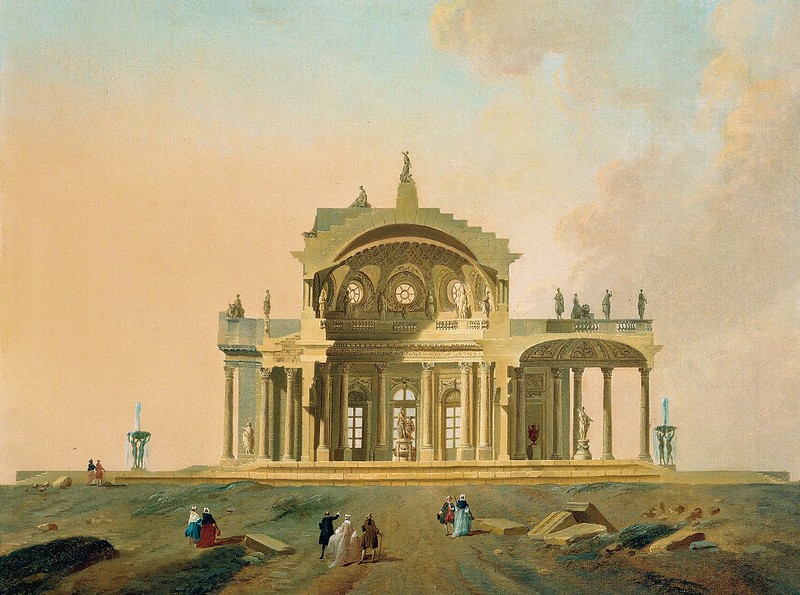
Pierre-Antoine Demachy (1723-1807) - Fantastical architectural studies with figures
Obra de Pierre-Antoine Demachy (1723-1807), pintor francès (1)


- Recordatori de Friedrich Kuhlau -
En el dia de la celebració del seu 231è aniversari de naixement


Parlem de Pintura...

Pierre-Antoine Demachy (Paris, 17 de setembre de 1723 - Paris, 10 de setembre de 1807) va ser un pintor francès. Actiu durant la segona meitat del segle XVIII, Demachy es va especialitzar en pintures de ruïnes, decoracions arquitectòniques i vistes de París. Fill d'un mestre fuster, va ser alumne de Servandoni, l'escenògraf més gran de l'època a França, d'origen italià. Més tard va rebre el reconeixement de 'pintor d'arquitectura' de la Reial Acadèmia de Pintura i Escultura de París. A partir del 1757, i fins el 1802, va exhibir les seves obres al Saló de París. Després de la mort del pintor Jacques-François Amand, es va instal·lar al Palau del Louvre on el seu taller de pintura es va fer molt popular i concorregut. Especialista reconegut en el seu gènere, Demachy va ser nomenat més tard professor de perspectiva de la Reial Acadèmia de Pintura i Escultura de París. Va morir en aquesta ciutat el setembre de 1807.


Parlem de Música...

Friedrich Kuhlau (Uelzen, 11 de setembre de 1786 - København, 12 de març de 1832) va ser un compositor danès d'ascendència alemanya. De família humil, es va traslladar a Lüneburg a l'entorn del 1793, ciutat on el 1796 va perdre l'ull dret en un accident. El 1802, i després d'uns anys de nomadisme familiar, es va instal·lar a Hamburg. Allà va rebre la primera instrucció musical de C.F.G. Schwencke, Stadtkantor i Musikdirektor d'Hamburg. A partir del 1804 va començar a participar en diversos recitals com a pianista en un any en què també va començar a publicar les seves primeres obres, principalment cançons i peces per a flauta i piano. El 1810 i després de la invasió francesa d'Hamburg, es va traslladar a Copenhagen on ràpidament va entrar a formar part de la vida musical de la ciutat. Allà va treballar com a professor de piano i compositor abans de ser nomenat músic de cambra de la cort. El seu èxit va arribar aviat amb la representació del singspiel Røverborgen el 1814. A partir del 1816 va treballar com a mestre del cor del Det Kongelige Teater, on també va estrenar la seva òpera Trylleharpen el 1817. A partir de la dècada del 1820 la seva popularitat va assolir el seu màxim amb la representació el 1824 de la seva òpera Lulu però especialment amb la seva obra Elverhøj (1828). Els anys següents es va dedicar a viatjar per Europa i Escandinàvia retornant a Copenhagen cap al final de la seva vida on, arruïnat i malalt, va morir el març de 1832.

OBRA:

Vocal secular:

Stage:
first performed in Copenhagen, Kongelige Teater, unless otherwise stated
MSS of full scores in DK-Kk unless otherwise stated
Amors Triumph, 1803–4, ov., Hamburg, 3 March 1804, lost
Røverborgen [The Robbers' Castle] (Spl, 3, A. Oehlenschläger, after C.L. Heyne), 26 May 1814, vs (Copenhagen, 1815), ov., S, 3rd ser., ci
Eurydice in Tartarus (lyric-dramatic scene, J. Baggesen), op.47, 17 June 1816 [partly re-used in Lulu], ov., arr. pf duet, S, 1st ser., x
Trylleharpen [The Magic Harp] (Spl, 2, Baggesen), op.27, 30 Jan 1817, autograph; ov. (1820)
Alfred (Spl, 3, A. von Kotzebue, trans. L.C. Sander), 1817, unperf., inc., lost
Aandsprøven, eller Krigseventyret [The Mental Trial, or The War Adventure] (Spl, 2, L. Kruse), 1819, unperf., inc., lost
Elisa, eller Venskab og Kjaerlighed [Elisa, or Friendship and Love] (lyrisk drama, 3, C.J. Boye), op.29, 17 April 1820, vs (Copenhagen, 1820–21)
Lulu (romantische Oper, 3, C.C.F. Güntelberg, after A.J. Liebeskind: Lulu, oder Die Zauberflöte), op.65, 29 Oct 1824, vs (Hamburg, 1825; Copenhagen, 1825)
William Shakespeare (incid music, 4, Boye), op.74, 28 March 1826, vs, S, 1st ser., iii, ov., S, 3rd ser., lvii
Hugo og Adelheid (Spl, 3, Boye), op.107, 29 Oct 1827, vs (Copenhagen, 1838)
Elverhøj [The Elf Hill] (incid music, 5, J.L. Heiberg), op.100, 6 Nov 1828, vs (Copenhagen, 1829), ov., S, 3rd ser., xi, Acts 4–5, S, 3rd ser., ccxli, clxiii
Trillingbrødrene fra Damask [The Triplet Brothers from Damascus] (incid music, 5, Oehlenschläger), op.115, 1 Sept 1830, autograph, vs (Copenhagen, 1831), ov., arr. pf duet, S, 1st ser., xviii

Choral:
An die Freude (F. von Schiller), solo vv, chorus, orch, 1813, frag.;
Kantatino, 2 S, chorus, fl, str, 1814;
12 Comic Canons, 3, male vv (?1821–2);
Die Feier des Wohlwollens (cant., Sander), 2 T, B, pf, op.36, 1814, vs (Hamburg, 1822);
6 Songs, 2 T, 2 B, op.67 (Copenhagen, 1825);
Formaelingskantate [Wedding-Cantata], S, A, T, B, chorus, pf, 1828;
9 Songs, 2 T, 2 B, op.82 (Bonn, 1828);
8 Songs, 2 T, 2 B, op.89 (Bonn, 1828)

1v, pf:
[6] Leichte Stücke (Hamburg, 1806);
Die Blumen, 6 songs (Altona, 1806);
3 Gesänge, op.5b (Altona, 1806);
6 Canzoni, op.9 (1814);
10 Deutsche Lieder, op.11 (1814);
3 Canzonetti, 1813 (1819);
[10] Deutsche Gesänge, op.19 (Hamburg, 1819);
3 Gedichte (L. Gerstenberg), op.21 (1820);
12 Deutsche Lieder, op.23 (Hamburg, 1820);
3 Gesänge, op.72b (Hamburg, 1823);
[2] Gedichte (I. Castelli), op.78 (Hamburg, 1826);
[6] Romanzen und Lieder (F. de la Motte Fouqué), op.106, 1826 (1830);
c30 other songs, pubd individually without op. nos.

Instrumental:

Orch.:
Piano Concerto, C, op.7 (1812), S, 3rd ser., cxxix, cxxxvi
Concertino, F, 2 hn, orch, op.45, 1821–2 (1830)

---

Chbr.:
Piano Quartet no.1, c, op.32 (1821)
Sonata, f, vn, pf, op.33 (Bonn, 1822)
Piano Quartet no.2, A, op.50 (Bonn, 1823)
3 Sonatas, F, a, C, vn, pf, op.79 (Copenhagen, 1826)
Piano Quartet no.3, g, op.108 (1832)
String Quartet, a, op.122 (1841), S, 3rd ser., ccvi

Flute:
Fl, str:
3 Quintets, D, e, A, fl, vn, 2 va, vc, op.51 (Bonn, 1823), no.1, S, 3rd ser., cxliii
Fl, pf:
Variations, on ‘Unter blüheaden Mandelbäumln’ from Weber’s Euryanthe, G, op.63 (1825);
Sonata, E , op.64 (Hamburg, 1825);
Sonata, G, op.69 (Hamburg, 1825);
Sonata, e, op.71 (Bonn, 1826);
3 Sonatas, G, C, g, op.83 (Bonn, 1827);
Sonata, a, op.85 (Mainz, 1827);
Variations, on ‘Pour des filles’ from Onslow's Le colporteur, B , op.94 (1829);
Rondo, on ‘Ah! quand il gèle’ from Le colporteur, e, op.98 (1830);
Variations, on ‘Toujours de mon jeune âge’ from Le colporteur, a, op.99 (1830);
Variations, on ‘Schönes Mädchen’ from Spohr's Jessonda, G, op.101 (Copenhagen, 1830);
Variations, on a Scottish folksong, F, op.104 (1830);
Variations, on an Irish folksong, G, op.105 (1830);
3 Duos, B , e, D, op.110 (Copenhagen, 1830);
Trio, G, 2 fl, pf, op.119 (Bonn, Paris and London, 1832)
Unacc. fl(s) (for solo fl unless otherwise stated): 
[12] Variations and Solos, op.10b (Hamburg, 1807);
3 Duos e, D, G, 2 fl, op.10a (1814);
3 Trios, D, g, F, 3 fl, op.13 (1815);
3 Fantaisies, D, G, C, op.38 (1822);
3 Duos, e, B , D, 2 fl, op.39 (1822);
3 Solos, F, a, G, fl, pf ad lib, op.57 (1824);
6 Divertissements, G, D, B, E , G, c , fl, pf ad lib, op.68 (Copenhagen, 1825);
3 Duos, G, C, e, 2 fl, op.80 (Bonn, 1827);
3 Duos, D, F, g, 2 fl, op.81 (Bonn, 1827);
3 Trios, e, D, E , 3 fl, op.86 (Hamburg, 1827);
3 Duos, A, g, D, 2 fl, op.87 (Mainz, 1827);
Trio, b, 3 fl, op.90 (Mainz, 1828);
3 Fantaisies, g, e, D, fl, pf ad lib, op.95 (Copenhagen, 1829);
3 Duos, D, e, A, 2 fl, op.102 (Copenhagen, 1830);
Quartet, e, 4 fl, op.103 (1830)

Piano four hands:
Sonata, F, op.8b (Hamburg, 1810);
Sonatina, F, op.17 (Copenhagen, 1818);
8 Waltzes, op.24 (1821);
6 Waltzes, op.28 (Hamburg, 1821);
3 Sonatinas, G, C, F, op.44 (Copenhagen, 1823);
Variations, on ‘Deh calma o ciel’ from Rossini's Otello, A , op.58 (1824);
3 sonates, F, C, G, op.66 (Hamburg, 1825);
3 Rondos, F, C, D, op.70 (Hamburg, 1826);
Variations, on Beethoven’s ‘Herz, mein Herz’, C, op.72a (Bonn, 1826);
Variations, on Beethoven's ‘Der Wachtelschlag’, F, op.75 (Hamburg, 1826);
Variations, on Beethoven's ‘Lebensglück’, A, op.76 (Hamburg, 1826);
Variations, on Beethoven's ‘Sehnsucht’, B , op.77 (Hamburg, 1826);
3 Rondos, C, D, D, op.111 (1831);
Variations on 3 themes, G, C, F, op.114 (1832);
Allegro pathétique, c, op.123 (Copenhagen, 1832);
Adagio and Rondo, A , c, op.124 (Copenhagen, 1832)

Piano two hands:
Sonatas:
E , op.4 (1810);
d, op.5a (1812);
a, D, F, op.6a (Hamburg, 1812);
D, pf, vn ad lib, op.6b (1812);
a, op.8a (1814);
G, C, E , op.26 (Bonn, 1821);
B , op.30 (1821);
G, op.34 (1822);
G, d, C, op.46 (Hamburg, 1823);
F, B , A, op.52 (1823);
3, A, F, C, op.59 (Hamburg, 1824);
3 with variations on themes by Rossini, F, A, C, op.60 (Hamburg, 1824);
E , op.127, 1815 (Copenhagen, 1833)

Sonatinas:
C, G, F, op.20 (1820);
C, G, C, F, D, C, op.55 (1823);
C, G, a, F, op.88 (Copenhagen, 1827)

Variations:
on ‘Guide mes pas’ from Cherubini's Les deux journées, E , op.12 (1815);
on the Danish air ‘Manden med Glas I Haand’, C, op.14 (Copenhagen, 1813);
on the Norwegian folksong ‘God dag, Rasmus Jansen’, a, op.15 (1816);
on the Danish folksong ‘Kong Christian stod ved højen mast’, D, op.16 (Copenhagen, 1818);
on ‘Willkommen, Purpurschale’ from Røverborgen, a, op.18 (Hamburg, 1819);
on a Danish song, f, op.22 (1820);
Fantaisie and Variations, on Swedish airs and dances, f, op.25 (Bonn, 1821);
on a Danish song, F, op.35 (Copenhagen, 1821);
on 6 Austrian folksongs, op.42 (1822);
on ‘Wir winden dir’ from Weber's Der Freischütz, C, op.48 (Copenhagen, 1822);
on 6 themes, from Der Freischütz, E , F, D, G, A, B, op.49 (Copenhagen, 1822);
on 3 themes from Weber's Preciosa, G, D, F, op.53 (Christiania, 1823);
on Bianchi's canzonetta ‘Silenzio che sento’, G, op.54 (1823);
on 3 themes from Euryanthe, A, C, A, op.62 (Copenhagen, 1824);
on the Swedish folksong ‘Och liten Karin tjente’, e, op.91 (1828);
3 Airs variés, on themes by Bellini and Hummel and an Austrian air, C, G, F, op.112 (1831);
on 2 themes from Rossini's Guillaume Tell, C, G, op.116 (Brunswick, 1831)

Rondos:
C, a, F, opp.1–3 (1810);
on a theme by Rode, a (Copenhagen, 1813);
on themes from Don Giovanni, Le nozze di Figaro and Boieldieu’s Le petit chaperon rouge, C, G, C, op.31 (Copenhagen, 1820);
op.40 [nos.1–6] (1822);
op. 41 [nos.1–8] (1822);
on themes from Le nozze di Figaro, C, G, F, op.56 (Copenhagen, 1823);
on themes from Auber's La neige and Rossini's Il barbiere di Siviglia, F, G, D, op.73 (Copenhagen, 1826);
on themes from Boieldieu's La dame blanche and Auber's Le maçon, C, F, A, op.84 (Copenhagen, 1827);
Les charmes de Copenhagen, on Danish airs, D, op.92 (Copenhagen, 1828);
on themes from Onslow's Le colporteur, B , op.96 (Copenhagen, 1828);
on themes from Hérold's Marie, C, A, op.97 (Copenhagen, 1829);
on themes from Rossini's Semiramide and French and German airs, G, C, F, op.109 (Copenhagen, 1830);
on Beethoven songs, G, B , C, op.117 (Brunswick, 1831);
on themes from Auber's Fra Diavolo, G, A, G, op.118 (Copenhagen, 1831);
on themes from Rossini's Ricciardo e Zoraide and Tancredi and Isouard's Joconde, C, D, A, op.113 (1832);
La légèreté, on a theme by Paganini, F, op.120 (Copenhagen, 1832);
La clochette, on a theme by Paganini, a, op.121 (Copenhagen, 1832);
C, op.125 (Copenhagen, 1833)

Other works:
Kaleidakustikon (waltzes to be composed by game of dice) (Copenhagen, 1820);
Divertissement, E , op.37 (1822);
6 Divertissements en forme de valses, op.61 (Hamburg, 1824);
Fantaisie sur des airs suédois, G, op.93 (Copenhagen, 1829);
Divertissement sur des thêmes de Mozart, B, op.126 (Copenhagen, 1833);
31 waltzes;
9 écossaises;
5 marches


Informació addicional... 

INTERPRETS: Les Fidelles
RECICLASSICAT: KUHLAU, Friedrich (1786-1832)
AMAZON: KUHLAU, F. - Grandes Sonates
SPOTIFY: KUHLAU, F. - Grandes Sonates


Tant si us ha agradat, com si no, opineu, és lliure i fàcil!

dimarts, 12 de març del 2013

KUHLAU, Friedrich (1786-1832) - Piano Quartet No.1, Op.32

Johan Christian Dahl - View from Vaekero near Christiania
Obra de Johan Christian Dahl (1788-1857), pintor noruec.


- En record del 181è aniversari del decés de Friedrich Kuhlau -


Friedrich Kuhlau (1786-1832) compositor i pianista alemany nascut a Uelzen, al Nord d'Alemanya. De tornada al classicisme preromàntic, visitarem Dinamarca de la mà de Kuhlau autor, que tot i veure la primera llum a Alemanya, les constants i successives guerres i la posterior incursió napoleònica al seu país, i per tal d'evitar l'obligada presència a l'exèrcit, el van invitar a emigrar a Dinamarca país aquest on viuria fins a l'últim dels seus dies. Precisament, el seu últim dia, va ser un 12 de març, per tant, és d'aquesta forma que avui, en record i en memòria seva, commemorarem la seva important trajectòria musical. De família humil i de músics amateurs, en prou feines van poder pagar les seves primeres, però determinants, classes de piano. Alhora, la desgracia el va acompanyar des de ben petit ja que en un desafortunat accident va perdre l'ull dret. Tot i l'adversitat real, el cert és que Kuhlau, amb esma i determinació, va seguir un camí ferm i decidit per tal de fer de la música la seva essència vital i professional. Nacionalitzat danès l'any 1813, seria a Copenhaguen on iniciaria la seva particular edat d'or amb la qual ajudaria a aquell desconegut territori a projectar-se musicalment d'una forma més apreciable. Autor de més de 200 obres, malaguanyades moltes d'elles per l'infortuni del foc, el seu gènere fou l'òpera i la instrumentació. Es desconeix l'existència d'obra de caràcter litúrgic. Referent immediat del seu país d'acollida, va ser un geni amb el piano i un magnífic inductor de la música de Beethoven, a qui admirava profundament, a Dinamarca. Ara bé, tot i ser autor d'un esplèndid concert de piano que fàcilment podrem trobar en gran varietat d'edicions, és evident que la seva producció més representativa del seu important repertori són les sonates de piano i la música per a flauta. En aquest sentit, avui m'introduiré en la seva particular cosmovisió de la música, aparentment fidel als postulats del seu contemporani i bon amic Beethoven, amb música de flauta i de piano. Concretament, una de les tantes sonates per aquest instrument amb acompanyament de piano. La Sonata per a flauta i piano en Sol major opus 69, adopta un caràcter preeminentment clàssic tot i que amb un recorregut temàtic profund, sobri i d'exploració de la incipient poesia romàntica en els tres moviments amb què s'estructura el conjunt. Preludi d'una obra major, el Quartet de piano i cordes número 1 en Do menor  opus 32, de 1820, dedicat a un compositor al que admirava profundament, l'alemany Andreas Romberg i publicat l'octubre de 1821 precisament un mes abans de la mort de Romberg. En sí mateix, és una partitura extensa, a cavall del classicisme i el romanticisme, que mira, es reflexa, creix i es desenvolupa a l'entorn de Beethoven i en què el piano bascula en un diàleg intens i emocionant amb unes cordes que ballen i pinten un paisatge verd i exuberant. Amb un final allegro que, per instants, ens recordarà inevitablement al gran mestre de mestres, a BachTot plegat per recordar la figura del danès clàssic més internacional tot i ser d'ascendència germànica. Kuhlau, de qui si volem podem escoltar alguna de les seves òperes a través de Spotify, va ser un mestre que va tenir en Beethoven la seva referència absoluta. Possiblement aquesta circumstància, comprensible tenint en compte la potència del geni de Bonn, va desdibuixar i apaivagar un llegat exquisit, poètic i virtuós. I si bé, i com deia, resulta relativament fàcil trobar esplèndides edicions de les seves obres, el cert és que actualment resulta car d'escoltar en escenaris d'arreu. Tanmateix, i per nosaltres, la sort de poder-ne gaudir no té preu ja que en un dia com avui recordar a Kuhlau no és una possibilitat, ni tant sols una obligació... simplement és un plaer!

A la interpretació del quartet de piano Asger Lund Christiansen (1927-1998) al violoncel, Elisabeth Westenholz al piano, Lars Grunth a la viola i Tutter Giskov al violí.

La sonata de flauta ens la interpreta Keith Pettway a la flauta i Paul Transue al piano.

Gaudiu i compartiu!


Font (on trobareu informació addicional així com dels discs on podeu trobar aquestes obres):


Tant si us ha agradat com si no, opineu, és lliure i fàcil!