Es mostren els missatges amb l'etiqueta de comentaris Monn G.M.. Mostrar tots els missatges

dimecres, 9 d’abril del 2025

MONN, Georg Matthias (1717-1750) - Sinfonia à Quattro

Bernardo Bellotto and Workshop - Nymphenburg Palace, Munich, (c.1761)


Georg Matthias Monn (1717-1750) - Sinfonia (B-Dur) à Quattro
Performers: Camerata Bern

---


Austrian organist and composer. Although born into a musical family, little is known about the details of his early life, save that he was a chorister at Klosterneuburg, where he no doubt learned enough about music to become an organist there around 1731. His other positions were at the monastery in Melk and subsequently around 1736 at the Karlskirche in the Viennese suburb of Wieden. He was also active at the Holy Roman court, where his instrumental music was extremely popular. His life was cut short prematurely by a lung ailment, probably pneumonia, although he suffered from ill health his entire life. His most important student was Johann Georg Albrechtsberger, probably for whom Monn created a treatise titled 'Theorie des Generalbasses in Beispielen ohne Erklärung', which remained unpublished. As a composer, his works include 16 symphonies, eight concertos (six for keyboard, one for violin, one for cello, plus another arrangement of a harpsichord concerto for cello or contrabass), partitas, three fanfares, and three preludes and fugues for organ. His style represents the infusion of the homophonic texture, contrasting themes of the early sonata principle, and fundamental modulatory patterns that reflect the predominant style of the late 18th century. He was also one of the first to create the fourmovement symphony by adding a minuet in one of his works. His brother Johann Christoph Monn (1726-1782) was also a composer and teacher.

divendres, 4 d’octubre del 2024

MONN, Georg Matthias (1717-1750) - Concerto a 5

Gaetano Stegani (1719-1787) - Capricci architettonici e paesaggi di fantasia


Georg Matthias Monn (1717-1750) - Concerto (D-Dur) a 5
Performers: Concіlіum Musicum Wien; Paul Angеrеr (1927-2017, organ & conductor)

---


Austrian organist and composer. Although born into a musical family, little is known about the details of his early life, save that he was a chorister at Klosterneuberg, where he no doubt learned enough about music to become an organist there around 1731. His other positions were at the monastery in Melk and subsequently around 1736 at the Karlskirche in the Viennese suburb of Wieden. He was also active at the Holy Roman court, where his instrumental music was extremely popular. His life was cut short prematurely by a lung ailment, probably pneumonia, although he suffered from ill health his entire life. His most important student was Johann Georg Albrechtsberger, probably for whom Monn created a treatise titled Theorie des Generalbasses in Beispielen ohne Erklärung, which remained unpublished. His works include 16 symphonies, eight concertos (six for keyboard, one for violin, one for cello, plus another arrangement of a harpsichord concerto for cello or contrabass), partitas, three fanfares, and three preludes and fugues for organ. His style represents the infusion of the homophonic texture, contrasting themes of the early sonata principle, and fundamental modulatory patterns that reflect the predominant style of the late 18th century. He was also one of the first to create the fourmovement symphony by adding a minuet in one of his works. His brother Johann Christoph Monn (1726-1782) was also a composer and teacher. 

dilluns, 3 d’octubre del 2022

MONN, Georg Matthias (1717-1750) - Concerto in D â 5

Bernardo Bellotto (1721-1780) - Portico d'Ottavia


Georg Matthias Monn (1717-1750) - Concerto in D â 5
Performers: Janos Sebestyen (1931-2012, cembalo); Hungarian Chamber Orchestra;
Vilmos Tátrai (1912-1999, conductor)

---


Austrian composer. The elder son of a coachman, Jakob Mann, and Catherina Päsching Mann, he was baptized Johann Georg but used the names Matthias Georg instead, possibly to avoid confusion with his younger brother Johann Christoph Monn. His preferred spelling, ‘Monn’, may be understood as a Lower Austrian dialect version of the family name Mann. He apparently sang in the choir at Klosterneuburg monastery in 1731-32 and at an early age (but not before 1738) became organist at the new Karlskirche in Vienna. There is little to support Gerber’s assertion that Monn was ‘Hoforganist’ at Melk Abbey or that he gave J.G. Albrechtsberger his first lessons in thoroughbass there. Albrechtsberger’s alleged reverence for Monn as a teacher (described by Sonnleithner) has not been proved, but a surviving set of thoroughbass exercises by Monn suggests that he devoted part of his career to teaching. As a composer, Monn ranked with Wagenseil as the leading Viennese counterpart to Johann Stamitz in Mannheim. Although he never attained wide European recognition his local reputation was substantial, as shown by performances of his music at the imperial court of Joseph II and in monasteries in Austria and present-day Slovakia. A biographical sketch by Sonnleithner, who claimed Albrechtsberger as his source, described Monn as a temperate and economical person, who apparently never married. Although he produced a remarkable number of well-crafted compositions in a variety of genres and styles, none was published during his short lifetime. His output has often been confused with his brother’s, and any listing or evaluation must therefore be subject to error.

Monn’s keyboard concertos were the first by a Viennese composer to show galant elements in their thematic structure. Several are infused throughout with cheerful galanterie, characterized by treble-dominated textures and major-mode diatonicism. Ritornello form persists, yet binary tonal plans underlie most movements, and some second and third movements have double bars and repeat signs. Others employ fugal, canonic or toccata-like textures in all movements. An extraordinary harmonic restlessness in the interior solo sections of some movements enhances the developmental character of the sometimes difficult, yet idiomatic, solo part (such as the Keyboard Concerto in E , f44, with the modulations e –c –f –b–e ). Tutti interjections and dialogue passages between solo and orchestra enliven the solo sections, creating textures normally associated with chamber music. Monn’s control of texture enables his music to flow seamlessly between contrapuntal and galant textures. The Violin Concerto (1747), probably the earliest of the few violin concertos before Haydn’s, offers a similar combination of idioms; walking basses alternate with passages of repeated bass notes more typical of north German concertos. Siciliana rhythms pervade the slow movement. The Cello Concerto exploits the technical possibilities of the instrument to a surprising extent, making especially good use of the low register. Schoenberg in 1911-12 made continuo realizations for it (ed. for vc and pf, Vienna, 1913/R), as well as for the D major keyboard concerto f41, which he later adapted as a cello concerto for Pablo Casals (New York, 1935/R).

dissabte, 8 d’abril del 2017

MONN, Georg Matthias (1717-1750) - Harpsichord concerto in B minor

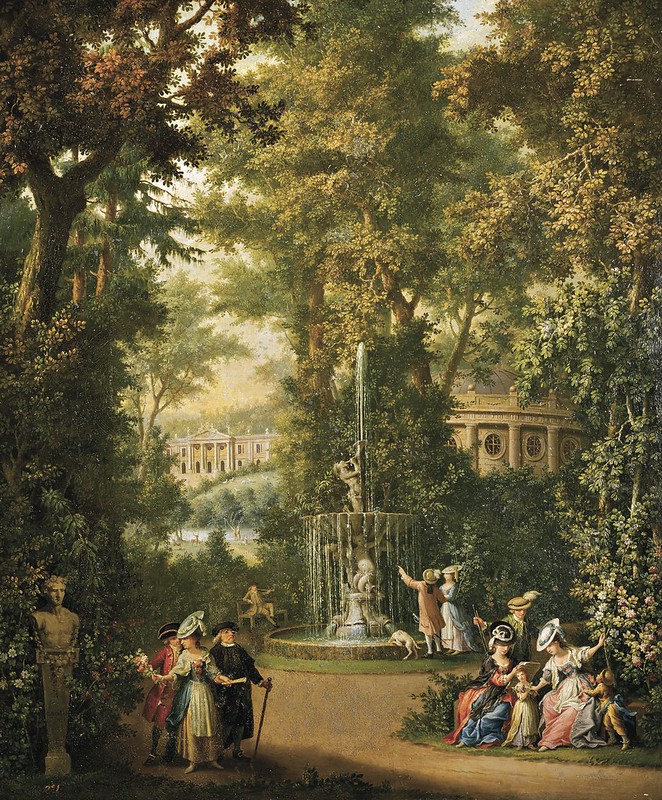
Giovanni Battista Innocenzo Colombo - Jardin


- Recordatori de Georg Matthias Monn -
En el dia de la celebració del seu 300è aniversari de naixement


Parlem de Pintura...

Giovanni Battista Innocenzo Colombo (Arogno, 16 de desembre de 1717 - Arogno, 10 d'abril de 1801) va ser un pintor suís. Membre d'una família d'artistes, es va formar amb el seu oncle, Luca Antonio Colombo. Després de la mort del seu oncle el 1737, es va traslladar a Magúncia on va començar a treballar com a pintor independent. El 1741 va rebre l'encàrrec de pintar amb perspectives fingides i al·legories la volta de l'Escala Imperial del vell ajuntament de Frankfurt del Main en motiu de la coronació de l'emperador Carles VII. Amb Niccolini, empresari teatral, va viatjar per diverses ciutats centreeuropees abans d'establir-se el 1748 a Hamburg, i després a Hannover, on va ser nomenat pintor de la cort de l'elector Jordi II. Des d'allà va viatjar a Schleswig-Holstein per pintar el fresc de la Glorificació de la Trinitat a l'església d'Uetersen. Més tard, va treballar com a pintor i escenògraf al servei del duc de Wurtemberg, on va col·laborar en la decoració de l'Òpera de Ludwigsburg i on va donar classes a l'Acadèmia de Belles Arts de Stuttgart, fundada el 1761. A l'entorn del 1763 es va traslladar a Como per treballar en la decoració del nou teatre i del seminari, i en els frescos de l'absis de l'església de Sant Giacomo. El 1769 va abandonar definitivament la cort de Württemberg per establir-se a Torí, contractat per la Companyia dels cavallers que administraven el Teatre Regio, per als que va treballar durant dues temporades. Entre els anys 1774 i 1780 va residir a Londres com a escenògraf i maquinista del King's Theatre. A Londres va presentar a la Royal Academy quatre paisatges, gènere del qual es coneixen alguns exemplars de marcat estil rococó, com Diana i Endimió (1762) o Escenes en un jardí. Els darrers anys va tornar a la seva vila natal, on hi va morir l'abril del 1801.


Parlem de Música...

Georg Matthias Monn (Wien, 9 d'abril de 1717 - Wien, 3 d'octubre de 1750) va ser un compositor austríac. Fill de Jakob Mann i Catherina Päsching Mann, va ser batejat amb el nom de Johann Georg si bé posteriorment se'l va canviar pel de Matthias Georg possiblement per evitar la confusió amb el seu germà petit i també compositor Johann Christoph Monn (1726-1782). També va modificar lleument el seu cognom familiar per adaptar-lo al dialecte austríac de la zona on va viure. Es va formar, a partir del 1731, com a cantant del cor del Monestir de Klosterneuburg. A partir del 1738 va ser organista a la Karlskirche de Viena ciutat on es creu, sense evidències documentals existents, que va estudiar amb Albrechtsberger. Com a compositor, va ser comparat amb Wagenseil si bé, tot i l'extensa producció, no va assolir un ampli reconeixement a nivell europeu si bé la seva reputació local va ser notable, com es va demostrar en les actuacions de la seva música a la cort imperial de Josep II i en els monestirs d'Àustria i del seu entorn proper. No obstant, cap de les seves obres va ser publicada en vida de l'autor degut, probablement, a la seva mort prematura esdevinguda a Viena l'octubre de 1750.

OBRA:

Vocal religiosa:

Masses (all for vv, orch, org; m - catalogue no. in MacIntyre, 1986):
C, m38, 1741, A-H, M, Wn, F-Pc*;
Missa B:V:M, C, A-WIL;
D, m40, GÖ, LA, SEI;
D, SEI;
B , m39, GÖ, LA, M, Wgm, Wn, WIL (2 copies);
G, Ee, CZ-KU (attrib. J. Haydn), doubtful;
G, CZK, doubtful;
C, m12, A-Ek, A-KR (2 copies), Wn, CZ-Bm, ? by J.N. Boog

Other vocal:
Mag, 4vv, orch, A-Wn*;
Fuga cum sancto spiritu, 4vv, Wn;
Motetto de tempore et venerabili, B solo, chorus, orch, Wgm;
2 Ger. Marienlieder, A solo, vn, org, SE, M, ed. R. Moder (Vienna, 1955)

Instrumental:

Orch.:
16 syms.:
2 for str, ww, f1/rD-1, 1740, A-Wn*, ed. in H, Minuet ed. in Mw, vi (1953), finale ed. in HAM, f2/rD-2, A-Wgm, F-Pc, H-Gk, ed. in F;
12 a 4, f4/rG-1, f7–10/(rF-1, D-3, B -1, B -2), f12/rA-1, f15–17/(rE -1, E-1, B-1), rD-4, Em-1, A-2, A-M, Wgm, Wm, Wn, B-Bc, D-Rtt, f4/rG-1, f8/rD-3, ed. in F. f17/rB-1 ed. in H, f9/rB -1, f10/rB -2, f15/rE -1, rA-2 ed. in R; 2 a 3, f24/rD-5, A-M, ed. in R, rA-3, H-Gk;
rC-101, 1765, lost, formerly A-GÖ;
f121/rG-101, lost, listed in Breitkopf suppl. 1766;
rD-101, B -102, lost, listed in Brtnice catalogue (see Straková, 1963, n.32);
f122, lost, formerly A-KN;
f120/rE -101, rE -102, both D-Rtt, by F.X. Pokorny, f120/rE -101 ed. in H

10 kbd concs.:
f35-6, 39a [arr. of vc conc.], 40-44, D-Bsb, CZ-KR [f41 and 2 concs. not in f], f41 ed. in F;
Vn Conc., 1747, A-Gmi, ed. I. Schubert (Graz, 1975);
Vc Conc., f39, A-Wgm, ed. in F

Attrib. both M.G. and J.C. Monn:
2 syms. a 3, rE-101, B -101, F-Pc;
3 kbd concs., f123–5, D-Bsb [123 also in CZ-KR], ed. in Kelly

---

Chbr.:
Sonata da chiesa style:
6 str qts, f3, 5-6, 11a, 13a, 14 (Vienna, 1808), 2 arr. from syms., see AMZ, x (1808), 433, f11, 13 ed. in F;
6 partitas, 2 vn, b, f18-19, 21, 25, 29-30, A-Wgm, Wn, some in A-GÖ, S, H-Gk, f29 ed. in H, f21 ed. K. Flieder (Vienna, 1981);
2 sinfonias, 2 vn, b, f27-8, 1 in A-M, 1 in Wm;
Trio, 2 vn, b, f23, Wn, H-Gk;
Concertino fugato, solo vn, 2 vn, va, vc, b, f37, 1742, A-Wgm;
Divertimento, pf, 2 vn, b, F. 38, Wgm

Sonata da camera style:
Partita, 2 vn, b, f22, A-Wgm;
Partita, 2 vn, b, f26, Wn, ed. K. Flieder (Vienna, 1981);
Divertimento, 2 va, b, f20, D-Bsb;
2 sonatas, 2 allegros, vn, b, f31-4, Bsb

Attrib. both M.G. and J.C. Monn:
7 divertimentos, 2 vn, b, f80-82, f86-9, A-Wgm, 5 in M all ed. in Henrotte. f86 in F. 3 divertimentos, 2 vn, b, GÖ: Divertimento, vn, b, f90, Wgm, ed. in Henrotte

Keyboard:
21 sonatas [p - catalogue no. in Pollack, 1984]:
19 sonatas, f45-61/p1-19 [f47 includes p3, 18, 19], D-Bsb [f57/p8 autograph];
p20, A-Wgm; f45-6/p1-2, p21, H-Bn, f45/p1 also in US-NYp

Other kbd:
4 minuets, f62-5, D-Bsb;
6 preludes and fugues, f66-71, D-Bsb, A-Wst, ed. F. Haselböck (Vienna, 1980);
8 sets of organ preludes preludes and versetti, f72-9, D-Bsb;
4 adagios and fugues, Bsb
Some works also in CZ-KR, CZ-Mms

Literatura:

Thoroughbass instruction manual (MS examples, without text), A-Wn

Font: En català: Georg Matthias Monn (1717-1750) En castellano: Georg Matthias Monn (1717-1750) In english: Georg Matthias Monn (1717-1750) - Altres: Georg Matthias Monn (1717-1750)


Informació addicional... 

INTERPRETS: Capella Agostino Steffani; Lajos Rovátkay
AMAZON: MONN, G.M. - Sinfonie & Concerti
CPDL: No disponible
SPOTIFY: MONN, G.M. - Sinfonie & Concerti


Tant si us ha agradat, com si no, opineu, és lliure i fàcil!