Es mostren els missatges amb l'etiqueta de comentaris Stadlmayr J.. Mostrar tots els missatges

diumenge, 11 de juliol del 2021

STADLMAYR, Johann (c.1580-1648) - Te Deum (1645)

Bernardino Mei (1612-1676) - Christ Cleansing the Temple (c.1655)


Johann Stadlmayr (c.1580-1648) - Te Deum (1645)
Performers: Neue lnnsbrucker Hofkapelle; Detlef Bratschke

---


German composer. The title-page and dedication of his Sacrum Beatissimae Virginis Mariae canticum (1603) report that he came from Freising. The date of his birth, given as 1560 by Fétis and others, was probably closer to 1580, for in 1619 he was called a ‘rather young and lively man’. The earliest documented reference to him is in Georg Draudius’s catalogue Bibliotheca classica (Frankfurt, 1611, 2/1625), where a collection of eight-part masses by him is said to have been published in 1596 (misprinted as 1569 but corroborated elsewhere). In 1603 he was a musician in the service of the Archbishop of Salzburg. In 1604, the year of his first marriage, he became vice-Kapellmeister and then Kapellmeister there, a post he held until 1607, when he was appointed to a similar position at the court of the Habsburg Archduke Maximilian II of the Tyrol at Innsbruck. Though later offered other positions he chose to remain in Innsbruck for the rest of his life. Maximilian, who was Grand Master of the Teutonic Order and specially interested in serious music, apparently held Stadlmayr in great esteem, for he bought him a house and included him in his will. After Maximilian’s death in 1618, the Innsbruck chapel was disbanded because his successor, Archduke Leopold V, kept his own musicians at his former Alsatian residence. Stadlmayr presented several petitions for employment so that he and his large family need not leave Innsbruck, where, as he said in 1620, he had ‘spared no effort in 13 of the best years of his life’. During this period, which also saw the death of his first wife (in 1619) and his remarriage (in 1621), he added to his income by working as government meat inspector. 

Not until 1624, after he had sought leave to apply for a post in Vienna, was he reappointed Kapellmeister, with an appropriate salary. Leopold also wanted to make him a member of the nobility, but he refused (as he had also done when Maximilian made him a similar offer some years before) because he lacked sufficient funds to maintain such a position. The court chapel now attained its greatest brilliance, and after Leopold died in 1632 his widow, Claudia de’ Medici, continued to support Stadlmayr despite financial difficulties caused by the Thirty Years War, which was ravaging neighbouring countries; part of her support was to help finance the publication of some of Stadlmayr’s works. Stadlmayr was almost exclusively a composer of Catholic church music, and a prolific one. 16th-century traditions as well as 17th-century innovations inform his style. He achieved clear articulation of the liturgical texts, as required by the Council of Trent, with short phrases of generally syllabic declamation that follow natural speech inflections. In imitative sections he highlighted the texts by frequent repetitions of a few words, and he often used stereotyped figures for expressive emphasis. His publications up to about 1628 continue 16th-century traditions of carefully handled polyphony and effectively treated homophonic chordal blocks in the Venetian manner. In some works the two kinds of texture are set against each other. In others one texture may predominate: the polychoral idiom does so in the masses and Magnificat settings for two and three choirs, while the textures of the fifth and ninth items in the Magnificat collection of 1603 are exclusively contrapuntal. Stadlmayr also continued to make use of plainchant in long notes for cantus firmi as well as of parody technique for many masses and Magnificat settings, which are based mainly on Italian works.

divendres, 13 de juliol del 2018

STADLMAYR, Johann (c.1580-1648) - Sacred music

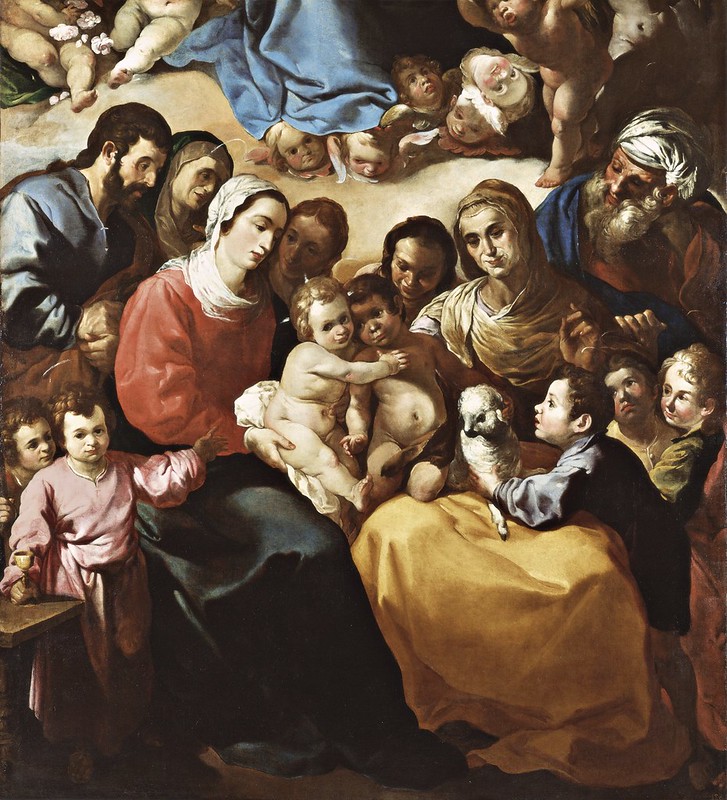
Francisco de Herrera - The Holy Family (c.1636)
Obra de Francisco Herrera (c.1590-c.1654), pintor espanyol (1)


- Recordatori de Johann Stadlmayr -
En el dia de la commemoració del seu 370è aniversari de decés


Parlem de Pintura...

Francisco Herrera (Sevilla, c.1590 - Madrid, c.1654) va ser un pintor espanyol. Fill de Juan de Herrera y Aguilar, es va formar inicialment amb el seu pare abans d'entrar al taller de Francisco Pacheco. A partir del 1609 va començar a realitzar les seves primeres obres. Anys després, el 1619, va ser denunciat pel fet d'acceptar nombrosos encàrrecs sense estar associar al Gremi de Pintors. A partir de la dècada de 1620, es va convertir en un dels mestres més elogiats i estimats de Sevilla rebent encàrrecs prou destacats i sent sol·licitat des d'altres ciutats espanyoles. A partir del 1638 va viure a Madrid on algunes fonts van documentar que va ser professor de Velázquez. El seu fill Francisco Herrera II va ser també pintor. Francisco Herrera, exponent destacat de la pintura sevillana de la primera meitat del segle XVII, va morir a Madrid a l'entorn del 1654.


Parlem de Música...

Johann Stadlmayr [Stadlmair, Stadelmaier, Stadelmayer, Stadelmeyer] (Freising?, c.1580 - Innsbruck, 12 de juliol de 1648) va ser un compositor alemany. Es desconeix la seva vida formativa sent la primera referència de 1603 com a músic al servei de l'Arquebisbat de Salzburg. Un any després, i també a Salzburg, es va casar i va ser nomenat vice-Kapellmeister i poc després Kapellmeister en un càrrec que va preservar fins el 1607. Aquell any es va traslladar a la cort de l'arxiduc Maximilià III a Innsbruck on va ser nomenat mestre de capella. El 1618, i després de la mort de l'arxiduc, va perdre la seva posició si bé va romandre a Innsbruck al servei del nou arxiduc Leopold V qui després d'anys de servei el va tornar a nomenar, el 1624, mestre de capella. El 1632, i després de la mort de Leopold V, va preservar el seu càrrec gràcies al suport de Claudia de Medici. Com a compositor va ser molt prolífic en música religiosa la qual va ser notablement apreciada. Johann Stadlmayr va morir a Innsbruck el juliol de 1648.

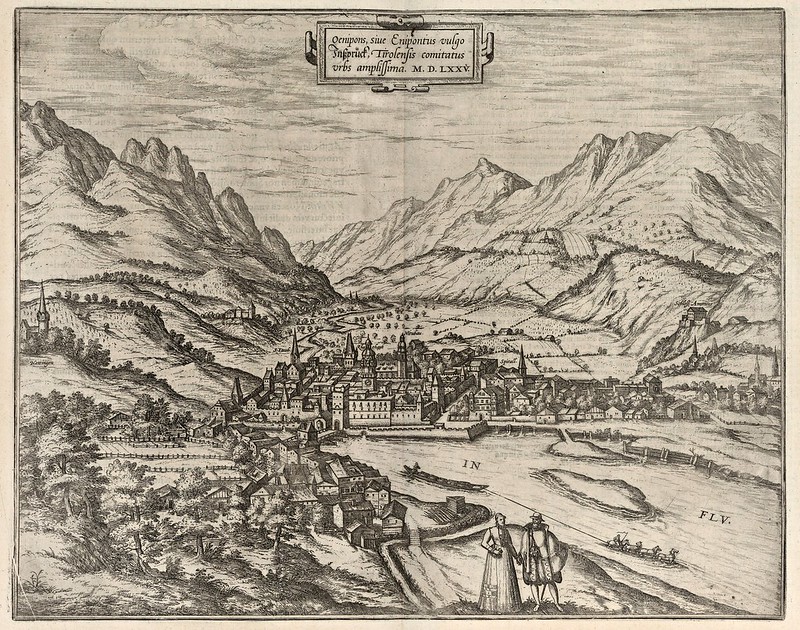
Georg Braun & Franz Hogenberg - Inspruck (Innsbruck) (1575)
Georg Braun (1541-1622) & Franz Hogenberg (1535-1590) - Inspruck (Innsbruck) (1575) (2)

OBRA:

Mass collections:
Missae, 8vv, 2 bc (org) (Augsburg, 1596), no known copy; cited in Draudius: Bibliotheca classica (Frankfurt am Main, 1611, 2/1625)
Missae, 8vv, 2 bc (org) (Augsburg, 1610)
Missae, 12vv, 3 bc (org) (Vienna, 1616)
Missae concertatae, 6vv, 2 cornetts/vn, 4 trbn, bc (Innsbruck, 1631)
Missae breves, 4vv, cum una pro defunctis et alia, 5vv, bc (Innsbruck, 1641) [1 mass 5vv]
Missae concertatae, 10 et 12 vocibus et instrumentis cum 4 partibus pro secundo choro (Cantus, 8vv, 2 cornetts/vn, 3 trbn/va, 2 bc) (Innsbruck, 1642) [1 with 2 addl vns]
Missae, 9vv primo choro concertante a 5vv, secundo pleno et necessario cum symphoniis ad libitum, 9vv, 3 cornetts/vn, 3 trbn/va, bc (Antwerp, 1643)

Magnificat collections:
Edition: Eight Magnificat Settings, ed. H.H. Junkermann (Madison, 1974) [incl. 4 from the 1603 collection, 1 from 1608, 2 from 1614, 1 from 1641]
Sacrum Beatissimae Virginis Mariae canticum, 5–8vv (Munich, 1603)
Mag, 4vv, super octo tonos, quibus accesserunt litaniae, antiphonae Mariales, 8vv (Passau, 1608) [incl. litany and 4 Marian ants also pubd in Antiphonae, 1636]
Super magnae matris divino carmine Magnificat, symphoniae variae … 8, 12vv, 2, 3 bc (org) (Innsbruck, 1614)
Cantici Mariani septies variati, liber quartus, 12vv, 3 bc (org), op.6 (Innsbruck, 1618)
Psalmi vesperini (1640) and Psalmi integri (1641) also contain Magnificat settings

Other collections:
Musica super cantum gregorianum … pars prima missarum dominicalium introitus complectitur … 5vv, bc ad lib (Ravensburg, 1625); 52 introits, 9 Gloria Patri settings; for contents see R. Mitjana (1911)
Musicae super cantum gregorianum pars secunda: festa proprium et commune sanctorum, 5vv, bc (Ravensburg, 1626); 50 introits; for contents see Mitjana
Hymni quibus totius anni decursu … 4vv … accomodi, quibus et alii hymni pro festis solemnioribus … accesserunt, 4–8vv, 2 cornetts/vn, bc (Innsbruck, 1628); 4-part hymns of part i, ed. in DTÖ, v, Jg. iii/1 (Vienna, 1896/R)
Moduli symphoniaci in augustissima Christi nati celebritate et ceteris deinceps natalibus et Purificatione virginis feriis, 5–10vv, bc (Innsbruck, 1629); 5 compositions by other composers, 9 by Stadlmayr
Antiphonae vespertinae … cum tribus litaniis Lauretanis duabus salutationibus angelicis, 2–8vv, bc (org) (Innsbruck, 1636)
Odae sacrae Jesu Christo … 5vv et totidem instrumentis si placet (2 vn, 3 va, bc) (Innsbruck, 16382); 4 compositions by A. Reiner, 13 by Stadlmayr
Salmi, 2, 3vv, 2 vn/cornetts (Innsbruck, 1640)
Psalmi vespertini omnes cum 2 Magnificat concertationibus musicis per 6vv, bc (Innsbruck, 1640)
Psalmi integri a 4vv concertantibus, 4 aliis accessoriis ad lib … 2 cornetts/vn, bc (Innsbruck, 1641)
Apparatus musicus sacrarum cantionum … 6–24 vocibus et instrumentis (Innsbruck, 1645); 44 vocal and 6 inst compositions
Psalmus quinquagesimus Davidis … 4–6, 8vv cum secundo choro et instrumentis senis si placet (Innsbruck, 1646) [3 Miserere settings for 2 solo vv and insts]

Works in anthologies:
Maria klar, du bist fürwahr, 4vv, in 1604
Bonitatem fecisti, 2vv, bc, in 1622
Cantate Domino, 2vv, bc, in 1623
Canzon [without text], 3vv, bc, in 1624
Ant, 4vv, bc, in 1628
3 Salve regina settings: 2vv, bc; 9vv, bc; 12vv, bc; in 1629
Dixit Dominus, rep. from Salmi (1640), in 1659


Informació addicional... 

INTERPRETS: Roswitha Schmelzl (soprano); Gert Hohmann (counter-tenor); Matthias Winckhler (bass); Robert Sellier (tenor); Andrea Lauren Brown (soprano); Manuel Warwitz (tenor); Les Cornets Noirs; Munich Orpheus Choir; Gerd Guzglhor
PRESTOCLASSICAL: Jubilate Deo
SPOTIFY: Jubilate Deo

Jubilate Deo

Tant si us ha agradat, com si no, opineu, és lliure i fàcil!