Es mostren els missatges amb l'etiqueta de comentaris Mozart F.X.. Mostrar tots els missatges

dilluns, 27 de juliol del 2026

MOZART, Franz Xaver (1791-1844) - Concerto pour le Piano Forte (c.1809)

Karl Gottlieb Schweikart (1772-1855) - Portrait of Franz Xavier Wolfgang Mozart (1825)


Franz Xaver Mozart (1791-1844) - Concerto (C-Dur) pour le Piano Forte, Op.14 (c.1809)
Performers: Henri Sigfridsson (piano); International New Symphony Orchestra; Gunhard Mattes (conductor)

---


Austrian composer and pianist, the sixth child and younger surviving son of Wolfgang Amadeus and Constanze Mozart. He received his first piano instruction in 1796 from František Xaver Dušek in Prague, where he lived with the Dušek family. In Vienna he continued his studies under Sigismund Neukomm, Andreas Streicher, J.N. Hummel, Antonio Salieri, G.J. Vogler and J.G. Albrechtsberger. His first compositions, which include the Piano Quartet op.1, appeared in 1805. On 30 March 1807 Salieri declared his pupil to possess ‘a rare talent for music’, and prophesied a career for him ‘not inferior to that of his celebrated father’. On 22 October 1807 Franz Xaver went to Lemberg (now L'viv). In Podkamien he accepted a post as tutor in the home of Count Viktor Baworowski, a position he held until December 1810. In 1811 he became a music teacher in the home of the imperial chamberlain, Janiszewski, in Sarki (near Lemberg). He gave up that post in 1813 and lived as a freelance musician in Lemberg, where he supervised the training of Julie Baroni-Cavalcabò. From 1819 to 1821 he undertook an extended concert tour during which he played in Kiev, Warsaw, Copenhagen (where he saw his mother and his stepfather, Georg Nikolaus Nissen), Hamburg, Berlin, Leipzig, Dresden (where he visited his cousin, Carl Maria von Weber), Prague, Vienna, Venice, Milan (where he visited his brother Carl), Zürich, Berne, Frankfurt, Mannheim, Augsburg, Munich and Salzburg (where he visited his aunt, Maria Anna).

In 1822 he returned to teach in Lemberg; in 1826 he went to Salzburg to see his mother. In the same year he renewed his studies in counterpoint with Wagenseil’s pupil, Johann Mederitsch, who bequeathed him all his compositions. Also in that year he founded the Cäcilien-Verein in Lemberg, but in 1838 he left Lemberg and settled in Vienna. In 1841 he was made honorary Kapellmeister of the Dommusikverein and the Mozarteum in Salzburg, and in 1842 he stayed with his brother there during celebrations on the unveiling of the Mozart memorial; at the festival concert he played his father’s D minor Piano Concerto k466. In December of the same year the Congregazione ed Accademia di S Cecilia in Rome named him maestro compositore onorario. In his will Franz Xaver stipulated, among other things, that any of his father’s autographs found in his papers, his father’s portrait and piano, as well as his own library, should be given to the Dommusikverein and the Mozarteum as a lasting memorial to his father. This Mozart-Nachlass passed partly to the Internationale Stiftung Mozarteum and partly to the consistorial archive in Salzburg. The brilliant pianistic figuration prominent in Franz Xaver’s music reveals the particular influence of his teacher Hummel. The more relaxed quality and richer sonority of his piano writing, as reflected especially in his Second Piano Concerto (1818), however, hint at the characteristic piano style of Chopin and Liszt.

divendres, 30 de juliol del 2021

MOZART, Franz Xaver (1791-1844) - Klavierkonzert Es-Dur, Nr.2 (c.1819)

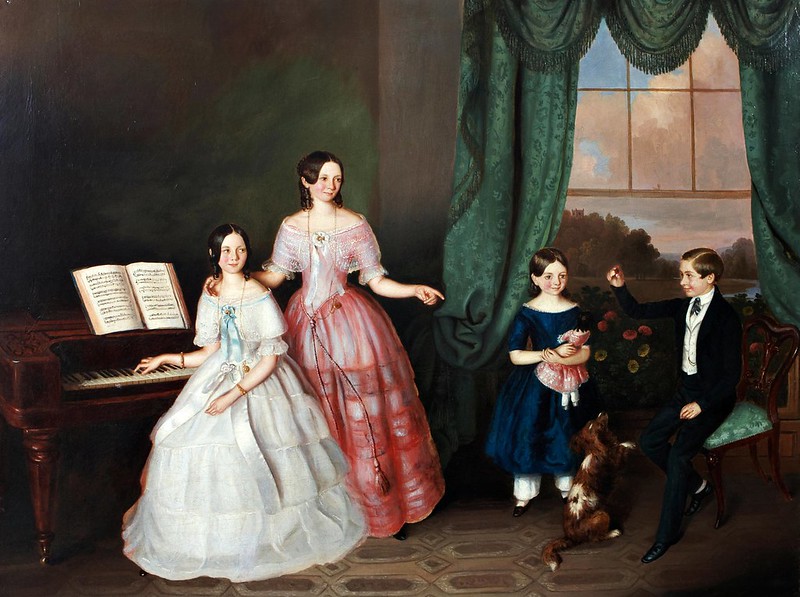
English School (19th Century) - A family in their drawing room


Franz Xaver Mozart (1791-1844) - Klavierkonzert Es-Dur, Nr.2 (c.1819)
Performers: Grant Johannesen (1921-2005, piano); The Chicago Sinfonietta; Paul Freeman (1936-2015, conductor)

---


Composer and pianist, the sixth child and younger surviving son of Wolfgang Amadeus and Constanze Mozart. He received his first piano instruction in 1796 from František Xaver Dušek in Prague, where he lived with the Dušek family. In Vienna he continued his studies under Sigismund Neukomm, Andreas Streicher, J.N. Hummel, Antonio Salieri, G.J. Vogler and J.G. Albrechtsberger. His first compositions, which include the Piano Quartet op.1, appeared in 1805. On 30 March 1807 Salieri declared his pupil to possess ‘a rare talent for music’, and prophesied a career for him ‘not inferior to that of his celebrated father’. On 22 October 1807 Franz Xaver went to Lemberg (now L'viv). In Podkamien he accepted a post as tutor in the home of Count Viktor Baworowski, a position he held until December 1810. In 1811 he became a music teacher in the home of the imperial chamberlain, Janiszewski, in Sarki (near Lemberg). He gave up that post in 1813 and lived as a freelance musician in Lemberg, where he supervised the training of Julie Baroni-Cavalcabò. From 1819 to 1821 he undertook an extended concert tour during which he played in Kiev, Warsaw, Copenhagen (where he saw his mother and his stepfather, Georg Nikolaus Nissen), Hamburg, Berlin, Leipzig, Dresden (where he visited his cousin, Carl Maria von Weber), Prague, Vienna, Venice, Milan (where he visited his brother Carl), Zürich, Berne, Frankfurt, Mannheim, Augsburg, Munich and Salzburg (where he visited his aunt, Maria Anna).

In 1822 he returned to teach in Lemberg; in 1826 he went to Salzburg to see his mother. In the same year he renewed his studies in counterpoint with Wagenseil’s pupil, Johann Mederitsch, who bequeathed him all his compositions. Also in that year he founded the Cäcilien-Verein in Lemberg, but in 1838 he left Lemberg and settled in Vienna. In 1841 he was made honorary Kapellmeister of the Dommusikverein and the Mozarteum in Salzburg, and in 1842 he stayed with his brother there during celebrations on the unveiling of the Mozart memorial; at the festival concert he played his father’s D minor Piano Concerto k466. In December of the same year the Congregazione ed Accademia di S Cecilia in Rome named him maestro compositore onorario. In his will Franz Xaver stipulated, among other things, that any of his father’s autographs found in his papers, his father’s portrait and piano, as well as his own library, should be given to the Dommusikverein and the Mozarteum as a lasting memorial to his father. This Mozart-Nachlass passed partly to the Internationale Stiftung Mozarteum and partly to the consistorial archive in Salzburg. The brilliant pianistic figuration prominent in Franz Xaver’s music reveals the particular influence of his teacher Hummel. The more relaxed quality and richer sonority of his piano writing, as reflected especially in his Second Piano Concerto (1818), however, hint at the characteristic piano style of Chopin and Liszt.
dilluns, 29 de juliol del 2013

MOZART, Franz Xaver (1791-1844) - The Other Mozart

Karl Friedrich Schinkel - Gotische Kirche auf einem Felsen am Meer (c.1815)
Obra de Karl Friedrich Schinkel (1781-1841), pintor alemany (1)


- Recordatori de Franz Xaver Mozart -
En el dia de la commemoració del seu 169è aniversari de decés


Font (on trobareu informació addicional així com dels discs on podeu trobar aquestes obres):

dissabte, 8 de setembre del 2012

MOZART, Franz Xaver Wolfgang (1791-1844) - Piano Concerto No.2

Franz Xaver Mozart
Litografia de Franz Xaver Mozart


Franz Xaver Wolfgang Mozart (1791-1844) compositor i pianista austríac nascut a Viena. Seguim, en el seu penúltim dia, parlant de Salzburg i d'aquells compositors que directa o indirectament hi van viure, treballar-hi o hi van tenir alguna presència real o simbòlica. Sota la monumental responsabilitat de ser l'únic, dels dos fills de Mozart que van sobreviure, que es va dedicar a la música, el seu nom complert ja era una llosa per un Franz Xaver conscient de l'enorme càrrega que el seu cognom implicava. Tal va ser així que la seva vida va ser una allargada ombra del passat musical del seu pare el qual mai va arribar a conèixer. No obstant això, va ser una persona extremadament perfeccionista i tremendament autocrítica conscient que, malauradament per ell, tot el que fes seria, sistemàticament, comparat amb la obra del seu pare. És ara en el nostre temps que podrem valorar, exempts de comparacions i en dret propi, les partitures d'un Franz Xaver que va tenir grans tutors i mestres en el seu precoç aprenentatge. HummelAlbrechtsberger o Salieri, entre d'altres. Per tant, a nivell acadèmic no podem sinó imaginar un afortunat alumne gaudint de mestres tant propers al seu pare i que de ben segur l'ajudarien a formar una vaga idea de com aquest era a l'hora de compondre i d'interpretar. La seva carrera la desenvoluparia, principalment, a Lviv, actualment Ucraïna, al servei d'un comte local. Allà va viure-hi durant quasi 30 anys abans de tornar, definitivament, a Salzburg. Ciutat, aquesta, on seria l'encarregat de dirigir el Mozarteum (on per cert demà dia 9 de setembre hi fan un concert de Michael Haydn per si alguna ànima despistada té la sort d'estar aquests dies per allà), l'escola de música de Salzburg. Per tant, és més que probable que la seva figura, en les més diverses geografies per on passés, estigués associada més a la presència del cognom Mozart que no pas a la promoció i a la interpretació de la seva pròpia música.

Tot i això, va tenir prou esma i saviesa per a compondre, no en la mesura, la varietat i la quantitat del seu pare etern, sinó en la justa idea de deixar un llegat més enllà de la extraordinària herència del seu pare que ell mateix s'encarregava de promocionar. Avui en dia es quasi una quimera trobar un sol escenari a Catalunya o a l'estat espanyol on es representin obres del Wolfgang Mozart fill. I tal com descobrirem avui, no serà perquè siguin obres menors. Escoltar un cognom Mozart i tenir la percepció de submergir-nos de ple al romanticisme és una sensació entranyablement agradable. Potser no tant amb el concert de piano número 2 en Mi sostingut major opus 25, escrit l'any 1818 i que ens recordarà inevitablement al seu mestre Hummel i de passada al seu pare. De fet, si ens diguessin que van ser escrits pel Mozart que tots coneixem ens ho creuríem. No dubto, així mateix, que a tots aquells a qui Mozart els delecta desconsoladament aquestes partitures del seu fill els hi resultaran deliciosament encantadores. Introduirem el concert amb una romàntica composició per a piano i violoncel en Mi major opus 19, escrita l'any 1820, d'una bellesa desbordant i d'un conjunt, el de música de cambra de Franz Xaver, que en recomano vehementment la seva audició. Anem finalitzant el monogràfic dedicat íntegrament a Salzburg. De fet, Franz Xaver va ser partícip de la inauguració, l'any 1842, del monument en honor al seu pare que podem trobar al centre del nucli antic de la ciutat austríaca. Demà tancarem el cercle virtuós dedicat a aquesta ciutat i ho farem, evidentment, amb una descomunal missa com ja marca la tradició dominical. Mentrestant, gaudim del fill del gran geni ja que, tot i viure permanentment sota la potent gravetat del seu pare, va trobar un petit espai per a trobar-se a sí mateix i regalar al món unes obres que també duen el cognom Mozart però amablement el nom de Franz Xaver!

El concert interpretat brillantment per Henri Sigfridsoon al piano i la International New Symphony Orchestra Lemberg sota la batuta de Gunhard Mattes.

La preciosa sonata ens la interpreta Saiko Sasaki al piano i Peter Hörr al violoncel.

Gaudiu i compartiu!


Font: (on trobareu informació addicional així com dels discs on podeu trobar aquesta obra):

Tant si us ha agradat com si no, opineu, és lliure i fàcil!