dilluns, 31 de maig del 2021

MARSH, John (1752-1828) - Symphony in B-flat Major, No.1 (1781)

William Marlow (1740-1813) - Rochester (1780)


John Marsh (1752-1828) - Symphony in B-flat Major, No.1 (1781)
Performers: The Chichester Concert; Ian Graham-Jones (conductor)

---


English composer and writer. Despite his showing an early interest in music, his father, a Royal Naval captain, denied him a musical education during his school years at Greenwich Academy, intending that he too should follow a naval career. In 1768, however, he persuaded his father to allow him to undertake legal training and he was articled to a solicitor in Romsey. During the two years before leaving home in Gosport, then his father's station, Marsh took up the violin, studying with Wafer, the organist of Gosport Chapel. This was his only formal musical training, but enabled him to become sufficiently proficient to join in the subscription concerts in Portsmouth and Gosport. In Romsey he applied himself as assiduously to music as to law, teaching himself to play the spinet, viola (which became a particular favourite), cello, oboe and organ. These were also the years of his first retained compositions, works written specifically for a series of subscription concerts he founded in the town. Following the completion of his clerkship in 1773, Marsh set up practice in Romsey and the following year married Elizabeth Brown, the daughter of a Salisbury doctor. In 1776 he moved to a partnership in Salisbury, where he took up residence in a house near Close Gate. During the seven years that he lived in Salisbury, Marsh played an active role in the city's thriving musical life: he was a violinist at the subscription concert series, of which he became leader in 1780, a member of the Catch Club and an occasional substitute organist at cathedral services. He had by now become a prolific composer; a number of his symphonies had been introduced both at the subscription concerts and at the annual Salisbury Festival. 

In 1783, having inherited an estate in Kent, Marsh abandoned his career as a practising lawyer and moved with his family to Nethersole House, some ten miles from Canterbury. He was immediately offered the directorship of the ailing Canterbury Concert, which he set about reorganizing with characteristic energy, soon transforming the Concert into a successful organization. Marsh recognised that he could ill-afford the upkeep of a large estate and within two years was again making plans to move. Following a short period at a prebendial house in the precincts of Canterbury Cathedral, the family moved to Chichester in the spring of 1787. The house in North Pallant (no longer standing) that Marsh bought from the poet William Hayley was to remain his home for the remaining 40 years of his life. As at Canterbury, his arrival coincided with a period when local concert life was at a low ebb and Marsh was again given the challenge of reviving the subscription concerts as manager and leader. His success ensured that Chichester enjoyed a thriving concert life until 1813, when he retired from concert leadership. Although he never lost interest in music, the last 15 years of his life were mainly devoted to his family and extensive travels, during which he frequently managed to take in one or more of the provincial music festivals. Active and in good health until the final months of his life, Marsh died at his home after a short illness and was buried a week later at All Saints, West Pallant.

diumenge, 30 de maig del 2021

ROSENGART, Aemilian (1757-1810) - Missa B-Dur (1796)

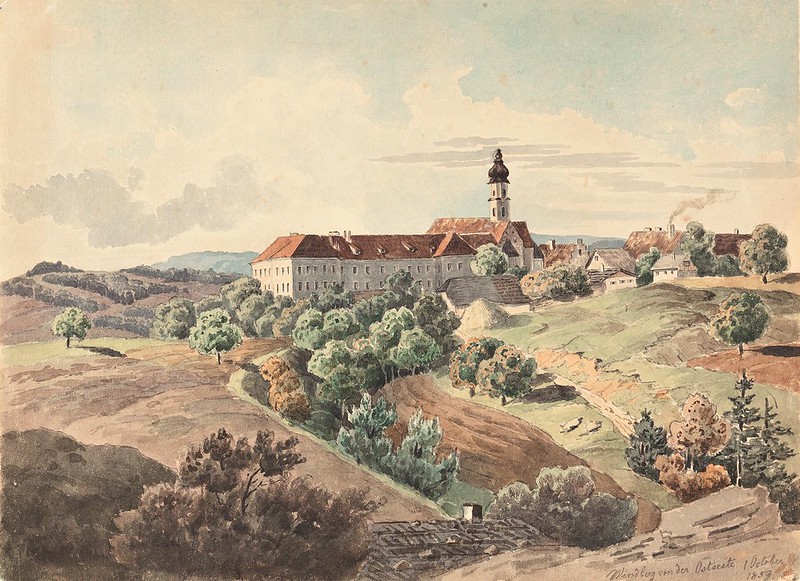
Wilhelm Scheuchzer (1803-1866) - Kloster Windberg bei Boden an der Donau


Aemilian Rosengart (1757-1810) - Missa B-Dur (1796)
Performers: Galina Dzeba (soprano); Ruth Sandhoff (alto); Anatolij Lomunov (tenor); Kirill Zukov (bass); Matthias Eisenberg (organ); Martin Hölker (cello); Sigismund Schwieger (double-bass); Rundfunk und Fernsehchor St. Petersburg; Vladimir Stolpovskich (conductor)

---


German theologian, philosopher and composer. He was educated at the Benedictine seminary in Ulm where he was ordained a priest in 1781. Shortly afterwards he moved to the Benedictine abbey of Ochsenhausen where he devoted himself to teaching theology and philosophy. In 1795 the abbot Romuald Weltin (1723-1805) promoted him as a musical director in a position he held until 1803, when he moved to Tannheim where he was abbot. As a composer he wrote nearly one hundred works, mainly religious music and most of them for choir with instrumental accompaniment. He died in Tannheim in May 1810.

divendres, 28 de maig del 2021

MOZART, Leopold (1719-1787) - Sinfonia D-Dur (c.1760)

Austrian School (18th Century) - Leopold Mozart (1791-1787) and Wolfgang Amadeus Mozart (1756-1791)


Leopold Mozart (1719-1787) - Sinfonia D-Dur (c.1760)
Performers: Münchener Kammerorchester; Hans Stadlmair (1929-2019, leitung)

---


German composer and pedagogue. The son of a bookbinder, Mozart received his earliest education from the Jesuits at the St. Salvator Gymnasium and Lyceum. While at the latter, he distinguished himself as an actor and singer, although he also progressed as a violinist and organist. As a polymath with many varied interests in the sciences and philosophy, he enrolled at Salzburg University, earning a bachelor’s degree in 1738. Although he was expelled the following year for lack of attendance in the natural sciences, he attached himself to the court of Count Johann Baptist of Thurn-Valsassina und Taxis as a violinist and valet, publishing his first works, a set of six church trio sonatas, as his Op. 1. In 1743 he was appointed second violinist at the court of the Prince-Archbishop of Salzburg, Count Leopold Anton von Firmian, later serving under his successors, Sigismund von Schrattenbach and Heironymous Colloredo. In 1758 he was appointed as vice Kapellmeister, a position he retained for the remainder of his life. Although the main emphasis in studies of his life have focused on the training of his son, Wolfgang Amadeus Mozart, during which he was absent from his post for long periods of time as he toured with his two children throughout Europe, his own reputation as a teacher and composer was significant. The most important treatise was his Versuch einer gründlichen Violinschule of 1756, a work that was translated into many languages during his lifetime and is still in print. Much information on his personality can be gleaned from biographical studies of his son, but it can be said that, although a disciplinarian, he had many interests beyond music; he was well read, and in later life he was a kind, generous individual, even though his relationship with his son can be seen as problematic. As a composer, Mozart was prolific and a worthy model for his son in the variety of works that he wrote. These include six university plays/oratorios; seven Masses; six litanies; numerous Psalms, Sequences, hymns, and such; 21 Lieder; 69 symphonies; four serenades; two divertimentos; six partitas; 12 concertos; much miscellaneous dance music; six trio sonatas; nine trios; three keyboard sonatas; and many smaller works. Mozart’s style is in the vein of Empfindsamkeit, although he has a descriptive flair in his music. For example, he frequently includes local everyday life in his musical portrayals of sleigh rides, hunts, peasant weddings, and so forth. His daughter, Maria Anna (or Nannerl), was the recipient of a pedagogical work, the Notenbuch, which contains practical small pieces (and a number of very early works by her brother). Mozart’s music has been cataloged according to LMV or Eisen numbers.

dimecres, 26 de maig del 2021

PAOLUCCI, Giuseppe (1726-1776) - Sinfonia a quattro

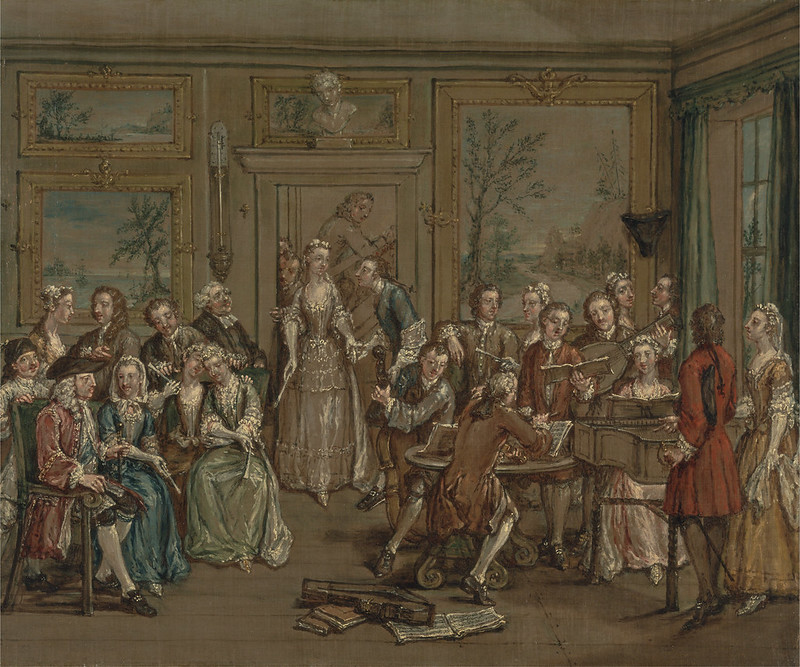
Marcellus Laroon II (1679-1772) - Musical Conversation (c.1760)


Giuseppe Paolucci (1726-1776) - Sinfonia a quattro
Performers: Symphonia Perusina

---


Italian composer and theorist. He studied in Bologna with Padre Martini during the 1750s and like him was a member of the Franciscan order. Eight sacred works from this period (1752-1756) are in the Bologna Conservatory library. About 150 letters from Paolucci to Martini are evidence of their close friendship. Between 1756 and 1769 he was maestro di cappella at S Maria Gloriosa dei Frari in Venice, and from August 1770 until January 1772 at S Martino in Senigallia. He then worked at S Francesco in Assisi until his death. Paolucci is best known for his treatise Arte pratica di contrappunto (Venice, 1765-1772), which served as a model for Martini’s Esemplare ossia Saggio fondamentale pratico di contrappunto (Bologna, 1774-1775). While Martini concentrated almost exclusively on the 16th century, Paolucci used a number of examples from the 18th, including one by Handel, as well as a passing reference to J.S. Bach. There is no detailed study of Paolucci’s music, which includes more than 200 sacred works (primarily for chorus, soloists and orchestra) and a few instrumental pieces. He published Preces octo vocibus concinendae in oratione quadraginta horarum (Venice, 1767)

dilluns, 24 de maig del 2021

UMSTATT, Joseph (1711-1762) - Cembalokonzert C-Dur

Attributed to Carle van Loo (1705-1765) - Music, Art and Science


Joseph Umstatt (1711-1762) - Cembalokonzert C-Dur, Nr.7
Performers: Gertrud Jemiller (cembalo); Lukas-Consort
Further info: Bamberger Hofmusik

---


Austrian composer. According to the parish register in St Stephen’s, Vienna, he was the second of five children of the court painter to the widowed Empress Anna Amalia of Austria. He was probably educated in Vienna. In 1749 he held an appointment in Dresden as musical director at the court of Count Brühl, where he became acquainted with J.A. Hasse and J.C.F. Bach. On 20 October 1752 he was appointed Kapellmeister and court composer to the Prince-Bishop J.P. von Frankenstein and his successor in Bamberg. The following years, up to his death, were his most creative. Umstatt composed in nearly all the forms of his time, both sacred and secular, and his works demonstrate the gradual change from Baroque polyphony to the Classical style. This can be seen in his masses (which include cantata masses in several movements, of both the missa solemnis and missa brevis types) where fugues stand alongside homophonic and cantabile sections. In his Missa pastoritia he made extensive use of folksong melodies and shepherd calls. The ‘stylus mixtus’ of J.J. Fux is Umstatt’s starting-point, but he also attempted to develop an individual style. He composed solo concertos for violin, flute, harpsichord and pantaleon. In his concertos Umstatt modified the Vivaldian concerto form, giving the solo episodes greater weight and prolonging them by comparison with the tuttis; virtuoso passages for the soloist play an important part in the harpsichord concertos. Umstatt’s use of sequence may be seen as conservative, but various flourishes, figurations and rhythmical formulas are a part of galant style. His 11 surviving symphonies are mostly in three movements (two have an additional minuet and trio). Most of his thematic material is of broken-chord, triadic matter; his music sometimes remains on this harmonic plane, whereas in the works of his contemporaries (such as Monn or Wagenseil) melodic lines often follow the opening chordal flourishes. In most of his symphonic movements there is a second theme in the dominant key, which does not return later in the movement. His development sections, in the common manner of the time, consist of modulating sequences with occasional use of motifs from the principal theme; and the reprises are short and incomplete, repeating only the closing section of the exposition. Umstatt’s music is typical of the older generation of the Viennese school; stylistically, his music stands alongside that of Monn and other better-known contemporaries, though Umstatt’s works do not reflect a special personal style.