divendres, 31 de desembre del 2021

BACH, Johann Christian (1735-1782) - Sinfonia (g-moll) a Più Stromenti

Thomas Gainsborough (1727-1788) - Johann Christian Bach


Johann Christian Bach (1735-1782) - Sinfonia (g-moll) a Più Stromenti (1770)
Performers: Pratum Integrum

---


German-English composer of international stature. The youngest son of Johann Sebastian Bach, he received his earliest musical training from his father and a cousin, Johann Elias Bach. After serving as a secretary to his father the final year of his father’s life, he moved to Berlin in 1750, receiving further instruction from his brother Carl Philipp Emanuel Bach. In 1755 he left for Milan, where he eventually obtained the patronage of Count Agostino Litta. Following study with Padre Giovanni Battista Martini and conversion to Roman Catholicism, he was appointed second organist at the Milan cathedral in 1760. A commission for an opera from the Teatro Regio in Turin the same year, however, altered his fortunes; the work, Cantone in Utica, was a success that led both to commissions throughout Italy and an international reputation as a composer of Italian opera. In 1762 he was invited to London, where he set the opera Orione. Its success and the appointment as Music Master to the Queen allowed him to reside permanently there. A further trip to Paris solidified his ability to publish his music, and, finally, his lodging with compatriot Carl Friedrich Abel resulted in a collaborative concert series beginning in 1764. For the next decade he traveled regularly to Paris where his works were highly esteemed, and in 1772 he was invited to Mannheim to set the opera Temistocle. In 1779 he wrote his first tragédie lyrique for Paris, Amadis de Gaule. Despite the successes, competition with rival concert a difficult economic situation, and ill health led to his early death. Bach can be considered one of the pivotal composers of the age. Unlike his brothers Wilhelm Friedemann Bach and Carl Philipp Emanuel Bach, he fully immersed himself in the Italian style, creating works that feature clear period lyrical themes, solid harmonic foundations, and distinct formal structures. His orchestration, often using obbligato instruments, is colorful, and Bach used various Mannheim orchestral devices to great effect. He was one of the most popular composers of the period, whose music had circulation throughout Europe, influencing a later generation of composers, such as Wolfgang Amadeus Mozart. He was a prolific composer in virtually all genres. His works include 39 operas, three serenatas, an oratorio, seven Mass/Requiem movements, 28 other sacred works, 15 concert arias and cantatas, 45 songs/canzonetts, 34 symphonies, 19 sinfonia concertantes, 28 keyboard concertos, 11 other concertos (violin, flute, oboe, and bassoon), six wind symphonies, 11 marches, a sextet, 13 quintets (string and piano), 20 quartets (string, flute, and piano), 14 trio sonatas, 12 trios (almost all piano trios), 26 violin sonatas, two viola da gamba sonatas, 23 keyboard sonatas (four for keyboard four hands), and numerous miscellaneous pieces for the keyboard and harp. His music has been cataloged according to Terry (T) or Warburton (W or CW) numbers.

dimecres, 29 de desembre del 2021

BACHSCHMID, Anton Adam (1728-1797) - Flauto Traverso Concerto: In G

De Sacy (fl. 1716) - Nature morte aux instruments de musique (1716)


Anton Adam Bachschmid (1728-1797) - Flauto Traverso Concerto: In G (1771)
Performers: Felix Rengli (flute); Nova Stravaganza

---


German composer and violin virtuoso of Austrian birth. He came from a long line of musicians who emigrated to Melk late in the 17th century from Traunstein, Bavaria. While still a young man he was appointed Thurnermeister (director of instrumental music) in Melk, a post which he held from July 1751 to May 1753. He left his native town for travels as a virtuoso and may have been employed briefly at Würzburg (or Wurzbach) before settling in Eichstätt. There he established himself as a versatile musician in the court orchestra of Prince-Bishop Johann Anton II, using steadily in rank from violinist (September 1753) to Konzertmeister (March 1768) and finally to court Kapellmeister (July 1773). Although he developed a reputation primarily as a church composer, Bachschmidt wrote a number of dramatic works for Eichstätt’s theatres. His turn from Latin school drama to Italian opera reflects the closing of the Jesuit theatre in Eichstätt in 1773.

dilluns, 27 de desembre del 2021

TAUSCH, Franz (1762-1817) - Symphonie concertante, Op.26 (c.1800)

Anoniem (19th Century) - Gezicht op Heidelberg en Schloss Heidelberg


Franz Tausch (1762-1817) - Symphonie concertante (B-Dur) pour deux clarinettes avec accompagnement de l'orchestre ... op. 26 (c.1800)
Performers: Daniel Pacitti (clarinet); Nicola Bulfone (clarinet); Orchestra da camera di Udine; Walter Themel (conductor)

---


German clarinettist, basset-horn player and composer. He founded the German playing style, which put beauty of tone above technique. He was a child prodigy: at the age of eight he played in the Mannheim orchestra with his father Jacob Tausch, who taught him. Moving with his father to Munich, Franz became a notable soloist and made several concert tours. He was chamber musician to the dowager Queen of Prussia in 1789 and from 1797 to Friedrich Wilhelm III. In 1805 Tausch opened the Conservatorium der Blasinstrumente in Berlin, where Heinrich Baermann and Crusell were among his pupils. His compositions are noteworthy, and make considerable demands on the player. They include a number of clarinet concertos, six quartets for two basset-horns and two bassoons (with two horns ad lib), duos for violin and viola and for two clarinets, and other chamber music for wind. After his death the conservatory continued under the direction of his son Friedrich Wilhelm Tausch (1790-1845), himself a fine player.

diumenge, 26 de desembre del 2021

HOMILIUS, Gottfried August (1714-1785) - Weihnachtsoratorium (1777)

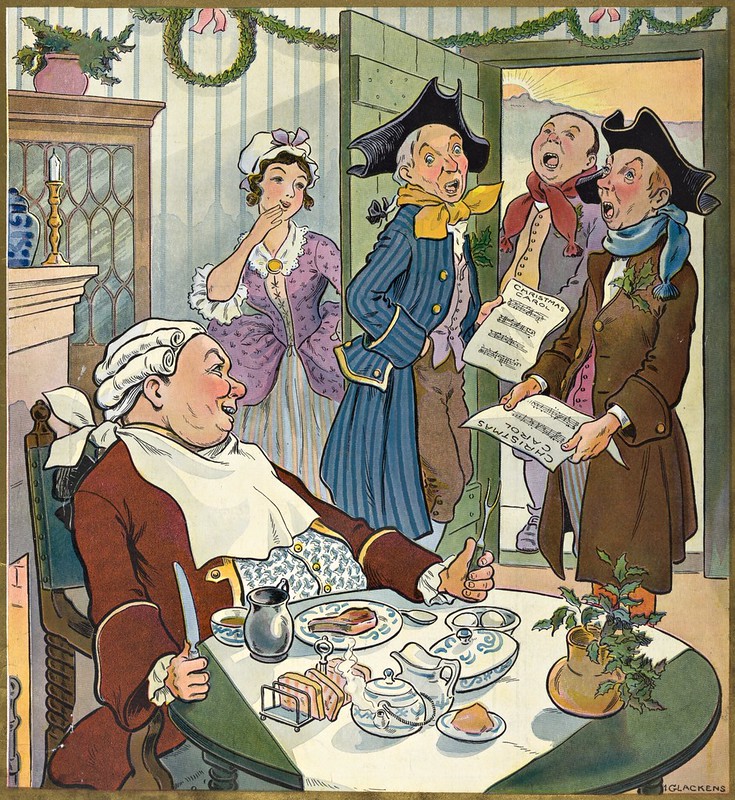
Louis Glackens (1866-1933) - Puck Christmas (1903)


Gottfried August Homilius (1714-1785) - Weihnachtsoratorium (1777)
Performers: Christiane Kohl (sopran); Annette Markert (alto); Marcus Ullmann (tenor); Tobias Berndt (bass); Sächsisches Vocalensemble; Virtuosi Saxoniae; Ludwig Güttler (conductor)

---


German composer, organist and Kantor. The son of a Lutheran pastor, he spent his childhood from 1714 in Porschendorf (Pirna district). After his father’s death in 1722 he attended the Annenschule in Dresden, where in 1734 he composed his earliest extant work, the cantata 'Gott der Herr ist Sonn und Schild'. He sometimes stood in for the organist at the Annenkirche, J.G. Stübner, who was probably his organ teacher. On 14 May 1735 he matriculated at Leipzig University in law; a class report from the professor A. Kästner (16 September 1741) reads: ‘For three years the candidatus juris has availed himself of my praelectionum iudicarum and striven to master the fundamenta iuris. He has, however, always allowed music to be his main task’. At this time he also took lessons from Bach in composition and keyboard playing, as mentioned by J.A. Hiller (Lebensbeschreibungen, 1784) and confirmed by Forkel (Ueber Johann Sebastian Bachs Leben, Kunst und Kunstwerke, 1802); he was probably also a pupil of, and assistant to, the organist at the Nikolaikirche, Johann Schneider. In 1741 Homilius applied unsuccessfully for the organist’s post of St Petri in Bautzen, submitting five chorale settings for organ of which two had obbligato parts for horn. His first post as organist was granted him in May 1742 by Dresden’s Frauenkirche, which possessed a new Silbermann organ. An application on 5 November 1753 for the post of organist at the Johanniskirche, Zittau, failed. On 10 May 1755, however, he was appointed Kantor at the Kreuzkirche in Dresden and teacher (Collega V) of the Kreuzschule (‘as he is skilled in Greek and all else, but is pre-eminent in music’), and at the same time music director of Dresden’s three principal churches – the Kreuzkirche, Frauenkirche and Sophienkirche; a month later the appointment was ratified by the Dresden town council. After the Kreuzkirche was destroyed in 1760 (during the Seven Years War), Homilius directed his activity mainly to the Frauenkirche. Tirelessly active until an advanced age, he composed a full yearly cycle of cantatas in the last years of his life, and in 1784 dedicated 12 Magnificat settings and a Latin motet (destroyed in World War II) to the Dresden council. He suffered a stroke in December of that year, and in the following March was retired.

divendres, 24 de desembre del 2021

VOGL, Georg (1725-1761) - Sinfonia Pastoritia (G-Dur) à 4 voci (c.1760)

Hendrik Meyer (1744-1793) - A Winter Scene (1787)


Georg Vogl (1725-1761) - Sinfonia Pastoritia (G-Dur) à 4 voci (c.1760)
Performers: Europasommers Orchestra

---


German violinist and composer. After early training in Freising at the Jesuit schools as a chorister, he was taken on by Count Clemens von Bayern as an ordinary musician. His early studies were with Placidus von Camerloher, but in 1758 he was sent to Italy to complete his training. There he became known for his violin playing and operas, written both for Italian theatres and for Jesuit seminaries in Germany. Also in Italy he was acclaimed as a 'violin virtuoso'. His Italian and German operas have not survived; his remaining music includes three symphonies, a violin concerto, a Requiem, and two litanies. His brothers, Pater Benedikt Vogl (1718-1790) and Pater Christoph Vogl (1722-1767) were also musicians but focused as a monastic composers in a Benedictine abbeys.