dimecres, 30 d’agost del 2023

HESSE, Adolf Friedrich (1809-1863) - Fantasie für die Orgel

Carl Hasenpflug (1802-1858) - Klosterruine im Winter (1851)


Adolf Friedrich Hesse (1809-1863) - Fantasie (d-moll) für die Orgel, Op.87
Performers: Luisella Gіnаnnі (organ); Emilio Trаvеrso (organ)

---


German organist and composer. He studied in his hometown with the organists Friedrich Wilhelm Berner and Ernst Köhler. On his first major concert tour in Germany met Hummel in Weimar and Spohr in Kassel. In Darmstadt he met Rinck with whom he studied in the winter of 1828-29. In 1831, he took over the principal organist post at the Bernhardinerkirche in Breslau where he remained the rest of his life. He was highly regarded as one of the most important organists in Germany, his virtuosic playing and agile pedalwork dazzled audiences in Paris, where he played an all-Bach programme—a novelty in France—for the inauguration of the organ at Saint-Eustache in 1844. Back in Breslau, he conducted the symphonic concerts of the city's Opera Orchestra. One of Hesse's pupils was the Belgian organist Jacques-Nicolas Lemmens. Hesse’s compositions combined fugal polyphony modelled on Bach with rich, Romantic harmonies influenced by Spohr, whom he greatly admired. He retired, feeling dissatisfied at the direction of ‘modern music’, around 1850.

dilluns, 28 d’agost del 2023

VON WINTER, Peter (1754-1825) - Concertino per il Clarinetto e Violoncello

Gustav Seeberger (1812-1888) - Ansicht von München über die Isar bei einsetzender Abenddämmerung


Peter von Winter (1754-1825) - Concertino (Es Dur) per il Clarinetto e Violoncello
Performers: Irène Güdel (cello); Jost Michaels (1922-2004, clarinet);
Chamber Orchestra Of The Sarre; Karl Ristenpart (1900-1967, conductor)

---


German composer. He was a pupil of several of the Mannheim court musicians before took over a post of violinist in the Electoral orchestra at the age of 10. He was given permanent employment there in 1776. He later studied with Abbe Vogler, then went with the court to Munich in 1778 and became director of the Court Orchestra. In 1787 he was named court Vice-Kapellmeister and in 1798 court Kapellmeister. In 1814 he received a title of nobility from the court for his long service. In Munich he brought out a number of operas, of which the most important were Helena und Paris (1782), Der Bettelstudent oder Das Donnerwetter (1785), Der Sturm (1798), Marie von Montalban (1800), and Colmal (1809). Frequent leaves of absence from Munich enabled him to travel; in Venice he produced his operas Catone in Utica (1791), I sacrifizi di Creta ossia Ariannae Teseo (1792), I Fratelli rivali (1793), and Belisa ossia La fedelita riconosciuta (1794). In Prague he produced the opera Ogus ossia Il trionfo del belsesso (1795). In Vienna he brought out Das unterbrochene Opferfest (1796; his most successful opera; produced all over Europe), Babylons Pyramiden (1797), and Das Labirint oder Der Kampfmit den Elementen (1798). In Paris he produced his only French opera, Tamerlan (1802), in London the Italian operas Lagrotta di Calipso (1803), II trionfo dell'amor fraterno (1804), Il ratto di Proserpina (1804), and Zaira (1805). In 1816 he embarked on a concert tour of northern Germany and Italy with his pupil Clara Metzger-Vespermann, later a celebrated singer, during the course of which he directed three of his operas in Milan in 1817 and 1818. His last opera for Munich was the Singspiel Der Sänger und der Schneider (1820), but he remained active until his last years as a composer of church music. As a composer, he also wrote several ballets, oratorios and sacred cantatas for the Munich court chapel, 28 masses and a vast amount of other church music, 4 symphones (including the grand choral sym. Die Schlacht, 1814), overtures, concertos and other concerted works, and much chamber music.

diumenge, 27 d’agost del 2023

GARCIA CARRASQUEDO, Juan Antonio (1734-1812) - Misa para 5 voces

Carlo Innocenzo Carlone (1686-1775) - Apotheose der heiligen Cäcilia mit Engelskonzert


Juan Antonio García Carrasquedo (1734-1812) - Misa (en Si bemol mayor) para 5 voces
Performers: Josep Bеnеt (tenor); Camerata Coral de la Universidad de Cantabria;
Coral de Santander; Purcell Playеrs; Lynne Kurzеknаbe (conductor)

---


Spanish composer. It is said he firstly studied in Zaragoza, possibly in the Cathedral choir with his uncle Francisco Javier García Fajer 'El Españoleto' but other sources situed him in Italy. Around 1756 he settled in Santander where he was appointed as the first Kapellmeister of the city's Cathedral. His trace was lost then and almost nothing is known about his life and career there. Shortly before his death his signature appears on a document welcoming Joseph Bonaparte, so it seems that he must have had French or Enlightenment leanings towards the end of his life. Carrasquedo died in Santander on April 12, 1812. He was buried in the old San Francisco cemetery. As a composer, he mainly wrote sacred music which has been forgotten after his death. 

divendres, 25 d’agost del 2023

MILLARES TORRES, Agustín (1826-1896) - Variaciones para Clarinete y Cuerda

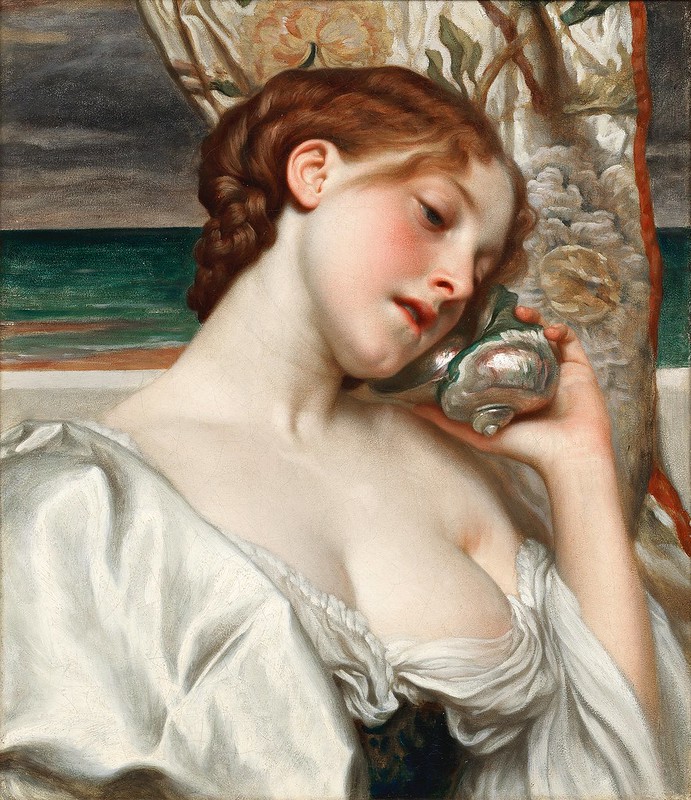
Frederic Leighton (1830-1896) - Sea Echoes


Agustín Millares Torres (1826-1896) - Variaciones para Clarinete y Cuerda
Performers: Radovan Cаvаllin (clarinete); Orquesta “Béla Bartók”; José Britο Lópеz (conductor)

---


Spanish historian, novelist and musician, author of the monumental work entitled "Historia General de las Islas Canarias". At the age of thirteen he entered the Seminary to attend high school while he was also receiving music lessons. In 1841 he served on Las Palmas Town Hall music band and began to compose regularly. In 1844, after obtaining a Bachelor's degree, he enrolled in the Escuela de Notariado de Las Palmas, where he obtained his degree in 1846. He then moved to Madrid to study at the Superior Conservatory of Music. Upon his return in Gran Canaria, he was teaching music at the Colegio San Agustín and took over the post of director of the Las Palmas Cathedral Music Chapel. On October 4, 1850, he married Encarnación Cubas Báez with whom he had eleven children. In 1882 he was appointed as member of the Royal Academy of History. As a composer, he wrote overtures, hymns, marches, waltzes, zarzuelas and sacred works.

dimecres, 23 d’agost del 2023

SPIESS, Meinrad (1683-1761) - Laetatus sum (1717)

Louis Chéron (1660-1725) - Cupid and Psyche before Jupiter (c.1710)


Meinrad Spiess (1683-1761) - Laetatus sum aus Cithara Davidis noviter animata ... opus II (1717)
Performers: Erika Rüggeberg (1940-2018, soprano); Convivium Musicum München;
Chor Der Herz-Jesu-Kirche München; Josef Schmidhuber (1924-1990, conductor)

---


German composer and theorist. Son of a farmer, he entered the Benedictine Abbey of Irsee in 1701 where he was ordained priest in 1708. Then he settled in Munich where he received music lessons from Giuseppe Antonio Bernabei. In 1712 he returned to the abbey at Irsee as kapellmeister, a post he held the rest of his life. There he was mainly in charge of the church music for which he wrote a largely number of masses, motets and other sacred works. In 1743 Lorenz Christoph Mizler accepted him as member of the reputed Societät der Musikalischen Wissenschaften in Leipzig, a society of music scholars and composers including, among others, Johann Sebastian Bach, Telemann and Handel.