dimecres, 29 de novembre del 2023

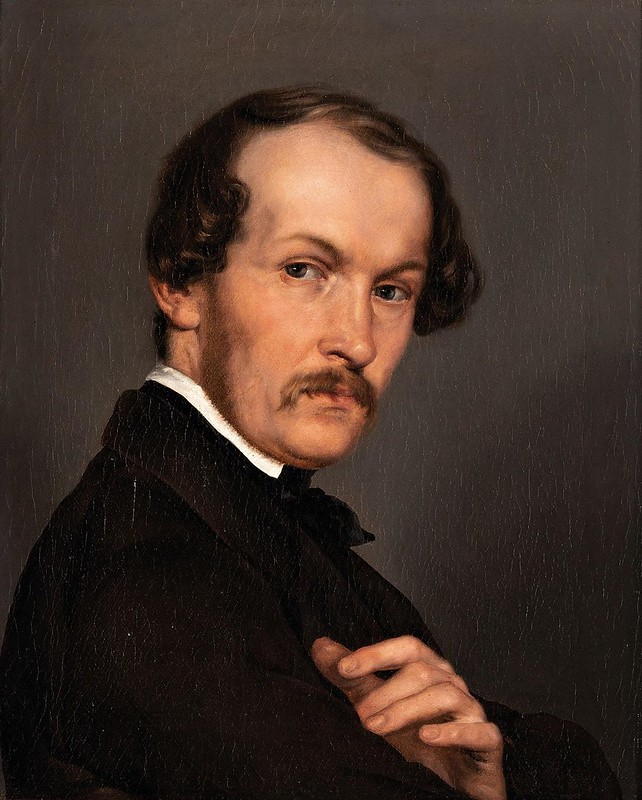
DONIZETTI, Gaetano (1797-1848) - Sinfonia per la morte di Capuzzi (1818)

Francesco Ferrari (1811-1878) - Ritratto di Gaetano Donizetti


Gaetano Donizetti (1797-1848) - Sinfonia (in re minore) per la morte di [Antonio] Capuzzi (1818)
Performers: Camerata Budapest; László Kοvács (conductor)

---


Italian composer. His father was from a poor family of artisans who obtained the position of caretaker in the local pawnshop. At the age of nine, he entered the Lezioni Caritatevoli di Musica, a charity institution that served as the training school for the choristers of S. Maria Maggiore; he studied singing and harpsichord there, later studying harmony and counterpoint with J.5. Mayr. With the encouragement and assistance of Mayr, he enrolled in the Liceo Filarmonico Comunale in Bologna in 1815, where he studied counterpoint with Pilotti; later, he studied counterpoint and fugue with Padre Mattei. His first opera, Il Pigmalione (1816), appears never to have been performed in his lifetime. He composed two more operas in quick succession, but they were not performed. Leaving the Liceo in 1817, he was determined to have an opera produced. Mayr helped him to obtain his first professional engagement, a commission that resulted in Enrico di Borgogna, performed in November 1818 at the Teatro di S Luca in Venice. Up to this point Donizetti's professional activities had been confined to northern Italy and to smaller theatres, but in 1821 he was invited to compose a new opera for the Teatro Argentina in Rome. The resulting work, Zoraid di Granata, was Donizetti's most successful yet, winning him an invitation from the leading impresario of the time, Domenico Barbaja, to write for Naples. Donizetti settled in Naples in February 1822 and was to be based there for the next 16 years. With Anna Bolena (Milan, 1830), Donizetti established himself as a master of the Italian operatic theater. Composed for Pasta and Rubini, the opera was an overwhelming success. Within a few years it was produced in several major Italian theaters, and was also heard in London, Paris, Dresden, and other cities. Donizetti left Naples in October 1838 and moved permanently to Paris. In March 1842 Rossini attempted to persuade Donizetti to accept the post of maestro di cappella at the cathedral of San Petronio in Bologna, but Donizetti declined in order to accept the far more prestigious position of Hofkapellmeister to the Habsburg court in Vienna and court composer to the Austrian emperor. The last opera produced in his lifetime was Caterina Cornaro (Naples, 1844). By this time Donizetti began to age quickly; in 1845 his mental and physical condition progressively deteriorated as the ravages of syphilis reduced him to the state of an insane invalid. In 1846 he was placed in a mental clinic at Ivry, just outside Paris; in 1847 he was released into the care of his nephew, and was taken to his birthplace where he died on 8 April 1848.

dilluns, 27 de novembre del 2023

KROMMER, Franz (1759-1831) - Concerto Pour deux Clarinettes (c.1802)

Unknown - Volkssänger in einem Gasthaus (c.1850)


Franz Vinzenz Krommer (1759-1831) - Concerto Pour deux Clarinettes
composé et dédié à M. de Marsano, Op.35 (c.1802)
Performers: Ludmila Pеtеrková (clarinet); Marjolein de Rοοs (clarinet);
Czech Ensemble Baroque; Roman Válеk (conductor)

---


Moravian composer. He was the son of the innkeeper and later mayor of Kamenice Jiří Kramář (1737–1810), and the nephew of the composer and choirmaster Anton Matthias Krommer (1742-1804) with whom he studied violin and organ. Later he was self-taught in composition. He became a violinist in the orchestra of the Duke of Styrum in Simontornya (1786), becoming his music director (1788). Towards the end of 1790 he became Kapellmeister of Pécs Cathedral; after 1793 he acted as Kapellmeister and composer in the service of a Duke Karolyi and later of Prince Antal Grassalkovich de Gyarak. In 1798 he became Kapellmeister to Duke Ignaz Fuchs. Then he returned to Vienna where in 1806 he applied, unsuccessfully, to join the Vienna Hofkapelle as a violinist. In 1810 he was appointed Ballett-Kapellmeister at the Wien Hofkapelle. On 14 June 1815 he was appointed Kammertürhüter to the emperor, and in this office accompanied Emperor Franz I to Paris and Padua in the same year, and to Verona, Milan and Venice in 1816. From 13 September 1818 until his death he succeeded Leopold Anton Kozeluch as the last official director of chamber music and court composer to the Habsburg emperors. As a composer, he wrote over 300 works, among them, accomplished solo concertos for wind instruments, as well as symphonies, sacred works, much chamber music and piano pieces. He was one of the most successful of the many influential Moravian composers in Vienna at the turn of the 18th century. His son August Krommer (1807-1842), an insurance agent in Vienna, was for a time a violinist in the orchestra of the Burgtheater, and also appeared in public as a pianist in 1833.

diumenge, 26 de novembre del 2023

DIAS DE OLIVEIRA, Manoel (c.1735-1813) - Te Deum laudamus

Vinzenz Fischer (1729-1810) - Triumphzug eines Feldherrn durch den Titusbogen (1791)


Manoel Dias de Oliveira (c.1735-1813) - Te Deum laudamus
Performers: Camerata Antiqua de Curitiba; Roberto de Regina (conductor)
 Further info: Te Deum

---


Brazilian composer, organist and conductor. He was active in the province of Minas Gerais during the late colonial period and worked as a scribe in several brotherhoods in São José del Rei and São João del Rei. In the register of death certificates and wills at the church of S Antônio in his native city he is described as ‘mestre compositor de muzica’. According to research by J.M. Neves, Oliveira was also a captain and a mulatto. His rather extensive output includes a Mass, a Miserere, Te Deum, Magnificat, novenas, litanies and motets. The works are preserved chiefly in the archives of the Lira Sanjoanense Orchestra and the Lira Ceciliana, though few of the manuscripts are autograph.

divendres, 24 de novembre del 2023

ATTWOOD, Thomas (1765-1838) - Trio for the piano forte, violin and violoncello obligato (c.1787)

George Barret (1723-1784) - River Landscape


Thomas Attwood (1765-1838) - Trio for the piano forte, violin and violoncello obligato, Op. I (c.1787)
Performers: Concilium Musicum Wien
Further info: Les Élèves De Mozart

---


English composer and organist. His father, Thomas Attwood, was an under-page to George III, and a viola player and trumpeter in the King's Band. Throughout his life Attwood benefited from royal patronage. At 9, he became a chorister at the Chapel Royal. In 1781 he was made one of the Pages of the Presence to the Prince of Wales, who made it possible for him to study in Naples with Felipe Cinque and Gaetano Latilla (1783-85). He then went to Vienna, where he received composition lessons from Mozart. In 1787 he returned to England and resumed his court position. He was made music teacher to the Duchess of York in 1791 and to the Princess of Wales in 1795. In 1796 he became organist at St. Paul's Cathedral and composer at the Chapel Royal. In 1813 he helped to organize the Philharmonic Society of London, with which he appeared as a conductor. When the Royal Academy of Music in London was organized in 1823, he was made a professor. In 1825 he became musician-in-ordinary to the king. He was named organist of the Chapel Royal in 1836. Mendelssohn became his close friend, and among his students were his godson, Thomas Attwood Walmisley, George Bridgetower and Cipriani Potter. Attwood's compositions, whether for the stage, the church or the home, were profoundly affected by his intense experience as Mozart's pupil. His output includes music for some 30 stage works, several instrumental pieces, much vocal music, including the fine coronation anthems 'I was glad' (1821) and 'O Lord, grant the king a long life' (1831), a Service in F, songs and glees. Thomas Attwood Walmisley edited 'Services and Anthems Composed by T. A.' (London, 1852).

dimecres, 22 de novembre del 2023

BACH, Wilhelm Friedemann (1710-1784) - Sinfonia a 6 (c.1740)

Jan Josef Horemans II (1714-1792) - Romantic scene (1760)


Wilhelm Friedemann Bach (1710-1784) - Sinfonia (d-moll) â 2 Travers:, 2 Violini, Viola et Basso (c.1740), Fk 65
Performers: Akademie für Alte Musik Bеrlin; Stephen Mаi (conductor)

---


German composer and organist. The eldest son of Johann Sebastian Bach, he received his earliest musical training from his father, later enrolling in the Thomasschule in Leipzig. In 1726 he was sent to Merseburg to study violin under Johann Gottlieb Graun, returning in 1729 to enroll in Leipzig University. There he studied mathematics, but in 1733 he was appointed organist at the Sophiakirche in Dresden. In 1746 he was appointed as organist at the Liebfraukirche in the Pietist city of Halle. Unfortunately, his relations with the town fathers and his cantor Georg Mittag were problematic, and he began to apply for other posts throughout Germany without success, although he was allowed in 1762 to style himself as Kapellmeister to the court of Hessen-Darmstadt even though he did not obtain the position. In 1764 he simply quit his position and began to support himself through private teaching, eventually leaving for Braunschweig in 1770 and subsequently for Berlin four years later. There, he continued to teach even though he was initially welcomed at the court of Anna Amalia, the sister of Frederick II of Prussia. His last years were spent in extreme poverty exacerbated by alcoholism. Although active as a composer, his reputation during his lifetime was primarily for his keyboard improvisation, no doubt due in part to the rigorous training provided by his father. His music, however, is often characterized by a mixture of older styles (also inherited from his father) and a sense of harmonic and formal experimentation that often created extreme contrast and jarring dissonances. Not surprisingly, some of his earlier compositions were so close in style to those of his father that they were misattributed. He was a good teacher; his students include his brother Carl Philipp Emanuel Bach, Johann Gottlieb Goldberg, and Johann Nikolaus Forkel, with whom he also collaborated on that author’s biography of Johann Sebastian Bach. His music, cataloged according to F (Falck) or BR numbers, consists of 32 cantatas (two secular); an opera, Lausus und Lydie; two Masses and several Mass movements; a German Te Deum; several other smaller sacred settings; 15 keyboard sonatas; 18 works for musical clockwork; around 40 polonaises; 10 keyboard fantasies; some 40 or so miscellaneous works for the keyboard; 11 fugues/canons; three sonatas for two keyboards (one titled “concerto”); eight symphonies; seven concertos (five for keyboard, and one each for flute and two harpsichords); a sextet; nine flute duets; three viola duets; and five trio sonatas. The famous portrait by Wilhelm Weitsch is now known to portray his cousin.