Es mostren els missatges amb l'etiqueta de comentaris Hertel J.W.. Mostrar tots els missatges

divendres, 10 d’octubre del 2025

HERTEL, Johann Wilhelm (1727-1789) - Concerto per il Organo

Cornelis Troost (1696-1750) - Sint Nicolaasfeest


Johann Wilhelm Hertel (1727-1789) - Concerto per il Organo | accompagnato | da | 2 Corni, 2 Flauti | 2 Violini, Violetta et Basso, | composto et dedicato | all'Altezza Serenissima | di | FEDERICO |
Duca Regnante di Meclenburgo
Performers: Mеrsеburger Hofmusik; Michael Schönhеit (organ & conductor)

---


German violinist, keyboard player and composer. Son of Johann Christian Hertel (1697-1754), he received his musical training from his father and members of the Bach family. He also came to the attention of Franz Benda, who heard him perform in 1742 in Strelitz, where his father had moved. Upon Benda’s recommendation Hertel was trained in Berlin and at the court of Zerbst before obtaining a position as Kapellmeister with Duke Christian Ludwig of Mecklenburg-Schwerin. From 1770 he was the privy councillor in the service of Princess Ulrike but continued to compose, arrange concerts at the court and give music instruction. In his last years he gave up the violin and devoted himself to keyboard instruments. As a theorist, Hertel wrote four volumes on musical compositions, which were published in Leipzig between 1757 and 1758. In his youth Hertel was considered one of the best violinists of Franz Benda’s school. As a composer, he is best known for his craftsmanship that blends a progressive harmonic language with technical display. His music includes a Mass, five Passions, 12 secular cantatas (and seven with nontraditional sacred texts), 11 Lutheran cantatas, numerous chorales, 40 concert arias, 60 Lieder, three motets, three Psalms (in German), two sets of incidental music for Shakespeare plays, 63 symphonies, 15 keyboard concertos (and 31 other concertos), three partitas, five trios, 19 violin sonatas, and 30 keyboard sonatas. His literary works include a treatise on thoroughbass, three autobiographies and a collection of essays by Voltaire and others. 

dilluns, 9 d’octubre del 2023

HERTEL, Johann Wilhelm (1727-1789) - Sinfonia in D-Dur

Anthony Devis (1729-1816) - A view of the Bishop's Palace, Farnham Castle


Johann Wilhelm Hertel (1727-1789) - Sinfonia in D-Dur
Performers: International Soloist Orchestra; Enrico Bаrtеllo (conductor)

---


German violinist, keyboard player and composer, son of Johann Christian Hertel (1697-1754). He received his musical training from his father and members of the Bach family. He also came to the attention of Franz Benda, who heard him perform in 1742 in Strelitz, where his father had moved. Upon Benda’s recommendation Hertel was trained in Berlin and at the court of Zerbst before obtaining a position as Kapellmeister with Duke Christian Ludwig of Mecklenburg-Schwerin. From 1770 he was the privy councillor in the service of Princess Ulrike but continued to compose, arrange concerts at the court and give music instruction. In his last years he gave up the violin and devoted himself to keyboard instruments. As a theorist, Hertel wrote four volumes on musical compositions, which were published in Leipzig between 1757 and 1758. In his youth Hertel was considered one of the best violinists of Franz Benda’s school. As a composer, he is best known for his craftsmanship that blends a progressive harmonic language with technical display. His music includes a Mass, five Passions, 12 secular cantatas (and seven with nontraditional sacred texts), 11 Lutheran cantatas, numerous chorales, 40 concert arias, 60 Lieder, three motets, three Psalms (in German), two sets of incidental music for Shakespeare plays, 63 symphonies, 15 keyboard concertos (and 31 other concertos), three partitas, five trios, 19 violin sonatas, and 30 keyboard sonatas.

dilluns, 14 de juny del 2021

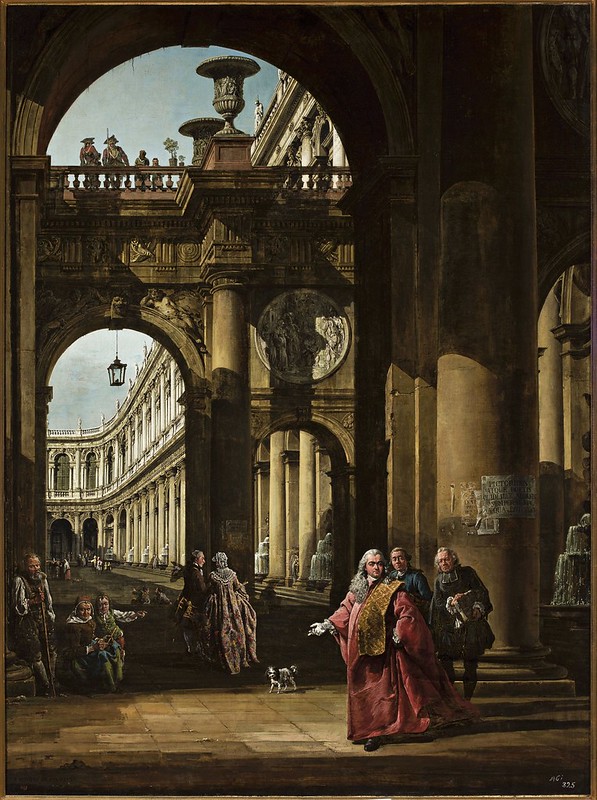
HERTEL, Johann Wilhelm (1727-1789) - Sinfonia G-Dur (c.1765)

Bernardo Bellotto (1722-1780) - Autoportret w stroju prokuratora weneckiego


Johann Wilhelm Hertel (1727-1789) - Sinfonia G-Dur (c.1765)
Performers: Neubrandenburger Philarmonie

---


German violinist, keyboard player and composer, son of Johann Christian Hertel (1697-1754). Destined at first to be a lawyer or theologian, he nevertheless received an early musical education from Bach’s pupil J.H. Heil (1706-64) and by the age of 12 he accompanied his father as harpsichordist on concert tours. In 1742-3 he was a violin pupil of Carl Höckh, the Konzertmeister in Zerbst, and in 1744 he was violinist and harpsichordist at the Strelitz court, where his father was also employed. He had contacts with leading Berlin musicians such as Franz Benda, C.H. and J.G. Graun, and C.P.E. Bach; Franz Benda taught him the violin and C.H. Graun encouraged him to compose. After the Strelitz Hofkapelle was dissolved (1752) he became court composer in Schwerin in 1754, and worked at times as organist and church music director in Stralsund (1759-60). He was Princess Ulrike’s private secretary from 1764 and when the Hofkapelle moved to Ludwigslust in 1767 Duke Friedrich dismissed him from it so that he could remain in Schwerin. From 1770 he was the privy councillor in the service of Princess Ulrike but continued to compose, arrange concerts at the court and give music instruction. In his last years he gave up the violin and devoted himself to keyboard instruments. In his youth Hertel was considered one of the best violinists of Franz Benda’s school; he composed an impressive series of nine violin concertos as well as chamber music and trio sonatas. His 17 keyboard concertos, rich in invention and distinguished by fluent passage-work, are important north German achievements in this genre and rank beside C.P.E. Bach’s and A.C. Kunzen's. His sonatas and other works for keyboard, mostly still typical of harpsichord composition, are markedly inferior to the concertos. His 40 symphonies occupy a major place in his creative output. While his symphonic writing at first adopted the style of the Berlin school of Hasse and Graun, after 1760 it underwent a stylistic change unique in north Germany at the time by absorbing south German influences. Scored mainly for strings, horns, oboes and flutes, his symphonies are notable for their uncomplicated, straightforward technique and an almost aphoristic, rhythmically succinct and brilliant handling of thematic material. He also wrote incidental music for stage works, overtures and other instrumental concertos including ten oboe concertos.

dijous, 14 de juny del 2018

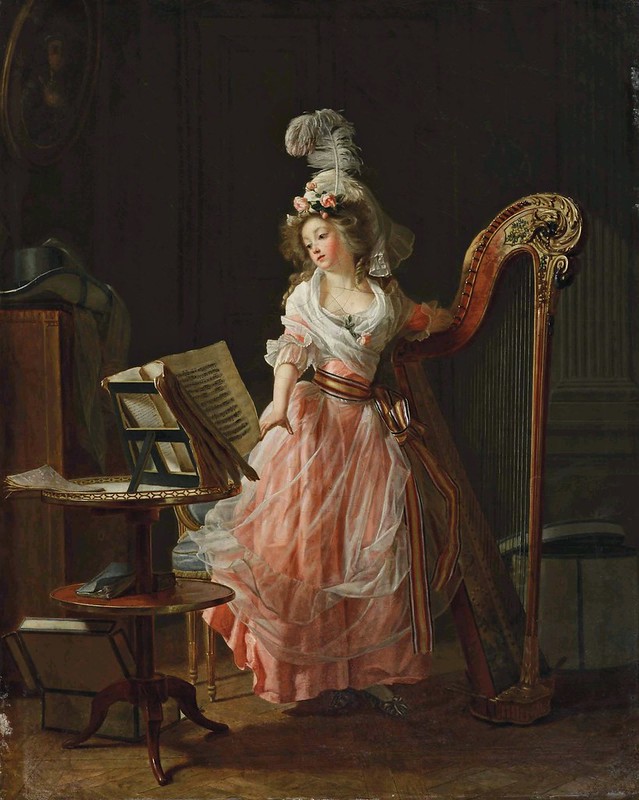
HERTEL, Johann Wilhelm (1727-1789) - Harp Concertos

Michel Garnier - La jeune musicienne (1788)
Obra de Michel Garnier (1753-1819), pintor francès (1)


- Recordatori de Johann Wilhelm Hertel -
En el dia de la commemoració del seu 229è aniversari de decés


Parlem de Pintura...

Michel Garnier (Saint-Cloud, 1753 - Paris, 1819) va ser un pintor francès. Es desconeix la seva formació inicial sent la primera referència de 1781, any en què va entrar a treballar al servei del duc Louis-Philippe d'Orléans. Abans del 1789 va entrar a l'estudi de Jean-Baptiste-Marie Pierre i va començar a produir diverses obres les quals van ser, principalment, escenes de gènere. A partir del 1791 va exhibir al Saló de París i entre el 1801 i 1810 va viure a Île-de-France, lloc on es va especialitzar en pintura de natures mortes. Al seu retorn a França es va instal·lar a París on hi va treballar fins el 1814 i on hi va morir el 1819.


Parlem de Música...

Johann Wilhelm Hertel (Eisenach, 9 d'octubre de 1727 - Schwerin, 14 de juny de 1789) va ser un violinista i compositor alemany. Fill de Johann Christian Hertel, es va formar amb el seu pare. I si bé la seva família va procurar-li una formació en teologia i dret, ben aviat es va decantar per la música estudiant amb Johann Heinrich Heil (1706-1764), un alumne de Bach. Amb 12 anys es va unir a les gires de concerts amb el seu pare abans d'estudiar violí amb Carl Höckh, el Konzertmeister de Zerbst. El 1744 va assolir el primer càrrec de violinista i clavecinista a la cort de Strelitz. Allà va entrar en contacte amb els músics de Berlín Franz Benda, els germans Graun i CPE Bach. El 1752 i després de la dissolució de la cort de Strelitz, va assolir el 1754 el càrrec de compositor de la cort a Schwerin. El 1759 va acceptar un càrrec d'organista i mestre de capella a Stralsund. A partir del 1770 es va convertir en el conseller privat al servei de la princesa Ulrike Sophie si bé no va deixar de compondre i organitzar concerts. Els darrers anys va abandonar el violí per a centrar-se en la música per a instruments de tecla. Johann Wilhelm Hertel va morir a Schwerin el juny de 1789.

OBRA:

Vocal secular:

Lieder:
Johann Friedrich Löwens [24] Oden und Lieder (Leipzig, 1757);
Johann Wilhelm Hertels Musik zu 24 neuen Oden und Lieder aus der Feder des Herrn Johann Friedrich Löwen (Rostock, 1760);
5 in Unterhaltungen, vii–x (Hamburg, 1769–70); 5 in D.B. Münter:
Sammlung geistlicher Lieder, i (Leipzig, 1773);
2, D-SWl; 2 vols., B-Bc

Other secular:
12 festival cantatas (J.F. Löwen), most for 2 S, T, B, orch, 1754–7, Bc, D-SWl;
Il vero omaggio (Metastasio), 1761, B-Bc;
more than 40 arias (most by Metastasio), 1v, orch, Bc, D-ROu, SWl;
Divertissement, 4vv, orch, 1767, B-Bc;
2 serenatas: 1 for 1v, orch, 1763 D-SWl;
1 for 1v, choir, orch, B-Bc, D-SWl

Vocal religiosa:

Sacred cants., all B-Bc, D-SWl, for 2 S, T, B, orch:
Das traurige Schicksal der Grossen auf Erden (Palitzsch), 4vv, orch, 1753, B-Bc;
Die Geburt Jesu Christi (H.J. Tode), 1777;
Die Gabe des Heiligen Geistes (Tode), 1777;
Die Himmelfahrt Christi (Tode), 1778;
Das Vertrauen auf Gott (Tode), 1778;
Der Ruf zur Busse (Tode), 1781;
Kirchen-Musik zur Feyer des Friedens-Festes, 1763

Other sacred:
Der sterbende Heiland (J.F. Löwen), passion, S, A, T, B, orch, 1764, B-Bc, D-SWl;
Passion in 4 parts (Tode), incl. Jesus in Gethsemane, 1780, Jesus in Banden, 1782, Jesus vor Gericht, 1782, Jesus in Purpur, 1783, all B-Bc, D-SWl;
Mass a 8, choir, str qt, SWl;
Ky, Gl, 4vv, org, B-Bc;
Herr, wie lange (Ps xiii), solo vv, choir, orch, 1777;
Wie lieblich sind deine Wohnungen (Ps lxxxiv), solo vv, choir, orch, 1775;
Jauchzet dem Herrn alle Welt (Ps c), choir, orch, 1780, SWl, B-Bc;
11 choral cants., solo vv, choir, orch, 1768–76, B-Bc, D-SWl;
Freuet euch, motet, 4vv, B-Bc;
Ich halte dich, motet, 4vv, org, Bc, D-SWl;
many chorales, 4vv, orch, SWl

Instrumental:

Incid music:
Richard III, Romeo und Julia, both (C.F. Weisse, after W. Shakespeare), 1767

Syms.:
6 sinfonie, 2 vn, va, b, 2 ob, 2 fl, 2 hn, bc (Hamburg, 1766);
2, 1755, D-DS, lost;
40, B-Bc;
15, D-SWl

Other orch:
15 kbd concs., others Bsb, SWl;
9 vn concs., B-Bc;
22 concs. for various solo insts, orch, Bc;
2 ovs., Bc;
3, minuets orch, Bc

---

Chbr:
Partita I–III, org, ob, bc, 1762, Bc, D-SWl;
5 trios, B-Bc;
6 marches, wind insts, Bc, D-SWl;
19 sonatas for vn, bc, B-Bc;
sonata a 4 and concerto a 5, wind insts, Bc

Kbd:
6 sonate, hpd, op.1 (Nuremberg, 1756);
sonata, hpd in Oeuvres mêlées, iii (Nuremberg, 1757);
other kbd sonatas, incl. 22 in B-Bc, 1 each in D-Bsb, Mbs, SWl

Literatura:

Gründliche Anweisung, wie man den General bass recht tractiren soll (MS, 1748, B-Br)
Abhandlung von der Musik (MS, 1749, Br)
Zusätze zum Walterschen musicalischen Lexicon, vorzüglich den historisch-biographischen Teil betreffend (MS, 1752–60, Br)
3 autobiographies (MS, 1783–4, Br); ed. E. Schenk: Johann Wilhelm Hertel: Autobiographie (Graz, 1957) [incl. list of lost works]
Sammlung musikalischer Schriften, i–ii (Leipzig, 1757–8); iii–iv (MS, Br)
[Catalogue of Hertel’s Library] (Schwerin, c1789)


Informació addicional... 

INTERPRETS: Silke Aichhorn (harp); Kurpfälzisches Kammerorchester; Kevin Griffiths (conductor)
RECICLASSICAT: HERTEL, Johann Wilhelm (1727-1789)
AMAZON: HERTEL - Harp Concertos
CPDL: No disponible
SPOTIFY: HERTEL - Harp Concertos


Tant si us ha agradat, com si no, opineu, és lliure i fàcil!

divendres, 9 d’octubre del 2015

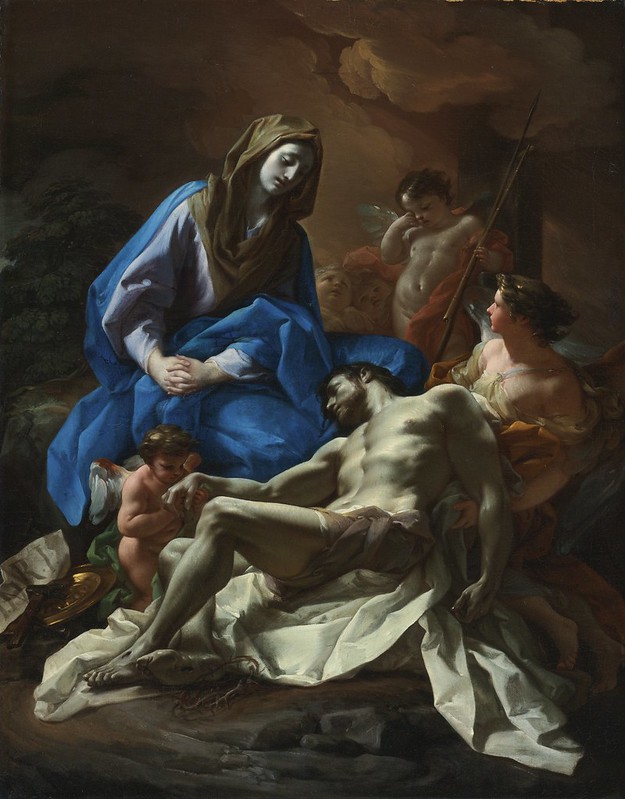
HERTEL, Johann Wilhelm (1727-1789) - Der Sterbende Heiland (1764)

Corrado Giaquinto - Pietà
Obra de Corrado Giaquinto (1703-1765), pintor italià (1)


- Recordatori de Johann Wilhelm Hertel -
En el dia de la celebració del seu 288è aniversari de naixement


Parlem de Pintura...

Corrado Giaquinto (Molfetta, 18 de febrer 1703 - Napoli, 1765) va ser un pintor italià. Va estudiar a Nàpols i a Roma, on aviat es va convertir en un dels pintors més prestigiosos de la ciutat. El 1753, va ser reclamat per Ferran VI, es va traslladar a Madrid com a pintor de cambra i va exercir el càrrec de director de l'Acadèmia de San Fernando. Entre les seves obres realitzades a Espanya, cal destacar els frescos del Palau Reial de Madrid, els quadres d'altar pel Convent de les Salesas Reals (Sant Francesc de Sales i Santa Joana de Chantal) i els retrats (Farinelli). L'art de Giaquinto constitueix, en certa manera, una continuació del de Luca Giordano, amb un gust compositiu i unes subtileses de forma i d'estructura molt personals, que fan d'ell un dels artistes més brillants del rococó napolità i romà. El 1762 va tornar a Nàpols, ciutat on va morir el 1765.


Parlem de Música...

Johann Wilhelm Hertel (Eisenach, 9 d'octubre de 1727 - Schwerin, 14 de juny de 1789) va ser un violinista i compositor alemany. Fill de Johann Christian Hertel, es va formar amb el seu pare. Si bé la seva família va procurar-li una formació en Teologia i Dret, ben aviat es va decantar per la música estudiant amb Johann Heinrich Heil (1706-1764), un alumne de Bach. Amb 12 anys es va unir a les gires de concerts amb el seu pare abans d'estudiar violí amb Carl Höckh, el Konzertmeister de Zerbst. El 1744 va assolir el primer càrrec de violinista i clavecinista a la cort de Strelitz. Allà va entrar en contacte amb els músics de Berlín Franz Benda, els germans Graun i CPE Bach. El 1752 i després de la dissolució de la cort de Strelitz, va assolir el 1754 el càrrec de compositor de la cort a Schwerin. El 1759 va acceptar un càrrec d'organista i mestre de capella a Stralsund. A partir del 1770 es va convertir en el conseller privat al servei de la princesa Ulrike Sophie si bé no va deixar de compondre i organitzar concerts. Els darrers anys va abandonar el violí per a centrar-se en la música per a instruments de tecla. Va morir a Schwerin el juny de 1789.

OBRA:

Vocal secular:

Lieder:
Johann Friedrich Löwens [24] Oden und Lieder (Leipzig, 1757);
Johann Wilhelm Hertels Musik zu 24 neuen Oden und Lieder aus der Feder des Herrn Johann Friedrich Löwen (Rostock, 1760);
5 in Unterhaltungen, vii–x (Hamburg, 1769–70); 5 in D.B. Münter:
Sammlung geistlicher Lieder, i (Leipzig, 1773);
2, D-SWl; 2 vols., B-Bc

Other secular:
12 festival cantatas (J.F. Löwen), most for 2 S, T, B, orch, 1754–7, Bc, D-SWl;
Il vero omaggio (Metastasio), 1761, B-Bc;
more than 40 arias (most by Metastasio), 1v, orch, Bc, D-ROu, SWl;
Divertissement, 4vv, orch, 1767, B-Bc;
2 serenatas: 1 for 1v, orch, 1763 D-SWl;
1 for 1v, choir, orch, B-Bc, D-SWl

Vocal religiosa:

Sacred cants., all B-Bc, D-SWl, for 2 S, T, B, orch:
Das traurige Schicksal der Grossen auf Erden (Palitzsch), 4vv, orch, 1753, B-Bc;
Die Geburt Jesu Christi (H.J. Tode), 1777;
Die Gabe des Heiligen Geistes (Tode), 1777;
Die Himmelfahrt Christi (Tode), 1778;
Das Vertrauen auf Gott (Tode), 1778;
Der Ruf zur Busse (Tode), 1781;
Kirchen-Musik zur Feyer des Friedens-Festes, 1763

Other sacred:
Der sterbende Heiland (J.F. Löwen), passion, S, A, T, B, orch, 1764, B-Bc, D-SWl;
Passion in 4 parts (Tode), incl. Jesus in Gethsemane, 1780, Jesus in Banden, 1782, Jesus vor Gericht, 1782, Jesus in Purpur, 1783, all B-Bc, D-SWl;
Mass a 8, choir, str qt, SWl;
Ky, Gl, 4vv, org, B-Bc;
Herr, wie lange (Ps xiii), solo vv, choir, orch, 1777;
Wie lieblich sind deine Wohnungen (Ps lxxxiv), solo vv, choir, orch, 1775;
Jauchzet dem Herrn alle Welt (Ps c), choir, orch, 1780, SWl, B-Bc;
11 choral cants., solo vv, choir, orch, 1768–76, B-Bc, D-SWl;
Freuet euch, motet, 4vv, B-Bc;
Ich halte dich, motet, 4vv, org, Bc, D-SWl;
many chorales, 4vv, orch, SWl

Instrumental:

Incid music:
Richard III, Romeo und Julia, both (C.F. Weisse, after W. Shakespeare), 1767

Syms.:
6 sinfonie, 2 vn, va, b, 2 ob, 2 fl, 2 hn, bc (Hamburg, 1766);
2, 1755, D-DS, lost;
40, B-Bc;
15, D-SWl

Other orch:
15 kbd concs., others Bsb, SWl;
9 vn concs., B-Bc;
22 concs. for various solo insts, orch, Bc;
2 ovs., Bc;
3, minuets orch, Bc

Chbr:
Partita I–III, org, ob, bc, 1762, Bc, D-SWl;
5 trios, B-Bc;
6 marches, wind insts, Bc, D-SWl;
19 sonatas for vn, bc, B-Bc;
sonata a 4 and concerto a 5, wind insts, Bc

Kbd:
6 sonate, hpd, op.1 (Nuremberg, 1756);
sonata, hpd in Oeuvres mêlées, iii (Nuremberg, 1757);
other kbd sonatas, incl. 22 in B-Bc, 1 each in D-Bsb, Mbs, SWl

Literatura:

Gründliche Anweisung, wie man den General bass recht tractiren soll (MS, 1748, B-Br)
Abhandlung von der Musik (MS, 1749, Br)
Zusätze zum Walterschen musicalischen Lexicon, vorzüglich den historisch-biographischen Teil betreffend (MS, 1752–60, Br)
3 autobiographies (MS, 1783–4, Br); ed. E. Schenk: Johann Wilhelm Hertel: Autobiographie (Graz, 1957) [incl. list of lost works]
Sammlung musikalischer Schriften, i–ii (Leipzig, 1757–8); iii–iv (MS, Br)
[Catalogue of Hertel’s Library] (Schwerin, c1789) 
Font: En català: Johann Wilhelm Hertel (1727-1789) En castellano: Johann Wilhelm Hertel (1727-1789) In english: Johann Wilhelm Hertel (1727-1789) - Altres: Johann Wilhelm Hertel (1727-1789)


Parlem en veu pròpia o en veu d'altri...

La tradición de las Pasiones tiene larga huella en la música religiosa alemana, centrada en el protestantismo. A partir de Bach este género, dramático aunque no teatral, que reúne el aria operística con el coral litúrgico, pasa a primer plano por su complejidad literaria y cantable. Prueba de ello es este Salvador agonizante de Johann Wilhelm Hertel (1727-1789), del cual ya exhumó CPO su Nacimiento de Jesucristo. Situado a fines del barroco y ya en pleno clasicismo dieciochesco, Hertel se inclina hacia una suerte de cantata dramática, sin personajes, con tres solistas vocales, coro y orquesta. El tema es de un riguroso patetismo: los fieles, al pie de la cruz donde agoniza el Redentor, reconocen su parte de responsabilidad en el sacrificio, se conduelen del martirio e imploran al Dios Padre que dé sentido al supremo delito de haber asesinado al Dios Encarnado. Un himno final convierte la penuria en una celebración. Cristo ha muerto pero tiene asegurada la eternidad tras su paso por las tinieblas infernales del mundo, instalado en su sitial mesiánico, juez, maestro y rey. Hertel sofoca el estremecimiento patético, elude los extremos y propone una lectura serena y, a la vez expresiva, racionalizada según el gusto del siglo ilustrado. El texto de su secretario Johann Friedrich Löwen prescinde de las citas evangélicas y resuelve la acción con una serie de recitativos, arias, corales y un dúo solístico. Una orquesta escueta da un clima de recogimiento íntimo, de meditación interiorizada, en tanto el coro evoca el templo y las voces se producen conforme a un melodismo rico y elegante. El director Michael Alexander Willens ha comprendido perfectamente el sesgo del compositor. Su sonoridad es recatada y su lectura, minuciosa, límpida y delicadamente musical. Las masas y los cantantes individuales rebosan de estudio y aplicación, con una muy concentrada dicción de las palabras. Por su especial compromiso en el canto florido, brilla especialmente la soprano Solset, a veces ya en pleno despliegue rococó.

Blas Matamoro - QuintadeMahler

---

In his youth Hertel was considered one of the best violinists of Franz Benda’s school; he composed an impressive series of nine violin concertos as well as chamber music and trio sonatas. His 17 keyboard concertos, rich in invention and distinguished by fluent passage-work, are important north German achievements in this genre and rank beside C.P.E. Bach’s and A.C. Kunzen's. His sonatas and other works for keyboard, mostly still typical of harpsichord composition, are markedly inferior to the concertos. His 40 symphonies occupy a major place in his creative output. While his symphonic writing at first adopted the style of the Berlin school of Hasse and Graun, after 1760 it underwent a stylistic change unique in north Germany at the time by absorbing south German influences. Scored mainly for strings, horns, oboes and flutes, his symphonies are notable for their uncomplicated, straightforward technique and an almost aphoristic, rhythmically succinct and brilliant handling of thematic material. He also wrote incidental music for stage works, overtures and other instrumental concertos including ten oboe concertos.

It was undoubtedly Hertel’s extremely rich vocal compositions, however, that caused Gerber to place him among the ‘most tasteful composers’ of the second half of the 18th century. He wrote in many vocal genres for the Schwerin court, including masses, settings of the Passion, sacred cantatas, secular festive cantatas, and arias and chorales with orchestral accompaniment. Indeed very little of his vocal production was known outside Schwerin; only one aria and two collections of lieder (1757–60) were published, apart from songs in contemporary anthologies or periodicals. The two lieder collections (with texts by J.F. Löwen, court secretary in Schwerin) show the influence of C.P.E. Bach, Telemann, J.V. Görner and A.C. Kunzen; they contain folklike, light-textured songs which can also be played on the piano alone. His literary works include a treatise on thoroughbass, three autobiographies and a collection of essays by Voltaire and others.

GROVE MUSIC ONLINE 

Gaudiu i compartiu! 


Informació addicional... 

INTÈRPRETS: Nicholas Mulroy (tenor); Berit Norbakken Solset (soprano); Andreas Wolf (bass); Kölner Akademie; Kölner Akademie Choir; Michael Alexander Willens
JPC: Hertel - Der Sterbende Heiland
CPDL: No disponible


Tant si us ha agradat, com si no, opineu, és lliure i fàcil!