Es mostren els missatges amb l'etiqueta de comentaris Schweitzer A.. Mostrar tots els missatges

dilluns, 6 de juny del 2022

SCHWEITZER, Anton (1735-1787) - Sinfonia (D-Dur) à 6 voci (c.1782)

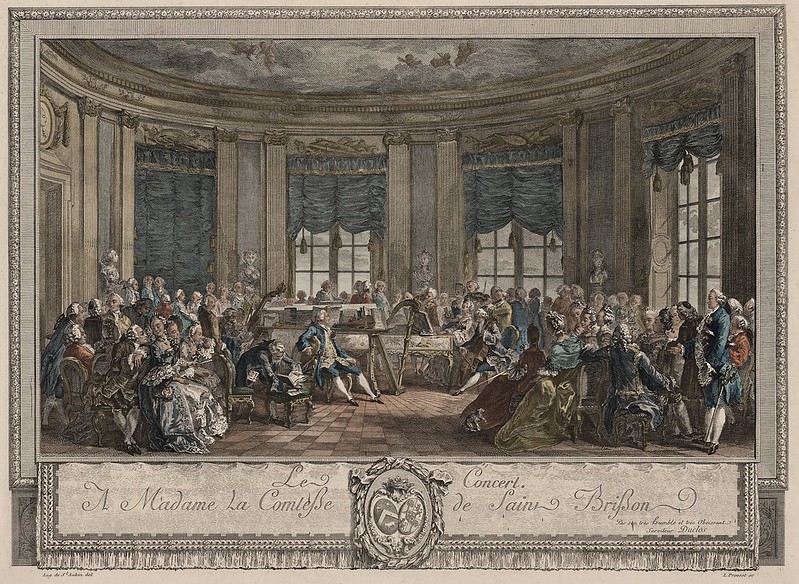
Augustin de Saint-Aubin (1736-1807) - Le Concert


Anton Schweitzer (1735-1787) - Sinfonia (D-Dur) à 6 voci (c.1782)
Performers: Thüringen PhiIharmonie; Hermann Breuer (conductor)

---


German composer. As a young man he served the Duke of Hildburghausen as chamber musician. To groom him in composition, the duke sent him to Bayreuth (1758) and later Italy (1764-66), after which he promoted him to Kapellmeister. When financial pressures forced the duke to dissolve his opera company in 1769, Schweitzer found employment as music director of the itinerant theatrical company of Abel Seyler, which was just beginning to add German operas to its spoken offerings. Schweitzer’s first work for the Seyler company, the one-act occasional piece Elysium (1770), gained considerable popularity as a musical afterpiece and was published in vocal score in 1774. He composed other celebratory pieces on mythological themes, but also comic operas. Seyler sent his music director on an expedition to recruit new singers in order to expand and elevate his musical productions in directions towards which Schweitzer’s music clearly pointed. By a stroke of good fortune, the music-loving Duchess Anna Amalia of Saxe-Weimar engaged Seyler’s company at this time (1771), and Schweitzer’s ambitions were at last given full rein. A heated rivalry with the duchess’s leading musician (later Kapellmeister), Ernst Wilhelm Wolf, flared up immediately. Through a series of bold new works composed in collaboration with major writers, Schweitzer quickly established himself as the superior figure. While Wolf continued composing the Hillerian comic operas in which the duchess delighted, Schweitzer turned to the witty, more urbane tone of F.W. Gotter’s farce Die Dorfgala (1772). On a more elevated plane, he composed not only celebratory dramas but also several dramatic ballets for the birthdays of the duchess and her sons, Karl Eugen and Konstantin. Two other experiments at Weimar opened new vistas for the German theatre. In May 1772 the Seyler company gave the première of the first German melodrama, Schweitzer’s setting of a translation of Rousseau’s Pygmalion.

A year later it was able to mount a serious five-act opera in German, Christoph Martin Wieland’s Alceste, the achievement for which Schweitzer is chiefly remembered. Theatrical collaboration between Schweitzer and Wieland had begun in mid-1772 with the dramatic ballet Idris und Zenide and continued that year with two dramatic prologues of Metastasian stamp, Aurora and Die Wahl des Herkules. When Wieland proposed the Alceste project to the duchess, he insisted that Schweitzer and not Wolf compose it. A brilliant success at Weimar, Alceste made its way quickly to many other German stages, establishing at a stroke seria-style opera in German as a musical reality. After Alceste Schweitzer began work on a new melodrama, Ariadne auf Naxos, adapted from a cantata text by H.W. von Gerstenberg by a member of the Seyler company, Johann Christian Brandes, in order to display the talents of his wife Charlotte. The work was only partly complete when a fire destroyed the Hoftheater at Weimar in May 1774. The Seyler troupe, by now one of the most respected in Germany, was immediately engaged by Duke Ernst II at the nearby court of Gotha. There Schweitzer found a far more formidable rival than Wolf in the court Kapellmeister Georg Benda. Benda supplanted Schweitzer almost immediately as the chief purveyor of important new dramatic compositions. Schweitzer’s main compositional challenge during these years came from elsewhere. The success of Alceste in 1775 at Schwetzingen and Mannheim prompted the Palatine court to commission another serious opera from Wieland and Schweitzer in 1777. He remained in Gotha as Benda’s successor after the latter resigned as the duke’s Kapellmeister in 1778. The Hoftheater was disbanded in September of the following year. Early in 1780 Benda remarked acidly in a letter to the composer F.W. Rust: ‘For the labours one now demands of a Kapellmeister here my successor Schweitzer is quite good, for he has nothing to do and does just that’.

dijous, 6 de juny del 2013

SCHWEITZER, Anton (1735-1787) - Symphony in D, No.2

John Trumbull - Declaration independence (1819)
Obra de John Trumbull (1756-1843), pintor nord-americà.

- En record del 278è aniversari del naixement d'Anton Schweitzer -


Anton Schweitzer (1735-1787) compositor i violista alemany nascut a Coburg. De tornada a Alemanya, avui celebrarem dos aniversaris, el primer d'ells fàcilment deduïble tenint en compte la filosofia d'aquest espai. El segon, el deixarem per al final per no restar protagonisme al desconegut compositor germànic. De fet, no allargarem la literatura en excés perquè de Schweitzer, a saber com es pronuncia, en sabem o se n'ha escrit molt poca cosa. Anem a esbrinar el què, qui i com, de tot plegat. Les primeres referències biogràfiques el situen com a cantor a Hildburghausen, al centre d'Alemanya. Allà, seria on iniciaria la carrera musical d'un autor que se'l coneix, principalment, per una de les seves òperes, Alceste, la qual ha estat editada en un parell d'ocasions. Més enllà d'aquesta introspecció lírica, el seu nom es dilueix irremeiablement fins que, entre mans, ens agenciem amb aquesta inesperada edició dedicada, íntegrament, al seu nom. El seu instrument, pel que sembla, va cavalcar entre la viola i el violoncel amb els quals jugaria un paper, més o menys determinant, a la Hofkapelle local d'Hildburghausen. El seu mestre seria un desconegut flautista i compositor de nom Jakob Friedrich Kleinknecht de qui, si un dia se'm permet la llicència, en parlaré. Dispersada la orquestra en la que treballava, va aspirar a un càrrec, amb èxit i adjudicació, de mestre de capella a Weimar. Un inoportú incendi en el teatre on desenvolupava la seva bona feina, el va obligar a emigrar de nou tot postulant, també com a Kapellmeister, a la cort de Gotha i en substitució d'un bon conegut nostre, Georg Anton BendaTot i el que pugui semblar en relació al seu profund desconeixement que en tenim, el cert és que la òpera Alceste, escrita sobre un llibret de Christoph Martin Wieland i que abans esmentava, va ser una de les produccions més representades a Alemanya durant el segle XVIII. 

Anonim - Antique print of Coburg
Gravat de Coburg (c.1750), obra d'autor anònim.

Avui, en honor i en record seu, recuperarem algunes de les poquíssimes mostres orquestrals del seu repertori. Aquest, a banda d'un nombre indeterminat d'òperes, imaginem que devia estar format per música instrumental i religiosa en sintonia amb els diferents càrrecs que regentava. Malauradament, o s'ha perdut o resta pendent de classificar i recuperar. En qualsevol cas, introduirem la seva música i l'estructurarem a l'entorn de la Simfonia número 2 en Re major, de caràcter breu i de tres moviments característicament clàssics, amb la obertura de la òpera Die Dorfgala de 1772. Aquesta, de perfil clàssic en el discurs, contrasta, inesperadament, amb l'estètica i la formalitat barroca de la obertura de la òpera Alceste de 1773. A continuació, escoltarem una ària, del segon acte, de la mateixa òpera per títol Weine nicht du meines Herzens Abgott per a soprano i orquestra. Finalitzarem, el menú del dia, amb la breu obertura de la òpera PolyxenaTotes aquestes partitures, conservades a la Biblioteca Nacional d'Alemanya, representen, amb fidelitat històrica, una de les millors aproximacions a la vida i obra de l'alemany. Ho celebrem en aquest dia de commemoració del seu aniversari. Alhora, i com avançava al principi, també haurem de celebrar l'aniversari de naixement de John Trumbull. I molts us preguntareu qui és aquest bon home, doncs un dels primers pintors nascuts als Estats Units i que avui ens il·lustra, patriòticament, la pintura de la declaració d'independència dels EUA tot i no ser, avui, 4 de juliol. Coincidència temporal per a celebrar música i pintura. Dues disciplines artístiques que permanentment ens enamoren i alegrement es donen la mà. Per tant, com sempre, felicitem els seus protagonistes que, amb la seva ciència, saviesa i creativitat, ens donen alegria però principalment ens omplen de fe, d'esperança i de vida!

A la interpretació, la 
Thuringian State Symphony Orchestra, amb la soprano Margot Stejskal i la direcció d'Hermann Breuer.

Gaudiu i compartiu!


Font (on trobareu informació addicional així com dels discs on podeu trobar aquestes obres):

CPDL: No disponible.
Schweitzer: Arias and Orchestral Works

Tant si us ha agradat com si no, opineu, és lliure i fàcil!