Es mostren els missatges amb l'etiqueta de comentaris Sammartini G.. Mostrar tots els missatges

dilluns, 6 de gener del 2025

SAMMARTINI, Giuseppe (1695-1750) - Concerto per la Flauta

Italian school (c.1700) - Young musicians


Giuseppe Sammartini (1695-1750) - Concerto (in Fa maggiore) a più istromenti & la flauta, IGS 25
Performers: Sophie Larivière (flute); Ensemble Caprice

---


Italian composer. He was the son of French oboist Alexis Saint-Martin and older brother of the better-known composer Giovanni Battista Sammartini. Young Giuseppe's first instruction likely came from his father, and by 1711 the two brothers were performing together in an orchestra. Giuseppe's first surviving compositions date to the mid-1710s. Around the time of that publication, Giuseppe and Giovanni became members of a Milan orchestra and by 1720 they had joined that city's Regio Ducal Theater orchestra. In 1729, Giuseppe departed Italy for Brussels, where he remained briefly before traveling to London, the city he would settle in for the remainder of his career. He was already recognized in England as a promising composer, owing to the publication there of his 12 Trio Sonatas in 1727. But it was his musicianship on the oboe that made him a celebrity in the English capital. In the 1730s Sammartini played in Handel's orchestra and performed in many productions of Handel's operas, including that of Arminio, which features difficult obbligato writing for the oboe in the Act II aria, "Quella fiamme." In 1736 Sammartini was appointed music teacher in the household of Prince Frederick of Wales. His duties included instructing the Prince's wife Augusta and her children in music, and undoubtedly involved many private chamber music performances before the Prince and his retinue. Sammartini held this post until his death. This final decade-and-a-half was apparently a very happy time for him: many of his works date to this period, some carrying dedications to the Prince (12 Sonatas, Op. 1; 1736) and to Augusta (12 Trios, Op. 3; 1743). Sammartini died at the household of the Prince during the week of November 17, 1750.

dimecres, 5 de gener del 2022

SAMMARTINI, Giuseppe (1695-1750) - Concerto (II) for the harpsichord

Friedrich Wilhelm Christoph Morgenstern (1736-1798) - Kindern des Prinzen Friedrich Karl von Schwarzburg-Rudolstadt (c.1780)


Giuseppe Sammartini (1695-1750) - Concerto (II) for the harpsichord, Opera Nona (Op.9)
Performers: Jean Pierre Boullet (cembalo); Ensemble 'Le Rondeau'

---


Italian oboist and composer. He was the son of a French oboist, Alexis Saint-Martin, and the elder brother of the composer Giovanni Battista Sammartini. The report of his death (discovered by Evelyn Lance) appeared in the Whitehall Evening Post of Saturday, 24 November 1750: ‘Last week died at his Royal Highness, the Prince of Wales, Signior S. Martini, Musick Master to her Royal Highness and thought to be the finest performer on the hautboy in Europe’. Sammartini probably studied the oboe with his father, with whom he performed in an orchestra at Novara for a religious ceremony in 1711. In 1717 he and G.B. Sammartini were listed as oboists at S Celso, Milan, and in 1720 the ‘Sammartini brothers’ were oboists in the orchestra of the Teatro Regio Ducale there. An oboe concerto by Giuseppe was published in Amsterdam as early as about 1717, and in 1724 he contributed an aria and sinfonia for the second part of a Milanese oratorio, La calunnia delusa. J.J. Quantz, who visited Milan in 1726, regarded Sammartini as the only good wind player in the opera orchestra; when he went to Venice he ranked him with the violinists Vivaldi and Madonis as the outstanding players he had heard. Sammartini left Italy for Brussels and then for London, where his collection of 12 trio sonatas, published by Walsh & Hare, had been announced on 30 September 1727. He was witness to his sister Maddalena’s marriage in Milan on 13 February 1728, and on 13 July 1728 he was granted a passport to travel to Brussels with his pupil Gaetano Parenti. 

Burney erronously mentioned that Giuseppe’s first appearance in England occurred at a benefit for ‘signor Piero’ at the Little Theatre in the Haymarket on 4 April 1723. The first reference to Giuseppe in England appears in London advertisements for a concert at Hickford’s Room on 21 May 1729, which also featured ‘several pieces on the hautboy by the famous Sig. St. Martini of Milan, just arrived from the Court of Brussels’ (Lasocki, 887). Sammartini remained in London for the rest of his life, quickly winning recognition as a brilliant performer. He performed at Lincoln’s Inn Fields on 13 May 1730. In the same year he played for Maurice Greene at Cambridge when Greene obtained the MusD degree, and also gave a successful benefit concert there. Sammartini took part in concerts at Hickford’s Room on 20 March 1732 (benefit concert) and 20 April 1733, and in the Castle concerts, and he played in the opera orchestra at the King’s Theatre. Burney mentioned an aria sung by Farinelli in Porpora’s Polifemo (1735) that was ‘accompanied on the hautbois by the celebrated San Martini’. Though Hawkins said that Sammartini was at first allied with Bononcini, he also played in Handel’s orchestra. Dean pointed out that Sammartini’s name is attached to many oboe solos in Handel’s opera autographs, such as the difficult obbligato for the aria ‘Quella fiamme’ in Arminio, Act 2 (1737). On 14 March 1741 Sammartini performed an oboe concerto at a benefit performance of Handel’s Parnasso in festa at the Haymarket Theatre. Giuseppe probably also played the flute and recorder; he composed numerous works for these instruments and such doublings were standard for orchestra players of that time.

dimarts, 6 de gener del 2015

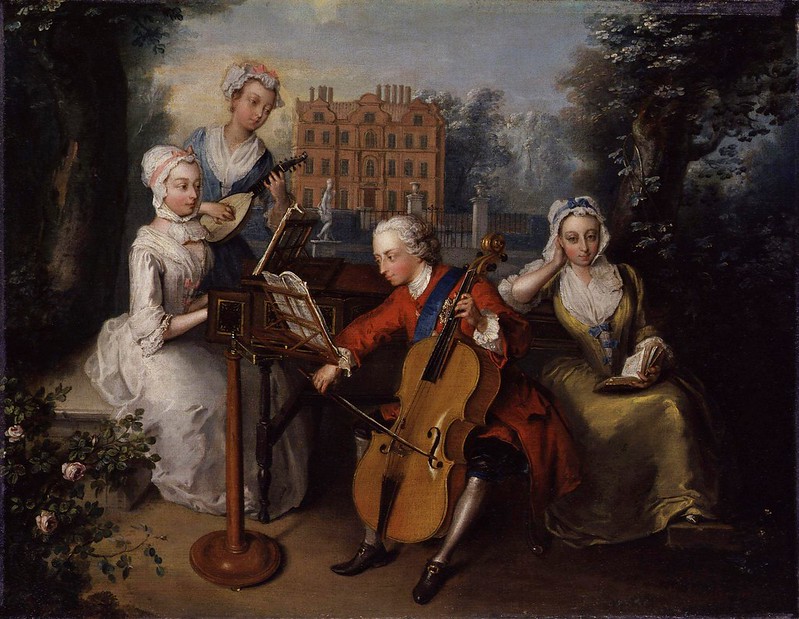
SAMMARTINI, Giuseppe (1695-1750) - Recorder Concerto in F

Philippe Mercier - Frederick, Prince of Wales, and his sisters (1733)
Obra de Philippe Mercier (c.1689-1760), pintor francès (1)


- Recordatori de Giuseppe Sammartini -
En el dia de la celebració del seu 320è aniversari de naixement


Parlem de Pintura...

Philippe Mercier (Berlín, c.1689 - Londres, 18 de juliol de 1760) va ser un pintor i gravador francès. Va estudiar pintura a l'Acadèmia d'Arts de Berlín abans de prendre classes al taller d'Antoine Pesne. Va viatjar a Itàlia i França abans d'establir-se el 1716 i definitivament a Londres sota la recomanació de la Cort d'Hannover. Allà es va casar i va viure a Leicester Fields. La seva habilitat amb al retrat va afavorir el seu nomenament com a pintor principal i bibliotecari dels Prínceps de Gal·les. Va gaudir del favor reial i va ser autor de nombroses pintures de la pròpia reialesa però també de la noblesa i aristocràcia local. Va pintar escenes de gènere i paisatges. Els darrers anys alguns escàndols van afectar la seva persona i va haver de renunciar com a pintor reial. Va abandonar Londres el 1740 i es va establir a York, on va seguir pintant retrats abans de tornar a Londres el 1751. Des d'allà va viatjar a Irlanda i Portugal sol·licitat per diversos comerciants anglesos. No hi va romandre gaire temps i va tornar a Londres, ciutat on va morir el juliol de 1760.

Font: En català: No disponible En castellano: Philippe Mercier (1689-1760) In english: Philippe Mercier (1689-1760) - Altres: Philippe Mercier (1689-1760)


Parlem de Música...

Giuseppe Gaspare Melchirorre Baldassare Sammartini (Milan, 6 de gener de 1695 - London, 17-23 de novembre de 1750) va ser un oboista i compositor italià. Fill de l'oboista francès Alexis Saint-Martin i germà gran del també compositor Giovanni Battista Sammartini, es va educar inicialment amb el seu pare abans d'entrar amb 15 anys a l'orquestra ducal. El 1717 va publicar la primera col·lecció de música, una sèrie de sonates. El 1729 va emigrar a Anglaterra on va treballar a les ordres d'Händel en l'orquestra de l'òpera. El 1736 va assolir el càrrec de director musical dels concerts de cambra del príncep Frederick de Wales. El 1740 va publicar la primera òpera, The Judgement of Paris. Compositor prolífic, va ser autor de gran quantitat de música, entre ella, una col·lecció de 6 concerts d'orgue Op.9, 24 sonates per a flauta i baix, 30 trios, 24 concerti grossi i 16 simfonies. Va morir a Londres el novembre de 1750.

OBRA:

Vocal secular:

The Judgment of Paris (pastoral, Congreve), Cliveden, c1740, GB-Lbl

9 cantatas:
Ahi qual cruccio, S, hpd, Lbl;
Da procella tempestosa, S, hpd, B-Bc, GB-Lbl;
In lode della … principessa di Gales, S, 2 vn, b, B-Bc;
L’olmo, S, b, Bc;
Naufraggio vicino, S, 2 vn, va, b, Bc;
Oh vita, vita, nò, S, hpd, GB-Lbl;
Più non sento, S, 2 vn, b, B-Bc;
Solitudine campestra, S, b, I-Rsc;
Tu piangi, Eurilla mia, S, be, Rsc

Arias:
Se a ciascun l’interno affanno;
Se fedel, cor mio, tu sei (Metastasio), from op Gli orti esperidi: both GB-Lbl
lost aria, Vuoi saper, in pt.1, and sinfonia to pt.2 of La calunnia delusa (orat, G. Machio), Milan, 1724;
lost aria, Vanne pur non dubitar, in La necessità socorsa dal glorioso Santo di Padoa (orat), Milan, 1725

Instrumental:

orch:
6 concerti grossi (A, e, c, B , A, D), 2 vn, va and vc concertino, 2 vn, b (1738/R)
[6] Concerti grossi (e, B , g, a, c, g), 2 vn, va and vc concertino, 2 vn, b (1747); arr. from trios op.3 nos.2, 3, 5, 9, 10, 12
8 Overtures (D, E , d, A, D, G, D, D), 2 hn, 2 tpt, timp, 2 vn and vc concertino, 2 vn, va, bc (vc, hpd), op.7 and 6 Grand Concertos (g, A, e, C, g, A), ob, 2 vn and vc concertino, 2 vn, va, bc (vc, hpd), op.8 (1752/R); op.7 no.2 in 6 overture … da vari autori, op.1 (Paris, c1755); op.7 no.4, B-Bc
Giuseppe St. Martini’s Concertos (A, F, G, B ), hpd/org, str (1754); ed. in TCMS, ii (1988)
8 Overtures (G, d, A, D, B , D, F, E), and 6 Grand Concertos (E, g, A, d, e, B ) in 7 Parts (1756); 6 concertos as op.11 (c1756)
Concerto, F, ob, str, in Concerti a 5 … libro primo (Amsterdam, c1717)
12 concertos, GB–Lbl; ob conc, Mp; 3 ob concs, E , G, D, fl conc, B , D-Dlb; rec conc, F, 2 fl concs, D, A, 2 vn concs, D (=ob conc. in Dlb), E , S-Skma; fl conc, D, L
Overtura (G), CZ-Pnm; minuets, marches, 3 ballets, GB-Lbl

chbr:
12 Sonatas (F, F, G, F, F, d, F, F, G, F, F, B ), 2 fl/vn, bc (1727, lost; 2/c1730/R)
[6] Sonate (D, G, C, G, c, b), bk 1, 2 fl, b (1736; repr. c1750 as op.4);
[6] Sonate (e, G, A, a, D, A), bk 2, fl, b (c1736; repr. Paris, c1742–3 as op.3; repr. 1757 as op.12)
12 Sonate Op.2 (G, C, e, G, D, a, D, e, G, a, A, D), fl, b (Amsterdam, c1736–7); nos.1–6 as op.2 (1745); nos.7–12 as op.4 (c1747); nos.1–3, 5 ed. in TCMS, ii (1988)
12 sonate Op.3 (A, e, B , G, g, D, e, D, a, c, E, g), 2 vn, vc, hpd ad lib (1743; Paris, 2/1744 as op.4)
6 Sonatas or Duets Op.6 (D, e, A, G, C, d), 2 fl, bk 1 (c1750)
Six Solos (G, G, G, G, g, G), fl/vn/ob, bc (c1760/R in Archivum Musicum, xxxi (Florence, 1996)
Pieces in 6 sonate a flauto traverso solo, e violoncello o basso continuo (Amsterdam, 1740), 6 Solos for Two Violoncellos compos'd by Sigr. Bonoucini and other … authors (1748), Collection of Lessons for the Harpsichord … by Jozzi, St. Martini of Milan, Alberti, Agrell, Bk.II/ no.6 (1762), 6 Solos for a German Flute or Violin … compos’d by Sigr Francesco Xaver Richter (1764)
Duets, marches, minuets in contemporary anthologies: see RISM
26 ob, fl, rec, vn, bc, sonatas (no.12 ed. D. Lasocki (London, 1981);
nos.13, 15, 21–4 ed. R. Platt (London, 1983)), (US-R; various trios and solos, B-Bc, GB-Lbl, Mp, US-NYp;
9 sonatas, 7 sinfonias, 1 conc., fl and rec, bc, I-PAc;
15 sonatas, 2 vn, bc, CH-EN

Font: En català: Giuseppe Sammartini (1695-1750) En castellano: Giuseppe Sammartini (1695-1750) In english: Giuseppe Sammartini (1695-1750) - Altres: Giuseppe Sammartini (1695-1750)


Parlem amb veu pròpia...

Giuseppe Sammartini va ser un compositor instrumental i en aquest sentit va ser, indubtablement, un dels més importants escriptors de concerts i sonates a Anglaterra entre els anys 1730 i 1750. Allà, a banda de compondre en abundància, va treballar al servei de l'orquestra de l'òpera sota la direcció, en viu i en directe, d'Händel. En aquell paisatge, al servei també d'un príncep per nom Frederick i perdudament enamorat de l'art i la música, es va fer un nom allunyat de la Itàlia que el va veure néixer. El seu germà, Giovanni Battista, i mestre entre altres de l'autor que recuperàvem ahir, va ser un actor determinant pel naixement del classicisme la influència del qual va marcar tota la generació de mestres posteriors, des de Mozart passant per Gluck i Haydn. A diferència del seu germà més innovador, Giuseppe va seguir més fidel al model barroc, especialment en la seva obra concertant. Partitures com les que avui escoltarem donaran fe d'aquest "conservadorisme" estètic i formal però que ajudades per una brillant interpretació ens resultaran irresistiblement atractives. Obres com la delicatessen en forma de Concert en Fa major per a flauta dolça, cordes i continuo. Una partitura amable i entranyable que emmudeix els sentits per la seva apassionada bellesa. L'acompanyarem amb el Trio en Si menor per a dos flautes travesseres i continuo, en una obra de cambra de quatre breus moviments. Ens resultarà fàcil entendre el per què la música de Sammartini va gaudir d'ampli i prolongat ressò a Anglaterra fins ben entrat el segle XIX, fins i tot superant a Corelli i Geminani. Bones raons devia tenir Sir John Hawkins, historiador i musicòleg, quan afirmava que Sammartini era "el millor intèrpret d'oboè que havia escoltat mai". Com a intèrpret no ho podrem contrastar, tanmateix com a compositor queda clar que inevitablement va ser un grandíssim mestre!

Gaudiu i compartiu! 


Informació addicional...

Sammartini, G. / Maute: Chamber Music for Flute and Recorder

Tant si us ha agradat, com si no, opineu, és lliure i fàcil!