Es mostren els missatges amb l'etiqueta de comentaris Kellner J.P.. Mostrar tots els missatges

diumenge, 28 de setembre del 2025

KELLNER, Johann Peter (1705-1772) - Cantata Nuptialis

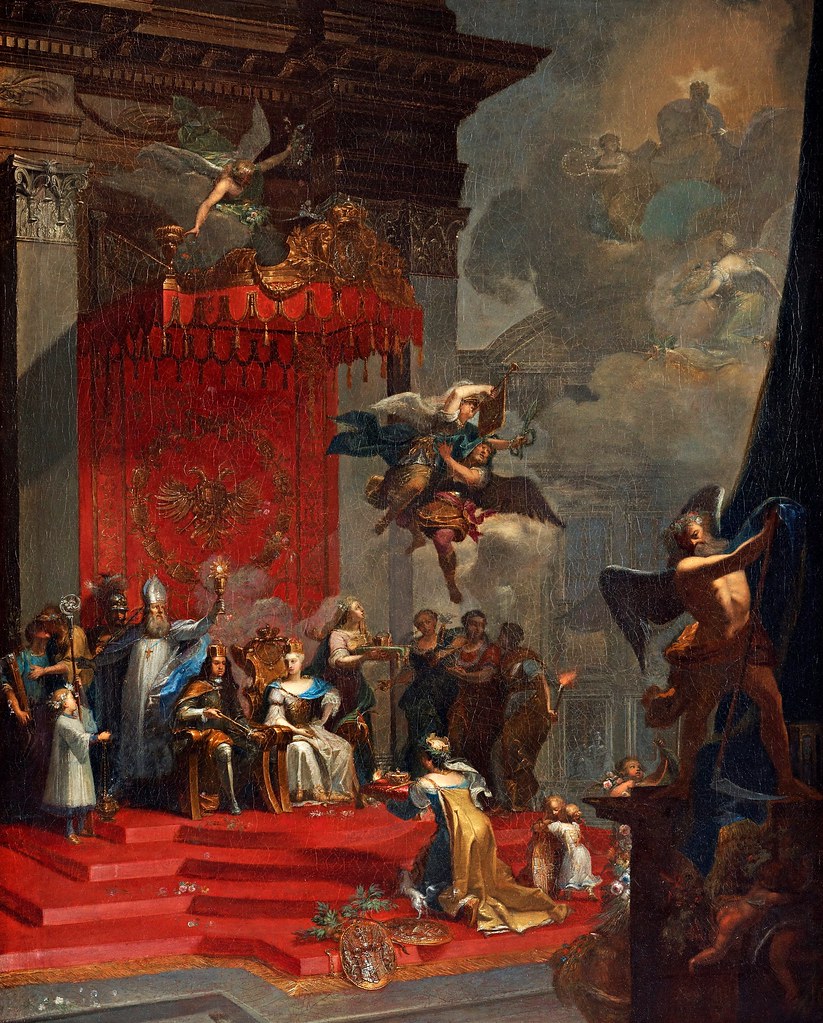
German School (18th Century) - Cyrus and Panthea


Johann Peter Kellner (1705-1772) - Cantata Nuptialis 'Es bleibet wohl dabei er weiß in allen Sachen'
| a 2 Clarini Tympalo[!] 2 Violin Viola C A. T B | et | Organo obligato
Performers: Anna Kellnhοfеr (soprano); Christoph Dittmаr (alto); Mirko Ludwig (tenor); Ralf Grοbе (bass);
Cantus Thuringia; Capella Thuringia; Bernhard Klаpprοtt (organ & conductor)

---


German organist and composer. His parents wished him to become a lamp-black merchant like his father, but he was determined to study music. In 1720 he began receiving his initial instruction in music from the Gräfenroda schoolmaster Johann Heinrich Nagel, a pupil of the Gotha court organist Christian Friedrich Witt. He continued his studies with the organist Johann Jacob Schmidt in Zella and received instruction in composition from Hieronymus Florentinus Quehl, who served as the music director at St. Mary’s Church in Suhl. From 1725 to 1727 he was a school caretaker and organist in Frankenhain, and from 1727 until his death in 1772 he was a school caretaker, music director, and organist at St. Lawrence’s Church in Gräfenroda. The fact that Kellner, despite his relatively brief training, was able to attain a very considerable level as a composer is something he owed not least to his contacts with the circle of Bach’s friends. This circle of friends included, along with members of the Bach family, pupils of Johann Sebastian Bach and musical acquaintances such as Jacob Adlung in Erfurt. It is to be assumed that these contacts were established through Johann Bernhard Bach, the organist at St. Michael’s Church in Ohrdruf. In 1790 Johann Ludwig Gerber reported of Kellner: "He was a very accomplished player and a great fuguist on the organ. […] An anecdote about him is told: that when he noticed that Bach had entered the church, he intoned on the organ the subject of a fugue, b.a.c.h., and expounded it after his manner, i.e., with very fine art" (Johann Ludwig Gerber, Historisch-Biographisches Lexicon der Tonkünstler, Vol. 1, Leipzig, 1790, cols. 715 f.). Kellner was famous throughout Thuringia as an organist and teacher. Kellner also played a critical role in the dissemination of the music of J.S. Bach, evinced by the many manuscript copies of Bach's compositions, primarily keyboard and organ works, that stem from his circle. These manuscripts, many of which are in Kellner's hand, often represent the earliest or only source of a work, and they shed light on the chronology, compositional history and authenticity of the music. As a composer, his own compositional efforts largely reflect those of his idol. However, beginning in the 1740s he began to change his style to reflect galant practice. Works in this new style include five keyboard sonatas published in 1752, as well as the compendium 'Manipulus musices' (1752–1759). He also composed a complete cycle of Lutheran church cantatas in 1753, which have been lost. His surviving 36 cantatas demonstrate a growing use of the new stylistic idiom. His son, Johann Christoph Kellner (1736-1803), was also organist and composer, and his brother Johann Andreas Kellner (1724-1785) was organist, horn player and composer.

divendres, 20 d’abril del 2018

KELLNER, Johann Peter (1705-1772) - Sacred Cantatas

Johann Georg Böhm - Tillskriven tysk romerska kejsarinnan Elisabeth Christina
Obra de Johann Georg Böhm (1673-1746), pintor alemany (1)


- Recordatori de Johann Peter Kellner -
En el dia de la commemoració del seu 246è aniversari de decés


Parlem de Pintura...

Johann Georg Böhm (1673 - Dresden, 1746) va ser un gravador i pintor alemany. Es desconeix la major part de la seva vida i es creu va romandre actiu a Alemanya durant la dècada del 1720. Va ser aleshores quan va realitzar la seva obra més coneguda per títol "Coronació de l'Emperador Carles VI com a Rei de Bohèmia el 5 de setembre de 1723 a Praga". Es creu també va realitzar obres religioses i de caràcter al·legòric així com diversos gravats. Johann Georg Böhm va morir a Dresden el 1746.


Parlem de Música...

Johann Peter Kellner (Gräfenroda, 28 de setembre de 1705 - Gräfenroda, 19 d'abril 1772) va ser un organista i compositor alemany. Es va formar inicialment a l'escola de la seva vila natal, on va tenir com a professor i director musical al Kantor Johann Peter Nagel. Precisament amb el fill de Nagel, Johann Heinrich Nagel, va rebre formació de clavecí i orgue. Més tard, es va traslladar primer a Zella, on va estudiar orgue amb Johann Schmidt, i després a Suhl, on va rebre classes de composició de l'organista Hieronymous Florentius Quehl. A l'entorn del 1722, i després de finalitzar la seva formació, va tornar a Gräfenroda on va treballar com a tutor. L'octubre de 1725 va assolir el seu primer càrrec de Kantor a Frankenhain, on hi va romandre fins el 1727, any que va tornar definitivament a Gräfenroda, on va ser nomenat assistent del Kantor Johann Peter Nagel i a partir del 1732, i després de la mort de Nagel, Kantor oficial, en un càrrec que va conservar la resta de la seva vida. A Turíngia va ser admirat com a organista i professor amb alumnes destacats com J.P. Kirnberger, J.E. Rembt i Johannes Ringk, entre altres. Com a compositor, va escriure obra per a orgue i diverses cantates, moltes d'elles en un estil proper al de Johann Sebastian Bach, a qui va admirar profundament. El seu fill Johann Christoph Kellner va ser també organista i compositor. Johann Peter Kellner va morir a Gräfenroda l'abril de 1772.

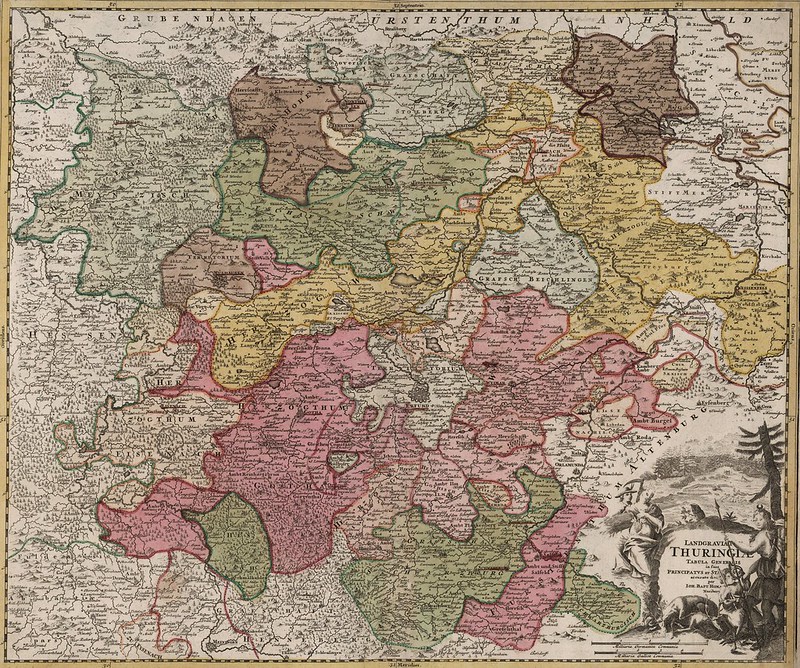
Johann Baptist Homann - Thuringiae (c.1725)
Johann Baptist Homann (1664-1724) - Thuringiae (c.1725) (2)

OBRA:

Vocal religiosa:

36 church cants., D-F;
Annual cycle of church cants. with obbl org, 1753 (lost)
Other works listed in Fechner and MGG1 may be by Kellner's son, Johann Christoph Kellner

Instrumental:

Org:
Fugue, d, Prelude and Fugue, d, 2 trios, D, G, all ed. G. Feder, Die Orgel, ii/7 (Lippstadt, 1958);
Prelude in C, ed. R. Wilhelm, Orgelmusik um Johann Sebastian Bach (Wiesbaden, 1985);
2 fugues, c, D;
3 preludes, C, C, g;
2 preludes and fugues, both G;

Chorale settings:
Herzlich tut mich verlangen (Leipzig, 1907);
Was Gott tut, das ist wohlgetan (Leipzig, 1907);
Wer nur den lieben Gott lässt walten (Wiesbaden, 1985);
Lobt Gott, ihr Christen, allzugleich;
Nun danket alle Gott;
Allein Gott in der Höh sei Ehr

Other kbd:
Certamen musicum, bestehend aus Präludien, Fugen, Allemanden, Couranten, Sarabanden, Giguen, wie auch Menuetten, 6 suites (1739–49);
3 Sonates (1752);
Manipulus musices, oder Eine Hand voll kurzweiliger Zeitvertreib, 4 suites (1752–6);
Concerto, F (Leipzig, 1956);
2 fugues, a, C; Menuet, a;
3 preludes and fugues, a, C, G;
2 sonatas;
12 Variationes


Informació addicional... 

INTERPRETS: Anna Kellnhofer (soprano); Christoph Dittmar (alto); Mirko Ludwig (tenor); Ralf Grobe (bass); Cantus Thuringia; Capella Thuringia; Bernhard Klapprott
JPC: KELLNER, J.P. - Sacred Cantatas
CPDL: No disponible
SPOTIFY: KELLNER, J.P. - Sacred Cantatas


Tant si us ha agradat, com si no, opineu, és lliure i fàcil!