Es mostren els missatges amb l'etiqueta de comentaris Guillemain L.G.. Mostrar tots els missatges

dimecres, 16 de novembre del 2022

GUILLEMAIN, Louis-Gabriel (1705-1770) - Symphonie (VI) en Sol majeur, Oeuvre XIVe (1748)

Anonymous - Gesellschaft mit jungem Paar


Louis-Gabriel Guillemain (1705-1770) - Symphonie (VI) en Sol majeur, Oeuvre XIVe (1748)
Performers: Ensеmblе Lе Biеn-Aimé

---


French composer and violinist. He was brought up by the Count of Rochechouart in Paris, where he began his violin studies. He later studied in Italy with the violinist G.B. Somis. By 1729, Guillemain was active in Lyons and soon after then he was appointed first violinist of the Dijon Académie de Musique, where he became well established as composer and performer. The Président à Mortier of the Dijon parliament sent Guillemain to Italy at great expense and included him in his will. In 1737 Guillemain became a musicien ordinaire to Louis XV and eventually one of the most popular and highest-paid court musicians. It was probably to give concerts that he went to Italy with the violinist Jean-Pierre Guignon in the late 1730s. Guillemain performed in private concerts before the king and queen and from 1747 to 1750 led the second violins in the Marchioness de Pompadour's court orchestra. His court triumph, however, came on 12 December 1748, with a performance of his ballet-pantomime L'opérateur chinois, given at the marchioness's theatre and again at the Comédie-Italienne on 11 January 1749. His works, primarily the symphonies, were often performed at the Concert Spirituel during the 1750s. Throughout his career at court, extravagant purchases kept him in debt. It has generally been thought that Guillemain never appeared in public as a soloist at the Concert Spirituel, possibly because he was too nervous to play before a large audience. But evidence shows that he may have been soloist in one of his own concertos at the Concert Spirituel on the Feast of the Blessed Sacrament (18 May) in 1750. He drank heavily in his last years, and was hastily buried on the day of his death; all this would seem to bear out the grim accounts of his suicide.

All 18 of Guillemain's publications consist of instrumental music, including works for unaccompanied violin, solo violin and keyboard, unaccompanied violin duos, trio sonatas, quartets, concertos, trio symphonies and divertissements for orchestral trio. The op.1 sonatas, in a conservative four-movement scheme and with ornamental melodic lines, make virtuoso demands on the violin: they abound in double and triple stops and difficult string crossings and leaps as well as intricate rapid passages and bowings. This technical display is also found in the unaccompanied caprices of op.18. The 12 trio symphonies, opp.6 and 14, are structurally of interest. They are in the Italian style and follow the normal three-movement, fast–slow–fast scheme. Each of the fast movements, however, displays a remarkably clear grasp of the sonata-allegro principle for works written in the 1740s. Guillemain's awareness of the various thematic functions, as well as the differentiation between primary and secondary materials, is surprising. His typical sonata-allegro procedure in the symphonies consists of a brief exposition with the primary theme in the tonic and a modulation to the dominant for the secondary material. The development section begins with a restatement of the primary material in the dominant and continues with episodic or developmental material, usually in the relative minor. The recapitulation is generally exact with only insignificant thematic reformulation. The symphonies are predominantly galant in style. The trio setting is homophonic virtually throughout, with the continuo often characterized by a perfunctory beat-marking accompaniment. The thematic material is put together in a series of independent, fragmented phrases, normally of two bars. Each unit is articulated by contrasting galant instrumental figurations, creating a mosaic-like additive procedure as opposed to a developmental one.

divendres, 1 d’octubre del 2021

GUILLEMAIN, Louis-Gabriel (1705-1770) - Simphonie (II), œuvre XIV (1748)

Etienne Jeaurat (1699-1789) - Le Carnaval des rues de Paris (1757)


Louis-Gabriel Guillemain (1705-1770) - Simphonie (II) dans le goût italien en trio, œuvre XIV (1748)
Performers: Ensemble Le Bien-Aimé

---


French composer and violinist. He was brought up by the Count of Rochechouart in Paris, where he began his violin studies. He later studied in Italy with the violinist G.B. Somis. By 1729, Guillemain was active in Lyons and soon after then he was appointed first violinist of the Dijon Académie de Musique, where he became well established as composer and performer. The Président à Mortier of the Dijon parliament sent Guillemain to Italy at great expense and included him in his will. In 1737 Guillemain became a musicien ordinaire to Louis XV and eventually one of the most popular and highest-paid court musicians. It was probably to give concerts that he went to Italy with the violinist Jean-Pierre Guignon in the late 1730s. Guillemain performed in private concerts before the king and queen and from 1747 to 1750 led the second violins in the Marchioness de Pompadour's court orchestra. His court triumph, however, came on 12 December 1748, with a performance of his ballet-pantomime L'opérateur chinois, given at the marchioness's theatre and again at the Comédie-Italienne on 11 January 1749. His works, primarily the symphonies, were often performed at the Concert Spirituel during the 1750s. Throughout his career at court, extravagant purchases kept him in debt. It has generally been thought that Guillemain never appeared in public as a soloist at the Concert Spirituel, possibly because he was too nervous to play before a large audience. But evidence shows that he may have been soloist in one of his own concertos at the Concert Spirituel on the Feast of the Blessed Sacrament (18 May) in 1750. He drank heavily in his last years, and was hastily buried on the day of his death; all this would seem to bear out the grim accounts of his suicide.

All 18 of Guillemain's publications consist of instrumental music, including works for unaccompanied violin, solo violin and keyboard, unaccompanied violin duos, trio sonatas, quartets, concertos, trio symphonies and divertissements for orchestral trio. The op.1 sonatas, in a conservative four-movement scheme and with ornamental melodic lines, make virtuoso demands on the violin: they abound in double and triple stops and difficult string crossings and leaps as well as intricate rapid passages and bowings. This technical display is also found in the unaccompanied caprices of op.18. The 12 trio symphonies, opp.6 and 14, are structurally of interest. They are in the Italian style and follow the normal three-movement, fast–slow–fast scheme. Each of the fast movements, however, displays a remarkably clear grasp of the sonata-allegro principle for works written in the 1740s. Guillemain's awareness of the various thematic functions, as well as the differentiation between primary and secondary materials, is surprising. His typical sonata-allegro procedure in the symphonies consists of a brief exposition with the primary theme in the tonic and a modulation to the dominant for the secondary material. The development section begins with a restatement of the primary material in the dominant and continues with episodic or developmental material, usually in the relative minor. The recapitulation is generally exact with only insignificant thematic reformulation. The symphonies are predominantly galant in style. The trio setting is homophonic virtually throughout, with the continuo often characterized by a perfunctory beat-marking accompaniment. The thematic material is put together in a series of independent, fragmented phrases, normally of two bars. Each unit is articulated by contrasting galant instrumental figurations, creating a mosaic-like additive procedure as opposed to a developmental one.

dimarts, 5 de novembre del 2013

GUILLEMAIN, Louis-Gabriel (1705-1770) - Amusements

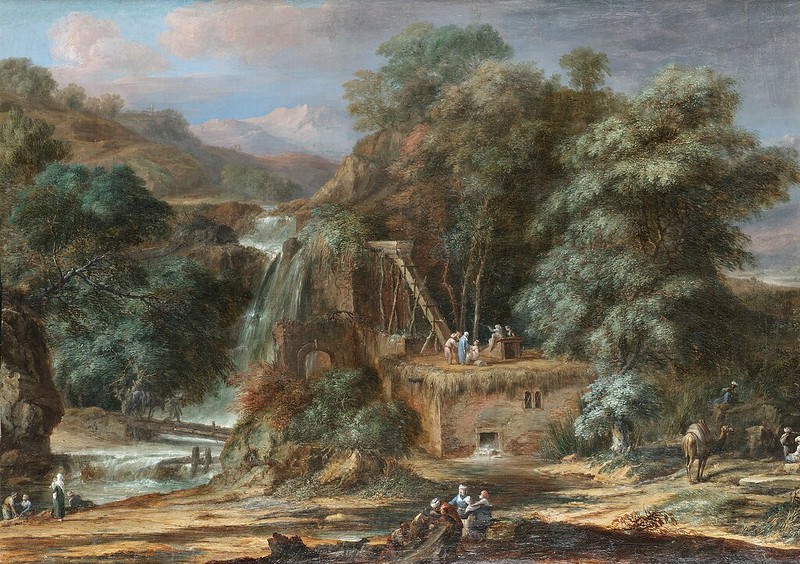
Christoph Ludwig Agricola - A river landscape with figures constructing an aqueduct beside waterfalls, oriental figures and camels nearby
Obra de Christoph Ludwig Agricola (1665-1724), pintor alemany (1)


- Recordatori de Louis-Gabriel Guillemain -
En el dia de la celebració del seu 308è aniversari de naixement


Parlem de Pintura...

Christoph Ludwig Agricola (Ratisbona, 5 de novembre de 1667 - 8 d'agost de 1719) va ser un pintor paisatgista alemany. Va passar viatjant la major part de la seva vida, visitant Anglaterra, els Països Baixos i França i residint per un període considerable a Nàpols. Els seus nombrosos paisatges, majoritàriament pintures de quart o gabinet, són notables pel seu realisme i especialment per la seva hàbil representació de les diferents estacions. En la composició seu estil mostra la influència de Nicolas Poussin, mentre que la il·luminació i el color imita a Claudio de Lorena. El museu de Brunswick conserva un Autoretrat amb paleta i pinzell, localitzant-se la major part de la seva producció en col·leccions privades.

Font: En català: No disponible - En castellano: Christoph Ludwig Agricola (1665-1724) - In english: Christoph Ludwig Agricola (1665-1724) - Altres: Christoph Ludwig Agricola (1665-1724)


Parlem de Música...

Louis-Gabriel Guillemain (París, 5 de novembre de 1705 - París, 1 d'octubre de 1770) va ser un compositor i violinista francès. Gràcies al suport del Comte de Rochechouart, Guillemain va aprendre violí. Per completar-ne els seus estudis se'n va anar a Itàlia. Va ser alumne de Giovanni Battista Somis i Jean-Marie Leclair i va tenir llocs importants a la cort reial de Versalles. El 1729 es va convertir en violinista de l'òpera de Lió i el 29 de març de 1734 va ser nomenat primer violí a la Reial Acadèmia de Dijon. Se'n va anar a París on va compondre una àmplia gamma de sonates mentre seguia com a violinista. El 1757 es va casar amb Catherine Langlais i el 1759 va entrar al servei del rei Lluís XV com a violinista. Les seves últimes composicions daten de 1762. En el seu camí a Versailles, i segons apunten les cròniques de l'època, es va suïcidar.

Font: En català: No disponible - En castellano: Louis-Gabriel Guillemain (1705-1770) - In english: Louis-Gabriel Guillemain (1705-1770) - Altres: Louis-Gabriel Guillemain (1705-1770)


Parlem amb veu pròpia...

Fa pocs dies, per caramboles quàntiques, vaig conèixer a Guillemain i, com tantes altres vegades, va resultar ser una inesperada sorpresa plàcidament agradable. Al no tenir referències ni el mínim coneixement relatiu al seu particular cosmos em centraré en la música la qual, de tradició francesa barroca i refinada i del gust del rei francès de l'època, és simplement deliciosa. Sota el nom genèric en francès d'Amusements (divertiments), va escriure una sèrie d'obres de cambra per a violí sol o amb acompanyament de flautes i clavecí. Per tant, avui escoltarem alguns d'aquests delicats amusements, concretament, el Premier amusement à la mode pour deux violons ou flûtes et basse Op. 8, les Pièces de clavecin en sonates avec accompagnement de violon en sol, Op. 13 on el clavecí sona meravellosament i el Deuxième divertissement de simphonies en trio, Op. 15 amb una deliciosa xacona final. Pels enamorats del barroc francès, és un regal que gustosament podreu ampliar ja que, en el seu cas, existeixen edicions monogràfiques al seu nom. Pel plaer natural i immediat de la seva música, no ens quedarà més remei que alçar l'esperit, mirar el cel blau i somriure!

Gaudiu i compartiu! 


Informació addicional...

INTÈRPRETS: Aliquando ensemble
AMAZON: Louis-Gabriel Guillemain: Amusements
CPDL: No disponible

Tant si us ha agradat, com si no, opineu, és lliure i fàcil!