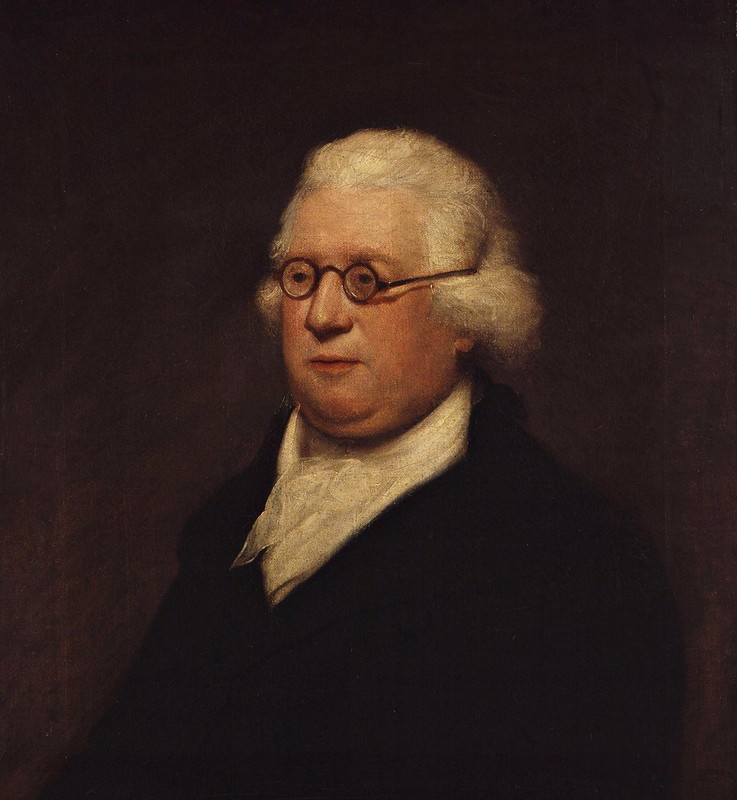
James Hook (1746-1827)
- Concerto (in D) for the Organ, No.5 Op.1 (1771)
Performers: Stеphеn Fаrr (organ); London Bаch Consort
Further info: James Hook (1746-1827) - Six Flute Trios Op. 83
---
English composer. He was born in the parish of St John, Maddermarket,
the son of James Hook, razor-grinder and cutler. He was born with a club
foot; early surgical operations improved the condition and, according
to Parke, ‘he could walk in a limping manner tolerably well’. Hook
showed remarkable musical talent at an early age, being able to play the
harpsichord at the age of four and performing concertos in public at
six. For a time he was taught by Thomas Garland, the Cathedral organist,
and before he was eight he had composed songs and his first opera. This
was considered by connoisseurs as an ‘extraordinary instance of
infantine genius’, but the music is lost. Hook’s father died in 1758 and
his mother carried on the cutlery business. From 13 November 1756
fairly regular advertisments appeared in the Norwich Mercury for
concerts at which Hook performed concertos, many of which were benefit
concerts. Hook employed his talents in various ways at this time,
including teaching, composing, transcribing music and tuning keyboard
instruments. At some time between June 1763 and February 1764 Hook moved
to London. His first position was that of organist at White Conduit
House, Pentonville, one of the many tea gardens that abounded in
18th-century London. He began to make a name for himself as an organist,
teacher and composer of light, attractive music, particularly songs. On
29 May 1766 Hook married Elizabeth Jane Madden at St Pancras Old
Church. His wife was both talented and artistic. She was a painter,
provided the libretto for Hook’s opera The Double Disguise (1784) and
the verses for some Vauxhall songs, and produced the designs and floral
decorations for the pillars in the orchestra at Vauxhall’s Jubilee
celebrations in 1786. Hook’s songs began to be regularly performed at
the main London pleasure gardens and the first of his many song
collections for the gardens at Marylebone and Vauxhall was published in
1767.
In May 1767 he had applied unsuccessfully for the post of organist for
the united parishes of St Matthew Friday Street and St Peter Westcheap,
but before 6 September 1772 he had been appointed organist of St Johns
Horselydown, Bermondsey. In 1768 he was appointed organist and composer
to Marylebone Gardens. He was also in demand to open new organs, both in
London and in nearby counties. Contemporary Norwich newspapers show him
to have been still performing in concerts around Norwich, frequently
playing many of his own compositions. He continued his keyboard teaching
and it is said that his income from this source alone amounted to over
£600 per annum. Hook remained at Marylebone Gardens until the end of the
1773 season and in 1774 was engaged in a similar capacity at Vauxhall
Gardens, a position he retained until 1820... Throughout this time he
composed operas, the majority of which were produced at Drury Lane and
Covent Garden Theatres. His son James Hook (1772-1828) provided the
librettos for Jack of Newbury (1795) and Diamond Cut Diamond (1797). On
20 March 1776 Hook’s only oratorio, The Ascension, was performed at
Covent Garden. His second son, Theodore Edward Hook (1788-1841), wrote
the words for many of Hook’s songs and between 1805 and 1809 provided
the librettos for eight of Hook’s operas. He later became the ghost
writer for Michael Kelly’s Reminiscences (1826). On 18 October 1805
Hook’s wife died, and a year later, on 4 November 1806, he married his
second wife, Harriet Horncastle James. It is not known why Hook left his
position at Vauxhall after almost a half century of service there; his
departure was sudden and surprising: ‘so little was his abrupt
retirement expected or understood, that the proprietor of the [gardens]
kept his station in the band open for him, during one entire season’. He
died in Boulogne in 1827 and his music library was sold at Puttick
& Simpson’s on 30 January 1874.