Es mostren els missatges amb l'etiqueta de comentaris Hoffmann E.T.A.. Mostrar tots els missatges

diumenge, 25 de gener del 2026

HOFFMANN, Ernest Theodor Amadeus (1776-1822) - Miserere (1809)

Eduard Gaertner (1801-1877) - Der Gendarmenmarkt im Winter


Ernest Theodor Amadeus Hoffmann (1776-1822) - MISERERE (b-moll) | posto in Musica (1809), AllH 42
Performers: Krisztina Laki (soprano); Gwendolyn Killebrew (alto); Aldo Baldin (tenor); Nikolaus Hillebrand (bass); Kölner Rundfunkchor; Kölner Rundfunk-Sinfonie-Orchester; Roland Bader (conductor)
Further info: Miserere B-Moll

---


German writer, composer, and jurist. After studying law and serving as a legal assessor in Poznan, he pursued formal musical training under the organist Christian Podbielski. His professional career in music included tenures as music director at the Bamberg theater and opera conductor in Leipzig and Dresden (1813-14) before he permanently relocated to Berlin in 1814. Utilizing the pseudonym Kapellmeister Johannes Kreisler, he contributed a series of influential essays to the Allgemeine Musikalische Zeitung, which were subsequently compiled in the collection Phantasiestücke in Callot’s Manier (1814). Hoffmann's literary output, characterized by the use of the fantastic, exerted a profound influence on the Romantic school of literature and indirectly shaped the evolution of German musical composition. As a composer, his catalog includes several operas, the ballet Harlekin, a symphony, and various chamber works, including a piano trio and four piano sonatas; while historically neglected, these works are noted for their technical originality. Furthermore, he was an accomplished artist known for his sketches and caricatures, as well as a music critic whose analytical reviews provided a rigorous theoretical framework for Romantic aesthetics. His multidisciplinary contributions significantly impacted subsequent generations of European artists, writers, and musicians. 

dimecres, 24 de gener del 2024

HOFFMANN, Ernest Theodor Amadeus (1776-1822) - Sinfonie Es-Dur

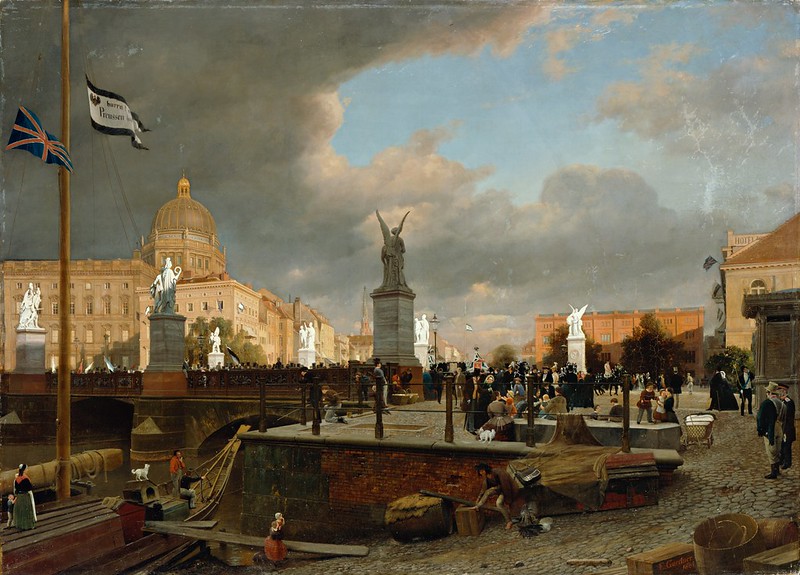
Eduard Gaertner (1801-1877) - Schlossbrücke in Berlin (1861)


Ernest Theodor Amadeus Hoffmann (1776-1822) - Sinfonie Es-Dur (c.1805)
Performers: Südwestdeutsche Philharmonie; Tamás Sulyok (1930-2020, conductor)

---


German writer and composer. His fantastic tales epitomize the Romantic fascination with the supernatural and the expressively distorted or exaggerated. As a critic, he placed his sharp mind at the service of a consistent (if partial) view of Romanticism and wrote vivid and forceful reviews of the music of his time. His work as a composer, which he himself regarded highly, has been neglected but shows a certain verve and originality. He was also a gifted artist, the author of some excellent sketches and caricatures. His personality and talents lent a distinctive, if somewhat lurid, hue to Romanticism and influenced several generations of artists, writers and composers. He was a student of law, and served as assessor at Poznan; also studied music with the organist Christian Podbielski (1741-1792). He acquired considerable proficiency in music; served as music director at the theater in Bamberg; then conducted opera performances in Leipzig and Dresden (1813-14). In 1814 he settled in Berlin, where he remained. He used the pen-name of Kapellmeister Johannes Kreisler (subsequently made famous in Schumann's Kreisleriana) ; his series of articles in the 'Allgemeine Musikalische Zeitung' under that name were reprinted as Phantasiestiicke in Callot's Manier (1814). As a writer of fantastic tales, he made a profound impression on his period, and influenced the entire Romantic school of literature; indirectly, he was also a formative factor in the evolution of the German school of composition. As a composer he wrote a number of operas, a ballet, 'Harlekin', some sacred works, a symphony, a piano trio, 4 piano sonatas and other chamber works. 

diumenge, 24 de gener del 2021

HOFFMANN, Ernest Theodor Amadeus (1776-1822) - Die lustigen Musikanten (1805)

E. T. A. Hoffmann (1776-1822) - The Nutcracker and the Mouse King (1816)


Ernest Theodor Amadeus Hoffmann (1776-1822) - Die lustigen Musikanten (1805)
Performers: Judith Schmidt (soprano); Verena Schweizer (soprano); Thomas Schulze (tenor); Klaus Lang (bass);
RSO Berlin; Lothar Zagrosek (conductor)

---


His father Christoph Ludwig Hoffmann (1736-97), Hofgerichts-Advokat (high court barrister) and later Justizkommissar (attorney-at-law) and Kriminalrat (counsellor in criminal law), married his cousin Lovisa Albertina Doerffer (1748-96); they lived apart after 1778, and Hoffmann stayed with his mother in the house of his grandmother. The two women lived in almost complete retirement in their rooms, and the boy’s education was directed by his uncle Otto Wilhelm Doerffer (1741-1811), with whom he shared a living-room and bedroom. Doerffer was well educated but unimaginative, mechanical and a strict disciplinarian; Hoffmann was quick to see his uncle’s faults and could never love or respect him, although he owed to him his earliest musical education and the lifelong habit of constant hard work. Hoffmann attended the Burgschule in Königsberg and became friends with Theodor Gottlieb von Hippel (1775-1843), later a West Prussian civil servant, whom he counted as his ‘most faithful and constant friend’; from Hippel comes the only reliable information about Hoffmann’s childhood, adolescence and early works. In keeping with the family tradition, Hoffmann was enrolled (unwillingly) in the faculty of law at Königsberg University (27 March 1792). At the same time he continued his studies in painting and was taught the piano by Carl Gottlieb Richter (1728-1809), thoroughbass and counterpoint by the Königsberg organist Christian Wilhelm Podbielski (1740-92) and (after Podbielski’s death) by the choirmaster Christian Otto Gladau (1770-1853), who had already been his violin teacher. Hoffmann completed his law studies in July 1795, and on 27 August 1795 he was appointed Auskultator (junior lawyer) by the Königsberg administration. After extricating himself from a painful love affair, in May 1796 he moved to Glogau, where Johann Ludwig Doerffer (1743-1803), his mother’s second brother, was a civil servant. There Hoffmann became engaged to his cousin Sophie Wilhelmine Doerffer (1775-1835) in 1798 (he broke off the relationship in 1802). Shortly after a journey to the Riesengebirge and Dresden he left Glogau with his uncle, who was moving to Berlin and who recommended Hoffmann, a Referendar (junior barrister) since 15 July 1798, for a similar position at the Berlin Kammergericht (Supreme Court). He enthusiastically attended Italian opera and the German Nationaltheater, made the acquaintance of B.A. Weber and took composition lessons from J.F. Reichardt. His earliest extant composition dates from this period: the three-act Singspiel Die Maske (completed in March 1799), to his own text. If the performances he saw in the Berlin theatres stimulated his musical creativity, his visits to art galleries decisively subdued his zeal as a painter. After passing his final law examination with distinction, he was appointed Assessor (assistant judge) at the high court in Posen (now Poznań) on 27 March 1800. There he wrote the Kantate zur Feier des neuen Jahrhunderts, the first of his compositions to be performed in public (New Year’s Eve, 1800). His setting of Goethe’s Singspiel Scherz, List und Rache also had its first performance in Posen; 18 years later Hoffmann still spoke warmly of this early work, whose score and parts had meanwhile been destroyed by fire.

Soon after breaking off his engagement to Sophie Doerffer, Hoffmann married Marianna Thekla Michaelina Rorer (1778-1859) on 26 July 1802. Earlier that year he had been appointed Regierungsrat (administrative adviser) and transferred to Płock in southern Prussia because of a well-founded suspicion that he had been drawing caricatures of authorities in the Posen garrison. His promising career was thus thwarted by an exile to provincial obscurity lasting until early 1804, during which time there could be no public performances of his music. He therefore attempted to have his compositions printed, and in May 1803 answered an advertisement by Nägeli, the publisher of the Répertoire des clavecinistes; under the pseudonym Giuseppo Dori he sent off a Fantasia in C minor, which met the publisher’s explicit demands for ‘a piano piece of large proportions, deviating from the usual sonata form and worked according to the rules of double counterpoint’. However, Nägeli rejected the piece, and a Piano Sonata in A  sent to Schott in Mainz likewise failed. Hoffmann even entered a literary competition organized by Kotzebue, but his comedy Der Preis (which took as its subject the competition itself) brought him no prize money, only the judges’ commendation. A second approach to Nägeli in March 1804 with a piano sonata did not even meet with a reply, and his hope of financial independence through a legacy from his aunt Johanna Sophie Doerffer came to nothing. He did at least succeed in his constant efforts to get himself transferred from Płock, and in March 1804 he was sent to Warsaw. In the Polish capital Hoffmann the musician had to make a completely fresh start; nevertheless, he found conditions so favourable to his musical ambitions that he could dispense with the income brought by his official position. After only a year he had an opera successfully staged (Die lustigen Musikanten, with text by Brentano); he completed the D minor Mass begun in Płock, had a piano sonata published in a Polish music magazine and found, in the weekly concerts of the Ressource music society (of which he became vice-president), opportunities to try out new compositions on the public. He also conducted the society’s orchestra (which was of a sufficiently high standard to perform Beethoven’s first two symphonies) and took part in its concerts as a pianist and singer. Moreover, it must have been for the Ressource concerts that he wrote his Symphony in E , his Quintet for harp, two violins, viola and cello and the lost Piano Quintet in D. When the dramatist Zacharias Werner commissioned him to write incidental music for his play Das Kreuz an der Ostsee, Hoffmann saw this as a welcome opportunity to gain a footing in the Berlin Nationaltheater, and he intended to solidify his anticipated reputation with a comic opera, Die ungebetenen Gäste, oder Der Kanonikus von Mailand (after Alexandre Duval). However, nothing came of all these plans: Werner’s play was rejected as unperformable, and Hoffmann’s Singspiel clashed with G.A. Schneider’s setting of the same plot, which was already under consideration by the Berlin theatre. After Napoleon entered Warsaw and disbanded the Prussian provincial government in 1806, Hoffmann continued to direct the music society’s concerts, even though most of its members were Prussian officials who had left the city. The performances were gradually eclipsed by the concerts of Paer, who had come to Warsaw in the emperor’s retinue, and Ressource soon gave up. Hoffmann, his circumstances now aggravated by material need and illness, occupied himself with preparing a new libretto from A.W. Schlegel’s translation of Calderón’s La banda y la flor.

At the beginning of June 1807, when former officials who refused to sign a declaration of submission and take an oath of allegiance were expelled from Warsaw, Hoffmann planned a move to Vienna bearing a recommendation from his colleague J.E. Hitzig. When he was not granted a pass he went to Berlin, arriving there only to learn that officials from the surrendered provinces of Prussia could not be given compensation for the loss of their positions. He advertised for the post of music director at any theatre, and was accepted by those of Lucerne and Bamberg. Having decided on the latter, he was commissioned to write a four-act opera, Der Trank der Unsterblichkeit (to a libretto by Count Julius von Soden), as a specimen of his work and was given the post with effect from 1 September 1808. At last it seemed that Hoffmann was achieving his goal: not only was he free from a merely breadwinning profession, but he could also use his status as music director of a theatre to further his career as a composer. He had particular hopes for the Calderón opera completed in Berlin, which he finally called Liebe und Eifersucht. But circumstances again thwarted him; when he took up the new post he found another director in place of Count Soden who had appointed him. A few weeks later Hoffmann’s contract as music director was cancelled, and it was only as a theatre composer that his association with the organization continued. In this capacity he wrote a large number of short commissioned compositions, including choruses and marches for plays, additional arias, and so on, nearly all of which have been lost. For two years he earned his living chiefly as a singing and piano teacher, since even the small salary due him as a theatre composer was constantly jeopardized by maladministration at the theatre. Once again he was forced to look for sources of income beyond the narrow confines in which he was working. During the time he was without work in Berlin, Hoffmann had again made contact with Nägeli in Zürich, no longer under a pseudonym but (after his successes in Warsaw) using his own name. A firm agreement seems to have been reached, but despite an active correspondence from Bamberg lasting until November 1809 not a single work of his appeared under Nägeli’s imprint. Early in 1809 he composed the Miserere in B  minor with orchestra for the Grand Duke Ferdinand, whose residence was in Würzburg, though this did not secure him an association with the court. He was more successful in his contact with Rochlitz, to whom he sent the story ‘Ritter Gluck’ on 12 January 1809, adding that he was prepared to send the Allgemeine musikalische Zeitung (AMZ) essays on music and reviews of musical works. Rochlitz published ‘Ritter Gluck’ in February, and dispatched the first works for review (including two symphonies by Friedrich Witt) at the beginning of March, inquiring in June whether Hoffmann would also review Beethoven’s symphonies; the historic review of the Fifth Symphony appeared a year later, and Hoffmann remained a regular contributor to the AMZ until 1815. In September 1809 Soden was compelled to resume the directorship of the Bamberg theatre, which had been ruined by bad management, and on 11 October his melodrama Dirna, with Hoffmann’s music, was first staged (later it was presented in Donauwörth and Salzburg); no other significant dramatic composition of Hoffmann’s was performed in Bamberg during his stay. 

His music for Sabinus, another melodrama by Soden, was left incomplete when the author again gave up his directorship of the theatre. Hearing of a vacancy for the position of conductor with Joseph Seconda’s company based in Dresden and Leipzig, Hoffmann asked Rochlitz for a recommendation; but the request came too late – Friedrich Schneider had already been engaged. The wretched state of affairs at the Bamberg theatre briefly improved when Franz von Holbein took over the direction on 1 October 1810. Hoffmann had known Holbein since 1798 in Berlin, and he was immediately engaged as the new director’s secretary, producer, scene-painter and stage designer, though not as conductor, and was also re-employed as a composer of incidental music. The melodrama Saul, which he had composed early in 1811 to a libretto by Seyfried, was performed that summer in Bamberg and in Würzburg as late as 1815, and he wrote the music for Holbein’s heroic opera Aurora in 1811-12. The mastering of unfulfilled passion remained Hoffmann’s poetic mission to the end of his life; he himself hinted (diary, 27 April 1812) at the close connection between his hopeless love for his young pupil Julia Mark, the crucial experience of his Bamberg years, and the impetus of his literary production. The wine merchant, bookseller and librarian C.K. Kunz, with whom Hoffmann regularly associated, was anxious to set up as a publisher, and when, on 15 February 1813, he proposed that Hoffmann should write for him, Hoffmann accepted the offer, but delayed a binding agreement until 18 March, St Anselm’s Day and Julia’s 17th birthday. The first work published under that day’s contract was the initial pair of volumes of Fantasiestücke in Callots Manier (Easter 1814), and included the ‘essays’ which had appeared in the AMZ: ‘Ritter Gluck’ (1809), ‘Johannes Kreislers, des Kapellmeisters, musikalische Leiden’ (1810), ‘Gedanken über den hohen Wert der Musik’ (1812) and ‘Don Juan’ (1813), as well as a recasting of the main part of two AMZ Beethoven reviews under the title ‘Beethovens Instrumentalmusik’, which had already appeared in the Zeitung für die elegante Welt (1813) and ‘Höchst zerstreute Gedanken’ (1814), also reprinted from the same journal. All the earlier pieces included in the Fantasiestücke were inspired by music, and in those written especially for the two volumes (the foreword, Jacques Callot, the ‘Kreisleriana’ Ombra adorata and Der vollkommene Maschinist, Nachricht von den neuesten Schicksalen des Hundes Berganza and Der Magnetiseur) references to Julia are obvious. Meanwhile Hoffmann continued to pursue his musical career. An invitation from Holbein in January 1813 proposed a move to the Würzburg theatre, but shortly afterwards Holbein resigned his directorship in Würzburg on account of politics and the plan was forgotten. In February Schneider resigned his position with Seconda (to become organist at the Leipzig Thomaskirche), and Rochlitz, remembering Hoffmann’s request, recommended him to fill the vacancy with the Dresden-Leipzig company. Hoffmann left Bamberg to take up this new post on 21 April 1813. To his friends he reported that his new orchestra treated him with civility and a kind of submissiveness, which differed considerably from the foolish manners of the Bamberg musicians (letter to Speyer, 13 July 1813). 

As a composer he supplied Morlacchi’s Italian court opera in Dresden with a duet for insertion into a work by the younger Guglielmi, La scelta dello sposo, but he was preoccupied with the opera Undine. He had come across Fouqué’s short story in Bamberg in the summer of 1812, and had immediately seen in it an ideal subject for a Romantic opera; Hitzig, his former colleague and friend in Berlin, had managed to persuade Fouqué himself to prepare the libretto. Hoffmann set about composing the opera with great enthusiasm, but his work on it was constantly interrupted and it was not completed until August 1814. His financial situation compelled him to fulfil his literary obligations punctually, so that gradually his career as writer came to take priority over his career as composer. His own feelings are clear from a letter (20 July 1813) to his publisher with final instructions for the printing of the Fantasiestücke: ‘I do not want to give my name, since that should only be known to the world by a successful musical composition’. He remained true to this principle – although Trois canzonettes were published in 1808 under Hoffmann’s name, nearly all his writings which preceded the première of Undine appeared anonymously. After falling out with the unmusical Seconda, Hoffmann was given notice on 26 February 1814; he was stunned by this dismissal, only four days after declining the offer of the music directorship in Königsberg. Although Rochlitz tried to assist him with further commissions for the AMZ, without a regular position he found his situation in Leipzig increasingly difficult. He produced some caricatures, pamphlets and even a musical portrayal of a battle, Deutschlands Triumph im Siege bei Leipzig (printed in Leipzig under a pseudonym), which used the war and its hardships for their subject. In July 1813 his old friend Hippel came to Leipzig and was able to offer him the prospect of rejoining the Prussian civil service. In his straitened circumstances Hoffmann had to seize this opportunity, though he tried his best to arrange for a subordinate post which would leave him time to pursue his musical activities; he was too brilliant a lawyer for the Prussian judiciary to contemplate this arrangement, and on 1 October 1814 he was appointed to the Kammergericht. In Berlin he vainly sought a job as theatre conductor, but was turned down in favour of the virtuoso cellist Bernhard Romberg, who was to be the conductor of Undine. Although Romberg’s efforts were considered by many inadequate (including Hoffmann), the opera was a great success from its first performance on 3 August 1816 until, after the 14th performance, the theatre was burnt to the ground. Although Undine was never again staged during Hoffmann’s lifetime (apart from an unsuccessful performance in Prague in 1821), he was soon busy with other plans. Helmina von Chezy had introduced him to Calderón’s El galan fantasma; he was immediately enthusiastic about it and asked Carl Wilhelm Salice-Contessa to work out a libretto for him. This was to be a lighter companion-piece to Undine, surpassing it in effect wherever possible. On 24 June 1817 Hoffmann offered the proposed opera to the administrator of the Berlin Opera, who, though not uninterested, deferred a decision. Hoffmann was determined to compose the piece, though Salice-Contessa’s work took longer than expected and was finished only in August 1818. He claimed to have composed the opera in his head before ever writing down a note; however, he delayed too long before committing his ideas to paper. The beginning of a fair copy entitled Der Liebhaber nach dem Tode was found in his Nachlass, but is now lost. During the last two years of his life he was overwhelmed with commissions for pocket-books and almanacs, and editors paid him princely sums for his stories. The literary projects closest to his heart – the second part of Kater Murr and Schnellpfeffer – were pushed into the background along with writing down the opera which was to have been his greatest musical work. For this Hitzig, his first biographer, reproached him bitterly, but Hoffmann, of course, could not have foreseen his early death.

dimarts, 25 de juny del 2019

HOFFMANN, Ernest Theodor Amadeus (1776-1822) - Piano Trio (1809)

Friedrich von Amerling (1803-1887) - Schlafende Fischerin (1834)
Obra de Friedrich von Amerling (1803-1887), pintor austríac (1)


- Recordatori d'Ernest Theodor Amadeus Hoffmann -
En el dia de la commemoració del seu 197è aniversari de decés


Parlem de Pintura...

Friedrich von Amerling (Wien, 14 d'abril de 1803 - Wien, 14 de gener de 1887) va ser un pintor austríac. Fill de Franz Amerling i Theresia Kargl, es va formar, entre els anys 1815 i 1824, a l'Acadèmia de Belles Arts de Viena. Posteriorment, es va traslladar a Praga on va continuar la seva formació a l'Acadèmia de Belles Arts fins el 1826. Entre els anys 1827 i 1828 va viure a Londres on va rebre la influència decisiva dels grans retratistes anglesos i especialment de Thomas Lawrence. Al seu retorn a Viena, va fer estada a París, on va estudiar amb Horace Vernet, i a Roma. A partir del 1828 va treballar al servei de la cort austríaca i de clients adinerats en una època en què també va realitzar nombrosos viatges per Europa, Anglaterra, Nord d'Àfrica i el Pròxim Orient. El 1878, i després d'una carrera fulgurant, va rebre el títol de cavaller i el 1879 l'Orde de la Corona de Ferro. Com a pintor, va ser autor d'un miler d'obres la majoria de les quals retrats i amb un estil característic de l'època Biedermeier, és a dir, proper al del pintor Ferdinand Georg Waldmüller i hereu, en certa manera, del realisme de Jean Auguste Dominique Ingres. Friedrich von Amerling, considerat un dels pintors de retrats més destacats d'Àustria, va morir a Viena el gener de 1887.


Parlem de Música...

Ernst Theodor [Wilhelm] Amadeus Hoffmann (Königsberg, 24 de gener del 1776 - Berlin, 25 de juny del 1822) va ser un escriptor i compositor alemany. Va néixer amb el nom d'Ernst Theodor Wilhelm, però va canviar 'Wilhelm' per 'Amadeus', fruit de la profunda admiració que sentia per Mozart. Membre d'una família de juristes, va continuar amb la tradició familiar i va estudiar jurisprudència, disciplina en la qual va exercir en ciutats com Posen, Plock i Varsòvia. El 1806, després de l'entrada de les tropes franceses, va perdre la seva feina i va treballar com a professor de música i mestre de capella, compositor d'obres teatrals i dibuixant d'escenografies, fins que el 1814 va assolir un nou càrrec a l'administració prussiana. No obstant, la seva producció no es va limitar exclusivament als àmbits literari i musical, sinó que també va incloure el dibuix i la pintura. Com a crític musical, va exercir també una activitat molt destacable en la qual cal remarcar especialment el fet d'haver estat un dels primers a reconèixer el geni de Beethoven. La seva obra literària el va convertir en un dels principals representants del romanticisme alemany, influït sobretot per Novalis i Ludwig Tieck. La seva insatisfacció amb la realitat quotidiana, amb el món filisteu, va despertar en ell l'anhel d'una existència superior, l'única possibilitat d'existir residia en la màgia, en aquesta altra realitat en què es fan realitat anhels i somnis, i que es mou en el més profund del subconscient. Aquest altre món va tenir en la seva obra un caràcter ambivalent, ja que en ell es feien realitat els somnis, però sempre amb un caràcter amenaçador i demoníac. La seva genialitat va ser per tant la perfecció del contrast, ja que el conte es feia realitat en la quotidianitat: la fantasia de la realitat va ser la temàtica de la seva obra literària. I si bé va ser notablement prolífic com a compositor, el seu èxit en aquest sentit fou escàs, només redescobert musicalment anys després de la seva mort, esdevinguda a Berlin el juny de 1822.

Ernest Theodor Amadeus Hoffmann (1776-1822) (2)

OBRA:

Voca secular:

Stage:
AV no. from Allroggen Verzeichnis (1970):
4 Die Maske (Spl, 3, Hoffmann), 1799, D-Bsb; excerpts ed. F. Schnapp, vs (Berlin, 1923)
8 Scherz, List und Rache (Spl, 1, Hoffmann, after J.W. von Goethe), Posen, 1801, lost
19 Die lustigen Musikanten (Spl, 2, C. Brentano), Warsaw, 6 April 1805, F-Pn, D iv–v
20 Das Kreuz an der Ostsee, i: Die Brautnacht (incid music, Z. Werner), 1805, D-Bsb, D ix
21 Die ungebetenen Gäste, oder Der Kanonikus von Mailand (Spl, 1, Rohrmann, after A. Duval: Le souper imprévu), 1805, lost
33 Liebe und Eifersucht (Spl, 3, Hoffmann, after P. Calderón de la Barca: La banda y la flor), 1807, Bsb, D vi–viii
34 Der Trank der Unsterblichkeit (romantische Oper, 4, J. von Soden), 1808, Bsb
37 Das Gelübde (incid music, 1, H. Cuno), Bamberg, 16 Oct 1808, lost
38 Die Wünsche (incid music, 1, Cuno), Bamberg, 9 Nov 1808, lost
39 Die Pilgerin (incid music, 1, Hoffmann), Bamberg, 18 Nov 1808, lost
41 Arlequin (ballet, C. Macco), Bamberg, 1 Jan 1809, Bsb, D ix
44 Das Gespenst (incid music, A. von Kotzebue), Bamberg, 9 April 1809, lost
51 Dirna (melodrama, 3, Soden), Bamberg, 11 Oct 1809, BAs
53 Wiedersehn! (prol, 1, Hoffmann), 1809, Bsb
54 Sabinus (melodrama, Soden), 1810, Bsb, inc.
55 Aurora (grosse romantische Oper, 3, F. von Holbein), 1811–12, rev. and reorchd L. Böttcher, Bamberg, 5 Nov 1933, BAs, WÜsa, ed. in DTB, v (1984); orig. version, Bamberg, 9 Sept 1990
56 [quodlibet], Bamberg, 2 Feb 1811, lost
59 Saul, König in Israel (melodrama, 3, J. Seyfried, after L.C. Caigniez: Le triomphe de David), Bamberg, 29 June 1811, BAs, WÜsa
61 Heinrich von Wolfenschiessen (incid music, A. Klingemann), Bamberg, 14 Jan 1812, lost
63 Roderich und Kunigunde, oder Der Eremit vom Berge Prazzo, oder Die Windmühle von der Westseite, oder Die triumphierende Unschuld (Parodie, prol, 2, J.F. Castelli), Bamberg, 23 Feb 1812,

Others:
AV no. from Allroggen Verzeichnis (1970):
3 Judex ille (J.W. von Goethe: Faust), solo v, 4vv, org, orch, 1795, inc., lost
6 Kantate zur Feier des neuen Jahrhunderts: Singet Chronos’ jüngstem Sohne (J.L. Schwarz), Posen, 31 Dec 1800, lost
31 Canzonets and duettinos, 1805–7, lost
32 Trois canzonettes, 2–3vv, pf (Berlin, 1808): Già riede primavera (P. Metastasio), Senza di te, ben mio, Oh che cucagna
50 Songs from Golo und Genoveva (F. Müller), 1809, lost [see AV77]
64 Tre canzonette italiane, S, 2 T, B, pf, 1812, A-Wgm, D xii: Spuntar la sol d’aprile, La tortorella amante, Sento l’amica speme
65 Prendi, l’acciar ti rendo (G.M. Foppa), recit and aria, S, orch, 1812, D-Bsb, D xi
66 Mi lagnerò tacendo della mia sorte amara (Metastasio), 1812, lost
67 [Sei] Duettini italiani, S, T, pf, 1812, Bsb (Berlin, 1819), D xii: Ombre amene (Metastasio); Dove sei, mio caro bene?; Vicino a quel ciglio (Metastasio); Viver non potrò mai lungi da te, mio bene; Vicino a te, ben mio, mi sento giubilar; Ah che mi manca l’anima
68 O nume che quest’anima, S, 2 T, B, 1808–12, Bsb, D xii
77 Still und hehr die Nacht: Nachtgesang (Müller: Golo und Genoveva), 6 male vv, 1819, CH-Bu, facs. in Schnapp, ii (1967), 224
78 Türkische Musik: Ein Kaiser einst in der Türkei (F. Förster), 4 male vv, 1820, RUS-KAu, D xii
79 Schwer ist die Kunst und kurz das Leben, canon, 4vv, 1820; unknown private collection
80 Ach warum weiter du fliehende Welle (Fouqué), lied, male vv, 1820–21, lost
81 Two drinking-songs (H.G. von Ahlefeldt), male vv, 1820–21, lost: Tafel halten bei drei Speisen, Wir trinken Wein vom freien Rhein
82 Walpurgisnacht (cant., Förster), 4vv, 1820–21, lost
83 Jägerlied (L. Tieck), solo vv, 4 male vv, ?1820–21, frag., D-Bsb, D xii
84 Katzburschenlied (Hoffmann), 4–5 male vv, 1821, frag., Allroggen (1970), 128, D xii

Lost:
AV no. from Allroggen Verzeichnis (1970):
70 Undine (Zauberoper, 3, F.H.C. de la Motte Fouqué), Berlin, 3 Aug 1816, Bsb, D i–iii
74 Thassilo (chorus and melodrama, Fouqué), Berlin, 22 Oct 1815, lost; rev. as drama, Berlin (1), 18 Jan 1817, lost
85 Der Liebhaber nach dem Tode (op, 3, C.W. Salice-Contessa, after Calderón: El galan fantasma), 1818–22, inc., lost
Several single pieces, AV nos.43, 45–7, 57–8, 69, 71, all lost
Other canzonets and songs, AV nos.2, 5, 35, 48–9, all lost

Vocal religiosa:

AV no. from Allroggen Verzeichnis (1970):
9–10 Masses, Vespers, 1802–3, lost
11 Mass, G, 2 S, 2 vn, org, 1802–3, lost
12–15 Motets, choruses, 4vv, 1802–3, lost
18 Mass, d, 4vv, orch, 1803–5, D-Bsb, D x
36 [Sex] Canzoni, 4vv, 1808, Bsb, B iv, D x: Ave maris stella, De profundis, Gloria Patri et Filio, Salve Redemptor, O sanctissima, Salve regina
42 Miserere, b , 2 S, A, T, B, 4vv, orch, 1809, Bsb, D x
72 Hymn, 1813, lost

Instrumental:

Orch.:
AV no. from Allroggen Verzeichnis (1970):
7 Overture: Musica per la chiesa, orch, 1801, D-Bsb, D x
23 Symphony, E , 1805–6, Bsb, D xi

---

Chbr.:
AV no. from Allroggen Verzeichnis (1970):
24 Quintet, c, hp, 2 vn, va, vc, before Oct 1807, Bsb, B ii, D xii
25 Quintet, D, pf, 2 vn, va, db, before Oct 1807, lost
52 Piano Trio, E, 1809, private collection, D xii

Piano:
AV no. from Allroggen Verzeichnis (1970):
1 Kleine Rondos, 1794–5, lost
16 Fantasia, c, 1803, lost
17 Sonata, A , 1803, lost
22 Sonata, A, in Wybor pieknych, vii (Breslau, 1805); ed. F. Schnapp (Kassel, 1968), D xii
26 Sonata, b , ?1807–8, lost
27 Sonata, f, ?1807, D-Bsb, B i, D xii
28 Sonata, C, ?1807, lost
29 Sonata, F, ?1807, Bsb, B i, D xii
30 Sonata, f, ?1807–8, Bsb, B i, D xii
40 Sonata, c , c1808, Bsb, B i, D xii
62 Waltzes, pf/?orch, 23 Jan 1812, lost
73 Deutschlands Triumph im Siege bei Leipzig (Leipzig, 1814) [pubd under pseud. A. Vollweiler]
76 Serapions-Walzer, c1818–21; unknown private collection

Literatura:

Music reviews and related essays:
‘Schreiben eines Klostergeistlichen an seinen Freund in der Hauptstadt’, Der Freimüthige, (1803), 573 [on use of Greek chorus in Schiller’s Braut von Messina]
‘Über Salomons Urtheil’, Allgemeine deutsche Theater-Zeitung (17 and 20 May 1808) [review of A. Quaisin: Le jugement de Salomon]
F. Witt: Symphonies nos.5 and 6, AMZ, xi (1808–9), 513–17
L. van Beethoven: Symphony no.5, AMZ, xii (1809–10), 630–42, 652–9
V. Fioravanti: I virtuosi ambulanti [vs by L. Wolff], AMZ, xii (1809–10), 204–8
C.W. Gluck: Iphigénie en Aulide [vs by G.C. Grosheim], AMZ, xii (1809–10), 770–71, 784–9
A. Romberg: Pater noster, AMZ, xii (1809–10), 209–12
J. Weigl: Das Waisenhaus, AMZ, xii (1809–10), 809–19
F. Paer: La Sofonisba [vs by C.F. Ebers], AMZ, xiii (1811), 185–95
L. Spohr: Symphony no.1, AMZ, xiii (1811), 797–806, 813–19
L. van Beethoven: Overture to Coriolan, AMZ, xiv (1812), 519–26
A. Gyrowetz: Der Augenarzt, AMZ, xiv (1812), 855–64
E. Méhul: Ouverture de chasse from Le jeune Henri, AMZ, xiv (1812), 743–7
A.H. Pustkuchen: Choralbuch und kurze Anleitung, AMZ, xiv (1812), 791–7
L. van Beethoven: Incidental music to Goethe’s Egmont, AMZ, xv (1813), 473–81
L. van Beethoven: Mass in C, AMZ, xv (1813), 389–97, 409–14
L. van Beethoven: Two piano trios op.70, AMZ, xv (1813), 141–54 [music exx. in suppl. 3]
C.A.P. Braun: Symphony no.4 and J.W. Wilms: Symphony op.23, AMZ, xv (1813), 373–80
‘Alte und neue Kirchenmusik’, AMZ, xvi (1814), 577–84, 593–603, 611–19
J.C. Ambrosch: Two songs, AMZ, xvi (1814), 811 only
A. Bergt: Christus, durch Leiden verherrlicht, AMZ, xvi (1814), 5–17
A. Boieldieu: Der neue Gutsherr [Le nouveau seigneur de village], AMZ, xvi (1814), 669–73
‘Der Opern-Almanach des Hrn. A. v. Kotzebue’, AMZ, xvi (1814), 720–21, 736–41
J. Elsner: Overtures to Andromeda and Leszek bialy, AMZ, xvi (1814), 41–6
M.K. Ogiński: 12 polonaises for piano, AMZ, xvi (1814), 792–4
J.F. Reichardt: Piano Sonata in F minor, AMZ, xvi (1814), 344–50
W.F. Riem: 12 lieder op.27, AMZ, xvi (1814), 680–92
F. Schneider: Piano Sonata op.29 [4 hands], AMZ, xvi (1814), 221–7
B. Stiastny: Il maestro ed il scolare and J. Stiastny: 2 pièces faciles et progressives, AMZ, xvi (1814), 726–8
‘Über einen Ausspruch Sacchini’s und Über den sogenannten Effect in der Musik’, AMZ, xvi (1814), 477–85
A. André: Piano variations on Ah vous dirai-je, maman and O du lieber Augustin and P.J. Riotte: Piano variations on a theme from Weigl’s Schweizerfamilie, AMZ, xvii (1815), 138–40
J. Fröhlich: Piano Sonata [4 hands] and Piano Concerto [4 hands], AMZ, xvii (1815), 806–8
Aus Hoffmann’s Leben und Nachlass, ed. J.E. Hitzig (Berlin, 1823/R), 246 only [frag.; orig., 1808, lost]

Concert reviews:
‘Briefe über Tonkunst in Berlin: erster Brief’, AMZ, xvii (1815), 17–27 [incl. remarks on concert by B. Romberg and perfs. of Sacchini’s Oedipe à Colone and Spontini’s Fernand Cortez]
E. Méhul: Ariodant, Dramaturgisches Wochenblatt, i (1815–16), 195
W.A. Mozart: Don Giovanni, Dramaturgisches Wochenblatt, i (1815–16), 107
W.A. Mozart: Die Zauberflöte, Dramaturgisches Wochenblatt, i (1815–16), 158
F. Paer: Camilla, Dramaturgisches Wochenblatt, i (1815–16), 92
A. Sacchini: Oedipe à Colone, Dramaturgisches Wochenblatt, i (1815–16), 99
A. Sacchini: Oedipe à Colone and R. Kreutzer: Paul et Virginie, Dramaturgisches Wochenblatt, i (1815–16), 179
B.A. Weber: Sulmalle and Maler Tenier, Dramaturgisches Wochenblatt, i (1815–16), 114
P. Winter: Das unterbrochene Opferfest, Dramaturgisches Wochenblatt, i (1815–16), 91
J.P. Schmidt: Die Alpenhütte, Berlinische Nachrichten von Staats- und gelehrten Sachen (12 Sept 1816)
G. Spontini: La vestale, Dramaturgisches Wochenblatt, ii (1816–17), 18
‘Einige Bemerkungen zu den Worten, die der Königl. Kammersänger Hr. Fischer in Nr.32 des “Gesellschafters” über das Verhältnis des Künstlers zum Publikum ausgesprochen hat’, Der Freimüthige, xv (Leipzig, 1818), 175
J.P. Schmidt: Das Fischermädchen oder Hass und Liebe, KPBZ (Vossische Zeitung) (3 Dec 1818)
‘An den Herrn Konzertmeister Möser’, KPBZ (6 Nov 1819)
‘Ein Brief des Kapellmeisters Johannes Kreisler’, Der Freimüthige, xvi (1819), 337, 342
‘Noch einige Worte über das Konzert des Herrn Konzertmeister Möser, am 26sten März d.J.’, KPBZ (30 March 1820)
‘Rüge’, KPBZ (25 April 1820) [reproof of anti-Semitic sentiments in a review in Der Freimüthige of works by Méhul and Meyerbeer]
‘Gruss an Spontini’, KPBZ (6 June 1820)
‘Über ein Konzert unter Leitung Spontinis zum Geburtstag Friedrich Wilhelms III’, KPBZ (5 Aug 1820)
C.W. Gluck: Armide, KPBZ (16 Sept 1820)
‘Zufällige Gedanken bei dem Erscheinen dieser Blätter’, Allgemeine Zeitung für Musik und Musikliteratur (9 and 16 Oct 1820)
‘Bescheidene Bemerkung zu dem die letzte Aufführung der Oper Don Juan betreffenden in No.142 dieser Zeitung enthaltenen Aufsatze’, KPBZ (30 Nov 1820); correction (2 Dec 1820)
G. Spontini: Lalla Rükh, Zeitung für Theater und Musik (24 Feb 1821)
‘Nachträgliche Bemerkungen über Spontinis Oper Olympia’, Zeitung für Theater und Musik (9, 16, 23 and 30 June, 14, 21 and 28 July, 4, 18 and 25 Aug, 1, 8 and 22 Sept 1821) [inc.]


Informació addicional... 

INTERPRETS: Hoffmeister Quartet; Trio Margaux
RECICLASSICAT: HOFFMANN, Ernest Theodor Amadeus (1776-1822)
AMAZON: Hoffmann ETA - Chamber music
SPOTIFY: Hoffmann ETA - Chamber music


Tant si us ha agradat, com si no, opineu, és lliure i fàcil!

diumenge, 24 de gener del 2016

HOFFMANN, Ernest Theodor Amadeus (1776-1822) - Messa d-Moll (1804)

Bernardo Bellotto - A capriccio river landscape with a church to the left (c.1765)
Obra de Bernardo Bellotto (1721-1780), pintor italià (1)


- Recordatori d'Ernest Theodor Amadeus Hoffmann -
En el dia de la celebració del seu 240è aniversari de naixement


Parlem de Pintura...

Bernardo Bellotto, o "Canaletto el jove" (Venezia, 30 de gener de 1721 - Warszawa, 17 d'octubre de 1780) va ser un pintor i gravador vedutista italià. Nebot de Canaletto, Bellotto va començar la seva formació artística als 15 anys al taller del seu oncle Giovanni Antonio Canal i no només va adoptar la seva especialitat, la pintura de veduta, sinó també el seu estil i fins i tot el nom Canaletto. Com el seu oncle, va viure a Venècia fins al 1742, data en què es va traslladar a Roma i potser també a la Toscana. Va treballar en diferents llocs d'Itàlia, a Llombardia i a Torí abans de viatjar a Anglaterra el 1746. Un any després va ser rebut a Dresden per l'aleshores Príncep Elector Frederic August II el Fort, que va mostrar un viu interès per la seva obra. A Viena va treballar per a María Teresa I i l'aristocràcia austríaca, passant per Munich, i retornant el 1762 a Dresden, on després de perdre el seu lloc a la cort, va treballar com a professor de perspectiva a l'acadèmia fundada el 1764. Bellotto no es va establir definitivament fins el 1768, any en què va ser nomenat pintor de la cort d'Estanislau II Poniatowski a Varsòvia. L'estreta col·laboració entre oncle i nebot fan difícil la delimitació entre les obres de joventut d'un i les de maduresa de l'altre. Les obres personals Bellotto es va diferenciar de les de Canaletto per un cromatisme més fred, per un predomini del clarobscur i per una realista precisió topogràfica. Les seves obres principals, com les 14 vedute de Dresden i la Vista de Varsòvia, van mostrar una qualitat semblant a les del seu oncle. Les seves vistes de capitals europees van constituir, per la seva precisió i fidelitat a l'original, una important font històrica, fins el punt que es van utilitzar per a la reconstrucció d'edificis històrics de Dresden i Varsòvia que havien patit danys durant la Segona Guerra Mundial. Va morir a Vàrsovia l'octubre de 1780.


Parlem de Música...

Ernst Theodor [Wilhelm] Amadeus Hoffmann (Königsberg, 24 de gener del 1776 - Berlin, 25 de juny del 1822) va ser un escriptor i compositor alemany. Va néixer amb el nom d'Ernst Theodor Wilhelm, però va canviar 'Wilhelm' per 'Amadeus', fruit de la profunda admiració que va sentir per Mozart. Membre d'una família de juristes, va continuar amb la tradició familiar i va estudiar Jurisprudència, càrrec que va exercir en ciutats com Posen, Plock i Varsòvia. El 1806, després de l'entrada de les tropes franceses, va perdre el seu lloc i va haver de dedicar-se a exercir com a professor de música i mestre de capella, compositor d'encàrrecs teatrals i dibuixant d'escenaris també per al teatre, fins que el 1814 va aconseguir d'un nou un càrrec en l'administració prussiana. No obstant, la seva producció no es va limitar exclusivament als àmbits literari i musical, sinó que va abastar també el dibuix i la pintura. Com a crític musical va exercir també una activitat molt destacable, en la qual cal remarcar especialment el fet d'haver estat un dels primers a reconèixer el geni de Beethoven. La seva obra literària el va convertir en un dels principals representants del Romanticisme alemany, influït sobretot per Novalis i Ludwig Tieck. La seva insatisfacció amb la realitat quotidiana, amb el món filisteu, va despertar en ell l'anhel d'una existència superior, l'única possibilitat d'existir residia en la màgia, en aquesta altra realitat en què es fan realitat anhels i somnis, i que es mou en el més profund del subconscient. Aquest altre món va tenir en la seva obra un caràcter ambivalent, ja que en ell es feien realitat els somnis, però sempre amb un caràcter amenaçador i demoníac. La seva genialitat va ser per tant la perfecció del contrast, ja que el conte es feia realitat en la quotidianitat: la fantasia de la realitat va ser la temàtica de la seva obra literària. I si bé va ser notablement prolífic com a compositor, el seu èxit en aquest sentit fou escàs, només redescobert musicalment anys després de la seva mort, esdevinguda a Berlin el juny de 1822.

OBRA:

Voca secular:

Stage:
AV no. from Allroggen Verzeichnis (1970):
4 Die Maske (Spl, 3, Hoffmann), 1799, D-Bsb; excerpts ed. F. Schnapp, vs (Berlin, 1923)
8 Scherz, List und Rache (Spl, 1, Hoffmann, after J.W. von Goethe), Posen, 1801, lost
19 Die lustigen Musikanten (Spl, 2, C. Brentano), Warsaw, 6 April 1805, F-Pn, D iv–v
20 Das Kreuz an der Ostsee, i: Die Brautnacht (incid music, Z. Werner), 1805, D-Bsb, D ix
21 Die ungebetenen Gäste, oder Der Kanonikus von Mailand (Spl, 1, Rohrmann, after A. Duval: Le souper imprévu), 1805, lost
33 Liebe und Eifersucht (Spl, 3, Hoffmann, after P. Calderón de la Barca: La banda y la flor), 1807, Bsb, D vi–viii
34 Der Trank der Unsterblichkeit (romantische Oper, 4, J. von Soden), 1808, Bsb
37 Das Gelübde (incid music, 1, H. Cuno), Bamberg, 16 Oct 1808, lost
38 Die Wünsche (incid music, 1, Cuno), Bamberg, 9 Nov 1808, lost
39 Die Pilgerin (incid music, 1, Hoffmann), Bamberg, 18 Nov 1808, lost
41 Arlequin (ballet, C. Macco), Bamberg, 1 Jan 1809, Bsb, D ix
44 Das Gespenst (incid music, A. von Kotzebue), Bamberg, 9 April 1809, lost
51 Dirna (melodrama, 3, Soden), Bamberg, 11 Oct 1809, BAs
53 Wiedersehn! (prol, 1, Hoffmann), 1809, Bsb
54 Sabinus (melodrama, Soden), 1810, Bsb, inc.
55 Aurora (grosse romantische Oper, 3, F. von Holbein), 1811–12, rev. and reorchd L. Böttcher, Bamberg, 5 Nov 1933, BAs, WÜsa, ed. in DTB, v (1984); orig. version, Bamberg, 9 Sept 1990
56 [quodlibet], Bamberg, 2 Feb 1811, lost
59 Saul, König in Israel (melodrama, 3, J. Seyfried, after L.C. Caigniez: Le triomphe de David), Bamberg, 29 June 1811, BAs, WÜsa
61 Heinrich von Wolfenschiessen (incid music, A. Klingemann), Bamberg, 14 Jan 1812, lost
63 Roderich und Kunigunde, oder Der Eremit vom Berge Prazzo, oder Die Windmühle von der Westseite, oder Die triumphierende Unschuld (Parodie, prol, 2, J.F. Castelli), Bamberg, 23 Feb 1812,

Others:
3 Judex ille (J.W. von Goethe: Faust), solo v, 4vv, org, orch, 1795, inc., lost
6 Kantate zur Feier des neuen Jahrhunderts: Singet Chronos’ jüngstem Sohne (J.L. Schwarz), Posen, 31 Dec 1800, lost
31 Canzonets and duettinos, 1805–7, lost
32 Trois canzonettes, 2–3vv, pf (Berlin, 1808): Già riede primavera (P. Metastasio), Senza di te, ben mio, Oh che cucagna
50 Songs from Golo und Genoveva (F. Müller), 1809, lost [see AV77]
64 Tre canzonette italiane, S, 2 T, B, pf, 1812, A-Wgm, D xii: Spuntar la sol d’aprile, La tortorella amante, Sento l’amica speme
65 Prendi, l’acciar ti rendo (G.M. Foppa), recit and aria, S, orch, 1812, D-Bsb, D xi
66 Mi lagnerò tacendo della mia sorte amara (Metastasio), 1812, lost
67 [Sei] Duettini italiani, S, T, pf, 1812, Bsb (Berlin, 1819), D xii: Ombre amene (Metastasio); Dove sei, mio caro bene?; Vicino a quel ciglio (Metastasio); Viver non potrò mai lungi da te, mio bene; Vicino a te, ben mio, mi sento giubilar; Ah che mi manca l’anima
68 O nume che quest’anima, S, 2 T, B, 1808–12, Bsb, D xii
77 Still und hehr die Nacht: Nachtgesang (Müller: Golo und Genoveva), 6 male vv, 1819, CH-Bu, facs. in Schnapp, ii (1967), 224
78 Türkische Musik: Ein Kaiser einst in der Türkei (F. Förster), 4 male vv, 1820, RUS-KAu, D xii
79 Schwer ist die Kunst und kurz das Leben, canon, 4vv, 1820; unknown private collection
80 Ach warum weiter du fliehende Welle (Fouqué), lied, male vv, 1820–21, lost
81 Two drinking-songs (H.G. von Ahlefeldt), male vv, 1820–21, lost: Tafel halten bei drei Speisen, Wir trinken Wein vom freien Rhein
82 Walpurgisnacht (cant., Förster), 4vv, 1820–21, lost
83 Jägerlied (L. Tieck), solo vv, 4 male vv, ?1820–21, frag., D-Bsb, D xii
84 Katzburschenlied (Hoffmann), 4–5 male vv, 1821, frag., Allroggen (1970), 128, D xii

Lost:
70 Undine (Zauberoper, 3, F.H.C. de la Motte Fouqué), Berlin, 3 Aug 1816, Bsb, D i–iii
74 Thassilo (chorus and melodrama, Fouqué), Berlin, 22 Oct 1815, lost; rev. as drama, Berlin (1), 18 Jan 1817, lost
85 Der Liebhaber nach dem Tode (op, 3, C.W. Salice-Contessa, after Calderón: El galan fantasma), 1818–22, inc., lost
Several single pieces, AV nos.43, 45–7, 57–8, 69, 71, all lost
Other canzonets and songs, AV nos.2, 5, 35, 48–9, all lost

Vocal religiosa:

9–10 Masses, Vespers, 1802–3, lost
11 Mass, G, 2 S, 2 vn, org, 1802–3, lost
12–15 Motets, choruses, 4vv, 1802–3, lost
18 Mass, d, 4vv, orch, 1803–5, D-Bsb, D x
36 [Sex] Canzoni, 4vv, 1808, Bsb, B iv, D x: Ave maris stella, De profundis, Gloria Patri et Filio, Salve Redemptor, O sanctissima, Salve regina
42 Miserere, b , 2 S, A, T, B, 4vv, orch, 1809, Bsb, D x
72 Hymn, 1813, lost

Instrumental:

Orch.:
7 Overture: Musica per la chiesa, orch, 1801, D-Bsb, D x
23 Symphony, E , 1805–6, Bsb, D xi

Chbr.:
24 Quintet, c, hp, 2 vn, va, vc, before Oct 1807, Bsb, B ii, D xii
25 Quintet, D, pf, 2 vn, va, db, before Oct 1807, lost
52 Piano Trio, E, 1809, private collection, D xii

Piano:
1 Kleine Rondos, 1794–5, lost
16 Fantasia, c, 1803, lost
17 Sonata, A , 1803, lost
22 Sonata, A, in Wybor pieknych, vii (Breslau, 1805); ed. F. Schnapp (Kassel, 1968), D xii
26 Sonata, b , ?1807–8, lost
27 Sonata, f, ?1807, D-Bsb, B i, D xii
28 Sonata, C, ?1807, lost
29 Sonata, F, ?1807, Bsb, B i, D xii
30 Sonata, f, ?1807–8, Bsb, B i, D xii
40 Sonata, c , c1808, Bsb, B i, D xii
62 Waltzes, pf/?orch, 23 Jan 1812, lost
73 Deutschlands Triumph im Siege bei Leipzig (Leipzig, 1814) [pubd under pseud. A. Vollweiler]
76 Serapions-Walzer, c1818–21; unknown private collection

Literatura:

Music reviews and related essays:
‘Schreiben eines Klostergeistlichen an seinen Freund in der Hauptstadt’, Der Freimüthige, (1803), 573 [on use of Greek chorus in Schiller’s Braut von Messina]
‘Über Salomons Urtheil’, Allgemeine deutsche Theater-Zeitung (17 and 20 May 1808) [review of A. Quaisin: Le jugement de Salomon]
F. Witt: Symphonies nos.5 and 6, AMZ, xi (1808–9), 513–17
L. van Beethoven: Symphony no.5, AMZ, xii (1809–10), 630–42, 652–9
V. Fioravanti: I virtuosi ambulanti [vs by L. Wolff], AMZ, xii (1809–10), 204–8
C.W. Gluck: Iphigénie en Aulide [vs by G.C. Grosheim], AMZ, xii (1809–10), 770–71, 784–9
A. Romberg: Pater noster, AMZ, xii (1809–10), 209–12
J. Weigl: Das Waisenhaus, AMZ, xii (1809–10), 809–19
F. Paer: La Sofonisba [vs by C.F. Ebers], AMZ, xiii (1811), 185–95
L. Spohr: Symphony no.1, AMZ, xiii (1811), 797–806, 813–19
L. van Beethoven: Overture to Coriolan, AMZ, xiv (1812), 519–26
A. Gyrowetz: Der Augenarzt, AMZ, xiv (1812), 855–64
E. Méhul: Ouverture de chasse from Le jeune Henri, AMZ, xiv (1812), 743–7
A.H. Pustkuchen: Choralbuch und kurze Anleitung, AMZ, xiv (1812), 791–7
L. van Beethoven: Incidental music to Goethe’s Egmont, AMZ, xv (1813), 473–81
L. van Beethoven: Mass in C, AMZ, xv (1813), 389–97, 409–14
L. van Beethoven: Two piano trios op.70, AMZ, xv (1813), 141–54 [music exx. in suppl. 3]
C.A.P. Braun: Symphony no.4 and J.W. Wilms: Symphony op.23, AMZ, xv (1813), 373–80
‘Alte und neue Kirchenmusik’, AMZ, xvi (1814), 577–84, 593–603, 611–19
J.C. Ambrosch: Two songs, AMZ, xvi (1814), 811 only
A. Bergt: Christus, durch Leiden verherrlicht, AMZ, xvi (1814), 5–17
A. Boieldieu: Der neue Gutsherr [Le nouveau seigneur de village], AMZ, xvi (1814), 669–73
‘Der Opern-Almanach des Hrn. A. v. Kotzebue’, AMZ, xvi (1814), 720–21, 736–41
J. Elsner: Overtures to Andromeda and Leszek bialy, AMZ, xvi (1814), 41–6
M.K. Ogiński: 12 polonaises for piano, AMZ, xvi (1814), 792–4
J.F. Reichardt: Piano Sonata in F minor, AMZ, xvi (1814), 344–50
W.F. Riem: 12 lieder op.27, AMZ, xvi (1814), 680–92
F. Schneider: Piano Sonata op.29 [4 hands], AMZ, xvi (1814), 221–7
B. Stiastny: Il maestro ed il scolare and J. Stiastny: 2 pièces faciles et progressives, AMZ, xvi (1814), 726–8
‘Über einen Ausspruch Sacchini’s und Über den sogenannten Effect in der Musik’, AMZ, xvi (1814), 477–85
A. André: Piano variations on Ah vous dirai-je, maman and O du lieber Augustin and P.J. Riotte: Piano variations on a theme from Weigl’s Schweizerfamilie, AMZ, xvii (1815), 138–40
J. Fröhlich: Piano Sonata [4 hands] and Piano Concerto [4 hands], AMZ, xvii (1815), 806–8
Aus Hoffmann’s Leben und Nachlass, ed. J.E. Hitzig (Berlin, 1823/R), 246 only [frag.; orig., 1808, lost]

Concert reviews:
‘Briefe über Tonkunst in Berlin: erster Brief’, AMZ, xvii (1815), 17–27 [incl. remarks on concert by B. Romberg and perfs. of Sacchini’s Oedipe à Colone and Spontini’s Fernand Cortez]
E. Méhul: Ariodant, Dramaturgisches Wochenblatt, i (1815–16), 195
W.A. Mozart: Don Giovanni, Dramaturgisches Wochenblatt, i (1815–16), 107
W.A. Mozart: Die Zauberflöte, Dramaturgisches Wochenblatt, i (1815–16), 158
F. Paer: Camilla, Dramaturgisches Wochenblatt, i (1815–16), 92
A. Sacchini: Oedipe à Colone, Dramaturgisches Wochenblatt, i (1815–16), 99
A. Sacchini: Oedipe à Colone and R. Kreutzer: Paul et Virginie, Dramaturgisches Wochenblatt, i (1815–16), 179
B.A. Weber: Sulmalle and Maler Tenier, Dramaturgisches Wochenblatt, i (1815–16), 114
P. Winter: Das unterbrochene Opferfest, Dramaturgisches Wochenblatt, i (1815–16), 91
J.P. Schmidt: Die Alpenhütte, Berlinische Nachrichten von Staats- und gelehrten Sachen (12 Sept 1816)
G. Spontini: La vestale, Dramaturgisches Wochenblatt, ii (1816–17), 18
‘Einige Bemerkungen zu den Worten, die der Königl. Kammersänger Hr. Fischer in Nr.32 des “Gesellschafters” über das Verhältnis des Künstlers zum Publikum ausgesprochen hat’, Der Freimüthige, xv (Leipzig, 1818), 175
J.P. Schmidt: Das Fischermädchen oder Hass und Liebe, KPBZ (Vossische Zeitung) (3 Dec 1818)
‘An den Herrn Konzertmeister Möser’, KPBZ (6 Nov 1819)
‘Ein Brief des Kapellmeisters Johannes Kreisler’, Der Freimüthige, xvi (1819), 337, 342
‘Noch einige Worte über das Konzert des Herrn Konzertmeister Möser, am 26sten März d.J.’, KPBZ (30 March 1820)
‘Rüge’, KPBZ (25 April 1820) [reproof of anti-Semitic sentiments in a review in Der Freimüthige of works by Méhul and Meyerbeer]
‘Gruss an Spontini’, KPBZ (6 June 1820)
‘Über ein Konzert unter Leitung Spontinis zum Geburtstag Friedrich Wilhelms III’, KPBZ (5 Aug 1820)
C.W. Gluck: Armide, KPBZ (16 Sept 1820)
‘Zufällige Gedanken bei dem Erscheinen dieser Blätter’, Allgemeine Zeitung für Musik und Musikliteratur (9 and 16 Oct 1820)
‘Bescheidene Bemerkung zu dem die letzte Aufführung der Oper Don Juan betreffenden in No.142 dieser Zeitung enthaltenen Aufsatze’, KPBZ (30 Nov 1820); correction (2 Dec 1820)
G. Spontini: Lalla Rükh, Zeitung für Theater und Musik (24 Feb 1821)
‘Nachträgliche Bemerkungen über Spontinis Oper Olympia’, Zeitung für Theater und Musik (9, 16, 23 and 30 June, 14, 21 and 28 July, 4, 18 and 25 Aug, 1, 8 and 22 Sept 1821) [inc.] 

Font: En català: Ernest Theodor Amadeus Hoffmann (1776-1822) - En castellano: Ernest Theodor Amadeus Hoffmann (1776-1822) - In english: Ernest Theodor Amadeus Hoffmann (1776-1822) - Altres: Ernest Theodor Amadeus Hoffmann (1776-1822)


Parlem en veu pròpia o en veu d'altri...

Parlar d'Hoffmann en aquest espai pot semblar estrany pels neòfits de l'univers musical ja que com la majoria de nosaltres sabem, va ser més conegut i admirat literàriament que musicalment. Les seves obres de ficció, combinant gràcilment el dibuix grotesc amb el paisatge sobrenatural i simbòlic, amb un hipnòtic realisme psicològic, van resultar determinants i certament influents en el sí del moviment romàntic alemany. No obstant, Hoffmann i anàlogament amb molts personatges més o menys il·lustres del seu temps, va ser un mestre polifacètic que va saber explorar la literatura, el dibuix, la pintura, la jurisprudència i circumstancialment la música. Perquè en el seu cas, el pentagrama fou més una afició tardana, si bé molt profunda i compromesa, que una professió a l'ús tot i haver estudiat piano amb Carl Gottlieb Richter (1728-1802), contrapunt amb Christian Wilhelm Podbielski, violí amb Christian Otto Gladau (1770-1853) i, anys més tard, cant amb J.F. Reichardt. De fet, no va ser oficialment reconegut com a compositor de ple dret fins el 1808, l'any en què va assolir un càrrec de mestre de capella en diversos teatres. Hoffmann, per la seva part, va viure en contacte permanent amb l'escola austríaca de música la qual va resultar determinant a l'hora de construir la seva peculiar producció musical, principalment teatral i religiosa. L'etiqueta Amadeus del seu nom no fou casual i va ser motivada adhoc per la seva incontrolable admiració per Mozart la influència de qui es va fer perceptible en nombroses de les seves obres, entre elles el benaurat Miserere (per cert mai publicat en vida d'Hoffmann i que tristament no va poder escoltar... cosa que nosaltres si ho podem fer aquí) o en la seva sorprenent Missa en Re menor per a solistes, cor i orquestra de 1804 que avui recuperarem. Una partitura amb un primer i inesperat regal en forma d'obertura en la tonalitat de re menor i amb una esplèndida fuga que introdueix brillantment la missa. De fet, es creu que aquesta breu obertura instrumental va ser escrita per Hoffmann per una altra missa de la qual només se'n conserva un esbós i que convenientment adaptada a la missa d'avui, en resulta un recurs poc habitual però certament pertinent. A partir del Kyrie inicial, la declaració de principis d'Hoffmann es basa en dues referències, Mozart i Haydn. Ambdós mestres, i en el cas d'Haydn més proper a la filosofia religiosa de Johann Michael Haydn que a la del seu germà Joseph, van ser la literatura en la que es va emmirallar per a construir una partitura de clara orientació solemne i on les similituds amb alguns compassos del mateix Rèquiem de Mozart són evidents. Una obra de gran escala, eminentment clàssica, si bé amb tocs de foscor romàntica, i especialment opulent en fugues ja que tots i cadascun dels moviments presenten aquest recurs en un moment o altre del seu discurs. Cal destacar, l'esforç en la recuperació del Hoffmann més musical ja que tot i el que pugui semblar escoltant-lo, al seu temps no va ser especialment respectat ni celebrat en aquest sentit. El seu Miserere, extroardinari, o l'exemple d'aquesta Missa ens obliguen a reconsiderar el seu estatus perquè no hi ha dubte que s'ho mereix. Celebrem-lo amb alegria i ben acompanyats de l'eucaristia de cada diumenge!

Gaudiu i compartiu! 


Informació addicional... 

INTERPRETS: Sibylla Rubens (soprano); Jutta Boehnert (soprano); Rebecca Martin (mezzo-soprano); Thomas Cooley (tenor); York Felix Speer (bass); WDR Rundfunkchor Koln & WDR Sinfonieorchester Koln; Rupert Huber (conductor)
RECICLASSICAT: HOFFMANN, Ernest Theodor Amadeus (1776-1822)
LAQUINTADEMAHLER: HOFFMANN, E.T.A. - Missa in D Minor & Miserere
SPOTIFY: HOFFMANN, E.T.A. - Missa in D Minor & Miserere


Tant si us ha agradat, com si no, opineu, és lliure i fàcil!

dijous, 24 de gener del 2013

HOFFMANN, Ernest Theodor Amadeus (1776-1822) - Arlequin Ballet

Edgar Degas - Four Dancers (1899)
Obra d'Edgar Degas (1834-1917), pintor francès.


Ernest Theodor Amadeus Hoffmann (1776-1822) compositor, escriptor i cantant alemany nascut a Konigsberg. Sant tornem amb les celebracions i abriguem-nos del fred tot recuperant la màgia musical i literària d'un prolífic artista en multitud de disciplines trencant, en el seu cas, el tòpic que diu "qui molt abraça poc estreny", doncs Hoffmann, nat el 24 de gener d'avui fa 237 anys, és un dels personatges antològics de la cultura del segle XIX, de la història de la literatura i, de passada, de la música. No obstant i si bé en música el seu àmbit, tot i ser prolífic en òperes i instruments, ha quedat més restringit en l'espai i en els ambients més professionals i no tant profans. I en el sentit literari, a una altra dimensió evidentment, podem fer un cert paral·lelisme amb De Brossard, l'autor que ahir amablement visitàvem i que, com dèiem, va fer de la música un entreteniment de la seva autèntica i literària passió. Però bé, avui ens centrarem en Hoffmann i en el seu art que també va saber aplicar magistralment a la música. Una música inesperadament innovadora tot i néixer en ple classicisme ja que aquesta és més romàntica que formalment clàssica ja que probablement fou induïda per l'esplèndida imaginació que demostraria en la seva ingent producció escrita, sovint, de gran càrrega poètica, profunda i certament singular i que tant bé trobarem materialitzada teatralment, i en què es parodia el mateix Hoffmann, en la òpera el Contes de Hoffmann d'Offenbach. Avui, tanmateix i per no trencar la filosofia i l'essència d'aquest espai, no parlarem d'òpera sinó de ballet o de música incidental d'Hoffmann. De fet, la música de ballet de principis del segle XIX no és fàcil de trobar i en canvi aquí en trobarem un extens exemple instrumental en què les melodies imaginàries, el to romàntic i la riquesa tímbrica hi són ben presents. I en certa forma, em remet subtilment a la fantàstica simfonia imaginària que en el seu dia, i uns quants anys abans, havia escrit el magnífic autor francès expert en ballets Jean Philippe Rameau. En el nostre cas, parlem del Ballet Arlequin, una obra instrumental que Hoffmann va compondre l'any 1809 i en què demostra una solvència i un nivell acadèmic prou interessant tenint en compte el marcat caràcter polifacètic que demostraria al llarg del seus 46 anys de vida. Precisament, no farà gaires mesos ja feia referència a Hoffmann i en aquell cas en parlava en relació amb una sorprenent partitura religiosa on el seu autor homenatjava a dos mestres clàssics que havien marcat un punt d'inflexió en la seva concepció de la música. Avui ens centrarem en exclusivitat en l'univers instrumental que un dia Hoffmann, i la seva inseparable eina de treball que indistintament emprava per escriure literatura, dibuixar o compondre, va crear per tal que avui, 237 anys després del seu naixement, ho puguem commemorar com honradament sabem fer, amb la paraula de la música!

El ballet ens l'interpreta la Deutsche Kammerakademie Neuss sota la direcció de Johannes Goritzki.

Gaudiu i compartiu!


Font: (on trobareu informació addicional així com dels discs on podeu trobar aquesta obra)

SPOTIFY: E. T. A. Hoffmann: Arlequin Ballet; Overtures

E. T. A. Hoffmann: Arlequin Ballet; Overtures

Tant si us ha agradat, com si no, opineu, és lliure i fàcil!