Es mostren els missatges amb l'etiqueta de comentaris Manfredini F.O.. Mostrar tots els missatges

dimecres, 22 de juny del 2022

MANFREDINI, Francesco (1684-1762) - Concerto con due Trombe (1711)

Matthijs Naiveu (1647-1726) - Townscape with a stage performance


Francesco Manfredini (1684-1762) - Concerto (in Re maggiore) con due Trombe (1711)
[Historical recording]
Performers: Roger Delmotte (trumpet); Albert Adriano (trumpet); Ensemble Instrumental de Paris;
Louis de Froment (1921-1994, conductor)

---


Italian composer. His father, Domenico, was a trombonist at Pistoia Cathedral from 1684. Francesco studied music at Bologna in his youth, taking violin lessons from Torelli and lessons in counterpoint (at that time virtually synonymous with composition) from Perti. Shortly before 1700 he left for Ferrara, probably because of the dissolution of the S Petronio orchestra in 1696. In Ferrara he became first violinist at the church of the Holy Spirit. On returning to Bologna in 1703 he joined the reconstituted orchestra, initially as an occasional violinist and from 1709 to 1711 as a regular member. In 1704 he was admitted as a player (suonatore) to the Accademia Filarmonica. His first publication, a set of 12 chamber sonatas entitled ‘Concertini’, dates from the same year. There is evidence of a visit, or at least a planned visit, to Venice in February 1707, for the accidental death by drowning of his colleague Giuseppe Aldrovandini occurred as he was on his way to join Manfredini before the latter's departure. In 1711 Manfredini became attached to the court of the music-loving Antoine I Grimaldi, Prince of Monaco, where he was active as a composer and performer of instrumental music. Five children were born to him in the principality between 1712 and 1723. During this period he maintained close contact with, and perhaps sometimes visited, Bologna, where his op.3 concertos were published in 1718 and two oratorios were performed a little later. In 1724 he moved to Pistoia to become maestro di cappella at the cathedral. During his tenure of this post, which lasted until his death, he emerged successful from many disputes with the cathedral chapter and with the musicians under him. 

In Pistoia Manfredini had the opportunity to continue his activity as a composer of oratorios, which were performed at local churches, in addition to writing many sacred works for liturgical use at the cathedral and elsewhere. Although Manfredini was clearly a prolific composer, only his published instrumental music, together with a handful of other instrumental works in manuscript, survives. The loss of his nine known oratorios is especially unfortunate. His idiom is firmly Bolognese in character and resembles that of Torelli, B.G. Laurenti, Perti and other members of the school associated with S Petronio, though his music lacks the stamp of a forceful personality and in that respect is inferior to Torelli's. Venetian influence has been discerned in his use of unison writing, and the op.3 concertos did not go unmarked by Vivaldi, despite their greater debt to Torelli. The ending of both the op.2 Sinfonie da chiesa and the op.3 concertos with a Christmas pastorale (whose Torellian antecedent is only too patent) deserves mention. These so-called ‘sinfonie’, with an optional viola part, are ordinary church sonatas; the ‘solo’ or ‘soli’ cues in the violin parts merely tell the player that his part is momentarily exposed. The best of Manfredini’s instrumental works are the six sonatas published in London in 1764 (but not necessarily composed late in the composer's life). These are worthy examples of the ‘mixed’ type of sonata juxtaposing church and chamber elements that became normal after 1700. 

dissabte, 15 de desembre del 2018

MANFREDINI, Francesco Onofrio (1684-1762) - Sinfonie da chiesa (1709)

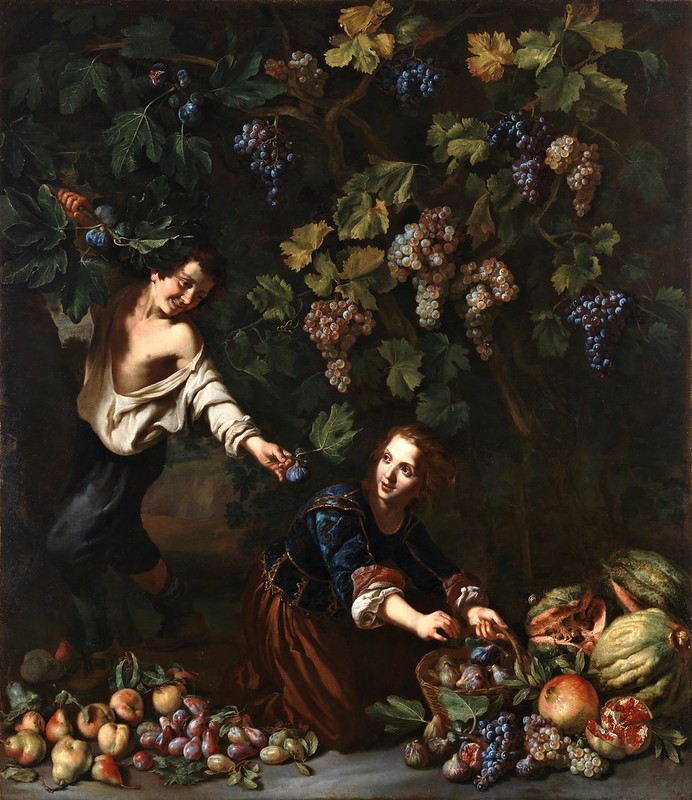
Michelangelo Cerquozzi - Niños cogiendo fruta
Obra de Michelangelo Cerquozzi (1602-1660), pintor italià (1)


Parlem de Pintura...

Michelangelo Cerquozzi (Roma, 1602 - Roma, 6 d'abril de 1660) va ser un pintor italià. Es desconeix la major part de la seva vida sent la primera referència de l'any 1634 com a membre de l'Accademia di San Luca. Com a pintor, va ser conegut amb el sobrenom de 'Michelangelo delle Battaglie' per la seva temàtica bel·licista, fet que fa pensar que va rebre formació de Vincent Leckerbetien. També es creu va gaudir de notable èxit a Roma, ciutat on hi va viure tota la seva vida, per la documentació d'alguns dels seus col·leccionistes com els cardenals Flavio Chigi i Bernardino Spada, entre altres. La seva fama també es va relacionar amb la del pintor Angeluccio amb qui va col·laborar habitualment en diverses obres. Michelangelo Cerquozzi va morir a Roma l'abril de 1660.


Parlem de Música...

Francesco Onofrio Manfredini (Pistoia, 22 de juny de 1684 - Pistoia, 6 d'octubre de 1762) va ser un compositor italià. Fill de Domenico Manfredini, instrumentista en aquell temps de la Catedral de Pistoia, es va formar inicialment amb el seu pare. Poc després, es va traslladar a Bolonya on va rebre classes de violí de Torelli i de contrapunt i composició de Perti. En una data anterior al 1700 va viatjar a Ferrara on va assolir un càrrec de primer violinista de l'església de l'Esperit Sant. El 1703, i després de tornar a Bolonya, es va incorporar a l'orquestra de la ciutat com a violinista ocasional entrant com a membre de ple dret a partir del 1709. El 1704 va ser admès com a suonatore de l'Accademia Filarmonica en l'any que va publicar la seva primera col·lecció musical per títol Concertini per camera Op.1 (1704). A partir del 1711 va constar com a intèrpret i compositor al servei d'Antoine I Grimaldi a Mònaco. Allà hi va romandre actiu fins el 1724, any que va tornar a Pistoia per treballar com a mestre de capella de la catedral de la ciutat. A partir d'aleshores va dedicar el seu temps a escriure oratoris i altra obra religiosa la majoria de la qual, no obstant, es va perdre anys després de la seva mort, esdevinguda a Pistoia l'octubre de 1762.

OBRA:

Vocal religiosa:

Oratorios:
music lost
S Filippo Neri trionfante nelle grotte di S Sebastiano di Roma (G.B. Neri), Bologna, 1719; Pistoia, 1725
Tomaso Moro (Neri), Bologna, c1720; Pistoia, 1727
Il doppio sacrifizio del Calvario (cantata sacra), Pistoia, 1725
La profezia d'Eliseo nell'assedio di Samaria (Neri), Pistoia, 1725
Salomone, assicurato nel soglio (D. Canavese), Pistoia, 1725
Discacciamento d'Adamo e d'Eva dal Paradiso terrestre, Pistoia, 1726
Il sacrifizio di Gefte (Neri), Pistoia, 1728
Il core umano combattuto da due amori, divino e profano (Neri), Pistoia, 1729
Golia ucciso da Davidde, Pistoia, 1734

Instrumental:

[12] Concertini per camera, vn, vc/theorbo, op.1 (Bologna, 1704)
1 trio sonata in Corona di dodici fiori armonici (Bologna, 1706)
[12] Sinfonie da chiesa, 2 vn, bc (org), va ad lib, op.2 (Bologna, 1709)
[12] Concerti, 2 vn, bc obbl, 2 vn, va, b, op.3 (Bologna, 1718)
Six Sonatas, 2 vn, vc, bc (hpd) (London, c1764)
Concerto a 4 con oboe e violini, A-Wn
Concerto con una o due trombe (1711), I-Bsp
Concerto, vn solo, 2 vn, va, vc, hpd, GB-Mp


Informació addicional... 

INTERPRETS: Capricornus Consort Basel
AMAZON: MANFREDINI, F. - Sinfonie da chiesa
CPDL: No disponible
SPOTIFY: MANFREDINI, F. - Sinfonie da chiesa


Tant si us ha agradat, com si no, opineu, és lliure i fàcil!