Es mostren els missatges amb l'etiqueta de comentaris Viotti G.B.. Mostrar tots els missatges

divendres, 12 de maig del 2023

VIOTTI, Giovanni Battista (1755-1824) - Concerto de Clavecin avec Violon Obligé (c.1787)

Louis Léopold Boilly (1761-1845) - A Game of Billiards


Giovanni Battista Viotti (1755-1824) - Concerto de Clavecin avec Violon Obligé (c.1787)
Performers: Eugene List (1918-1985, piano); Carroll Glenn (1918-1983, violin);
The Biedermeier Orchestra; Kurt List (1913-1970, conductor)

---


Italian violinist and composer. His father, a blacksmith, was an amateur musician who taught his son music and also bought a small violin for him to practice on. At the age of 11, Viotti was sent to Turin, where he gained the favor of Alfonso del Pozzo, Prince della Cisterna, who oversaw his education. After lessons with Antonio Celoniat, Viotti became a pupil of Pugnani in 1770. In 1775 he became a member of the last desk of 1st violins in the orchestra of the Royal Chapel in Naples. In 1780 he and Pugnani launched a major concert tour, performing in Switzerland, Dresden, Berlin, Warsaw, and St. Petersburg. By 1782 Viotti was in Paris on his own, where he first appeared at the Concert Spirituel (March 17). He immediately established himself as the premier violin virtuoso of the day, and gave regular concerts there until 1783. In 1784 he entered the service of Marie Antoinette in Versailles; he also acted as concertmaster of the orchestra of Prince Rohan-Guemenee. Thanks to the patronage of the Court of Provence, he opened the Theatre de Monsieur in Paris in 1788, which became the Theatre Feydeau in 1791. During his tenure there, he staged major works from the Italian and French repertories, including those of his close friend Cherubini. In 1792 he fled the revolution-wracked city of Paris for London, where he made his debut at Salomon's Hanover Square Concert on Feb. 7, 1793. He was the featured violinist of Salomon's concerts until 1795, and also acting manager of the Italian opera at the King's Theatre (1794-95). He became music director of the new Opera Concerts in 1795 and, in 1797, concertmaster and director of the orch. at the King's Theatre. In 1798 he was ordered by the British government to leave England on suspicion of Jacobin sympathies. After living in Schenfeldt, near Hamburg (1798-99), he was back in London by 1801, where he was engaged mainly in a wine business, although he later helped to found the Phil. Society and appeared in some of its chamber-music programs. 

In 1818 his wine business failed, and he returned to Paris, where he became director of the Opera in 1819. He resigned in 1821, serving as its nominal director until 1822, but then abandoned music altogether and returned to London in 1823 to be with his closest friends, Mr and Mrs William Chinnery. He died in their home in Portman Square. Viotti's role in the history of instrumental music, in both performance and composition, was very important. He elevated performing standards from mere entertainment to artistic presentation, and he may be regarded as one of the chief creators of modern violin playing. He was the first to write violin concertos in a consciously formulated sonata form, with the solo part and the orch. accompaniment utilizing the full resources of instrumental sonority more abundantly than ever before in violin concertos. He publ. 29 violin concertos (of which No. 22, in A minor, is a great favorite), 10 piano concertos (some of which are transcriptions of violin concertos), 2 symphonies concertantes for 2 Violins, Strings, Oboes, and Horns, 21 string quartets, 21 string trios, various duos for 2 Violins, 6 serenades for 2 Violins, several duos for 2 Cellos, 3 divertissements for Violin Unaccompanied, 12 sonatas for Violin and Piano, etc. His song known as "La polacca de Viotti" (used in Paisiello's La Serva padrona, 1794) acquired great popularity. For the rectification of Viotti's birth date (heretofore given as May 23, 1753), see Stampa di Torino of Sept. 29, 1935, which published for the first time the text of his birth certificate; an infant brother of Viotti was born in 1753; their Christian names were identical (the brother having died before the birth of the future musician), which led to confusion. The bicentennial of Viotti was widely celebrated in the wrong year (1953). 

dimecres, 2 de març del 2022

VIOTTI, Giovanni Battista (1755-1824) - Piano Concerto in g (1794)

Unknown artist - G.B. Viotti (c.1783)


Giovanni Battista Viotti (1755-1824) - Piano Concerto in g (1794)
Performers: Eugen List (1918-1985, piano); Austrian Tonkuenstler Orchestra; Zlatko Topolski (conductor)

---


Italian violinist and composer. Viotti was probably of humble origins (according to Fétis his father was a blacksmith), and his talent was manifest early. In 1766 he was taken to Turin under the protection of Prince Alfonso dal Pozzo della Cisterna, in whose home he lived and was educated. He first studied with Antonio Celoniat, but when Pugnani returned from London in 1770, Viotti became his pupil. Widely travelled and highly regarded as a performer and composer, Pugnani had been a pupil of G.B. Somis and was, through him, the heir of Corelli. He was the only teacher Viotti acknowledged in later life. Viotti entered the orchestra of the royal chapel at Turin on 27 December 1775. For five years he occupied the last desk of the first violins. Early in 1780 he and Pugnani set out on a concert tour, first to Switzerland, then to Dresden and to Berlin, where Viotti’s first publication, the concerto in A now known as no.3, was issued in 1781. Concerts in Warsaw preceded an extended visit to St Petersburg, and late in 1781 they returned to Berlin. Until this time Viotti had been presented as the ‘pupil of the celebrated Pugnani’, but he parted with Pugnani in Berlin and proceeded alone to Paris. After at least one private appearance Viotti made his début at the Concert Spirituel on 17 March 1782. His success was instantaneous, and it established him at once in the front rank of all violinists. After 8 September 1783 he retired abruptly from public concerts, and in January 1784 he entered the service of Marie Antoinette at Versailles. In 1788, having secured the patronage of the Count of Provence, he established a new opera house called the Théâtre de Monsieur. He proved a vigorous and ambitious administrator. His excellent company introduced a number of important works, both Italian and French, including the operas of his friend and associate Cherubini. By mid-1792 the Revolution had made Viotti’s situation untenable, and in July he fled to London. 

He had completed the most successful and influential period of his life; probably half of his published works, including 19 violin concertos, had appeared during the decade in Paris. In London Viotti turned again to performance and made a thoroughly successful début at Salomon’s Hanover Square Concert on 7 February 1793. In 1795 he became musical director of the new Opera Concerts. In the 1794-5 season he served as acting manager of Italian opera at the King’s Theatre and succeeded William Cramer as leader and director of the orchestra at the King’s Theatre in 1797. In February 1798 the British government, suspecting Viotti of Jacobin activity, ordered him to leave the country. There is no evidence that the order was justified, and Viotti protested his innocence in a statement to The Times and in an autobiographical sketch written a few months later. For a year and a half he lived with English friends in Schenfeldt, near Hamburg, where he published a set of duos op.5, conceived ‘some in pain, some in hope’, according to the dedication. He left Germany in July 1799, and by 1801 (probably earlier) he had returned to London. He then retired almost entirely from music and devoted his energies to a wine business which he had entered before his exile. He continued to play and compose for his friends, and his works continued to be published in London and Paris, but he made no effort to re-establish his musical career. The failure of his business in 1818 left Viotti deeply in debt to his English friends. His former patron, the Count of Provence, was now Louis XVIII, and on 1 November 1819, having applied for the position, Viotti was appointed director of the Paris Opéra. But the assassination of the Duke of Berry at the Opéra less than four months later aroused the antipathy of the public and the royal patrons. Viotti struggled with the difficulties for more than a year and in November 1821 he resigned. In 1823 he returned to London to be with his closest friends, Mr and Mrs William Chinnery. He died in their home in Portman Square. 

dijous, 3 de març del 2016

VIOTTI, Giovanni Battista (1755-1824) - Sinfonia concertante No.1 (1786)

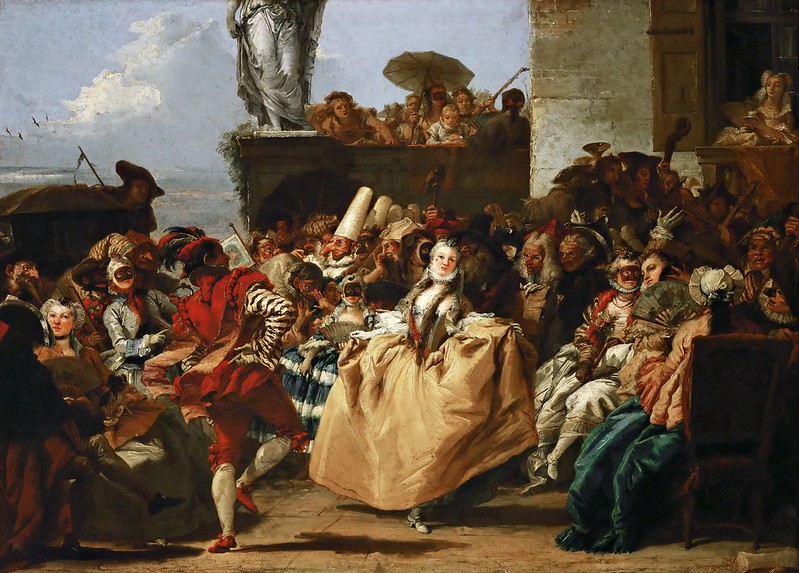
Giovanni Domenico Tiepolo - Carnival Scene or The Minuet (1754-55)
Obra de Giovanni Domenico Tiepolo (1727-1804), pintor italià (1)


- Recordatori de Giovanni Battista Viotti -
En el dia de la commemoració del seu 192è aniversari de decés


Parlem de Pintura...

Giovanni Domenico Tiepolo (Venècia, 30 d'agost de 1727 - Venècia, 3 de març de 1804) va ser un pintor i gravador italià, fill gran del famós pintor Giambattista Tiepolo i germà del també pintor Lorenzo Baldissera Tiepolo. De la mateixa manera que el seu germà Lorenzo, es va formar amb el seu pare Giambattista i ambdós van col·laborar en el taller familiar, principalment completant encàrrecs del seu pare. A l'haver de produir obres amb una estètica homogènia, no va poder manifestar un estil propi fins que el seu pare va morir. Va ser a partir del 1750 que va començar a realitzar obres per sí mateix, destacant la sèrie Via Crucis per a l'oratori de San Polo de Venècia. Va seguir treballant amb el seu pare fins i tot quan aquest va treballar al servei de Carles III d'Espanya el 1762, on van decorar diversos salons del Palau Reial de Madrid. Després de la mort de Giambattista, Giovanni Domenico va tornar a Venècia, mentre que Lorenzo va preferir quedar-se a Madrid, on va morir pocs anys després. El seu estil va canviar sobtadament, dedicant-se a escenes de gènere i personatges populars i de caràcter més profà. Precisament va ser aquesta obra, en què destaquen els esbossos que va fer de Polichinela, la que va influenciar a Goya quan va visitar Itàlia. Giovanni Domenico va ser també un important gravador, fet que va potenciar el ressò de la seva obra però especialment la del seu pare. Va morir a Venècia el març de 1804.


Parlem de Música...

Giovanni Battista Viotti (Fontanetto da Po, 12 de maig de 1755 - London, 3 de març de 1824) va ser un violinista i compositor italià. Apreciat com a violinista des dels seus inicis, va ser protegit pels prínceps Del Pozzo della Cisterna, qui el van enviar a estudiar amb Antonio Celoniat (fl.1737-1785). El 1775 va entrar a la capella de la cort de Savoia, dirigida aleshores per Gaetano Pugnani, qui 5 anys després el va convidar a una gira de concerts per Suïssa. Des d'allà, Viotti es va dirigir a Dresden, Berlín, Varsòvia i Sant Petersburg. L'èxit obtingut com a virtuós el 1782 en el Concert Spirituel de París, va fer que es decidís a establir-se en aquesta ciutat, on va entrar al servei de la cort de Maria Antonieta. Durant els anys següents va disminuir la seva activitat com a concertista i es va dedicar fonamentalment a l'ensenyament, la composició i l'organització de concerts. El 1788 va formar una companyia d'òpera, però després de la Revolució Francesa es va veure obligat a abandonar França i, el 1792, va marxar a Londres, on va reprendre els seus concerts. El 1794 va entrar al King's Theater com a director artístic primer, i després com a director d'orquestra. No obstant i sota l'acusació de jacobí, va ser expulsat d'aquest país i es va traslladar a Hamburg, on va passar un breu període fins que la revisió del seu cas li va permetre tornar a Londres el 1801. Allà va abandonar la vida musical i es va aventurar com a empresari de vins, activitat en la qual va fracassar ràpidament. Va tornar a París com a director del Teatre Italià i de l'Òpera el 1819, càrrecs dels quals va ser acomiadat dos anys després. Com a violinista va ser considerat com el fundador de la influent escola francesa, la qual van heretar posteriorment alguns dels seus alumnes com Rode, Baillot i Kreutzer. Com a compositor, va ser un defensor de la tradició instrumental italiana de l'època clàssica, si bé es va mostrar obert a l'incipient romanticisme. Els seus concerts van mostrar la influència de Haydn, mentre que en les obres solistes s'observa una síntesi de les tendències violinístiques de l'escola italiana posterior a Tartini. Va morir a Londres el març de 1824.

OBRA:

Vocal secular:

Au fond d'une sombre vallée, cantata, WVII:1, L. 1804, F-Pc (F-Pn);
Gli Zingarelli, Aria «composée pour Mad.me [Élisabeth Vigée] Lebrun», WVII:2, L. 1802, F-Pc;
Les Souvernirs (Assis auprès d'une fontaine), Aria, WVII:3, P. 1784; L. May 1803, F-Pc;
Privez l'amour, Aria, WVII:4, L. 1817, F-Pc;
C'est la verdure (S. Segur), romanza, WVII:5, F-Pc;
Dis moi ce que j'éprouve (E. Vigée-Le Brun), romance, WVII:6, 1802, F-Pc;
Vo triste tacito, dedicata a M. Chinnery, canzonetta, WVII:7, Gilwell House 5 Dec. 1804, F-Pc;
Nous nous croyons heureux, Aria, WVII:8, P. 1814, F-Pc;
O cara semplicità, Aria, WVII:9, L. 1812, F-Pc;
Stanco di pascolar, Aria, WVII:10, L. [?], F-Pc;
J'amais, j'étois aimé, Aria, WVII:11, F-Pc;
Ah, rammenta, o bella, Aria, WVII:12, L. 1804, F-Pc;
Che gioia che contento, Aria polacca (adatt. del V.-Konz. WI:2, III mov. per Le nozze di Dorina di Sarti), WVII:1a, P. 1791;
Consola, amato bene, Aria (adatt. del V.-Konz. WI:3, III mov. per Una cosa rara di Martín y Soler), WVII:2a, [ca. 1791], F-Pc.

Instrumental:

Orch.:
Sinfonie concertanti:
1re Symphonie Concertante, in Fa maggiore 2 V., 2 Ob. u. 2 Hn. ad lib., Str., WI:30, P. 1787;
2me Symphonie Concertante, in Si bemolle maggiore 2 V., Fl., 2 Ob. u. 2 Hn. ad lib., Str., WI:31, P. 1788;
Concertante... arrangé sur le 3me concerto de violon, in La maggiore 2 Fl., Str., 2 Ob., 2Hn. (adatt. del V.-Konz. WI:3), WIa:19, P. circa 1788.

Concertos:
Concerto n. 1 in Do maggiore, P. 1782 (WI:1);
Concerto n. 2 in Mi maggiore, dedicato a L.-A.-C. Rohan-Guémenée, P. 1782 (WI:2);
Concerto n. 3 in La maggiore, Bln. 1781; mit neue II mov., P. 1782 (WI:3);
Concerto n. 4 in Re maggiore, P. 1782 (WI:4);
Concerto n. 5 in Do maggiore, P. 1782 (WI:5);
Concerto n. 6 in Mi maggiore, P. 1782 (WI:6);
Concerto n. 7 in Si bemolle maggiore, dedicato a M. Soltikov, P. circa 1783-86 (WI:7);
Concerto n. 8 in Re maggiore, P. circa 1783-86 (WI:8);
Concerto n. 9 in La maggiore, P. circa 1783-86 (WI:9);
Concerto n. 10 in Si bemolle maggiore, P. circa 1783-86 (WI:10);
Concerto n. 11 in La maggiore, P. 1787 (WI:11);
Concerto n. 12 in Si bemolle maggiore, P. 1787-88 (WI:12);
Concerto n. 13 in La maggiore, P. 1788 (WI:13);
Concerto n. 14 in la minore, P. circa 1788-89 (WI:14);
Concerto n. 15 in Si bemolle maggiore, P. circa 1788-89 (WI:15);
Concerto n. 16 in mi minore, P. circa 1789-90. Mozart scrisse le parti orchestrali di timpani e trombe per il I e il III movimento, k470a (WI:16);
Concerto n. 17 in re minore, P. circa 1790-91 (WI:17);
Concerto n. 18 in mi minore, P. circa 1790-93 (WI:18);
Concerto n. 19 in sol minore, P. 1791; revisione di Viotti, P. 1818 (WI:19);
Concerto n. 20 in Re maggiore, 1792-95, L. 1795 (WI:20);
Concerto n. 21 in Mi maggiore, 1792-97, P. circa 1802 (WI:21);
Concerto n. 22 in la minore, 1793-97, P. circa 1803 (WI:22);
Concerto n. 23 in sol minore, 1793-94, P. circa 1804 (WI:23);
Concerto n. 24 in si minore, 1793-97, P. circa 1805 (WI:24);
Concerto n. 25 in la minore, 1795-96, P. circa 1806 (WI:25);
Concerto n. 26 in Si bemolle maggiore, 1793-97, P. circa 1808 (WI:26);
Concerto n. 27 in Do maggiore, dedicato al duca di Cambridge, 1794-96, P. circa 1815 (WI:27);
Concerto n. 28 in la minore, dedicato a J.-A.-B. Law, 1803-12, P. circa 1823 (WI:28);
Concerto n. 29 in mi minore, dedicato a W. B. e M. Chinnery, 1801-17, P. circa 1824 (WI:29).
Concerti per violoncello e orchestra
Concerto per violoncello con violini, viola, oboe, corni e basso, C/Do maggiore, WId:1, I-Fc (duefelhalft) Flz., hrsg. von I. Gomez, 1968.
Concerti per flauto e orchestra (adattamento dai concerti per violino)
Concerto de J. B. Viotti arrangé pour la flûte... par C. Fuerstenau, e/Mi minore, (V.-Konz. WI:16), WIa:17, Offenbach 1802;
Nouveau concerto de J. B. Viotti arrangé pour la flûte... par C. Devienne, G (V.-Konz. WI:23), WIa:18, Offenbach 1804.
Concerti per pianoforte e orchestra (adattamento dai concerti per violino)
adatt. di M.me de Montgéroult del WI:6 = WIa:1, in Mi bemolle maggiore, P. 1787;
adatt. di L.W. Lachnith del WI:10 = WIa:2, in Si bemolle maggiore, P. 1787; 1789;
adatt. di T. Latour del WI:9 = WIa:3, in La maggiore, P. circa 1788-89; 1796;
Konzert No.4 (mancante), WIa:4, P. circa 1790;
adatt. di J.L. Dussek del WI:13 = WIa:5, in La maggiore P. 1791;
adatt. di L. Adam del WI:17 = WIa:6, in Re minore, P. circa 1792;
adatt. di J.L. Dussek del WI:23 = WIa:7, in Sol maggiore, L. circa 1795-96;
adatt. di I. Hüllmandel del WI:20, II mov. = WIa:8, D/Re maggiore, L. 1795;
adatt. di D. Steibelt del WI:19 = WIa:9, in Sol minore, P. circa 1797;
adatt. di J.L. Dussek del WI:25 = WIa:10, in La maggiore L. 1796;
adatt. di I. Hüllmandel del WI:10, I mov.; WI:14, II mov.; WI:12, III mov. = WIa:11, in Sol maggiore, L. 1803;
adatt. di N. Isouard del WI:21 = WIa:12, in Mi maggiore, P. u. L. circa 1803;
adatt. di J.B. Cramer del WI:27 = WIa:13, in Do maggiore, L. 1813;
adatt. di Viotti del WI:24, I u. III mov. = WIa:14, in Si minore, F-Pc (1801);
adatt. di D. Steibelt del WI:130 = WIa:15, in Fa maggiore P. circa 1790;
adatt. di Viotti del WI:31, I u. III mov., WIV:24, II mov. = WIa:16, in Si bemolle maggiore F-Pc;
adatt. di L.W. Lachnith del WI:3, I u. III mov. = WIa:20, in La maggiore P. circa 1782-86.

Chbr.:
Quartetti per due violini, viola e violoncello:
Six quatuors concertants... dédiés a son Altesse Royale Madame La Princesse de Prusse, A, C, Es, B, Es, E, op.1, WII:1-6, P. 1783-85;
Six quatuors concertants..., A, C, F, B, Es, E, op.3, WII:7-12, P. 1782-86;
Trois quatuors concertans... Dédiés à son frère A.[ndré] Viotti, F, B, G, WII:13-15, P. 1817;
Three Quartetts... Dedicated to Philip Cipriani, F./V., V., Va., Vc, b, c, Es, op.22, WII:16-18, L. 1801-06;
Six quatuors d'airs connus, dialogués et variés..., op.23, WIId:1-6, [ca. 1794-1802; opera spuria: sono di Viotti solo le due Polonaises];
Quatuor..., g, adatt. del V.-Konz. WI:19 = WIIa:1, P. circa 1816;
Quatuor..., e, adatt. del V.-Konz. WI:18 = WIIa:2, P. circa 1818;
Trois Quatuors... 2me livre, adatt. del WIV:22-24 = WIIa:3-5, Leipzig 1809.

Trii per due violini e violoncello:
Six trios concertans... dédiés au Célèbre Pugnani, A, E, C, G, B, A, op.2, WIII:1-6, P. 1783-86;
Three Trios..., dedicati a J.Ch. Hankley, A, d, D, WIII:7-9, L. 1796;
Trois trios..., Es, g, D, op.16, WIII:10-12, P. circa 1801-02;
Trois trios..., A, E, G, op.17, WIII:13-15, P. circa 1802;
Trois trios..., b, D, B, op.18, WIII:16-18, P. 1804;
Trois trios..., B, a, E, op.19, WIII:19-21, P. circa 1808.

Duetti per due violini:
Six duos concertans..., Ier liv., Es, B, E, D, C, A, WIV:1-6, P. 1789;
Six duos concertans..., 2e livre, B, C, G, D, a, D, WIV:7-12, P. circa 1789-90;
Six duos faciles..., 3e livre, C, G, D, F, c, B, WIV:13-18, P. circa 1796;
Six duos concertans..., A, e, B, f, C, E, op.5, dedicati a W.B. e M. Chinnery, WIV:19-24, [ca. 1797-98] Hamburg 1799;
Trois duos..., C, A, F, op.18, dedicati a J. Ch. Hankey, WIV:25-27, P. u. L. 1803;
Hommage à l'amitié. Three Duetts Concertante..., B, g, E, dedicati a J. Cary, WIV:28-30, L. circa 1803;
Three Duets Serenatas..., Book 1-2, A, D, G, Es, G, a, op.23, dedicati al duca di Cambridge, WIV:31-36, L. circa 1804;
Trois duos concertans..., adatt. del WIII:7 = WIVa: 3; WIII:8 = WIVa:2; WIII:9 = WIVa:1, P., circa 1796-97;
Six Duets Concertanti..., adatt. del WIV:37-42 = WIVa:4-9, L. circa 1800;
Trois duos pour deux violons... op. 19, adatt. del WII:16-18 = WIVa:10-12, P. circa 1806-07;
Trois grands duos concertans... op. 20, adatt. del WIII:13-15 = WIVa:13-15, P. circa 1809;
Trois grands duos concertans... op. 21, adatt. del WIII:16-18 = WIVa:16-18, P. circa 1809;
Trois grands duos concertans... op. 22, adatt. del WIII:19-21 = WIVa:19-21, P. circa 1812-13.

Duetti per due violoncelli:
Six Duets Concertanti..., D, A, c, a, G, E, op.6, Book. 1-2, dedicati a J. Crosdill, WIV:37-42, L. circa 1798-99.

Opere per violino:
Six sonates pour violon et basse, E, A, D, B, E, B, op.4, WV:1-6, P. circa 1788;
Six sonates..., IIe livre, A, E, B, E, G, c, WV:7-12, P. circa 1789-92;
Trois nouvelles sonates..., 3e livre, e B, A, WV:13-15, P. circa 1809-16;
Recueils d'airs connus et variés..., WV:16-18, P. circa 1788; «Arietino l'Amico», B, Arietta perV. u. Kl., WV:22, F-Pc;
Duetto a un violino solo... per il suo amico Cherubini, WV:23, P. 15 March 1821, US-NYpm;
Per rimediar la colpa, V. solo u. Kl., E, WV:24, F-Pc;
Trois divertissemens... dédiés à son ami L. Duport, V. u. Kl., adatt. del WV:19-21 = WVa:7-9, P. circa 1818, F-Pc;
Andante et rondo..., V. u. Kl., adatt. del WI:19 = WVa:16, P. circa 1823, F-Pc.

Opere per violoncello:
Trois divertissemens..., Vc. u. Kl., a, F, D, dedicati a J.-L. Duport, WV:19-21, P. circa 1818.

Opere per tastiera:
Trois sonates..., Kl., V. u. Vc., B, G, Es, dedicate a E. Marshall, op.15, WVI:1-3, P. circa 1801-02;
Three Sonatinas..., Kl., V. u. Vc., C, B, Es, op.7, WVI:4-6, L. circa 1802;
Serenata. Chi sa se non divertirà La Padrona!, Kl., V. obbl., Vc., WVI:7, F-Pc;
Sonate..., Kl., V. u. Vc.,, B, WVI:8, P. circa 1791-92.

Other:
Grand Sonata for Harp with Accompaniment for a Violin (ad libitum), B, dedicata a S. Dunmore, WVI:9, L. 1811; Suite in D, Str., WVIII:1, F-Pc [V. u. Vc. parts complete, II V. u. II Vc. incomplete];
Due Canoni, 2 V.? u.. Kl., WVIII:2, F-Pc;
frammenti autografi e ms. incompleti in F-Pc;
Meditazione in preghiera, Vl. u. Orch., [opera dubbia].

Literatura:

Mémoire au Roi, Concernant l'Exploitation du Privilège de l'Opéra, demandé par le Sieur Viotti, P. 29 April 1789, F-Pc;
Précis de la vie de J.B. Viotti depuis son entrée dans le monde jusqu'au 6 mars 1798, 23 March 1798, Viotti Papers, GB-Lcm;
Opinion sur la manière d'enseigner et d'apprendre à jouer du violon, frammento, facs. in: F.-A. HABENECK: Méthode théorique et pratique de violon, P. circa 1835.

Font: En català: Giovanni Battista Viotti (1755-1824) En castellano: Giovanni Battista Viotti (1755-1824) In english: Giovanni Battista Viotti (1755-1824) - Altres: Giovanni Battista Viotti (1755-1824)


Parlem en veu pròpia o en veu d'altri...

Viotti’s interest as a composer centred on his own instrument. Despite his involvement with opera, he wrote no theatrical works. His arias that found their way into the operas of other composers are arrangements from his concertos; his original arias are simple, unpublished songs written for his friends. All of his piano concertos are arranged from violin concertos, despite publishers’ attempts to claim originality in two cases. Of nearly 30 piano sonatas, only seven are not demonstrably arrangements. In chamber music he preferred old-fashioned combinations (violin and bass, or two violins and bass) which assured the dominance of the violin. Of the more modern genres, his favourite was the violin duo. His string quartets, except perhaps the last three, take little notice of the balance in texture achieved by Haydn. Only the 29 violin concertos fully reflect Viotti’s musical imagination, his power as a performer and his development as a composer. These are his most important works, both musically and historically. The repertory that Viotti worked with as a student is still unknown, but his teacher Pugnani was a widely travelled modern virtuoso and Turin was a respected, up-to-date musical centre. Viotti’s first concerto (no.3 in A) clearly reveals that his starting point for the genre was the cosmopolitan galant style developled in the 1770s in Paris by composers of various nationalities. After his arrival in Paris symphonic and operatic influences rapidly broadened the scope and deepened the drama of his concertos. The last six Paris concertos (nos.14–19), all but one in minor keys, complete the development from the galant style and approach Romanticism. Only the orchestration, particularly the French-Italian practice of assigning accompaniment to two violins and bass, remains conservative.

Viotti’s last ten concertos, written in London, are products of his full maturity. They surpass the late Paris concertos not in drama and boldness, but in craftsmanship: fuller orchestration, more varied accompaniment and richer texture, possibly influenced by contact with Haydn, particularly his late symphonies. The figuration and passage-work still reflect Viotti’s fine technique, but the brilliance is tempered by pervasive lyricism. Somewhat more varied in form than their predecessors, the late concertos occasionally show forward-looking features, by linking movements (no.26), quoting material from the first movement in the last (no.21) and foreshadowing an allegro theme in the slow introduction (no.27, and previously in no.16). Viotti most directly influenced his French contemporaries in the 1780s and early 1790s. His late Paris concertos served as models for Rode, Kreutzer and others of less talent throughout their careers. The London concertos, delayed several years in publication, were already regarded as ‘classical’ when they appeared on the Continent from 1803, and had less effect. Although Mozart knew at least some of Viotti’s works (he added parts for trumpet and timpani to Concerto no.16), assumptions of influence are doubtful. Viotti’s influence on Beethoven, however, has been convincingly demonstrated (see Schwarz, 1958). Among German violinists, Spohr was the most significant to use the Paris concertos as his starting-point, as can be seen by comparing his first concerto with Viotti’s no.13. In spite of elements of early Romanticism, Viotti’s concertos are generally marked by restraint, and they balance display with expression and formal clarity. They fell quickly from favour with 19th-century performers, who required more flamboyant virtuosity; however, as études for advanced students they continued to influence the German school as well as the Franco-Belgian. The admiration of some of the finest 19th-century violinists culminated in Joachim’s revival of no.22 in A minor, for which Brahms, in a letter to Clara Schumann (June 1878), expressed unstinted admiration.

GROVE MUSIC ONLINE (source/font: aquí)

Gaudiu i compartiu! 


Informació addicional... 

INTERPRETS: Guido Rimonda (violin); Cristina Canziani (piano); Camerata Ducale
RECICLASSICAT: VIOTTI, Giovanni Battista (1755-1824)
PRESTOCLASSICAL: VIOTTI, G.B. - Sinfonia concertante No. 1 & Violin Concerto No. 4
CPDL: No disponible
SPOTIFY: VIOTTI, G.B. - Sinfonia concertante No. 1 & Violin Concerto No. 4


Tant si us ha agradat, com si no, opineu, és lliure i fàcil!

dissabte, 11 de febrer del 2012

VIOTTI, Giovanni Battista (1755-1824) - Piano Concerto in g

La loteria a la plaça de Montecitorio, obra de Giovanni Panini, pintor italià del segle XVIII.


Giovanni Battista Viotti (1755-1824) compositor i violinista italià nascut a Fontanetto Po. Intèrpret del violí, va gaudir de fama i reconeixement a finals del segle XVIII fins al punt de ser reconegut com el més gran violinista d'Europa. No obstant, Viotti fou un personatge peculiar. Sovint, menyspreava les mostres de gratitud vers la seva persona i intentava evitar, com fos, les aparicions públiques o els grans concerts. Sota la protecció dels prínceps Dall Pozo della Cisterna (i no és un joc de paraules) va gaudir de tot allò necessari pel seu desenvolupament professional. De fet, amb 20 anys i sota la docència de Pugnani, entraria a formar part de la capella de la Cort de Saboia. A partir d'aqui, la seva vida seria un anar i venir per Europa (hem de tenir en compte les restriccions inherents a l'hora de viatjar en aquella època... "Carromato express"). París, Berlin, Dresde, Londres, Viena o St. Petersburg van ser punts de parada obligats per la seva condició de violinista on tocava amb regularitat i amb l'admiració del seu públic que, curiosament, ell tant repudiava. Probablement o no, aquest fet el va fer disminuir la seva presència a les sales de concert fins el punt que les seves aparicions es convertiren en fets excepcionals. Reconvertit en empresari de vins, amb poca fortuna certament, va intentar prescindir de la seva condició artística per a sobreviure, fet que no aconseguiria havent de tornar a la palestra musical. Arruïnat, va haver de deixar en testament les seves obres i els seus violins, entre ells un Stradivarius, per a saldar la totalitat dels seus deutes. Probablement, Viotti al seu temps no va ser realment conscient de l'admiració que despertava entre els cercles acadèmics i musicals on era considerat, de llarg, el més gran violinista del seu temps i el pare de moltes de les innovacions en l'ús d'aquest instrument, sobretot en la forma concertant. Autor molt prolífic del gènere concertant per a violí, va escriure 29 concerts d'aquest tipus. A banda, va escriure obres de cambra, algunes obres vocals i, fins i tot, un Concert per a piano en Sol menor el qual és un autèntic tresor d'un violinista de cap a peus i que tindrem el plaer d'escoltar en el dia d'avui. Representa i ens donarà fe d'aquest artista contemporani dels Haydn, Mozart i Beethoven però, alhora, tant poc conegut al nostre petit país i que amb el violí, i al seu temps, fou insuperable.

El concert per a piano ens l'interpreta la Torino Symphony Orchestra amb Felicja Blumental (1908-1991) al piano i sota la direcció d'Alberto Zedda.

Gaudiu i compartiu!


Font: (on trobareu informació addicional així com dels discs on podeu trobar aquesta obra)

Tant si us ha agradat, com si no, opineu, és lliure i fàcil!