Es mostren els missatges amb l'etiqueta de comentaris Rauzzini V.. Mostrar tots els missatges

dilluns, 19 de desembre del 2022

RAUZZINI, Venanzio (1746-1810) - Sonata (I) in C (1786)

Unknown - A View of the Parade at Bath (c.1785)


Venanzio Rauzzini (1746-1810) - Sonata (I) for the Piano-Forte with an Accompanyment for the Violin Adlibitum, Op.15 (1786)
Performers: Zsolt Kalló (violin); Tamás Szekendy (1961-2014, fortepiano)

---


Italian soprano castrato and composer. After early studies in Rome and possibly also in Naples with Porpora, he made his début at the Teatro della Valle in Rome in Piccinni’s Il finto astrologo (7 February 1765). His first major role was in Guglielmi’s Sesostri at Venice during Ascension Fair 1766. In the same year he entered the service of the Elector Maximilian III Joseph at Munich, where he remained until 1772. He first appeared there in Traetta’s Siroe (Carnival 1767) and later that year was given leave to perform in Venice and in Vienna, where Mozart and his father heard him in Hasse’s Partenope. Burney, visiting Rauzzini in August 1772, praised his virtuosity and the quality of his voice, but was most impressed by his abilities as a composer and harpsichordist. His last known operatic performance in Munich was in Bernasconi’s Demetrio (Carnival 1772). According to Michael Kelly he was forced to leave because of difficulties with noblewomen engendered by his good looks. Rauzzini performed for two more years in Italy before moving permanently to England. Engaged for Carnival 1773 at Milan, he was primo uomo in Mozart’s Lucio Silla (26 December 1772) and in Paisiello’s Sismano nel Mogol (30 January 1773). In January Mozart wrote for him the brilliant motet Exultate, jubilate (kv165/158a). Later that year he sang at Venice and Padua, and in 1774 at Turin (Carnival) and Venice (Ascension Fair). From November 1774 to July 1777 Rauzzini sang regularly at the King’s Theatre in London, making his simultaneous début as singer and composer in the pasticcio Armida. Bingley reported that his acting in Sacchini’s Motezuma (7 February 1775) greatly impressed Garrick. Both Burney and Lord Mount Edgcumbe, however, deemed his voice sweet but too feeble, a defect Burney ascribed to Rauzzini’s devoting too much time to composition. Indeed, Rauzzini contributed arias to four other pasticcios in the season 1775-76 and wrote a comic opera, L’ali d’amore. 

Piramo e Tisbe, his best-loved opera, was first staged in London on 16 March 1775 it was revived there in three other seasons and performed at many continental theatres. In the following years many of his works, both vocal and instrumental, were published in London. Rauzzini’s singing also gradually won over London audiences. For his last London appearance in 1777 he composed an Address of Thanks, presumably the cantata La partenza ‘sung by him and Miss Storace’. In the autumn of 1777 Rauzzini took up residence in Bath, where he managed concerts by many renowned performers, among them his pupils John Braham, Nancy Storace, Charles Incledon, Mrs Billington and Mme Mara. At Dublin in 1778 he met and taught Michael Kelly and promoted his career with advice to study in Naples. In the spring of 1781, again in London, Rauzzini sang in concerts with Tenducci and others and wrote the second act of the opera L’omaggio di paesani al signore del contado. He was intermittently in London during the next three seasons to stage his operas L’eroe cinese, Creusa in Delfo and Alina, o sia La regina di Golconda, which was heavily criticized by the Public Advertiser (10 May 1784). Ballets with music by him were performed at the King’s Theatre in the season 1783-84, and he also directed the production of Sarti’s Le gelosie villane (15 April 1784). During this period a scandal arose over his claim that certain arias in Sacchini’s operas were his own. He was not in London when his incidental music for Reynold’s Werter (originally performed at Bath) was used at Covent Garden on 14 March 1786, and after the London première of his unsuccessful opera La vestale (1 May 1787) he remained permanently at Bath in his handsome town house and sumptuous country villa in Perrymead. Among his many guests was Haydn, who wrote the canon Turk was a faithful dog and not a man during a visit from 2 to 5 August 1794. Near the end of his life Rauzzini published a set of 12 vocal exercises with an introduction summing up his ideas on the art of singing and reflecting his own tasteful execution.

dijous, 9 d’abril del 2015

RAUZZINI, Venanzio (1746-1810) - String Quartet in E flat major, Op. 2, No. 1

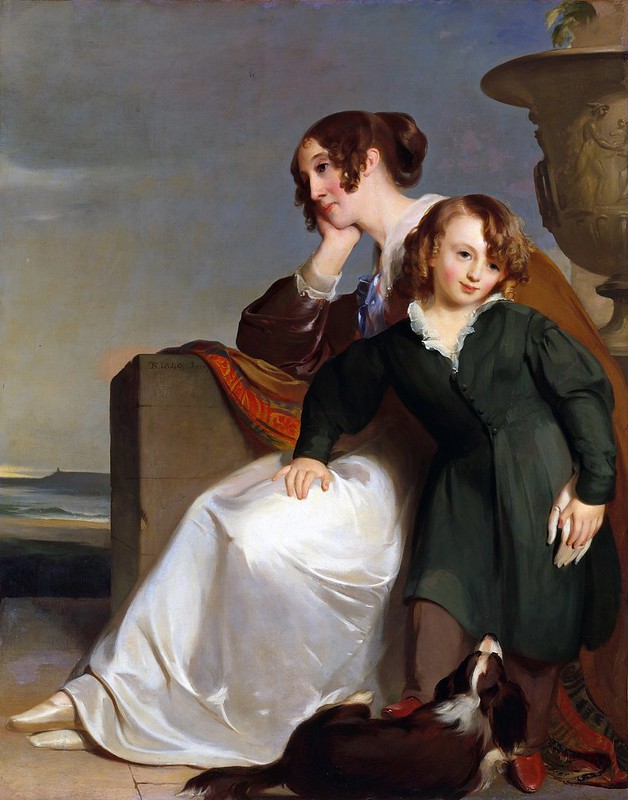
Thomas Sully - Mother and Son (1840)
Obra de Thomas Sully (1783-1872), pintor anglès (1)


- Recordatori de Venanzio Rauzzini -
En el dia de la commemoració del seu 205è aniversari de decés


Parlem de Pintura...

Thomas Sully (Horncastle, 19 de juny de 1783 - Filadelfia, 5 de novembre de 1872) va ser un pintor anglès. El 1792 va emigrar, amb la seva família, als EUA. Allà, va participar com a acròbata en el circ i teatre familiar abans d'estudiar pintura amb el seu germanastre Jean Belzons. Va estudiar a Nova York fins el 1794, any de la mort de la seva mare. El 1799 va viatjar, juntament amb el seu germà Lawrence Sully, a Richmond. Durant els seus estudis va conèixer i estudiar amb Henry Benbridge i Thomas Lawrence els quals van influenciar decisivament la seva obra posterior. El 1801 es va estrenar com a pintor amb una miniatura. El 1803 va inaugurar el seu propi taller a Richmond. El 1809 va viatjar a Anglaterra on va estudiar amb Benjamin West. Els seus retrats, en un estil molt proper al dels seus mestres es van fer molt populars i va rebre peticions de nombrosos personatges famosos com Thomas Jefferson o la Reina Victòria. Si bé va pintar paisatges i escenes històriques, el seu corpus principal fou el retrat amb un llegat immens de més de 2000 pintures. Va morir a Filadelfia el novembre de 1872.

Font: En català: No disponible En castellano: Thomas Sully (1783-1872) In english: Thomas Sully (1783-1872) - Altres: Thomas Sully (1783-1872)


Parlem de Música...

Venanzio Rauzzini (Camerino, bap. 19 de desembre de 1746 - Bath, 8 d'abril de 1810) va ser un cantant i compositor italià. Germà de Matteo Rauzzini, va estudiar a Nàpols amb Nicola Porpora, fent el seu debut al Teatro della Valle de Roma el 1765. Un any després, va rebre una oferta per ocupar un càrrec a la cort del príncep elector Maximilià III. El 1773 va tornar a Milà fruit del seu matrimoni amb una aristòcrata d'allà. El 1774 es va traslladar a Londres on, gràcies a la seva condició de castrat, va actuar amb freqüència en el teatre del Rei. El 1777 va viatjar a Bath ciutat on, a banda de viure-hi la resta de la seva vida, va dirigir bona part de l'organització musical. Va ser criticat per 'dedicar massa temps a la composició' i poc temps a la interpretació. La seva música va ser ben rebuda i va escriure nombrosa obra vocal, entre ella 14 òperes i un rèquiem, i considerable obra instrumental. Va morir a Bath l'abril de 1810.

OBRA:

Vocal secular:

Armida (os, pasticcio, 3), 19 Nov 1774, Favourite Songs (London, c1774)
Piramo e Tisbe (azione tragico, 2, R. Calzabigi, after M. Coltellini), 16 March 1775, A-Wn, F-Pn, I-Bc, arias (London, 1775) and in A Select Collection of the Most Admired Songs, Duetts &c (Edinburgh, 1779)
La sposa fedele (opera comica, pasticcio, 3, P. Chiari), 31 Oct 1775, Favourite Songs (London, c1775)
Didone abbandonata (os, pasticcio, 3, P. Metastasio), 11 Nov 1775, Favourite Songs (London, c1775)
The Duenna, or Double Elopement (comic op, pasticcio, 3, R. Sheridan), London, CG, 21 Nov 1775; aria, By him we love offended [= Fuggiam dove sicura], in The Duenna (London, c1775) and A Select Collection of the Most Admired Songs, Duetts &c (Edinburgh, 1779)
L’ali d’amore (opera comica, 3, C.F. Badini), 29 Feb 1776; rev., 13 March 1777, Favourite Songs, op.3 (London, c1777) and in A Select Collection of the Most Admired Songs, Duetts &c (Edinburgh, 1779)
Astarto re di Tiro (os, pasticcio, 3, G. Bottarelli), 2 Nov 1776, Favourite Songs (London, c1776)
L’omaggio di paesani al signore del contado (os, 3), 5 June 1781; only Act 2 by Rauzzini
Ezio (os, pasticcio, 3, Metastasio), 17 Nov 1781, Favourite Songs (c1781)
L’eroe cinese (os, 3, Metastasio), 16 March 1782, arias (London, 1782)
Creusa in Delfo (os, 2, G. Martinelli), 29 April 1783; aria, Spiegar non posso (London, ?c1783)
Alina, o sia La regina di Golconda (os, 3, A. Andrei, after M.-J. Sedaine), 18 March 1784, ov. and arias (London, c1784)
La vestale, o sia L’amore protetto dal cielo (os, 2, Badini), 1 May 1787, 3 arias GB-Lbl
The Village Maid (comic op, pasticcio, 3), lib (London, 1792); aria, Silent I tread, Cpl
Incid music: Werter (F. Reynolds after J.W. von Goethe), Bath, 3 Dec 1785, revived London, CG, 14 March 1786, Epithalamium, lost; Cymbeline (W. Shakespeare), Bath, before 1797, Dirge (London, n.d.) and in A Periodical Collection of Vocal Music (1797)
Doubtful: Astarto (os, 3, A. Zeno and P. Pariati), Munich, Residenz, sum. 1769/72; Pompejo (os, 3), Munich, Residenz, 1773

Spurious:
L’eroe cinese, Munich, 27 April 1770 [by Sacchini]

Cantatas:
La partenza, London, King’s, 5 July 1777; as op.4 (London, 1777)
La sorpresa, London, 1779; 2 arias, Lbl
Il tributo, Fonthill, home of W. Beckford, 29 Sept 1781, music lost
Old Oliver, or The Dying Shepherd (P. Pindar), Bath, c1796 (London, c1796)

Other vocal:
12 Italian Duettinos, 2vv, bc, op.5 (London, 1778)
4 Favourite Italian Duets, 2vv, hpd/pf, also 4 Easy Airs, 1v, hpd/pf/hp, op.13 (London, 1784)
6 Italian Canzonets, 1v, pf (London, c1785)
A Periodical Collection of Vocal Music (Bath, 1797, 2/1800)
A Set of 12 Solfeggi or Exercises for the Voice (London, 1808)
Miscellaneous Eng. songs and It. arias, pubd singly and in 18th-century anthologies
Miscellaneous It. arias: A-Wgm; B-Bc; GB-Lbl, Cpl; I-PAc, Rc, Tn

Vocal religiosa:

Requiem, London, Little Haymarket, 1801; 2 numbers, Lbl

Instrumental:

Thematic catalogue in Reindl (1961)
15 sonatas, pf/hpd, vn acc.: 6 as op.1 (London, 1777), 6 as op.8 (London, 1781), 3 as op.15 nos.1–3 (London, 1786)
12 str qts: op.2 (London, c1777), op.7 (London, c1778)
6 qts, pf/hpd, 2 vn, vc, op.6 (London, c1778)
4 duets, pf/hpd 4 hands: 3 as op.12 (London, 1783), 1 as op.15 no.4 (London, 1786)
Sinfonia, D, D-W
Miscellaneous dances, sonatas and lessons pubd in 4 contemporary anthologies

Font: En català: Venanzio Rauzzini (1746-1810) En castellano: No disponible In english: Venanzio Rauzzini (1746-1810) - Altres: Venanzio Rauzzini (1746-1810)


Informació addicional...

Venanzio Rauzzini: Master of Music in Jane Austen's Bath

Tant si us ha agradat, com si no, opineu, és lliure i fàcil!