diumenge, 8 de gener del 2023

KEISER, Reinhard (1674-1739) - Der hochmütige gestürtzte und wieder erhabene Croesus (1710)

Theodoor van Loon (1581-1649) - Adoration of the Magi


Reinhard Keiser (1674-1739) - Ausschnitte aus 'Der hochmütige gestürtzte und wieder erhabene Croesus' (1710)
Performers: Lisa Otto (1919-2013, soprano); Ursula Schirrmacher (soprano); Manfred Schmidt (tenor); Karl-Ernst Mercker (tenor); Hermann Prey (1929-1998, baritone); Theo Adam (1926-2019, bass); Günther Arndt-Chor; Ein Kinderchor; Die Berliner Philharmoniker; Wilhelm Brückner-Rüggeberg (1906-1985, conductor)

---


German composer. He was the son of Gottfried Keiser (? - before 1732), an organist and composer, and Agnesa Dorothea von Etzdorff (1657-1732), who had married only four months before his birth. The elder Keiser seems to have lost or given up his position as organist at Teuchern in 1674 or 1675 and departed, leaving his wife and two sons behind. On 13 July 1685 Keiser enrolled at the Thomasschule, Leipzig, for seven years, and it was there presumably that he received his principal musical education, studying under Johann Schelle and perhaps Johann Kuhnau. Mattheson observed, however, that he owed his composing skill almost entirely to natural ability and the study of the best Italian music. After leaving the Thomasschule, Keiser probably soon made his way to Brunswick, where the court opera was flourishing under the leadership of Johann Kusser; by 1694 he had obtained an appointment as ‘Cammer-Componist’. His opera Procris und Cephalus, on a text by the court poet F.C. Bressand, was performed in Brunswick that year, while another opera, Basilius, was done in Hamburg. Between 1695 and 1698 Keiser produced five more operas for the Brunswick-Wolfenbüttel court, all with Bressand, but in 1696 or 1697 he moved to Hamburg as Kusser’s successor at the Opera. There he found one of his most sympathetic literary collaborators in C.H. Postel, with whom he wrote eight operas, including Adonis (1697), Janus (1698) and the lost Iphigenia (1699). Beginning in 1703 Keiser also tried his hand at managing the opera house, in partnership with a literary man named Drüsicke. According to Mattheson their administration got off to a good start but was soon beset by financial difficulties, at least partly precipitated by riotous living by Keiser and his friends. In spring 1704 the theatre was temporarily closed, and Keiser left briefly for Weissenfels, where he gave the first performance of his Almira, originally intended for Hamburg.

Drüsicke apparently passed on the Almira libretto to the youthful Handel, a member of the opera orchestra, who scored a great success with his own setting in January 1705, leading to strained relations between the two composers that no doubt contributed to Handel’s decision shortly afterwards to leave for Italy. Octavia (1705), Keiser’s first opera after returning from Weissenfels, inaugurated an important series of eight historical dramas with librettos by Barthold Feind. Following the final collapse of his administration in 1707, Keiser appears to have absented himself from the opera house for more than a year, passing much of his time visiting the estates of noble friends. He may not have participated in the highly successful première of Der Carneval von Venedig in summer 1707, and he composed no new work for 1708. Whatever rift may have existed between him and the new director, J.H. Sauerbrey, seems to have been healed by 1709, and his dominance over the Hamburg repertory became more complete than ever. In 1721 he may have conducted a performance of Tomyris in Durlach before returning to Hamburg, where his arrival was celebrated on 9 August with a performance of his oratorio Der siegende David. In 1725 and 1726, while Telemann composed relatively little for that theatre, Keiser turned out five major new works, two revised versions, and parts of two intermezzos. On 2 December 1728 Keiser succeeded Mattheson as Kantor of Hamburg Cathedral, an important post which nonetheless brought him meagre remuneration. He never again composed a wholly new opera, though he did revise Croesus in 1730. His diminished productivity probably had less to do with the demands of his ecclesiastical duties than with the increasingly sorry state of the Hamburg Opera, which finally closed its doors in 1738. After the death of his wife in 1735, he ‘found reason’ (in Mattheson’s words) ‘to remain completely in retirement’ until his own death four years later. 

divendres, 6 de gener del 2023

SEHLING, Josef Anton (1710-1756) - In natali Domini

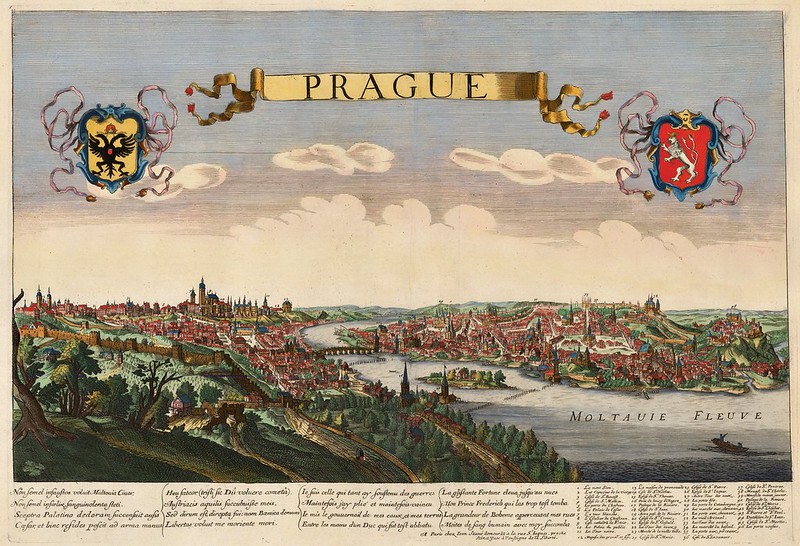
Jean Sauvé (1635-1692) - Prague


Josef Anton Sehling (1710-1756) - In natali Domini
Performers: Thurgauer Kammerchor und Barockensemble; Raimund Rüegge (conductor)

---


Bohemian composer. After studying music in Prague and Vienna, he was appointed choirmaster of two Prague monastic churches, as well as court musician and composer of Count Morzin. He was also active as second violinist to the metropolitan Prague Cathedral from 11 January 1737. He did not succeed in gaining either the post of choirmaster (in March 1737) or that of a first violinist there (1739), but he assisted the choirmaster Jan František Novák during the latter’s illness. In 1743 his music to the drama Judith was performed by the Prague Jesuits on the coronation of Maria Theresa as Queen of Bohemia. In Sehling’s music collection, which formed a large part of the metropolitan chapter music library (591 items, now in CZ-Pak), sacred works of retrospective (Venetian and Viennese) and modern (Neapolitan) style are equally represented. His own output stands between the late Baroque and pre-Classical styles. His apparently earlier compositions are close in style to the sacred music of Caldara, while in other works a Neapolitan continuo-homophony predominates. The instrumental parts, especially violins, gradually assume a more important role, while the vocal parts are subordinate and rather static. His Christmas motets, pastoral masses and pastorellas are among the most important specimens of the genre in Bohemia before F.X. Brixi. His brother František Sehling (1715-1774) was a tenor and instrumentalist; he sang at Prague Cathedral from 1743, and acted as deputy when Josef Antonín was absent.

dimecres, 4 de gener del 2023

AGRICOLA, Johann Friedrich (1720-1774) - Kündlich groß ist das gottselige Geheimnis (1768)

Circle of Andrea Mantegna (c.1431-1506) - The adoration of the Magi


Johann Friedrich Agricola (1720-1774) - Kündlich groß ist das gottselige Geheimnis (1768)
Performers: Berit Norbakken Solsеt (soprano); Myriam Arbouz (alto); Nicholas Mulroy (tenor); Matthias Viеwеg (bass);
Kölnеr Akademie; Michael Alеxander Willеns (conductor)

---


German musicographer, composer, organist, singing master and conductor. His father occupied an important post as government agent and jurist in Dobitschen. Burney, who visited the Agricolas in 1772, reported that Johann Friedrich’s mother, born Maria Magdalena Manke, ‘was a near relation of the late Mr Handel, and in correspondence with him till the time of his death’; but later Handel research has failed to substantiate this claim. Agricola began his study of music as a young child. In 1738 he entered the University of Leipzig, where he studied law; during this time he was a pupil of J.S. Bach and visited Dresden, where he heard performances of Passion oratorios and Easter music by Hasse. In 1741 he moved to Berlin, became a pupil of Quantz, made the acquaintance of C.P.E. Bach, C.H. Graun and other musicians, and embarked on a career that touched many aspects of Berlin’s musical life. In 1749 and 1751 he published, under the pseudonym ‘Flavio Anicio Olibrio’, pamphlets on French and Italian taste, taking the part of Italian music against F.W. Marpurg’s advocacy of French music. As a former pupil of J.S. Bach, he collaborated with C.P.E. Bach in writing the obituary of J.S. Bach that appeared in Mizler’s Musikalische Bibliothek in 1754 and became a central source for subsequent biographies. He published Tosi’s Opinioni de’ cantori antichi e moderni in German translation in 1757, adding notes and comments which caused the translation to be regarded as a landmark in the teaching of singing. He arbitrated the debate that began in 1760 between Marpurg and G.A. Sorge. He also corresponded with Padre Martini and the dramatist G.E. Lessing and assisted in the preparation for publication of Jakob Adlung’s Musica mechanica organoedi (1768), drawing particularly on what he had learnt about the construction of organs and other keyboard instruments from J.S. Bach. From 1765 to 1774 he was a principal contributor of articles about music in C.F. Nicolai’s Allgemeine deutsche Bibliothek.

Most of these reflect a conservatism that might be considered typical of north German music critics. Agricola’s study of melody (1771) remains one of the important writings about a neglected subject; and his biographical sketch of C.H. Graun (1773), like his participation in the Bach obituary, served as a point of departure for later writers on the subject. Agricola’s career as a thoroughly italianized composer of opera was fostered and then blighted by the patronage of Frederick the Great. His first intermezzo, Il filosofo convinto in amore, was performed with much success at Potsdam in 1750, and Frederick appointed him a court composer in 1751. In the same year, however, he married Benedetta Emilia Molteni, one of the singers of the Opera, disregarding the king’s rule that singers in his employ must remain single. Frederick punished the pair by reducing their joint salary to 1000 thalers. When Graun, Frederick’s chief opera composer, died in 1759, Agricola was appointed musical director of the Opera without the title of Kapellmeister. Frederick, who had always been critical of his composers – including Graun himself – was particularly harsh in his censure of Agricola’s operas. In October 1767, after hearing the rehearsals of Amor e Psiche, he wrote to his attendant Pöllnitz: ‘You will tell Agricola that he must change all of Coli’s arias – they are worthless – as well as those of Romani, along with the recitatives, which are deplorable from one end to the other’. An effort of 1772 entitled Oreste e Pilade, ordered by Frederick as entertainment for a visit by the Queen of Sweden and the Duchess of Brunswick, proved to be so far from what Frederick wanted that the entire opera had to be rewritten and retitled I greci in Tauride. Agricola was respected by his colleagues as a composer of considerable ability. His sacred works were in demand during his lifetime; copies of many of them survive in European libraries and archives. 

dilluns, 2 de gener del 2023

BRIXI, František Xaver (1732-1771) - Concerto ex C a Viola Principali

Franz Christoph Janneck (1703-1761) - Festive gathering in an interior


František Xaver Brixi (1732-1771) - Concerto ex C a Viola Principali
Performers: Jаn Pěruškа (viola); Chamber Orchestra from members of the Czеch PhiIharmonic Orchestra;
Andrеаs Sеbаstiаn Wеisеr (conductor)

---


Bohemian organist and composer, son of Šimon Brixi (1693-1735). He received his musical education at the Piarist Gymnasium, Kosmonosy (1744-49), where in 1748 he was classified ‘felicissimus ingenii’. In his last year at the Gymnasium his teacher was Václav Kalous (1715-1786), a composer who was also choirmaster at the monastery church. In 1749 Brixi left for Prague where he became organist first at St Havel, and later at the churches of St Martín, St Mikuláš and St Mary na Louži. He soon became one of the best-known composers in Prague, evidence of which can be seen in that from 1757 to his death he was consistently chosen to write the musica navalis for St John’s Eve. On 1 January 1759 he was appointed Kapellmeister of St Vít Cathedral, thus attaining at the age of 27 the highest musical position in the city. At the same time he is said to have become choirmaster of the Benedictine monastery of St Jiří at Hradčany in Prague. He died 12 years later of tuberculosis in the hospital of the Brothers of Charity. Brixi was one of the leading musical figures of mid-18th-century Bohemia. His tremendous output of about 500 works was rooted in the Neapolitan style, particularly that of Alessandro Scarlatti, Francesco Feo and Francesco Durante, and he was also influenced by the Viennese school of Mancini, Reuter and Bonno. Brixi’s style is distinguished from that of his contemporaries by its fresh melodic writing, vivacious rhythm and lively bass lines, and from that of his predecessors by its simple yet effective instrumentation. He often made use of folk music in his works. During his lifetime his music was widely disseminated in Bohemia and Moravia, as well as in other countries, especially Austria, Bavaria and Silesia. He had a profound effect on Bohemian musical taste, and Mozart’s favourable reception in Prague in the 1780s was at least partly due to Brixi’s lasting influence. The easy appeal of his musical style left an impression on Czech composers for the rest of the 18th century. 

diumenge, 1 de gener del 2023

ALTNIKOL, Johann Christoph (1720-1759) - Cantata 'Frohlocket und jauchzet in prächtigen'

Peter Paul Rubens (1577-1640) - Music making angels (c.1626)


Johann Christoph Altnikol (1720-1759) - Cantata 'Frohlocket und jauchzet in prächtigen'
Performers: Barbаra Schlіck (soprano); Hеіn Mееns (tenor); Hаrry van der Kаmp (bass);
Rhеinischе Kantorei; Das Klеinе Konzert; Hermаnn Mаx

---


German organist and composer. He attended the Lauban Lyceum in 1733, and was a singer and assistant organist at St Maria Magdalena, Breslau, from about 1740 until the beginning of 1744. He then wished to return to Germany and devote himself to ‘higher studies’ at Leipzig, and as his parents were poor, he asked for a viaticum. He was granted four thalers on 23 January 1744, and on 19 March he matriculated at Leipzig University as a theological student. He soon began to assist Bach, chiefly as a bass, and did so regularly from Michaelmas 1745. In taking on a university student Bach exceeded his authority, but he was always short of basses, for the boys of the Thomasschule often left before their voices had settled. On 16 April 1746 W.F. Bach recommended Altnickol as his successor at Dresden, saying that he had studied the keyboard and composition with his father; but he was disregarded. On 26 April 1747 Altnickol applied to the Leipzig Council for a grant, saying that he had been singing bass for three years. Burgomaster Stieglitz seized the opportunity to say that the Kantor had no business to make such appointments; but the council agreed to pay 12 thalers (19 May), given proof that Altnickol had actually done the work. Bach certified on 25 May 1747 that Altnickol had worked continuously from Michaelmas 1745. On 8 November 1747 a vacancy for an organist and schoolmaster arose at Niederwiesa (near Greiffenberg, Silesia); on 3 December the son of some local worthy drafted a letter inviting Altnickol to apply. The draft went to another local worthy for approval (no names are given) with a covering letter stating that the writer had known Altnickol at Lauban and Leipzig, and that he was a peaceable and upright man, no great theologian, but a good bass, violinist and organist, who understood composition and had endeared himself to Herr Bach.

Subsequent events show that he had also endeared himself to Fräulein Bach. On 1 January 1748 Bach testified that Altnickol was a pupil of whom he need not be ashamed; on 18 January Altnickol was appointed, and he gave satisfaction. He is said to have been a fine organist. A post at St Wenzel, Naumburg, fell vacant in the summer, and on 24 July 1748 Bach recommended Altnickol to the council, who unanimously appointed him on 30 July, before they had even received his formal application. There is a story that the council preferred Bach’s candidate to Johann Friedrich Gräbner, who was being put forward by the all-powerful Count Brühl; by rushing the matter, they were able to say that the Count’s recommendation came too late. Gräbner nevertheless became Altnickol’s successor in 1759. Altnickol moved in at mid-September, and married Bach’s daughter Elisabeth Juliana Friderica on 20 January 1749. He invited the Naumburg Council to the wedding, thus securing a present of six thalers. A son, Johann Sebastian, was born on 4 October, but was buried on 21 October. On 24 November Altnickol’s father died, and a few months later Bach fell seriously ill. According to Forkel, it was to Altnickol that Bach dictated his last chorale prelude (though the familiar manuscript fragment is not in Altnickol’s hand). After Bach’s death, Altnickol exercised the function of a trustee, with responsibility for distributing his estate. He took Bach's mentally handicapped son Gottfried Heinrich with him to Naumburg, where he also taught J.G. Müthel, Bach’s pupil, until 1751. At the end of 1753 he, like W.F. Bach, competed unsuccessfully for an appointment at the Johanniskirche, Zittau; and in 1757 he taught the trumpeter J. Ernst Altenburg. In Naumburg Altnickol directed performances of a pasticcio Passion cantata with music by C.H. Graun, Bach and Telemann and of a presumably early version of Bach's St Matthew Passion.