dilluns, 27 de febrer del 2023

VAN BLANKENBURG, Quirinus (1654-1739) - Duplicata Ratio Musices, ou La Double Harmonie (1733)

Ernst Ludwig Creite (fl. 1728-1765) - Portret van Quirinus van Blankenburg


Quirinus van Blankenburg (1654-1739) - Duplicata Ratio Musices, ou La Double Harmonie (1733)
Performers: Gerard Dekker (1931-2010, clavecimbel)

---


Dutch composer, organist, theorist and poet. He was the son of Gerbrant Quirijnszoon van Blankenburg (c.1620-1707), organist in Zevenbergen and Gouda. He probably received his first instruction in music from his father. He started his musical career at an early age, as an organist in Rotterdam (1670-75, at the Remonstrantse Kerk) and at Gorinchem (1675-79). For some years from 1679 he studied at the University of Leiden (he was registered under the name Gideon van Blankenburg). In the mid-1680s he settled at The Hague, where he stayed for the rest of his life. He was organist of the Walloon church from 1687 to 1702. In 1699 he was appointed to the Nieuwe Kerk but was active there only after the new organ had been completed in 1702. Because of his old age his pupil Frans Piton deputized for him from 1720. He was sought after as a music teacher by the nobility of The Hague: his pupils included Willem Bentinck, Ludwig Friedrich, Prince of Württemberg, and probably Count Unico Wilhelm van Wassenaer. Blankenburg was considered a proficient keyboard player and a first-class expert on carillon and organ building. His advice was requested as early as 1676 in connection with the carillon newly ordered from Pieter Hemony for the tower of the St Janskerk, Gouda, where his father was organist. He proposed the inclusion of C and D in the lowest octave but was strongly opposed by other advisers and by Hemony himself. He published a defence of his position (De nootsakelijkheid van Cis en Dis in de bassen der klokken, c.1677, now lost). Hemony replied with De onnoodsakelijkheid en ondienstigheid van Cis en Dis in de bassen der klokken (Delft, 1678/R1927), but Blankenburg's proposal eventually prevailed. Later on he was asked to try out newly built or restored organs and carillons in various towns and cities, but his judgments, which may have been influenced by financial interests, drew him into controversy several times. 

Blankenburg's printed music consists entirely of keyboard pieces. The Clavicimbel- en orgelboek der Gereformeerde Psalmen en kerkzangen comprises essentially homophonic settings for organ or harpsichord of all the psalms and hymns of the Dutch Protestant Church. The rhythm and harmony of the original 16th-century melodies are adapted to 18th-century taste, with many ornaments added. A few of the settings are preceded by a fugal prelude. De verdubbelde harmony is a little volume written in honour of the marriage of Prince Willem Carel Hendrik Friso and Princess Anna of Hanover. It contains a number of small, unpretentious pieces of various kinds. Some were printed on transparent silk and could be played when viewed from either side. A volume announced in 1739 as Fugues, allemande, courante, sarabande, bourée, gavotte, menuets, gigue et autre pièces de clavecin apparently never appeared, possibly because of Blankenburg's death. Three autograph manuscripts (D-ROu) include vocal and harpsichord pieces (see Praetorius). Some are by Blankenburg himself, others are arrangements by him of vocal extracts from operas by Handel and Destouches and from a cantata by J.G.C. Störl. The remainder of the pieces are anonymous or can be attributed to other composers. Blankenburg's curious treatise Elementa musica is principally a textbook on thoroughbass but also includes many autobiographical remarks. He accused François Campion and Handel of the unauthorized use of some of his musical ideas. One was the theme for a fugue, and he included in the book his own fuga obligata based on it. He dated his theme 1725, and accused Handel of using it in his Six fugues or voluntaries (1735). We now know, however, that Handel wrote these pieces around 1720.

diumenge, 26 de febrer del 2023

CAPILLAS, Francisco López (1614-1674) - Missa 'Aufer a nobis'

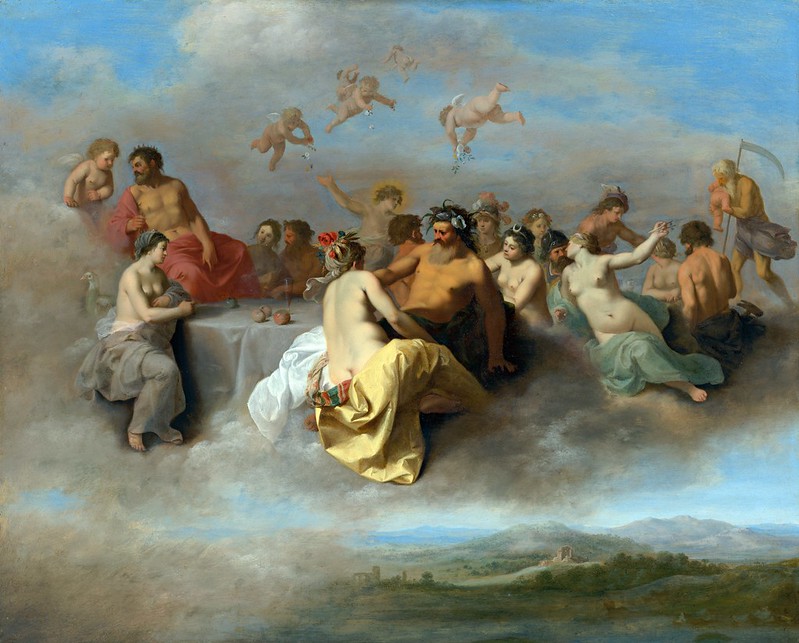
Cornelis van Poelenburch (c.1594-1667) - Meeting Gods in the clouds


Francisco López Capillas (1614-1674) - Missa 'Aufer a nobis'
Performers: Capella Prolationum; Ensemble La Danserye

---


Mexican composer and organist. The son of Bartolomé López (who was possibly a royal notary) and María de la Trinidad, López was probably admitted to the choir of Mexico City Cathedral around 1625, he would have studied with its maestro de capilla Antonio Rodriguez Mata. A Francisco López, who may well be the composer, graduated in theology at the University of Mexico on 20 August 1626. Stevenson has suggested that López may have studied with Juan de Riscos during a visit to Jaén, where Riscos was maestro de capilla until 1643 (Stevenson: ‘Mexico City Cathedral Music’, 1987). On 17 December 1641 López was named assistant organist and dulcian player (bajonero) at Puebla Cathedral under Juan Gutiérrez de Padilla, who had facilitated his appointment. His duties as a dulcian player were replaced with singing duties on 13 September 1645. He probably received the degree of licenciado from the University of Mexico no earlier than autumn 1646. Between 1642 and 1647 he frequently substituted for the principal organist, Pedro Simón, and on 15 January 1647 López was promoted to the position. However, following the reappointment of Simón in January 1648 (and a subsequent lowering of his own salary), López left Puebla on 15 May 1648 in search of better opportunities. His whereabouts for the next six years are unclear. On 10 March 1654 López presented a book of his compositions to the authorities at Mexico City Cathedral. When the cathedral choirmaster Fabián Ximeno died a month later, López was appointed to the dual post of organist and maestro de capilla within four days of Ximeno's death, even though the chapter had announced a 40-day waiting period for the vacancy. From this time López signed himself ‘López Capillas’ (‘López of the Chapels’).

In January 1656 he was asked by the viceroy, the Duke of Alburquerque, to compose a mass for the investiture of four bishops on the feast of St James; the result may have been the four-choir mass received with amazement by Gregorio Martín de Guijo and noted in his Diario, 1648-64 (ed. M. Romero de Terreros, Mexico, 1952). During the following years López supervised the two brilliant dedications of the new cathedral and strengthened his reputation for outstanding ability and conscientious service, but his pleas that the posts of organist and maestro de capilla be separated were refused until 1668, when the cathedral engaged Joseph Ydiáquez as principal organist. A beautifully illustrated choirbook of compositions by López, which was presented to Madrid (it is now in E-Mn M2428), may have played a part in securing a full prebend for López which was granted by a royal decree dated 23 March 1673. At the time of his death López was earning 1000 pesos, one of the largest salaries ever received by a church musician in Mexico during the colonial period. A will made on 13 January 1674 reveals that as well as valuable silver objects and a number of paintings he owned three violones and an organ. López was the first maestro de capilla of Mexico City Cathedral to be born in the city. His numerous compositions, among the finest produced in New Spain, are written exclusively according to the prima pratica but with notable skill and fluency. Their smooth polyphony masks a learned and greatly varied use of canon (e.g. the second Agnus Dei of the Missa Quam pulchri), parody techniques and complex mensural practices. In a ‘Declaracíon de la Missa’, a preface to his hexachord mass, he cites three chapters of Guevara's lost Compendio de musica to validate his mensural practice; he also cites Cerone's El melopeo y maestro. As influences on his musical style he mentions Hellinck, Richafort, Morales and Palestrina. 

divendres, 24 de febrer del 2023

LIDARTI, Christian Joseph (1730-1795) - Overture 'Ester' (1774)

James Gillray (1757-1815) - Dilettanti-Theatricals; of a Peep at the Green Room, February 18, 1803


Christian Joseph Lidarti (1730-1795) - Overture 'Ester' (1774)
Performers: Orchestre National de Montpellier; Friedemann Layer (1941-2019, conductor)

---


Austrian composer of Italian descent. He studied at a Cistercian monastery in Klagenfurt and afterwards at the Jesuit seminary in Leoben. While enrolled in philosophy and law courses at the University of Vienna, he studied the harpsichord and harp and began to teach himself composition. In Vienna the Kapellmeister Giuseppe Bonno, his uncle, reproached him for his dilettantism and directed him to study the classic theorists. In 1751 he went to Italy to complete his musical education. After short stays in Venice and Florence, he spent five years in Cortona as a music teacher and composer and studied with Jommelli in Rome in 1757. From then until at least 1784 he was a player in the chapel of the Cavalieri di S Stefano in Pisa. In 1761 he became a member of the Accademia Filarmonica in Bologna and later in Modena. His last dated composition is from 1793. Lidarti's regular association and correspondence with his colleagues such as Martini, Jommelli and Burney indicates that they held him in high esteem. Five letters to Martini spanning the years 1762-84 are in the Bologna Conservatory library. Lidarti's instrumental works (of which there are nearly 200) are bipartite in structure and show a preference for forms such as the minuet, even in sonata finales. They are lightly ornamented and often approach near-equality in voicing. Van der Straeten depicts Lidarti as a cellist, a fact omitted from his autobiography but borne out by the unusual technical demands placed on the cello in much of his chamber music, especially the quartets, in which the cello is more prominent than in the majority of quartets of that time. His compositions maintain a serene songlike quality, interrupted only by occasional fugal or canonic passages. 

dimecres, 22 de febrer del 2023

DE SOUSA CARVALHO, João (1745-1798) - Laudate pueri Dominum

Ecole française du XVIIIe siècle - Allégorie de la Science


João de Sousa Carvalho (1745-1798) - Laudate pueri Dominum
Performers: Kumi Arata (soprano); Maitrise du Centre de Musique Baroque de Versailles;
Les pages et les chantres de la Chapelle; Olivier Schneebeli (conductor)

---


Portuguese composer and teacher. On 28 October 1753 he began music studies at the Colégio dos Santos Reis in Vila Viçosa. A royal grant enabled him to enrol on 15 January 1761 at the Conservatorio di S Onofrio in Naples, where he studied with Cotumacci. In 1766 his setting of Metastasio’s La Nitteti was performed in Rome. On returning to Portugal he joined the Irmandade de S Cecília at Lisbon on 22 November 1767. In the same year he was appointed professor of counterpoint in the Seminário da Patriarcal, where he later served as mestre (1769-73) and as mestre de capela (1773-98) and taught such noted musicians as António Leal Moreira, Marcos António Portugal and João José Baldi. In 1778 he succeeded David Perez as music teacher to the royal family. Upon retirement from the Seminário da Patriarcal he owned extensive properties in both the Algarve and Alentejo. Carvalho was the foremost Portuguese composer of his generation, and one of the finest in the country’s history. His numerous elaborate church works in the style of Jommelli display a thorough control of counterpoint and structure, with keen, assertive melodic writing in the fast movements. He is equally distinguished as a composer of opere serie and serenatas, of which 14 by him were performed at the royal palaces of Ajuda and Queluz. Two of his operas have enjoyed modern revivals: L’amore industrioso (1943, 1967) and Testoride (1987). 

dilluns, 20 de febrer del 2023

CHEDEVILLE, Nicolas (1705-1782) - Sonate (V) en do majeur (1737)

Govert Flinck (1615-1660) - Rembrandt as a Shepherd with a Staff and Flute (1636)


Nicolas Chédeville (1705-1782) - Sonate (V) en do majeur, opera XIII (1737)
Performers: The Suffolk Consort

---


French composer, arranger, musette maker, player and teacher, brother of Pierre Chédeville (1694-1725) and Esprit Philippe Chédeville (1696-1762). His great uncle Louis Hotteterre was one of his godfathers and may have taught him music and the art of turning instruments. In the early 1720s he entered the opera orchestra as oboe and musette player, and on 1 November 1725 he took over the reversion of Jean Hotteterre's post in the Grands Hautbois from Esprit Philippe. After Jean's death in 1732, he acquired the title to this post. On 2 December 1729 he took out his first privilege to publish his own compositions. At first he called himself ‘Chedeville le jeune’ on the title-pages of these works; from op.3 he listed himself as ‘Chedeville le cadet’. The dedications of many of his works show that he was much sought after as a musette teacher by members of the most highly-placed families in France. He taught Princess Victoire from about 1750, which led to his appointment as maître de musette de Mesdames de France. In his musette making he seems to have added to the instrument's lower compass, building musettes going down to c' (according to the Mercure de France, November 1733). The Mercure also reported that he had rearranged the keys on the little chanter, making it easier to play. On 1 July 1748 he retired from the opera, although he agreed to return to play the musette there whenever he was needed, according to La Borde. Although he retained his post in the Grands Hautbois until his death, he must have dropped out of sight by 1780, because in that year La Borde, who claimed that he was the most celebrated musette player France had ever had, said that he was dead; in fact he lived for two more years. Nicolas's first two collections of pieces for musette or hurdy-gurdy, entitled Amusements champêtres (opp.1 and 2), are similar to his elder brother's early Simphonies; his op.3 works with the same title are more substantial and technically difficult. His op.6, inspired by a campaign on which he accompanied the Prince of Conti, contains movements with titles of battles, some of which express the ‘war-like images’ he referred to in his dedication. 

In 1737 he made a secret agreement with Jean-Noël Marchand for the latter to obtain a privilege to engrave, print and sell a work as Vivaldi's Il pastor fido, op.13, but in a notarial act dated 17 September 1749 Marchand declared that Chédeville was the composer, also revealing that Chédeville had provided the money for the publication and was receiving the emoluments. It is not certain why Chédeville chose to have his own work attributed to Vivaldi and issued under the privilege of Marchand, but perhaps, as Lescat has suggested, he was trying to give the musette, his favourite instrument, the endorsement of a great composer that it had lacked up until then. His interest in Italian music was strong around this time. On 7 August 1739 he was granted a privilege to print, engrave and issue to the public his own arrangements of concertos and sonatas by Italian composers for the musette, hurdy-gurdy or flute. The names of ten Italian composers are mentioned in the privilege, along with those of Quantz and Mahaut. Le printems, ou Les saisons amusantes (1739) features arrangements of Vivaldi's ‘La primavera’, op.8 no.1, along with other concerto movements by Vivaldi. His op.7 is his only collection specifically for the transverse flute, oboe or violin. The pieces have Italian tempo markings, a greater variety of keys than the musette works and more pronounced features of Italian style. In his op.9, dedicated to the ‘illustrious virtuosos’, both ladies and gentlemen, who were his students, he turned again to the rustic, pseudo-countrified style so fashionable at the time. Not arranged into sonatas or suites, the pieces appear to reflect the skill of the pupil to whom each is dedicated; some are quite simple, while others, such as ‘The Virtuoso’, use many ‘double stops’ and have rapid, difficult passage-work. Op.14, dedicated to Princess Victoire, features variations, incuding 12 based on ‘Les folies d'Espagne’. Though Nicolas's works are on the whole more substantial and glittering than those of Esprit Philippe, both were basically intended for the same purpose – that of the amusement of wealthy amateurs who played for their own pleasure – and both served that purpose well.