dimecres, 30 de novembre del 2022

FÖRSTER, Christoph (1693-1745) - Ehre sei Gott in der Höhe

Sebastiano Ricci (1659-1734) e Marco Ricci (1676-1730) - Susanna davanti a Daniele


Christoph Förster (1693-1745) - Ehre sei Gott in der Höhe
Performers: Hanna Herfurtner (soprano); Carola Günther (alto); Georg Poplutz (tenor); Raimonds Spogis (bass);
Kölner Akademie; Michael Alexander Willens (conductor)

---


German composer. He studied first with the organist Pitzler, then left Bibra for Weissenfels where he learnt thoroughbass and composition from Heinichen. When Heinichen went to Italy, Förster became a pupil of Georg Friedrich Kauffmann at Merseburg. In 1717 he was appointed violinist in the Merseburg court orchestra and later became Konzertmeister there. While employed at the court Förster dedicated six sonatas, six cantatas and 12 concertos to the duchess; he also learnt Italian, the predominant language for secular vocal music. Förster was granted leave of absence from Merseburg on several occasions: in 1719 he visited Heinichen at Dresden and in 1723 went to Prague where he met Fux, Caldara, Conti and other eminent musicians involved in the coronation celebrations of Charles VI. In August 1742 he played a leading part (under Johann Graf) in the birthday festivities of Prince Friedrich Anton of Schwarzburg-Rudolstadt, and the following year was appointed vice-Kapellmeister at Rudolstadt. Among works written for this court is a birthday cantata dedicated to Princess Bernhardine (5 May 1745). When Graf died in 1745 Förster succeeded him as Kapellmeister, but held this post for only a few weeks before his own death. There is some confusion surrounding Förster’s activities between 1739 and 1743. Loewenberg (Grove5) stated that he held an appointment at Sondershausen during this period, but in Förster’s application for the post at Rudolstadt (3 March 1743) he merely said he had been Kammermusikus and Konzertmeister at Merseburg ‘for a long time’. In his own day Förster was greatly respected as a composer of church music. Gerber thought highly of the cantatas; when a boy he had sung many ‘agreeable’ arias by Förster in the local church at Sondershausen. In his instrumental music, Förster has been described as one of the leading exponents of the French overture: the overture in A major (ed. Riemann) shows a fine sense of form and a keen appreciation of instrumental colour. Whereas the orchestral suites are indebted to French models, the sinfonias and concertos display the influence of the Italian style. Förster’s chamber music invites comparison with Telemann’s. Both composers show the same ability to combine learned counterpoint and melodious themes, the same predilection for voice change and love of short melodic phrases in the galant manner. Few of Förster’s works were printed in the 18th century. The two main publications were a set of six symphonies published by Haffner (Nuremberg, 1747) and six Duetti oder Trii for two violins and optional continuo engraved by Telemann (see Mattheson). Förster was an extremely prolific composer. According to Walther he had written over 300 pieces by 1732, and the Breitkopf catalogues mention numerous works by him. It is obvious that existing work-lists are far from complete. Unfortunately many manuscripts lack the distinguishing Christian name so that authorship is open to dispute.

dilluns, 28 de novembre del 2022

LULLY, Jean Baptiste (1632-1687) - Ouverture avec tous les Airs de l'opéra Atys (1676)

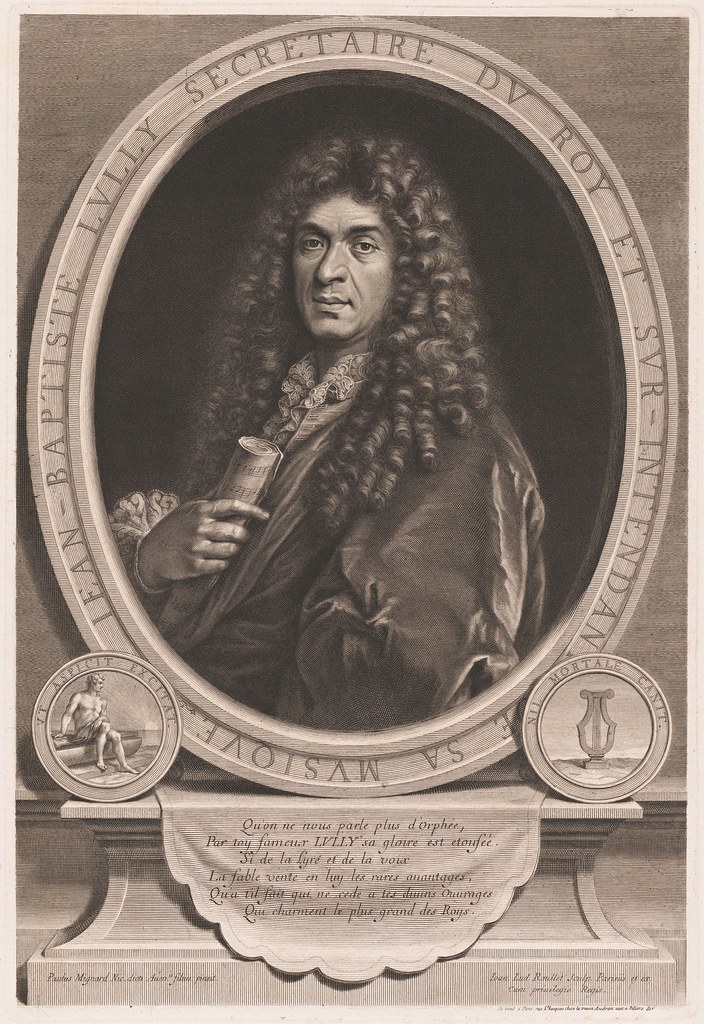
Jean Louis Roullet (1645-1699) - Portret van Jean-Baptiste Lully


Jean Baptiste Lully (1632-1687) - Ouverture avec tous les Airs de l'opéra Atys (1676)
Performers: Capriccio Basel Baroque Orchestra; Dominik Kiefer (conductor)

---


French composer, violinist and dancer. Born Giovanni Battista Lulli, he was the second son of a Tuscan farmer, Lorenzo Lulli (1599-1667). Little is known of the son’s education. Perhaps he learned the fundamentals of music from the friars of the Via Borgo Ognissanti in Florence. Somehow, possibly as early as 1645, he managed to be appointed as a tutor of Italian to Anne- Marie-Louise d’Orléans, cousin of King Louis XIV of France. In February 1646, Lully moved to Paris. A source printed in 1695 identifies Lully’s teachers from this point: the organists at the church of St. Louis of Rue Saint-Antoine, Nicolas Métru and Nicolas Gigault, the violinist Jacques Cordier, and the dancer Jean Regnault. Possibly through Regnault, Lully entered the service of Louis XIV and danced in the Ballet Royal de la Nuit, caught the eye of the king, and was appointed compositeur de la musique instrumentale on 16 March 1653. His dancing and obvious talent for composition allowed Lully to persuade the king to establish an instrumental ensemble apart from his official one, Les Vingtquatre Violons du Roi. Lully was able to form the new orchestra, Les Petits Violons, according to his own ideas of ensemble playing, and it would become famous throughout Europe. In 1656, Les Petits Violons made its debut in the ballet Les Galanteries du Temps, the earliest surviving ballet composed entirely by Lully. On 24 July 1662, he married Madeleine Lambert, a composer’s daughter 20 years of age. They had six children. To this point, Lully as composer had contributed chiefly to court ballets. But age began to curtail his dancing, and he retired as a dancer by 1668. In 1664, however, he entered upon a second stage of his career as composer: a collaboration with the great dramatist Jean-Baptiste Poquelin (1622-1673), known by his stage name Moliére, on a series of comédies-ballets, comic dramas in which Lully’s dance music interweaves with Molière’s poetry, beginning with Le Mariage Forcé (29 January 1664), including Le Bourgeois Gentilhomme (14 October 1670), and concluding with Psyché (17 January 1671).

In March 1672, Lully was to able buy the royal privilege of producing “academies for opera . . . in the French language”—essentially a patent for a monopoly granted by Louis XIV—from its original holder, the poet Pierre Perrin (c.1620-1675), and immediately moved to establish the Académie Royale de Musique. Because the privilege brought no court financing of the new venture, Lully entered into a partnership with long-time acquaintance and theater architect Carlo Vigarani (1637-1713) in August 1672, and together they adapted a tennis court for their productions. They began with Les Fêtes de L’Amour et de Bacchus, a pastiche made of Lully’s earlier ballet music, and they mounted the first original tragédie lyrique in April 1673, Cadmus et Hermione. This created a sensation, luring the king to the tennis court to see it. By 28 April 1673, the king authorized Lully to use the Palais Royal theater rent-free, and after the opening of Alceste in January 1674, Louis brought the business of tragédie lyrique into the court, supported by the court’s sets, costumes, and machinery and by funded rehearsals. With such backing, Lully produced a new opera nearly every year until he died in 1687, usually working with the great librettist Philippe Quinault (1635-1688). His control of the royal opera privilege virtually eliminated all rivals from Paris, although he did allow provincial opera companies to operate. He also managed the Palais Royal almost as a monopoly, setting high prices for seats. The royal privilege allowed him to earn royalties on his printed librettos and, after 1677, royalties from prints of his music. From then on, he published complete scores of all his tragédies lyriques, a phenomenon unknown in the rest of Europe, where opera scores were lucky to survive in manuscript. In December of 1686, while conducting his Te Deum at the Church of the Feuillants, he wounded himself in the foot. The wound became gangrenous, and Lully died on 22 March 1687.

diumenge, 27 de novembre del 2022

ZACH, Jan (1713-1773) - Missa ex D à 4 (c.1755)

Pier Leone Ghezzi (1674-1755) - Pope Benedict XIII Presiding over the Provincial Roman Synod


Jan Zach (1713-1773) - Missa ex D à 4 (c.1755)
Performers: Mаyа Bοοg (soprano); Grаhаm Pushее (alto); Stеvе Dаvislim (tenor); Wοlf Mаtthiаs Friеdrich (bass); Kammerchor Collegium Vocale Innsbruck; Cappella Istrοpolitаnа; Bеrnhard Siеbеrеr (conductor)

---


Bohemian composer and organist. The son of a wheelwright, he went to Prague in 1724 and began his career as a violinist at St Gallus and at St Martín. Later he became organist at St Martín and, by 1737, at the monastic church of the Merciful Brethren and the Minorite chapel of St Ann. According to Dlabač he was a pupil of B.M. Černohorský (who was in Prague, 1720-27) in organ playing and composition. In 1737 Zach competed unsuccessfully for the post of organist at St Vitus’s Cathedral. He is reported to have left Bohemia, but was in Prague until 1740. About 1745 he was at Augsburg, and on 24 April 1745 he was appointed Kapellmeister at the court of the Prince-Elector of Mainz, succeeding his countryman Jan Ondráček. On 4 October of the same year a mass by Zach was given at Frankfurt, at the coronation of Emperor Franz I. Zach visited Italy in 1746 and in autumn 1747 he spent about two months in Bohemia. At the Mainz court he was involved in various disputes, probably caused by his eccentricity. He was suspended in 1750, and in 1756 he was dismissed and succeeded by another Bohemian musician, J.M. Schmid. He sought appointments at the court of the Prince-Elector at Trier and later at Cologne, and apparently spent the rest of his life travelling, visiting various courts (Koblenz, Cologne, Darmstadt, Dillingen, Würzburg, Werhammer, Wallerstein) and monasteries (Seligenstadt, Amorbach, Eberbach, Stams). In 1767 and between 1771 and 1772 he again visited Italy, staying for two months at Bressanone on his return journey. He earned his living by selling and dedicating copies of his works and by teaching; he also performed as a soloist on the harpsichord and the violin and conducted performances of his compositions. He appears to have had close contact with the Cistercian monastery at Stams, Tyrol, where he stayed several times; at various times he was music teacher at the Jesuit school in Munich and possibly choirmaster at the Pairis monastery in Alsace.

In January 1773 he was at the Wallerstein court; four months later, according to the Frankfurt Kayserliche Reichs-Ober-Post-Amts-Zeitung of 5 June, he died on a journey, at Ellwangen, and was buried in the local monastic church of St Wolfgang. Zach seems to have been a complicated personality both as man and as artist: his musical expression ranges from introverted melancholy to robust verve, with an intense rhythmic drive. A full chronology of his works has not been established. His output includes both instrumental and sacred music; both genres reflect a stylistic transition from the late Baroque to the pre-Classical. In his church music, retrospective polyphony and Venetian ‘mixed style’ (for example the Requiem in G minor k B18) co-exist with a more homophonic, concertante idiom of Neapolitan orientation, often pervaded with Czech dance rhythms. His best sacred works include the Requiem in C minor (k B17), abounding in melodic chromaticism and striving for dramatic expressiveness, the Stabat mater and the Missa solemnis. Zach’s sinfonias and partitas are scored for strings, solo or orchestral, or for strings and wind. Various types of pre-Classical formal organization are represented, notably the three-movement Italian overture form (sometimes expanded to four movements). Both the sinfonias and concertos use many devices of the galant style, such as periodic two- or four-bar structure, much passage-work and ornamentation, parallel 6ths and 3rds, Alberti bass and so on. The national character of Zach’s music was noted as early as 1774 by M. Gerbert: ‘qui praestantissimum suae gentis characterem sine peregrini Italiae styli admixtione egregie expressit’ (De cantu et musica sacra, ii, 371). Komma has shown that many of Zach’s engaging melodies and rhythms have their roots in Czech folksong and dance.

divendres, 25 de novembre del 2022

REICHARDT, Johann Friedrich (1752-1814) - Sonata per il Pianoforte e Violino

Nicolaas Hopman (1794-1870) - Portrait of two musicians (1826)


Johann Friedrich Reichardt (1752-1814) - Sonata (F-Dur) per il Pianoforte e Violino
Performers: Massimo Spadano (violin); Arthur Schoonderwoerd (pianoforte)

---


German composer, political writer and writer on music. Son of a lutenist, Johann Reichardt (c.1720-1780), he received his early musical education from his father. His early teachers also included J.F. Hartknoch (a young musician from Riga then learning the publishing trade in Königsberg), a local musician named Krüger, the organist C.G. Richter, who introduced Reichardt to the music of C.P.E. and J.S. Bach, and the violinist F.A. Veichtner, a pupil of Franz Benda. He attended Königsberg university, where he became acquainted with the philosophy of Emanuel Kant. Like other young artists in the 18th century, he began his career with years of travel. The first of his journeys began in spring 1771 with a performing tour of north German musical and literary centres; he met J.A.P. Schulz, Ramler, Friedrich Nicolai, Franz Benda, J.A. Hiller, J.G. Naumann, C.P.E. Bach, Lessing, Klopstock and Claudius. During this journey he spent two long periods in Berlin, where he attended performances of Graun and Hasse operas at the declining royal opera and oratorios at public concerts, studied briefly with Kirnberger and was deeply impressed by his first substantial hearing of Handel’s music. In 1775 he applied for and won the post of Kapellmeister to Frederick II though he had little experience in musical composition. He married Juliane Benda, Franz Benda’s daughter, in 1776, and remarried soon after she died in 1783. Tours to Italy and Vienna in 1783 (where he became friends with Joseph Martin Kraus) as well as France and England in 1785 both broadened his education and served to implement a Concert spirituel in Berlin. 

He was close friends with Johann Wolfgang von Goethe and Friedrich von Schiller, working with the former in 1789 on the Singspiel Claudine von Villa Bella. From the end of 1794 until the accession of Friedrich Wilhelm III in 1797, Reichardt lived in Hamburg and Giebichenstein, active as a political journalist, and editing the journals Frankreich and Deutschland. In 1796 he was appointed director of the Halle salt mines, a position which gave him leisure to pursue his own interests. In 1806 Napoleon’s troops occupied parts of Prussia, and also Halle and Giebichenstein. Reichardt and his family fled to north Germany, and returned in October 1807 to find the estate in Giebichenstein in ruins. With barely enough money to support his family, he had to depend on income from writing and composing until 1811, when he was given a small pension. He made several more journeys, to Berlin, Leipzig and Breslau, but his brilliant reputation had gone. He died largely forgotten. As a composer, his musical style is often dramatic, with orchestration that foreshadows the Romantic period, and he can be considered both an adherent of the Sturm und Drang style and one of the principal composers of Lieder of the Berlin School. His compositions include 1500 Lieder, 29 operas (mostly Singspiels), 11 sets of incidental music to plays, two ballets, two oratorios, 13 German cantatas, a Requiem, two Te Deums, eight Psalms, nine symphonies, 11 concertos (nine for keyboard), three quintets, a quartet, 15 trios, 26 keyboard sonatas, 16 violin sonatas, and over 100 horn duets. Reichardt can be seen as one of the most intellectual composers of the period.

dimecres, 23 de novembre del 2022

BUSTIJN, Pieter (1649-1722) - Suitte (VI) pour le Clavessin (c.1712)

Anonyme - Portrait d'un jeune musicien (1767)


Pieter Bustijn (1649-1722) - Suitte (VI) pour le Clavessin (c.1712)
Performers: Jаcquеs Ogg (clavecin)

---


Dutch organist, carillonneur and composer. His family were French-speaking. He may have studied with Remigius Schrijver (?-1681), a Middelburg organist; he completed the music for Uitbreidinge over het Bouk der Psalmen (3vv, bc; Middelburg, 1682; lost), begun by Schrijver, who had died before completion of the work. In 1681 Bustijn was appointed organist of the Nieuwe Kerk, and carillonneur of the abbey bell tower in Middelburg. He served as organ adviser in Middelburg and Goes and may have been director of the Middelburg collegium musicum during the period 1681-1729. In 1712 the carillon of the Middleburg abbey tower was destroyed; its replacement, constructed by the famous bellfounders Jan Albert de Grave and Claas Noorden of Amsterdam in 1714, was inspected by Bustijn and Abraham de Coup, organist of the Walloon church and carillonneur of the market bell-tower, and, according to various reports, was of outstanding quality. Relatively little Dutch keyboard music of the time has survived. Bustijn’s IX suittes pour le clavessin (Amsterdam, c1712/R in Exempla Musica Zelandica, i (Middelburg, 1992 [incl. biographical information]); 3 ed. in EMN, i, Amsterdam, 1964) are of great importance to the history of the genre in the Netherlands. Their balanced arrangement by key is reminiscent of the use of symmetrical cycles culminating in the art of Bach. Their style points to that of the keyboard works of Bach and Handel, as well as showing some French influence. The suites were known to members of Bach’s circle: no.VIII (in A), in J.L. Krebs’s hand, can be found in an anthology of keyboard music (D-Bsb) compiled by Johann Gottfried Walther, who also mentions the works in his Musicalisches Lexicon.