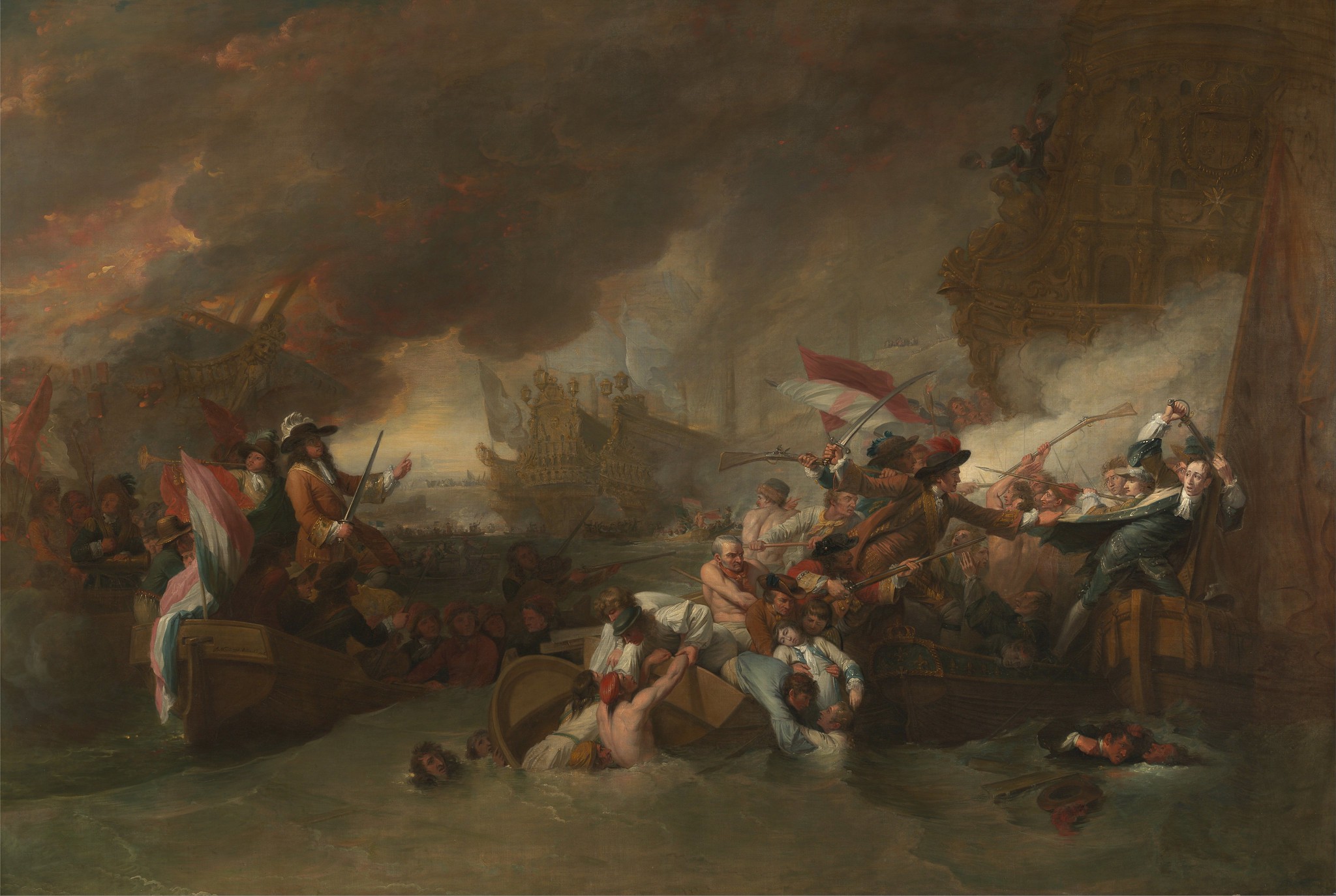
 Obra de Benjamin West (1738-1820), pintor estatudinenc.
Jules Armingaud (1820-1900) - Épithalame
Josepha Barbara Auernhammer (1758-1820) - 6 Variations sur un Theme Hongrois
Michael Bergson (1820-1898) - Grand Duo Dramatique op. 40
Marie Bigot (de Morogues) [Kiené] (1786-1820) - Sonata Op.1
Bartolomeo Bortolazzi (1773-1820) - Sonate D-Dur, Op.9
Augusta Browne (1820-1882) - Song of New England (1844)
Joseph Corfe (1740-1820) - I Will Magnify Thee, O Lord
François Joseph de Trazegnies (1744-1820) - Sonate 2
Karl Anton Florian Eckert (1820-1879) - Langsamer Marsch
Lewis Edson (1748-1820) - 큰영화로신주
Joseph Gehot (1756-1820) - String Quartet in G, Op.1 Nr.2
Gustav Graben-Hoffmann (1820-1900) - Fünfmalhunderttausend Teufel
Henri Hamal (1744-1820) - Trumpet Concerto in D
Béla Kéler (1820-1882) - Vom Rhein zur Donau, Op.138
Pavel Křížkovský (1820-1885) - Odvedeného prosba (1862)
Ludwig Wenzel Lachnith (1746-1820) - Sinfonia B-Dur
Gustave Nadaud (1820-1893) - Le message
Giacomo Bartolomeo Tomadini (1820-1883) - Bone pastor
Martin Andreas Udbye (1820-1889) - 4 Small Pieces for Bassoon and Piano
Georg Vierling (1820-1901) - Ouverture 'Die Hexe' (1884)
- 200è aniversari de compositors a qui difícilment escoltarem -
(1820-2020)
(1820-2020)
Portraits source: ©Tassos Dimitriadis
Parlem de Pintura...
Benjamin West (Springfield, 10 d'octubre de 1738 - London, 11 de març de 1820) va ser un pintor nord-americà. Especialitzat en escenes històriques i retrats, va ser un dels artistes més destacats de la seva època. Es va formar en gran part de forma autodidacta. Va realitzar retrats a Filadèlfia entre 1746 i 1759, any que va marxar a Itàlia, on va adoptar un estil clàssic en la seva pintura degut a l'exhaustiu estudi de les obres de mestres italians com Tiziano i Rafael. El 1763 es va traslladar a Anglaterra país on aviat es va guanyar l'amistat del retratista anglès Sir Joshua Reynolds i la protecció de Jordi III, qui li va encarregar la realització de retrats dels membres de la família reial i, el 1772, el va nomenar pintor de la cort. West va ser un dels fundadors, el 1768, de la Royal Academy of Arts, i es va convertir en el seu president quan va morir Reynolds el 1792. Se'l considera un dels pioners del realisme en trencar la tradició de representar els soldats en les escenes de batalles contemporànies amb vestimentes greco-romanes, com s'aprecia en la seva obra La mort de Wolfe (1771, Galeria Nacional, Ottawa). West va estimular i va influir a molts joves pintors nord-americans que van estudiar al seu taller de Londres, entre els quals cal citar Gilbert Charles Stuart i John Singleton Copley. Entre les obres més destacades de l'artista en destaquen El tracte d'un penic amb els indis (1772, Independence Hall, Filadèlfia) i Mort sobre un cavall pàl·lid (1796, Museu d'Art de Filadèlfia). Benjamin West va morir a Londres el març de 1820.
Parlem de Música...
War ein österreichischer Komponist volkstümlicher Lieder. Anton Absenger wuchs in einer kinderreichen Bauernfamilie in der Oststeiermark auf. Schon früh erhielt er Unterricht auf der Violine und dem Flügelhorn. Im Alter von dreiundzwanzig spielte er als Flügelhornist in der Kapelle Johann Gungls. Mit dieser machte er eine ausgedehnte Konzertreise. Von Graz gelangte er über München, Nürnberg und Frankfurt am Main zunächst nach Köln. Von da ging es über Berlin, Danzig, Königsberg und Riga bis nach St. Petersburg. Von da aus ging es über Hamburg, Dresden Prag und Wien wieder zurück. Auf dieser Reise sammelte er reichlich Erfahrung. In Graz leitete er die Streichgruppe des Bürgercorps und der Nationalgarde. Bei August Svoboda (1795-1863) studierte er Harmonielehre und Kontrapunkt. 1852 ging er als letzter Türmermeister nach Leoben. Mit diesem Amt war auch das Amt des Stadtmusikdirektors verbunden. Dieser war auch für den Dienst als Regens chori an den drei dortigen Kirchen wie St. Xaver zuständig. Er gründete er eine Musikschule aus der eine Knabenkapelle hervorging. Des Weiteren leitete er den Männergesangverein Leoben und war als Musiklehrer am Gymnasium tätig. 1855 konzertierte er mit ihr erfolgreich in Graz. Mit J.Lorenz und K. Kraushofer gründete er eine Volksmusikspielgruppe. Ausgedehnte Konzertreisen führten ihn mit dieser Gruppe nach München, Mannheim und Paris. 1865 spielten sie vor Kaiser Franz Joseph I. im Schloss Schönbrunn. Bei dieser Gelegenheit erhielt er die K. und k. goldene Medaille für Kunst und Wissenschaft. Nach dem J. Lorenz gestorben war, löste sich die Gruppe auf. Absenger ging aber mit seinen Kindern weiter auf Konzertreisen. Dies verbreitete zwar die steirische Musik in Europa, seine eigentlichen Ämter in Leoben vernachlässigte er aber dadurch. 1883 wurde er ohne Pension entlassen. Er erhielt nur eine Abfertigung von 300 Gulden. Absenger war der letzte der die Ämter des Stadtmusikdirektors und des Regens Chori in Leoben auf sich vereinigte. Er war auch der letzte Türmermeister. Absenger war nun freier Künstler und war später immer mehr auf Unterstützung und Spenden seiner Freunde und Verehrer angewiesen. Er ist auf dem Friedhof St. Leonhard in Graz begraben. In Graz ist die Absengerstrasse nach ihm benannt.
Paolo Altieri (1745-1820)
Italian composer and music teacher. He was educated in Naples, where he met two wealthy citizens from Noto, a small city in south-eastern Sicily, who invited him to their city. Altieri arrived in 1766, became a music teacher, married and held the position of maestro di cappella for all the city’s churches. He worked in Noto until his death. A collection of Altieri’s compositions was given to the Biblioteca Comunale of Noto by a local bishop who had acquired it from a relative of Altieri’s: it comprises 449 works, mostly sacred vocal music, but also secular vocal music and instrumental works.
Pedro Aranaz y Vides (1740-1820)
Spanish composer. After studying eight years with Luis Serra at the cathedral of Nuestra Señora del Pilar in Zaragoza, he competed for the music directorships of the cathedrals of Santo Domingo de la Calzada (1763), El Pilar (1765) and Zamora (1768), but was each time rejected, probably because he was not yet in holy orders. In 1765 he went to Madrid, where he made his name as a composer of tuneful, folkloric tonadillas. In 1769 he was appointed maestro de capilla at Cuenca Cathedral, where despite offers from better-paying cathedrals he remained until his death, composing much staid ecclesiastical music. He was ordained a priest in 1773 and retired from conducting in 1797. At Salamanca in 1791, Manuel Alonso Ortega rated him first among contemporary composers of expressive sacred music.
Jules Armingaud (1820-1900)
French violinist and composer. A pupil of Alard, he attempted to enter the Paris Conservatoire in 1839 but was refused admission, according to Fétis, because of his advanced and individualistic talent. He played in the orchestra of the Opéra-Comique, and in the revolution of 1848 he was active, with Edouard Lalo, in the leftist Association des Artistes Musiciens. In 1855 he formed, with Lalo, Joseph Mas and Léon Jacquard, a string quartet in which he played first violin. The quartet enjoyed a great reputation for the works of Mendelssohn and Beethoven; many of their quartets had seldom been performed before. Clara Schumann apparently played with the Armingaud quartet during visits to Paris in 1862 and 1863. The ensemble was later transformed, by the addition of wind instruments, into the Société Classique. Armingaud was praised for his graceful but solid playing and his beautiful tone. His compositions, which run to at least op.53, are primarily light works for violin and piano, described by van der Straeten as ‘florid [and] showy’, but they also include a fantasy on themes from Lohengrin and a chorus with orchestra. He published two books of musical aphorisms, Consonances et dissonances (Paris, 1882) and Modulations (Paris, 1895).
Josepha Barbara Auernhammer (1758-1820)
Austrian pianist and composer. She was the 11th child of Johann Michael Auernhammer and Elisabeth Auernhammer, née Timmer. She studied with Georg Friedrich Richter, Leopold Kozeluch and, from 1781, with W.A. Mozart, with whom she fell in love. On 27 June 1781 Mozart wrote of her: ‘I dine almost daily with H. v. Auernhammer; the young lady is a fright, but plays enchantingly, though in cantabile playing she has not got the real delicate singing style. She clips everything’. In the same year Mozart dedicated his sonatas for piano and violin k296 and k376–80/374d-f, 317d, 373a to her. (The dedication to Auernhammer on the edition of the piano variations Ah, vous dirai-je, maman k265/300e was added in 1785 by the publisher Christoph Torricella.) Auernhammer corrected the proofs of several of Mozart’s sonatas, and her performances with him were enthusiastically described by Abbé Stadler. At a private concert in the Passauerhof in Vienna on 23 November 1781, she and Mozart played the sonata for two pianos k448/375a and the double concerto k365/316a. They also appeared together in concerts in January 1782 and on 26 May 1782. After her father’s death, Mozart found lodgings for Auernhammer with Countess Waldstätten in the Leopoldstadt area. A legacy of almost 20,000 gulden from her great-uncle Karl Timmer on his death in 1785 was probably the basis of Auernhammer’s decision to continue devoting herself to her career as a pianist. In 1786 she married a civil servant, Johann Bessenig (c.1752-1837), with whom she had four children. She continued to appear regularly in concerts at the Burgtheater and privately, amd gave her last public concert on 21 March 1813 with her daughter Marianna, who also made a name for herself as a singing teacher and pianist. Auernhammer composed mainly piano music, particularly variations, which are marked by a comprehensive knowledge of pianistic technique and an artistic use of the instrument.
Joan Barrau i Esplugues (1820-?)
Compositor espanyol. Va ser professor de piano i de cant al Conservatori del Liceu de Barcelona. El 1851 es va traslladar a Itàlia, i el 1855 es va establir a l'Havana, on va ensenyar i va ser director d'un teatre. De retorn a Barcelona, va continuar la seva labor docent i va fundar la Societat Liricodramàtica del Cercle del Liceu. Com a compositor, va escriure algunes fantasies i un mètode de cant. Es desconeix la data i població del seu decés.
Edouard Batiste (1820-1876)

Was a French composer and organist. He studied at the Imperial Conservatoire as a teenager, winning prizes in solfège, harmony and accompaniment, counterpoint and fugue, and organ. In 1840, he won the Prix de Rome together with François Bazin. In 1842, he became the organist at Saint-Nicolas-des-Champs church in Paris, where he remained for 12 years, before becoming organist at Saint-Eustache Church. While at Saint-Eustache, he performed the organ in the premiere of Hector Berlioz's Te Deum in April 1855, conducted by the composer. His students included Edward Morris Bowman and Joseph Lennon. He died in Paris on 9 November 1876.
Maria Carolina Benda [Wolf] (1742-1820)

Singer and composer, daughter of Franz Benda and his first wife, Franziska Louise. She studied singing and the harpsichord with her father and took a position as a Hofsängerin in Weimar in 1761. She married the Weimar Kapellmeister Ernst Wilhelm Wolf in 1770, but continued her musical career and performed at the Weimar Liebhabertheater (1775-83), where Goethe was director. She composed the songs Die Rose and An die Rose (published in Der teutsche Merkur, 1779) and a setting of Ich träumte wie um Mitternacht, which appeared first in her husband’s collection Ein und fünfzig Lieder (1784) and later in the Mildheimisches Liederbuch (1817).
Michael Bergson (1820-1898)
Polish pianist and composer. He took his first music lessons in Warsaw, later studying composition with F. Schneider in Dessau and with K.F. Rungenhagen and W. Taubert in Berlin. In 1840 he went to Paris, where he continued his piano studies. He spent the years 1846–50 in Florence, Bologna and Rome, and from 1850 to 1853 he was in Vienna, Berlin and Leipzig. He then settled in Paris, performing as a pianist at numerous concerts. In 1863 he was appointed professor at the Geneva Conservatoire, and later became its director. Late in life he moved to London and taught there privately until his death. Bergson’s works adhere strictly to the conventions of the period, particularly his pieces intended for domestic performance. These generally make few demands on the players and place great emphasis on cantabile melodic lines. Sometimes Bergson gave his pieces programmatic titles (e.g. Un orage dans les lagunes). Many of the piano pieces are in the style and forms of Chopin (e.g. Impromptu Mazourka op.35). Some works show the influence of national musical traditions, for example I zingari: grand caprice hongrois op.42 and La tatamaque: danse havanaise op.51. A large proportion of his work consists of pedagogical works (e.g. 12 nouvelles études caractéristiques op.60 and École nouvelle du mécanisme op.65), operatic paraphrases and fantasias, and the popularity of his own music is attested by the number of arrangements that were made of it. He composed three operas: Luisa di Montfort was performed in 1847 in Livorno, Florence and elsewhere in Italy, and in 1849 in Hamburg; Salvator Rosa was not staged, but parts of a one-act operetta Qui va à la chasse perd sa place were given in Paris in 1859.
Marie Bigot (de Morogues) [Kiené] (1786-1820)

Alsatian pianist. At the age of five she moved with her parents to Neuchâtel, Switzerland, where her mother gave her early piano lessons. In 1804 she married Paul Bigot, librarian to Count Razumovsky in Vienna, and thus gained introductions to Haydn, Salieri and Beethoven. On 20 February 1805 she played to Haydn, who exclaimed ‘Oh! my dear child, it is not I who wrote that music, it is you!’. In May 1805 she played at the opening concert of the Augarten, encouraged by Beethoven, and Nohl recorded that she played the ‘Appassionata’ Sonata at sight from the autograph, which Beethoven later gave her. It is clear from Beethoven’s correspondence that he was on friendly terms with the Bigots, and Marie also partnered Schuppanzigh in his concerts. There was intense rivalry between Marie Bigot and the eminent piano manufacturer Nanette Streicher. In 1809 the Bigots moved to Paris, where she came in contact with Cherubini, Baillot and many others; Cramer and Fétis praised her playing highly. Her husband was captured during the Russian campaign of 1812, and the remaining years of her life were devoted to teaching; one of her pupils was the young Mendelssohn. She also published some piano works in Vienna and Paris. Her playing was clearly of exceptional quality. Fétis wrote: ‘exquisite feeling gave her a rare understanding of every masterpiece, and enabled her to interpret every kind of expression, and, reaching to her fingertips, gave her playing-style indefinable charm unequalled in her time’.
Bartolomeo Bortolazzi (1773-1820)

Compositore e mandolinista italiano. Nacque a Toscolano sulla sponda occidentale del Lago di Garda in provincia di Brescia (oggi comune di Toscolano Maderno) Al momento della nascita di Bartolomeo, Toscolano faceva parte, come quasi tutta la provincia, della Repubblica di Venezia e godeva di un fiorente artigianato nel settore della lavorazione della carta. Bartolomeo dovette, seppure a malincuore, seguire le orme del padre Domenico per apprendere il mestiere del cartaio. Era un mestiere poco gradito dal piccolo Bartolomeo che aveva un carattere inquieto più propenso a sognare che a lavorare la carta e con una prepotente passione per la musica, tanto da diventare in brevissimo tempo, un ottimo suonatore di mandolino, stimato e ammirato dai suoi compaesani e dagli amici delle borgate vicine. Esaltato dai successi ottenuti, Bartolomeo divenne sempre più ansioso e inquieto. La sua famiglia, il suo paese, il suo lago, gli erano troppo angusti; egli voleva trovare nuovi spazi, conoscere altri paesi, altra gente, e portare la sua musica altrove. Questo sogno si avverò nel 1790 quando, in compagnia dei suoi amici Bazzani e Lena, suonatori di chitarra e Pietro Ferrari, cantore di arie buffe, abbandonò il tetto natio: aveva 18 anni. L'avventura era cominciata percorrendo paesi e città dell'Italia del Nord, tenendo concerti nelle piazze, nelle osterie e nei teatri. Il successo fu immediato, applausi e denaro consentirono all'allegra brigata di condurre una vita lieta e spensierata. Non soddisfatti del felice inizio dell'avventura, vollero andare oltre e decisero di varcare i confini per trasferirsi in Francia. Anche in terra francese gli allegri musicisti ebbero successi e denaro; ma ben presto il fuoco della Rivoluzione, che aveva sconvolto la Francia e l'Europa, incominciò a scaldare l'aria e pose frettolosamente fine alla vita lieta e spensierata di Bartolomeo e dei suoi amici, costringendoli in gran fretta a lasciare la Francia e cercare lidi più sicuri e tranquilli. Ritornati a Toscolano, dopo breve tempo furono ripresi dalla febbre dell'avventura e partirono alla volta del Tirolo, da dove passarono in Austria visitando le città più importanti dell'Impero fino a raggiungere Vienna. Anche qui non mancarono successi e riconoscimenti che permisero loro di condurre una vita senza preoccupazioni economiche. Fu a Vienna che Bortolazzi ebbe la fortuna di incontrare il celebre pianista Colò di Riva di Trento che, favorevolmente impressionato dal talento di Bartolomeo, lo avviò a seri studi musicali e letterari. Tali studi furono affrontati dal Bortolazzi con amore e intelligenza pronta e vivace. A Vienna,scrive il Valentini, andavano a gare nel prodigare al nostro Bortolazzi inviti, nel offrirgli impieghi e protezioni, nel regalargli denaro e onorificenze, tutti rapiti dalla bella arte del suo strumento, dalla facilità, eleganza e melodia delle sue composizioni che improvvisava a bizzeffe”.
Nel 1799 Bortolazzi si trasferì a Londra, forse invitato da una loggia massonica. Difatti, presso il British Museum, si trovano alcune composizioni vocali dedicate ai “fratelli della Loggia dei Pellegrini”. Ed è a Londra che egli incontrò, nel 1799, il giovane compositore slovacco Johann Nepomuk Hummel (1778-1837), che gli dedicò il famoso concerto per mandolino e orchestra (ora reperibile presso il British Museum). Evidentemente il giovane Hummel rimase affascinato dal virtuosismo di Bortolazzi, tanto da dedicargli il concerto, che nella stesura, risente dei consigli che gli vennero suggeriti dal Bortolazzi, soprattutto per quanto riguarda il modo di trattare la scrittura dello strumento. Il mandolino era abbastanza conosciuto a Londra, in quanto Giovanni Battista Gervasio aveva tenuto un concerto nel 1768 e Pietro Leone aveva fatto pubblicare in quegli anni il metodo per mandolino. Inoltre lo strumento era stato impiegato da Georg Friedrich Händel (1748), da Thomas Arne (1764) e da altri compositori. È probabile che Bortolazzi, durante la sua permanenza a Londra, che durò dal 1799 al 1802. Abbia avuto l'occasione di conoscere alcuni musicisti che si trovavano in quella città in quegli anni. Fra questi il celebre Giovanni Battista Viotti (1755-1824), il celebre tenore e compositore Luigi Asioli e la celebre cantante Giuseppina Grassini ed altri. Alla fine del 1802 Bortolazzi ritornò a Vienna e si preparò a partire per la Germania per una serie di concerti in compagnia del figlio Giacomo Giuseppe. Il 2 settembre 1803 il giornale “Leipziger Allgemeine Musikalische Zeitung” ci informa di un concerto di Bortolazzi a Dresda. Nel 1804, a Berlino. Suonò accompagnato con la chitarra del figlio Giacomo Giuseppe di 8 anni, le variazioni tratte da un tema dell'opera “La bella molinara” di Giovanni Paisiello. Tre settimane dopo egli si esibì a Lipsia Nel 1805 Bortolazzi ritornò a Vienna dove tenne molti concerti e lavorò come insegnante di mandolino e chitarra e come compositore. L'ultimo resoconto sulla vita di Bortolazzi a Vienna risale all'8 aprile 1805. A Vienna il mandolino era ormai di casa, basti pensare che Beethoven, che vi si era trasferito nel 1782, aveva scritto nel 1796 le sue composizioni per mandolino e clavicembalo. I giornali si occuparono con assiduità delle esecuzioni del “celebre mandolinista Bortolazzi” che dimostrava sempre “molta abilità, leggerezza e delicatezza”. La stima dei viennesi fu un incoraggiamento a Bortolazzi per stabilire a Vienna la sua residenza definitiva. La sua attività di concertista, di insegnante e compositore, gli consentivano una vita tranquilla e serena con la sua famiglia. Bortolazzi muore a Paraíba do Sul, Brasile alla fine del 1845 o all'inizio del 1846.
Augusta Browne (1820-1882)
Irish-American composer and writer on music. Her family had moved to the USA by 1830, and during the 1840s and 50s she was organist at the First Presbyterian Church in Brooklyn, New York. She was described as a ‘professor of music’ on her compositions published in New York and Boston between 1842 and 1855. One of the most prolific women composers in the USA before 1870, she wrote mainly drawing-room songs and salon piano pieces; Moore, in one of the few published acknowledgments of an American woman composer before 1900, attributes ‘over 200’ compositions to her and describes her as ‘a composer of note’. Her songs are often in modified ABA form; the best known include The Chieftain’s Halls (1844) and The Warlike Dead in Mexico (1848). She made use of English and Irish musical sources (for example, John Braham’s The Death of Nelson was a model for The Warlike Dead, and Thomas Moore’s A Selection of Irish Melodies supplied the themes for The Hibernian Bouquet variations), and she resisted any vernacular American styles, describing them as ‘taste-corrupting’. Browne was confused in her own lifetime with another composer: Cheney describes her (in The American Singing Book, Boston, 1879) as best known for The Pilgrim Fathers, a work actually written by Harriet Browne (c1790–1858). Augusta Browne became a prominent author in the late 1840s, writing two books and contributing articles on musical taste to various magazines, including the Columbian Lady’s and Gentleman’s Magazine and the Musical World and New York Musical Times. In her article ‘A Woman on Women’ (Knickerbocker Monthly, lxi/1, 1863, p.10) she asserted the right of women to a thorough musical education.
Gottfried Conradi (1820-1896)

Norwegian conductor and composer. He studied medicine at first, but from 1843 founded several choirs in Christiania, and in 1853-4 was director of music at the Norske Teater. In 1855-6 he studied music in Germany, and from 1857 to 1859 conducted the Christiania subscription concerts; subsequently he made his living as a choral conductor and music teacher. He also composed male-voice choruses, cantatas, songs and piano works, and edited the songbooks 30 sange til brug i skoler og mindre sangforeninger (1875) and Tostemmige sange til skolebrug (1876). His essay on the history of Norwegian music, Kortfattet historisk oversigt over musikens udvikling og nuvaerende standpunkt i Norge, was published in Christiania in 1878; it contains a brief autobiography.
Joseph Corfe (1740-1820)
Organist and tenor, son of Joseph Corfe (b 1705). He was a chorister at Salisbury Cathedral, 1752–3, lay vicar, 1759–60, and was apprenticed to the cathedral organist John Stephens. He was made a Gentleman of the Chapel Royal in 1783 and in 1784 sang at the Handel Commemoration. He was also organist of Salisbury Cathedral from 1792 to 1804. Joseph was a respected singing teacher with Nancy Storace and Mrs Second among his pupils. He married Mary Bernard on 14 April 1766 and they probably had three sons. His published works include A Treatise on Singing (1799), Sacred Music (1800), The Beauties of Handel (1803), Beauties of Purcell (c1805), Thorough Bass Simplified (1805) and Church Music (c1810), as well as glees, songs and anthems.
Patrick Anthony Corri (1820-1876)
Irish composer. Son of Haydn Corri (1785-1860), grandson of Domenico Corri (1746-1825) and brother of Henry Corry (1822-1888), he was chorister in Dublin churches, where he probably received his musical training. About 1845 he appeared as a baritone singer in London at Princess's theatre. He also sang in Manchester and in the Grecian theatre in London. From 1857 until his death he worked as a musical director at Weston's music hall. As a composer, he mainly wrote vocal music.
José Maria de Iparragirre (1820-1881)

Poeta y compositor español. Nació en 1820 en la calle mayor del casco antiguo de Villarreal de Urrechua. Sus padres eran José Agustín Iparraguirre Aramburu y Francisca Manuela Balerdi Escorta. Su padre era el dueño de una pastelería. Estudió primeramente en Ceráin bajo la tutela de un tío suyo que era maestro. A los 11 años fue enviado a estudiar a Vitoria, pero regresó pronto al hogar paterno. En 1833, a los trece años, sus padres se mudaron a Madrid. Esto coincidió casi con el estallido de la primera guerra carlista. Iparraguirre se escapó de su casa –“sin más opinión que el amor a mis paisanos”– con la intención de volver a casa de su tío en Ceráin. Sin embargo, se alistó voluntario en las filas carlistas, en el primer batallón de Guipúzcoa. Contaba por entonces solo 14 años. Estuvo alistado hasta 1839. Fue herido en una pierna en la batalla de Arrigorriaga (1835) y Castrejana, cuando tenía tan solo 15 años, ambos en Vizcaya, y luego en la batalla de Mendigorría, en Navarra (16 de julio de 1835), estando a punto de caer prisionero días antes. Encuadrado en el escuadrón de alabarderos de la Guardia Real del pretendiente Carlos, configurado por jóvenes escogidos de las cuatro provincias, siguió ahí hasta acabar la guerra. Rechazó el convenio de Vergara y se exilió a Francia. En los momentos que le quedaban libres durante la guerra, pulsó la guitarra, acompañándose en canciones cuya letra y música creaba. Su pasado carlista y su afición por la música le ganaron la protección de algunos mecenas franceses, y con su ayuda estudió canción bajo la cantante Caroline Duprez. En 1848, ante el estallido de la Revolución de Febrero, se sumó a los revolucionarios franceses que derrocaron la monarquía de Luis Felipe de Orleans, cantando La Marsellesa frente a la muchedumbre. Cuando Napoleón III dio el golpe de Estado, Iparraguirre fue expulsado de Francia por subversivo y recorrió media Europa con una compañía teatral para ganarse la vida. Viajó como cantante itinerante por Italia, Suiza y Alemania, hasta radicar en Londres en 1851. Durante su estancia en Londres, Iparraguirre tocó para el general Mazarredo, quien le propuso la posibilidad de conseguirle un indulto para poder volver a España. En 1853 le fue concedido el indulto y volvió a Bilbao, de donde se dirigió a Madrid.
Fue en el Café de San Luis de Madrid donde en 1853 interpretó en público, con Juan Maria Blas Altuna acompañándolo al piano, la canción Guernikako Arbola. Este zortziko se hizo popular y se extendió por todo el País Vasco. En Bilbao, el propio Iparraguirre lo cantó en dos establecimientos de la Plaza Nueva, La Pastelería y el Café de la Iberia, y fue cantado por todos, a veces multitudinariamente con la presencia del propio Iparragirre. Esto pareció subversivo a las autoridades, que consideraban a Iparraguirre un "agitador de masas". Por ello, en 1855 fue detenido por la Guardia Civil en Tolosa. Mientras estaba apresado en los calabozos del juzgado de Tolosa, compuso otra de sus canciones más populares, Nere amac balequi, un zortziko donde evocaba a su madre. Iparraguirre fue desterrado de las Provincias Vascongadas por las autoridades, y pasó los siguientes dos años en el resto de España. Después de dos años de destierro, regresó a Guipúzcoa en 1856 donde conoció a la joven Angela Querejeta, con la que entablaría una relación sentimental. Temeroso de las autoridades y con pocas posibilidades de medrar, en 1858 se fugó a Francia, desde donde zarpó desde Bayona para Argentina el 29 de agosto de 1858 en la compañía de Angela. Se casaron en Buenos Aires en 1859, cuando Iparraguirre contaba con 36 años de edad y ella 17 años. Tuvieron ocho hijos, dos varones y seis mujeres (Iparraguirre había tenido otro hijo de soltero): Benigno, Francisca, Ángela, Lucía, Juan, Felisa y Dominga. Residieron en Argentina y Uruguay durante 19 años hasta que en 1877, gracias a la ayuda económica de algunos amigos y conocidos y a la organización de un concierto en su honor, pudo regresar a España. Habiendo dejado a su familia en Argentina, Iparraguirre se sostuvo financieramente dando recitales públicos ambulantes por todo el País Vasco. Falleció en 1881, cuando tras una copiosa comida, al regresar al casería de Ichaso, donde residía le pilló una lluvia torrencial que le provocó una pulmonía. Fue enterrado en Villarreal de Urrechua, donde aún hoy se conserva su tumba.
François Joseph de Trazegnies (1744-1820)
Organist and composer, son of Gummarus Franciscus de Trazegnies (1717-1786). In 1763 he was appointed organist of St Walburgis, Antwerp, and in 1786 he succeeded his father at the Lady chapel in the cathedral. In 1802 he was also made organist of the chapel of the Holy Sacrament, and in 1803 he was appointed to the great organ in the cathedral. From 1803 to 1817 he was organist at the St Carolus-Borromeuskerk. He was also an expert on organs and a composer; his three published volumes of harpsichord pieces attracted some famous musicians and organ builders as subscribers. They consist of small-scale pre-Classical sonatas in three movements, most of them in monothematic sonata form. In compositional technique and style they are indebted to the Italian 18th-century harpsichord sonata and to J.C. Bach. Intended for pupils and amateurs, they are light and charming, but conventional and with little melodic inspiration. Trazegnies is one of the last Flemish composers to represent the galant harpsichord style at a time when, in Vienna, Haydn and Mozart were already composing their mature bithematic sonatas.
Jean Etienne Despreaux (1748-1820)

French composer and administrator, brother of Louis Félix Despréaux. His father, Jean-François Despréaux (1693-1768), was an oboist and possibly a flautist, active at the Opéra and the Concert Spirituel; a brother, Claude-Jean-François Despréaux l’aîné (b mid-18th century; d Paris, 11 Aug 1794), was a violinist who, according to Fétis, composed sonatas for the violin and harpsichord. Jean-Etienne was a dancer at the Opéra from 1764 until 1781, when he retired; he returned briefly as a directeur de la scène in 1792. He was later an inspector at the Opéra and taught maintien and dancing at the Conservatoire from 1807 to 1815. During this time he invented a chronometer ‘which is able to fix precisely the time of each measure’; in explanation he published a Nouveau chronomètre musical établi sur des bases astronomiques (Paris, 1813). His major works are parodies of popular operas by F.-A. Philidor, Piccinni, Rameau, Boieldieu and others. Despréaux and the dancer Marie Madeleine La Guimard performed together in these pieces and were married in 1789. He may have been the Despréaux who, on attending an opera at Versailles, asked for a seat where he could hear the music but not the words, because ‘I greatly esteem the music of Lully, but have contempt for the verses of Quinault’ (Almanach des spectacles, 1772).
Karl Anton Florian Eckert (1820-1879)

German pianist, composer, and conductor. Considered a prodigy by the age of six, Eckert, through the support of the poet F. Förster, studied with some of the best instructors in Berlin, including Rechenberg and Karl Wilhelm Greulich (piano), Bötticher and Hubert Ries (violin) and Karl Friedrich Rungenhagen (composition). By the age of ten he had written an opera, Das Fischermädchen. At 13 he wrote an oratorio, Ruth. He spent the early years of his adult life traveling with the aid of wealthy patrons, studying with various well-known musicians including Felix Mendelssohn. In 1851 he became accompanist at the Theatre des Italiens, Paris. A year later he was appointed conductor. That same year he made a trip to America with Henriette Sontag, a tour marred by public scandal and disputes with the impresario Bernard Ullman. In 1853 he was director of the Court Opera in Vienna. He succeeded Friedrich Wilhelm Kücken as a Hofkapellmeister in Stuttgart. Wilhelm I, the King of Prussia, called Eckert back to the Royal Court Opera in Berlin in 1868, where he worked as a court conductor until his death. From 1875 to 1879 he was a member of the Prussian Academy of the Arts.
Lewis Edson (1748-1820)
American composer. A blacksmith by trade, he was teaching singing schools as early as 1769. Shortly after the start of the American Revolution his family moved to Lanesboro, Massachusetts, where he served as chorister in the Anglican church and became widely known in the area as ‘the great singer’. His whereabouts are unknown between 1791, when he sold his Lanesboro property, and 1806, when he turned up in Mink Hollow. Edson's 26 known compositions were introduced in a variety of tunebooks, including The Social Harmonist (New York, 1801–3) of his son Lewis Edson jr, also a composer. The first collection to include Edson's music was Simeon Jocelyn and Amos Doolittle's The Chorister's Companion (New Haven, 1782); his three fuging tunes published there, ‘Bridgewater’, ‘Greenfield’ and ‘Lenox’, would prove to be the most frequently printed American pieces in tunebooks issued up to 1810. The sturdy vigour of their melodies and the apt way in which they set their texts surely contributed to their popularity. Lewis Edson jr's music manuscript, at the New York Public Library, includes two tunes by his father, one of which ‘Resurrection’ was never published.
Emile Ettling (1820-1881)

French composer and violinist. Nothing is known about his life.
Adolphe Louis Eugène Fétis (1820-1873)
Pianist, teacher and composer, son of François-Joseph Fétis (1784-1871). He studied at the Brussels Conservatory and then in Paris, where his teachers included Henri Herz (piano) and Halévy (composition). He taught harmony and piano in Brussels, Antwerp and, later, Paris. His compositions include comic operas and operettas, songs, light piano and harmonium works, and a string quintet. Of his operettas, only the one-act Le major Schlagmann (1859, Paris, Bouffes-Parisiens) was performed complete and published. Based on a weak libretto, its overture was better received than most of the numbers, the counterpoint described by Le Ménestrel's critic Jules Lovy as redolent of a Haydn scherzo. The following year an aria from his opéra comique L'oncle Tranchard was performed at the Salle Pleyel.
Joseph Gehot (1756-1820)
Flemish violinist, composer and teacher, active in England and the USA. At the age of 11 he was presented to Prince Charles of Lorraine, then staying in Brussels. He was entrusted to the care of Pierre van Maldere, whose early death did not, however, interrupt his apprenticeship; he continued to be supported by Charles of Lorraine until 1780. Gehot seems to have had the job of helping to organize the soirées held at Mariemont, the governor's hunting lodge. According to Fétis, he soon began doing concert tours in Germany and France. The only evidence of his success is the interest taken by publishers in his early works, some of which were printed by more than one publisher. His early tours in England in 1780 were also successful. Gehot seems to have benefited from the protection of the Duke of Pembroke, to whom he dedicated the London edition of his early works. As his reputation grew his works were published in Berlin, as well as London, and his theoretical and practical treatises on the violin, harmony, counterpoint and figured bass were also published. Gehot played at the Professional Concert and taught the violin at the Opera House, Hanover Square. In the summer of 1792, together with James Hewitt, B. Bergman, William Young and Phillips, Gehot decided to leave London for the United States. The arrival of these musicians caused a great stir in New York, and Gehot scored a veritable triumph at an opening concert on 21 September 1792 with his Overture in twelve movements, expressive of a voyage from England to America (now lost), evoking his ocean crossing. With some associates, Gehot launched into a series of concerts but they proved a commercial failure. Taken on by Alexander Reinagle and Thomas Wignell, Gehot left for Philadelphia. There he became a first violinist at the New Theatre from its opening in 1793. After that there is no trace of him and he died, according to John Parker, ‘in obscurity and indigent circumstances’.
Gustav Graben-Hoffmann (1820-1900)

German teacher and composer. He was a teacher in Schubin (now Szubin), near Bromberg, and in 1840 moved to the state school in Posen on the Graben (hence his hyphenated name) before going to Berlin to train as a concert singer and to study composition. By 1844 he was a soloist in the Berlin Sing-Akademie, but in 1848 illness compelled him to abandon a concert career, and he became a singing teacher and composer. In 1850 he founded a ladies’ music academy in Potsdam. After a year in Styria and Saxony he went to Leipzig, where in 1857 he completed his composition studies. From 1858 to 1868 he taught singing in Dresden and later in the service of the Grand Duchess of Mecklenburg-Schwerin. He returned to Berlin in 1869, and a year later started a ladies’ singing academy; but, as in Dresden three years later, he had relatively little success. In 1885 he returned to Potsdam, but again found himself unable to establish a foothold in musical life. His last years were spent in straitened circumstances. Graben-Hoffmann’s numerous salon-like lieder, duets and choruses (of which the ballad 500,000 Teufel achieved particular popularity) were intended for the use of middle-class households, but owing to their derivative qualities quickly went out of fashion. More important were his pedagogical writings, in which he took a stand against straining the voice and a misplaced virtuosity, and advocated a general theoretical training and a special rhythmic schooling for singers. His vocal methods (1872 and 1874) were used by many teachers. A collection of his letters is in the Deutsche Staatsbibliothek, Berlin.
Giovanni Battista Grazioli (1746-1820)
Italian composer and organist, father of the composer Alessandro Grazioli (1780-1834). He moved at an early age to Venice, where he studied with Bertoni. In 1778 he temporarily replaced Bertoni as organist at S Marco when the latter was granted a leave of absence to go to Paris and London. On 28 May 1782 he became second organist and on 21 January 1785, first organist, when Bertoni was made maestro di cappella; he remained in this post until 1789. Grazioli composed a large number of sacred vocal works, most of which survive only in manuscript. It is his three sets of six keyboard sonatas opp.1–3, however, that have attracted the greatest interest among musicologists, even though they clearly display the limitations of a school of composers in decline. While there are some more modern features in his music (the sonatas op.3, for example, have violin accompaniment), Grazioli’s works displays conservative influences. These include monothematicism and the expressive use of a recitative style still closely based on opera, as in the introduction to sonata op.3 no.1, which still clearly preserves the use of a basso continuo. The sonatas are all in major keys and are in three movements, usually in the sequence fast-slow-fast. The middle movement is always in a contrasting key, in eight cases the subdominant, in three the relative minor, and in one the tonic minor. All movements are in binary form, usually rounded by a more or less exact return of the opening material. The first movement generally presents a strong thematic profile, while the second contains the most expressive writing. In the first two movements frequent melodic decorations recall the galant style. The third movement is usually more straightforward, with regular phrasing and melody clearly derived from passage-work. The texture of the sonatas is predominantly homophonic with a persistent use of the Alberti bass. Frequent echo repetitions of short phrases contribute to the clarity of structure. Contrary to Caffi’s assertion, it is clear from Blondeau’s writing that Grazioli also composed for the theatre. Fétis credited G.B. Grazioli with the composition of 20 organ sonatinas, but these are actually the work of his son Alessandro.
Cornelius Gurlitt (1820-1901)

Was a German composer. He was a classmate of Carl Reinecke, whose father was head of the famous Leipzig Conservatory. Gurlitt studied with Reinecke's father for six years. His first public appearance at the age of seventeen was well received, and he decided to go to Copenhagen to continue his studies. There he studied organ, piano, and composition under Curlander and Weyse. While in Copenhagen he became acquainted with the Danish composer Niels Gade, and they remained friends until Gade's death. In 1842, Gurlitt moved to Hørsholm, where he resided as organist and music teacher for four years. He then moved to Leipzig, Germany, where Gade was musical director for the Gewandhaus concerts. Gurlitt next traveled to Rome, where his brother, Louis Gurlitt, a well-known painter, was studying. Cornelius Gurlitt's abilities as a musician were quickly recognized in Rome, and the papal Accademia di Santa Cecilia nominated him an honorary member, graduating as a Professor of Music in 1855. While in Rome he also studied painting with excellent results. On his return to Altona, the Duke of Augustenburg engaged him as teacher for three of his daughters. When the Schleswig-Holstein war broke out in 1849, Gurlitt became a military band master. His output was prodigious in quantity and breadth, ranging from songs and teaching pieces to operas, cantatas, and symphonies. He was born in Altona, Schleswig-Holstein and died in Altona.
Henri Hamal (1744-1820)
Composer, nephew of Jean-Noël Hamal (1709-1778). At an early age he was placed under the care of his uncle Jean-Noël, who took charge of his education. He became duodenus at the cathedral of St Lambert, Liège, and at the age of 19 received a grant from the Fondation Darchis allowing him to go to Italy, where he remained until 1769. He stayed at the Liège College in Rome and visited Naples to study with Sarti. He returned to Liège, where he succeeded his uncle as director of music at the cathedral. His career there was less eventful than his uncle's, but on 17 February 1793 the revolutionary committee of Liège decided to demolish the cathedral and he lost his job. Though not a revolutionary, Henri was one of the enlightened persons who had founded the Société d'Emulation, which brought him into disfavour under Prince-Bishop Hoensbruck; Hamal wrote cantatas for him and his successor in the Walloon language, but he was absent from the solemn celebration of the last office at the cathedral, which was entrusted to Simon Leclercq. Hamal, now retired, became a man of letters, and collected art works and scores. He refused the post of director of music at the collegiate church of St Paul, which had become a cathedral in 1804, but accepted membership, under the French regime, of the jury of public education in the Ourthe département. During his last years he wrote Annales des progrès du théâtre, de l'art musical et de la composition dans l'ancienne principauté de Liège depuis l'année 1738 jusqu'en 1806: essai sur les concerts et le théâtre de Liège (MS, B-Lc, ed. M. Barthélemy, Liège, 1989). He also wrote notes on painters and sculptors from the 16th century to the 18th. He composed mostly sacred music, some in collaboration with his uncle; however, his talent is best seen in his secular music, in which he made a skilful synthesis of the Italian and French styles, devoting himself to the new requirements of the Classical style.
Thomas Haweis (c.1734-1820)

Initially apprenticed to a surgeon and pharmacist, Haweis decided to study for the ministry at Oxford and was ordained in the Church of England in 1757. He served as curate of St. Mary Magdalen Church, Oxford, but was removed by the bishop from that position because of his Methodist leanings. He also was an assistant to Martin Madan at Locke Hospital, London. In 1764 he became rector of All Saints Church in Aldwinkle, Northamptonshire, and later served as administrator at Trevecca College, Wales, a school founded by the Countess of Huntingdon, whom Haweis served as chaplain. After completing advanced studies at Cambridge, he published a Bible commentary and a volume on church history. Haweis was strongly interested in missions and helped to found the London Mission Society. His hymn texts and tunes were published in Carmino Christo, or Hymns to the Savior (1792, expanded 1808).
Samuel Holyoke (1762-1820)
American composer, tune book compiler and singing master. He was descended from two noteworthy New England families, the Holyokes and the Peabodys. He studied at Harvard College (BA, 1789; MA, 1792), during which time he contributed several secular songs to The Massachusetts Magazine, and published his first book of psalmody, Harmonia Americana (Boston, 1791). With Hans Gram and Oliver Holden he brought out The Massachusetts Compiler of Theoretical and Practical Elements of Sacred Vocal Music (Boston, 1795), a collection of mostly European music prefaced by the lengthiest exposition of music theory printed in America during the century. Holyoke was one of the most prolific American composers of his generation. He published almost 700 of his own pieces, mainly in his monumental book The Columbian Repository of Sacred Harmony (Exeter, NH, 1803) and in his collection designed for Baptist worshippers, The Christian Harmonist (Salem, MA, 1804); he also left more than 150 compositions in manuscript (in US-NH and Boxford Historic Document Center). He taught singing schools in New England throughout his life, founded the Essex Musical Association in 1797 and published two collections of instrumental music (The Instrumental Assistant, i–ii, Exeter, NH, 1800–07) as well as numerous occasional sacred works. Holyoke, whose melodic gift was slight, allied himself with the forces of musical reform in turn-of-the-century New England, and attempted to make music his primary profession. He lacked the musical training of some of his European-emigrant contemporaries, however, and died in poverty. Some of his music has been edited by H. Eskew and K. Kroeger in Selected Works of Samuel Holyoke (1762–1820) and Jacob Kimball (1761–1826) (New York and London, 1998).
Béla Kéler (1820-1882)

Hungarian conductor and composer. As a patriotic Hungarian he used the Hungarian form of his name with surname first. He was at first a law student and then for four years a farmer before he took up music seriously, teaching himself theory from the writings of Albrechtsberger. After a spell as theatre violinist in Eperjes (Prešov), he moved to Vienna in 1845, taking a place as first violin in the orchestra of the Theater an der Wien and studying further with Simon Sechter. In 1854 he took over Gungl's orchestra in Berlin for a time and in 1855 that of August Lanner in Vienna on the latter's death; in 1856 he became bandmaster of the 10th Austrian Infantry Regiment. In 1860 he started an orchestra in Budapest, but this failed and from 1863 to 1870 he was conductor at Wiesbaden, composing there his most successful works including the Lustspiel-Ouverture. From 1872 his concert tours took him through Germany, to London and Manchester in 1874–5 and to Denmark and Switzerland. Brahms's fifth Hungarian Dance is based on Kéler's csárdás Bártfai emlék op.31. In 1879 he celebrated his silver anniversary as a conductor with a Jubiläums-Fest-Ouverture. An account of his life is given in Z. Sztehlo: Kéler Béla (Budapest, 1930).
Ivan Frantsevich Kerzelli (1760-1820)
Russian composer. Like his brother Mikhail Kerzelli (1755-1818), he probably received his musical training from his father Frants Kerzelli (c.1730-1794) or his uncle Ivan Kerzelli (fl.1773-80). He is listed as a violinist in the Znemenka orchestra but later became musical director of the Petrovsky theatre. He is known to have composed seven folk operas, most of which were between 1790 and 1800.
Louis (Ludwig) Köhler (1820-1886)

German pianist, composer, critic and teacher. He quickly developed as a pianist and was sent to Vienna, where he studied the piano with C.M. von Bocklet and theory with Sechter and Seyfried. After a further two years in Brunswick, he settled in 1845 in Königsberg, where he initially worked in the theatre and conducted the Singverein. From 1847 Köhler devoted himself exclusively to piano pedagogy and to writing about music. He was music critic for the Hartungsche Zeitung for almost 40 years (1849–86), and contributed to Signale from 1844 until his death. His correspondence articles from Königsberg for Brendel's Neue Zeitschrift für Musik brought him to the attention of Liszt and Wagner in 1852, but it was his first book, Die Melodie der Sprache (1853), that established him as one of the leading New German writers, a reputation substantiated by his many journal articles, newspaper reviews and books of the 1850s and 60s. He also proposed the idea behind the Allgemeiner Deutscher Musikverein, which he, Liszt and Brendel (among others) developed at the 1859 Tonkünstlerversammlung in Leipzig. Köhler remained influential throughout his career in the area of piano pedagogy: he published collections of graded instructional pieces and books of exercises, published new editions of the works of Classical and Romantic composers, wrote widely disseminated books (under Liszt's influence) about piano pedagogy (most notably the Systematische Lehrmethode of 1857–8), and taught a great number of pupils, some of whom became prominent musicians, including Adolf Jensen and Hermann Goetz. In 1880 Köhler received the title of Professor from the King of Prussia. Köhler published over 300 original compositions, pedagogical works and editions. The compositions included songs, choruses, piano pieces, a ballet and three operas, one of which (Maria Dolores) was performed (1844, Brunswick).
David Koning (1820-1876)

Was een Nederlands pianist en componist. Hij was zoon van koopman Nicolaas Koning (Davidszoon) en Antonia Tripper. Hij huwde zelf met Gerardhina Maria Heijdeman. Zoon David Koning (1853-1921) werd eveneens pianist en componist. Dochter Gerardina Koning was ook pianist (soleerde onder meer in 1880 in een concert met de Goudsche Orkest Vereeniging) en schreef Dass du mich liebst, das wusst’ ich voor zangstem en piano. Hij kreeg zijn muziekopleiding, nadat hij eerst aan een opleiding van de handel was begonnen. Hij studeerde Duits en muziek in Frankfurt am Main vanaf 1834 bij Aloys Schmitt en keerde later terug naar Nederland om zijn studie aldaar voort te zetten. Ondertussen had hij reizen ondernomen naar het buitenland. Uit die periode dateert ook zijn eerste composities. Hij was voorts directeur bij het theater Felix Meritis. Voor een van zijn ouvertures ontving hij een prijs van de Maatschappij tot Bevordering der Toonkunst. Naast componeren hield hij zich bezig als pianist en muziekonderwijzer.
Pavel Křížkovský (1820-1885)

Czech composer and choirmaster. He came from that part of Silesia now belonging to the Czech Republic, but which at the time of his childhood was strongly germanized, and whose cultural centre was Troppau (now Opava). His first contact with music came from his uncles, who were village musicians, and he acquired a rudimentary musical education from the choirmaster Alois Urbánek in the church choir at Neplachovice (near Holasovice) and later as a chorister of the monastery church at Opava. He then studied at the German Gymnasium at Opava (1833–9); after leaving in 1839 he entered the philosophy faculty in Olomouc, but poverty compelled him to give up his studies. On returning to Opava he qualified as a teacher and taught Czech as an assistant schoolmaster at Jamnice (1841–3). In autumn 1843 he went to Brno to resume his study of philosophy, and he spent most of the rest of his life in the Moravian capital.
Paul Ignaz Kurzinger (1750-1820)
Composer, son of Ignaz Franz Xaver Kürzinger (1724-1797). He received his musical training from his father. As a violinist he joined the orchestra of the electoral court at Munich in 1775, where in the same year his opera La Contessina was produced. Two years later he went to Regensburg to play in the orchestra of the Prince of Thurn and Taxis, and he directed the court opera theatre there from 1780 to 1783. While in Regensburg he wrote a number of operas and ballets. Later he moved to Vienna, where he continued to write theatrical works, including the opera Die Illumination for the Burgtheater in 1787. He became music director at a private school in Vienna, and remained there for the rest of his life.
Ludwig Wenzel Lachnith (1746-1820)
Bohemian composer and horn player. He was probably the son of Franz Lachnith, a church musician in Prague, and in his youth learnt the violin, harpsichord and horn. From 1768 he was in the service of the Duke of Zweibrücken and in 1773 he received permission to travel to Paris, where he performed one of his own horn concertos at the Concert Spirituel on 28 March. Apparently he settled in Paris soon after 1780 (though remaining on the salary lists at Zweibrücken until 1786) studying the horn with Rodolphe (until obliged by ill health to discontinue) and composition with F.-A.D. Philidor. From 1781 to 1783 he appeared in the Concerts de la reine. After being exiled during the Revolution, he returned to Paris in 1801 and was appointed instructeur at the Opéra, holding this post for ten months and again from 1806 to 1816. Lachnith wrote a number of orchestral and choral works but is remembered primarily for his stage works. His first, L'heureuse réconciliation (1785), offered evidence of a sound technique but was marred by a weak libretto: ‘The result is sometimes laborious and painful, but one notices in it the ideas, appropriate intentions and intelligence of a good composer’ (Mercure de France, 26 June 1785). It was performed only twice. Several elaborate pasticcio arrangements enjoyed greater publicity, the most infamous of which was his adaptation of Mozart's Die Zauberflöte entitled Les mystères d'Isis. Lachnith not only cut and rearranged the score, adding recitative to replace the spoken dialogue, but also incorporated music from other Mozart operas and a Haydn symphony. The work acquired the nickname ‘Les misères d'ici’ and was criticized by Berlioz as a ‘wretched hotchpotch’ (Mémoires, Paris, 1870/R), although Lachnith's intentions – ‘to make a foreign comic opera worthy of the first theatre of Europe’ (see Mongrédien) – were sincere. Les mystères was certainly popular, receiving regular performances in Paris for more than 25 years, and helped familiarize French audiences with Mozart's operatic style. In collaboration with Christian Kalkbrenner, Lachnith based other pasticcios on religious subjects which were presented at the Opéra during Holy Week as oratorios en action in place of orchestral concerts. His original instrumental works include symphonies, concertos, accompanied keyboard sonatas (in a severely Classical style) and string quartets. He also arranged chamber works by Haydn and Pleyel for keyboard (sometimes with accompanying instruments) and published pedagogical essays on piano technique with J.L. Adam.
Greek composer, father of Napoleon Lambelet. He studied reportedly in Bologna (possibly at the Liceo Filarmonico), and in Corfu with Mantzaros, becoming one of that composer’s most renowned disciples. From an undated letter (reproduced by Grekas) written by Isabella Galleti-Gianoli, who sang the leading soprano role in Olema la schiava, it is clear that after 1857 Lambelet had settled in Naples, where his operas are said to have been performed; he later returned to Greece, however, where most of his manuscripts were lost during a flood. His three operas, all on Italian texts, were important items of the early Greek opera repertory. Both Olema la schiava and Il castello maledetto were composed for the S Giacomo Theatre, Corfu. Galleti-Gianoli praised Olema la schiava for its ‘nobility of inspiration, the perfection of the form and the sensitive and flowing melody’.

Hungarian composer and violinist. His title of nobility was ‘izsépfalvi és kevelházi’. He was taught the violin by his father, János Lavotta sr, an official of the council of government at Pozsony (now Bratislava) and later at Buda. He attended secondary schools at Nagyszombat (Trnava) and Pozsony, and studied law at Pozsony and Pest. He continued his musical education in Pozsony with Bonaventura Sabodi, Ferenc Hossza, Joseph Zistler and the military bandmaster Glanz. After a short period of military service at Pozsony, Lavotta went to Vienna in 1784 for further musical studies, and in 1786 moved to Pest. From 1788 to 1791 he was an official of the council of government and in 1791–2 tutor to the sons of Count Károly Zichy. It was not until 1792 that Lavotta decided upon a musical career. In 1792–3 he conducted, as music director, the orchestra of the Hungarian Actors’ Society in Pest and Buda. From about 1797 to 1799 he lived in Miskolc, and in 1802–4 in Kolozsvár (now Cluj-Napoca), where he was director of the theatre orchestra. From 1804 Lavotta led an unsettled life, wandering restlessly and seeking hospitality at the country houses of noblemen, although he had a music shop at Debrecen in 1816–17. While visiting his friend Fülep Eöri, a doctor in Tállya, he died, his health completely ruined by alcoholism. Like János Bihari and Antal Csermák, Lavotta belonged to the generation of violin virtuosos and composers that was responsible for the creation of a new Hungarian national style, the classical verbunkos. Lavotta was the first member of the Hungarian upper class in that era to devote himself entirely to music, and he was also the first professional musician to be recognized as an equal by the upper class. As a composer he showed less refinement than Csermák, and lacked the powerful originality of Bihari. As well as displaying the new national style, his works also show the influence of the German and Polish music of his time. Apart from dances he composed various pieces of programme music, including Nobilium hungariae insurgentium nota insurrectionalis hungarica (1797), a suite in 18 movements. In this work Lavotta attempted for the first time to adapt the new Hungarian music to more advanced, cyclical forms. For these and similar attempts to combine the melodic and formal resources of eastern and western Europe Lavotta’s contemporaries extolled him as a cultivated innovator, in contrast to Bihari, who was the instinctive, unrefined gypsy. Only two series of his compositions appeared in print during his lifetime, Ungarische Werbungs Tänze for two violins and bass (Vienna, 1810), and Verbunkós nóták oder Aecht ungarische National-Tänze for piano (Vienna, 1814). Shortly after his death some of his verbunkos dances were published in various collections, such as Magyar nóták Veszprém vármegyéből (‘Hungarian dances from County Veszprém’, vols.1 and 4), edited by Ruzitska (Vienna, 1822–4), Nemzeti Magyar tántzok (‘Hungarian national dances’), edited by A. Mohaupt (Pest, 1823–4), Pannonien oder auserlesene Sammlung ungarischer Tänze, vol.2, and Flora oder vaterländische Tänze aus Ungarn älterer und neuerer Zeit, vols.1 and 2, edited by G. Mátray (Vienna, 1826, 1829). His manuscripts, consisting chiefly of verbunkos dances, German dances, minuets, contredanses and polonaises, are in the music collection of the National Széchényi Library in Budapest (H-Bn).
Va ser un compositor i professor de cant italià. Als setze anys obrí a Nàpols una escola de cant que fou la més important d'aquella capital. Com a compositor va escriure, entre altres, Guida all'arte del canto (Nàpols, 1851), i Studio di perfetta intonazione (Nàpols, 1873). A més va compondre les òperes La Sartina e l'Usuraio (1853), La Spaccalenga (1860), L'Albergo dell'Allegria (1864), i Lida.

War ein deutscher Komponist, Organist und Dirigent. Friedrich Lux’ Vater, Georg Heinrich Lux (1779–1861), war Komponist und Organist. Er gab seinem Sohn erste Musikstunden, späterer Lehrer Friedrichs war Friedrich Schneider in Dessau. Am Dessauer Hoftheater erhielt Friedrich Lux 1841 die Stelle des Musikdirektors. Im Stadttheater Mainz arbeitete er ab 1851 als Kapellmeister. Im Jahre 1864 wurde Friedrich Lux Musikdirektor und Dirigent der Mainzer Liedertafel. Als Chorleiter in Mainz führte er Werke wie Paulus, Messiah und die Matthäuspassion auf. Zu Lebzeiten galt Lux als einer der bedeutendsten Orgelvirtuosen im südwestdeutschen Raum.
Gaetano Marinelli (1760-1820)
Italian composer. He was a pupil of Manna and P.A. Gallo at the Conservatorio di S Maria di Loreto, Naples, and then from 1772 at the Pietà dei Turchini, where he studied under Cafaro and Lorenzo Fago and became a maestrino. In 1776 his intermezzo Il barone di Sardafritta, perhaps a student work, was performed at a Naples convent. The autograph of a sacred cantata, Tobia alle nozze con Sara, is dated January 1781. His first known comic opera was I tre rivali, for the Teatro Pace, Rome, in Carnival 1784 (an earlier work for that theatre is considered doubtful). The next year he wrote Gli uccellatori for the Teatro della Pergola, Florence. In 1786 he married in Naples and went to Madrid, where he lived until 1789, working as a singing teacher. In Carnival 1790 two comic operas were performed in Naples, La contadina semplice and La bizzarra contadina, in December another, Gli accidenti inaspettati, and on 30 May 1791 he achieved a performance at S Carlo with his first opera seria, Lucio Papirio. This led to a contract for the spectacle opera La vendetta di Medea, given in Venice in 1792, a year in which he wrote a total of four operas. Thereafter he wrote two or three a year, mainly for Naples and Venice, but after 1796, when Napoleon invaded Italy, his output dropped, with some apparently barren years. Marinelli is said to have been in the service of the Duke of Bavaria, so one or more visits to Munich may account for the apparent gaps in his output. However, there is no evidence that he was still working in Munich in 1811, as is sometimes stated. Marinelli had moved to Portugal by 1817, when he composed a wedding cantata for the crown prince, Dom Pedro. He was said to have been teaching singing at Oporto about 1820. Only one non-stage work by him is known today, a Stabat mater for two sopranos, bass and instruments. According to Gerber, several numbers from Marinelli's operas were popular with amateurs, and Gervasoni called him an ‘excellent composer’ who ‘has a style that is very expressive and of a particular newness’.
While Marinelli's serious operas for Naples consist primarily of recitatives and arias with one or two duets, La vendetta di Medea exhibits the radical departures from traditional Italian practice then taking place in Venice. Elements formerly found only in French-inspired operas, such as choruses, here co-exist with multi-sectional ensemble finales hitherto the province of comic opera. Many scenes are realized entirely in obbligato recitative. The Act 1 solo scena for Medea (soprano) involves a chorus of Furies that acts as a second character. Marinelli explored the textural options of obbligato recitative, solo with chorus, a cavatina with interruptions by the Furies, and finally an aria with a tutti closing. Staged death, new to Italian opera, takes repugnant form at the end of the opera, when Medea, enraged at the treachery of Giasone [Jason] (soprano castrato), murders their children on stage and exits in a flying carriage, leaving the palace in ruins and calling down a rain of fire. Issipile and Germanico are equally notable for their use of the chorus, ensembles and unusual constructions. Some of Marinelli's sinfonias (in one movement) have slow introductions. Wind instruments, including english horn, are used in recitatives as well as in arias and ensembles, and Marinelli exploits contrasts of key (as in the finale of Medea) and tempo as well as timbre for expressive purposes. Arias in either rounded ternary or rondò forms often have two tempos and even two metres. In the comic operas of the 1790s some of the larger ensembles incorporate extensive action in constructions similar to the finale.
Edmond Membrée (1820-1882)

Est un compositeur français. Edmond Membrée fait ses premiers pas musicaux à Valenciennes, sa ville natale, puis entre en 1833 au Conservatoire de Paris où il étudie le piano avec Zimmerman et Alkan, l'harmonie avec Dourlen, et la composition avec Carafa. Il y obtient un premier prix de solfège en 1836. Il compose essentiellement des œuvres vocales, dont la ballade Page, écuyer, capitaine, qui est un très grand succès populaire de l'époque, ou la cantate dramatique Polyphème et Galathée, créée par Berlioz le 28 janvier 1851 à la tête de sa Grande Société philharmonique de Paris. Dans cette veine, il écrit de nombreuses romances et mélodies (dont certaines sur des paroles de Paul Déroulède), des ballades, mais également de grands ouvrages pour la scène, comme les opéras François Villon (1857) et L’Esclave (1874), représentés à l'Opéra de Paris. Il est lauréat du prix Chartier de l'Institut en 1873 pour ses Trios de genre pour violon, violoncelle et piano, et est fait chevalier de la Légion d'honneur en 1875. Son portrait fut peint par Eugène Giraud vers 1870.

Composer and conductor, son of Nicolas Mori (1796-1839) and brother of Nicholas Mori (1822-c.1890). He studied with W.S. Bennett and later (1836) had lessons from P.-J.-G. Zimmermann in Paris. A well-known London musician, he directed and managed the short-lived London Orchestra (established 1854), an early attempt to establish a permanent orchestra in the capital. He composed a cantata Fridolin (Worcester Festival, 1851), an operetta The River Sprite (Covent Garden, 9 February 1865, vocal score, London, 1865) on a libretto of George Linley, and many songs and ballads.
Gustave Nadaud (1820-1893)

Was a French songwriter and chansonnier. Nadaud's first career was as an accountant; he took up songwriting as a hobby at age 28. His friends encouraged him, and he submitted his work for publication in L'Illustration and Le Figaro. This genre of songwriting followed on from writers of the previous generation such as Pierre-Jean de Béranger. Many of his songs were political; his Pandore and Soldat du Marsala were both forbidden under the Second French Empire. Others were like simple folk songs, such as Carcassonne, which is the lament of a peasant who was never able to visit Carcassonne, a city on the Aude River near the Pyrenees, famous for its medieval fortress. Although Nadaud wrote over 300 songs, he died in poverty. A college in Wattrelos, in northern France, is named after him.
Francisco de Sá Noronha (1820-1881)

Portuguese composer and violinist. Being largely self-taught, he emigrated to Brazil in 1837 and toured south America. Subsequently, he appeared in New York and Philadelphia (1846–47), London and Leeds (1854) and Portugal. Although the most significant part of his performing career ended around 1860 he continued to play in public until his death. He was director of the S Januário (1852) and Fénix Dramática (1880) theatres in Rio de Janeiro, and also of the Oporto Teatro Baquet (1861, 1875). These appointments resulted in a vast repertory of comic operas, operettas and vaudevilles on Portuguese texts. Noronha was the first Portuguese composer to write operas based on literary works by national writers. The librettos of Beatrice di Portogallo (1863) and L’arco di Sant’Anna (1867), inspired by Almeida Garrett's works, have many characteristics in common with those of his mid-19th-century Italian contemporaries, but the choice of Pinheiro Chagas’s Brazilian novel A virgem de Guaraciaba for the libretto of Tagir (1876) seems to reflect the influence of Carlos Gomes’s Guarany. Considered by his contemporaries as a creator of a Portuguese melodic style with authentic folk characteristics, his music is strongly influenced by the Italian operatic tradition.
Achille Pistilli (1820-1869)
Fu allievo del conservatorio di Napoli, ove studiò pianoforte con Francesco Lanza, armonia e contrappunto con Francesco Ruggi e composizione con Gaetano Donizetti. Le sue prime prove come compositore si hanno attorno al 1837, anno in cui furono eseguita alcune sue creazioni di carattere religioso e la sua operetta Il finto feudatario nel teatrino del conservatorio. Terminati gli studi nel 1843, per gran parte della sua vita si dedicò all'insegnamento, pur non tralasciando la compozione. Achille Pistilli conobbe un triste tramonto: impazzito per la morte del figlioletto, che amava sopra ogni altra cosa, fu ricoverato nel manicomio di Aversa, ove si spense del 1869. Oltre ai melodrammi, questo musicista compose inni, brani pianistici e molta musica sacra.
Ange Prumier (1820-1884)

Fils d'Antoine Prumier, Ange Antoine Conrad Prumier (1820-1884) fut formé à la harpe par son père et prit sa succession. Artiste fort distingué, fils du précédent [Antoine Prumier], fut élève de son père au Conservatoire de Paris, où il remporta un second prix de harpe en 1836, et le premier prix en 1838. Il obtint ensuite un accessit de fugue en 1840, et le premier prix en 1843. Après avoir été attaché pendant longtemps comme harpiste à l'orchestre de l'Opéra-Comique, il remplit aujourd'hui les mêmes fonctions à celui de l'Opéra. Depuis 1870, M. Prumier a succédé à Labarre comme professeur de harpe au Conservatoire.
Felice Alessandro Radicati (1775-1820)

Italian composer and violinist. He studied violin with Gaetano Pugnani and in 1800 began his career as a performer, travelling within Italy, as well as to France, Vienna, London, Dublin and Lisbon. In 1801 he married the singer Teresa Bertinotti. During his performance tours he also wrote and had performed various orchestral and chamber compositions and operas. In 1809 his opera Coriolano was produced in Amsterdam, and while he was in London Fedra (1811) had its première. Returning to Turin in 1814, he took up the position of maestro at the Cappella. In 1815 he was appointed to the directorship of the Municipal Orchestra in Bologna where he remained until his death, serving also as first violinist at the Teatro Comunale (1816–17), maestro di cappella at S Petronio and professor of violin at the Liceo Musicale. He published his teaching method Applicazione del mutuo insegnamento alla musica in Bologna in 1819. His students included Giuseppe Manetti, who is credited with establishing the Bolognese Violin School in the mid-19th century. Radicati was a strong proponent of chamber music in the late 18th and early 19th centuries, and wrote string quintets and quartets as well as trios, duets and solos for various combinations of string instruments. He drew praise from contemporaries, including Paganini and Beethoven. He also wrote two concertos, one for violin and the other for clarinet. His works are characterized by bold harmonic language and formal freedom and have been described by modern commentators as eloquent. Many of Radicati’s chamber works were published during his lifetime by Artaria, Cappi, Ricordi, Schott and Weigl.
Richard Redhead (1820-1901)

English organist and composer. He trained as a chorister at Magdalen College, Oxford, under Walter Vicary. In 1839 he was appointed organist of Margaret Chapel (now All Saints), Margaret Street, London, by the Rev. F.W. Oakeley, under whose guidance he trained the prototype surpliced parochial choir which heralded the Tractarian choral revival. In conjunction with Oakeley, Redhead produced the first Anglican plainsong psalter, Laudes diurnae (1843), and other liturgical music for Anglo-Catholic use. From 1864 he was organist of St Mary Magdalene, Paddington, for which he published several works, including the Book of Common Prayer with Ritual Music (1865).
George Frederick Root (1820-1895)

American composer and music educator. He was taught to play the flute by his father, and also learned other instruments. He spent his boyhood on the family farm, and had his first formal music lessons only at the age of 18 when he went to Boston; he also had singing lessons. After two years he was engaged as an assistant in Lowell Mason’s singing classes. In 1841 he began coaching in Mason’s teachers’ classes and soon started directing regular sessions in vocal technique. In 1844 Root introduced Mason’s methods to New York, where he taught at several institutions. He directed the choir of the Mercer Street Church, formed a vocal quartet and in 1846 published The Young Ladies’ Choir, the first of many choral collections and teaching methods. Root went to Paris in 1850 to study singing. He returned to the USA in 1851 and resumed teaching. When Mason moved to New York in 1853 Root helped him to organize the first Normal Musical Institute for training teachers. For these classes Root composed The Flower Queen (1852), possibly the first secular cantata by an American; it enjoyed considerable popularity, and was followed by similar dramatic cantatas, of which The Haymakers (1857) was the most successful. Such cantatas, musically unpretentious but with attractive choruses, contributed to Root’s growing reputation as a composer as well as teacher. While in New York he also wrote songs and articles for the New York Musical Review and Choral Advocate. In the 1850s Root began publishing parlour songs, at first under the pseudonym G. Friedrich Wurzel. The first of these was The Hazel Dell (1852); other early popular successes were There’s music in the air (1854) and Rosalie, the Prairie Flower (1855). When the Civil War broke out Root was the first composer to respond; The first gun is fired! May God protect the right! was issued on 15 April 1861, three days after Fort Sumter was fired upon. He wrote some 30 other war songs, including the immensely successful Tramp! Tramp! Tramp! Root also composed hymns and gospel songs, the best-known of which is The Shifting Shore (1856). In all Root composed more than 200 songs, exceeding even those of Stephen Foster in number and rivalling them in popular success.
With his publications and his teachers’ classes well established, Root abandoned classroom teaching. When his brother Ebenezer Root and C.M. Cady founded the firm of Root & Cady in Chicago in 1858, Root invested funds; in 1860 he became a partner in the firm. In selecting works for publication he urged composers to conform to the severe limitations of range and difficulty he imposed on his own music to make it accessible to the widest public. From 1863 to 1872 he contributed songs and articles to Root & Cady’s own periodical, The Song Messenger of the Northwest. The firm was almost ruined by the great Chicago fire of 1871 and Root withdrew, but he continued to write and edit educational works and religious song collections. He also collaborated with his daughter Clara Louise Burnham in a series of dramatic cantatas for children. His son, Frederick Woodman Root (1846–1916), was an organist, composer and successful singing teacher, whose publications included F.W. Root’s School of Singing (1873). He was briefly music critic for the Chicago Herald and was for a number of years editor of the Song Messenger. Throughout his career Root remained a layman’s musician, thinking of music primarily in terms of singing in the classroom, the church and the home; in his autobiography he wrote, ‘I never dreamed of eminence as a writer of music … I am simply one who … makes music for the people, having always a particular need in view’.
Louis Joseph Saint-Amans (1749-1820)
French composer. He abandoned law studies to travel around southern France with an Italian troupe performing opere buffe, and then spent three years in Italy as tutor to the children of a Swiss baron. Having studied the music of several Italian composers, he decided to pursue a career as an opera composer in Paris, arriving in 1769 and making his début the following year with the opéra comique Dom Alvar et Mincia. As neither this, nor two other works for the Comédie-Italienne, was particularly successful, Saint-Amans turned to the Opéra and composed a number of ballets and tragédies. Most of these remained unperformed, although he was invited to write French recitative and ballets for Sacchini’s L’olympiade (1777). He moved to Brussels in 1778 and, during a six-year period as conductor of the Théâtre de la Monnaie, composed further works that were well received. After returning to Paris he was appointed professor of singing at the Ecole Royale de Chant (later the Conservatoire). He continued to write opéras comiques until the early years of the 19th century, but lack of critical acclaim and a move to Brest (following the loss of his position at the Conservatoire) may have led him to abandon composing for the stage during his last 15 years. Saint-Amans also composed several religious works – motets, oratorios and a Te Deum for Napoleon’s birthday celebrations in 1807 – in addition to a modest number of instrumental works, although few of these are inspired in character or design. The span of Saint-Amans’ career coincides exactly with that of the leading opéra comique composer of the period, Grétry. That Saint-Amans was overshadowed by more successful contemporaries is evident from reviews criticizing the lack of melodic invention and harmonic design in his music, although Burney commented favourably on the overture to Dom Alvar et Mincia. His reworking of operas by earlier composers – Le poirier (Vadé), Ninette à la cour and La fée Urgèle (Duni) – met with greater success, but the charming simplicity of such works had, by the late 18th century, become distinctly outmoded.
Austrian composer, pianist and singing teacher. The son of a painter well known for his portraits of Beethoven, Weber and Spohr, he entered the Paris Conservatoire at the age of 16, studying the piano, composition (with Berton and Halévy) and singing (with Bordogni and Banderali). In the 1840s he travelled to Italy for further study in singing and in 1846 his opera Alessandro Stradella was produced in Florence. From 1850 to 1853 he was in London, acting as maestro al cembalo at Her Majesty's Theatre, as well as touring with Balfe, Sims Reeves and Clara Novello. While doing similar work at the Théâtre Italien Opera in Paris (1854–9), his comedy List um List was produced in Schwerin in 1858 under Flotow and became popular in several theatres in north Germany. He taught singing at the Leipzig Conservatory from 1874 to 1877, and then in Munich until 1886, later returning to Leipzig. As a singing teacher he had a considerable reputation and was also well known as an accompanist. He wrote chamber music, piano music and songs, and made editions of vocal works by A. Scarlatti, Porpora and Paradisi and of other Italian music. Schimon's wife, Anna Regan (1841-1902), whom he married in Florence in 1872, was a singer of some distinction. She studied in Dresden and then worked under her aunt Karoline Unger in Florence. She made her début in Siena and went on to sing at the court theatre in Hanover. As court singer to the Grand Duchess Helena Pavlovna, she sang in St Petersburg under Berlioz; she also appeared in London, being especially successful in performances of lieder. She toured widely until her marriage, when she appeared less frequently; after Schimon's death she taught in Munich.
Austrian composer, dramatist and singer. A powerful treble choirboy in Vienna, he went on to tour the provinces with itinerant theatre troupes after completing his secondary education. In 1792–3 he joined the Theater in der Josefstadt, where he took leading parts and composed Singspiele and occasional music. In 1796 he moved to Schikaneder’s Freihaus-Theater auf der Wieden, first appearing as composer there with a score for Gieseke’s Die zwölf schlafenden Jungfrauen. Before the year was out he had also written two plays for the company. During the next 25 years he wrote many original plays, adaptations and much theatre music, frequently sharing the latter task with Seyfried, Henneberg and other composers (as with his own Holga die Göttin des Kristallengebirges, 1800). He gradually gave up composition (his work also includes some church compositions) but continued to write plays. Although he is reported to have left Schikaneder for the court theatre in 1800 he continued to supply works for the former. He was also chorus director and producer at the court theatre, ran the Hoftheater–Musikverlag and started a music copying and hire business. In 1804 he joined the Theater an der Wien as actor and chorus master, and continued to provide many plays and librettos, including the popular Idas und Marpissa (1807), with music by Seyfried. His greatest success was the quodlibet Rochus Pumpernickel (after Molière’s Monsieur de Pourceaugnac, in collaboration with Haibel and Seyfried). This work proved one of the most popular products of the Viennese theatre – it was given innumerable performances all over German-speaking lands and ran to several editions and at least three sequels. Stegmayer’s son Ferdinand (1803-1863) was a pianist, conductor and composer who at 22 was appointed music director at the Königstädtisches Theater, Berlin. After serving as Kapellmeister in Prague and Leipzig he returned to Vienna in 1852, where he founded the Singakademie (1858).

German conductor. After his early musical training under Maurer, Ganz and Rungenhagen in Berlin, and violin studies with Lüstner, he went to Dresden in 1843 to study singing and then to Paris, where he was conductor of the German Gesangverein; among the works he performed there was Mendelssohn's Antigone, which drew from the composer a characteristic letter (27 May 1844); Mendelssohn also commended Stern's songs. He returned to Berlin in 1846 and the next year founded the Sternscher Gesangverein, which he conducted until 1874. In 1850, with Kullak and Marx, he founded the Berliner Musikschule; notwithstanding the defection of Kullak in 1855 and Marx in 1857, the conservatory, known from 1857 as the Stern Conservatory, flourished to become one of the finest in Europe. Stern was also conductor of the Berlin Sinfonie-Kapelle (1869–71) and was responsible for the two seasons of the Reichsall concerts (1873–5). He published many vocal pieces and arrangements, an unperformed opera Ismene and some chamber works; his editions of singing exercises by Vaccai, Crescentini, Mazzoni and others were widely used.

Swedish-German composer. After studying with Albrechtsberger in 1795 and with Haydn from 1796 to 1799 in Vienna, he travelled by way of Prague, Dresden, Berlin and Stralsund to Stockholm, on the recommendation of his friend Fredrik Samuel Silverstolpe, a Swedish diplomat residing in Vienna. During his stay in Stockholm (1800–01) he became a member of the Swedish Royal Academy of Music and took part in the first Swedish performance of Haydn’s The Creation (3 April 1801), though he failed to be appointed court conductor of the Hovkapellet. Among the compositions written in Stockholm were a symphony in D (performed in February and March 1801) and a cantata dedicated to Queen Fredrika. In the autumn of 1801 Struck left Stockholm and went to Florence, returning to Vienna the following year, where he settled as a piano teacher. In 1809 he married, and he settled in Pressburg with his wife and children eight years later. Struck’s music hardly rises above the conventional. In a letter of 12 May 1801, Silverstolpe described him as unquestionably a genius, but vain, lacking and despising culture, and satisfied with studying only the technical aspects of composition. His Fourth Symphony was severely criticized in the Allgemeine musikalische Zeitung (1809, 1811), but his chamber music found more favour there (1807, 1819).

Est un pianiste et compositeur français. Professeur de musique, pianiste et compositeur à Paris, il fut célèbre pour son salon musical sis rue Louis-le-Grand, qui était fréquenté par Jules Verne, Victor Massé ou Aristide Hignard parmi d'autres grands noms du théâtre du xixe siècle. Il était membre comme Jules Verne, Massé et Hignard du Club des onze sans femmes fondé par Verne et Hignard et était un grand ami des trois hommes. On lui doit de nombreuses compositions qui comprennent des opéras, opérettes, des musiques pour orchestres et de très nombreuses études pour piano.
Flemish violinist and composer. The great-grandson of the painter David Teniers, he travelled for many years in the Netherlands, England and France as a violinist in theatre orchestras. In 1775 and 1776 he was a first violinist at the Théâtre des Spectacles at Brussels, and in 1780 he was a first violinist and maître des simphonies at The Hague opera. From 1792 he was a member of the Théâtre de la Monnaie orchestra in Brussels. After an unsuccessful attempt to gain a place at the court he joined a travelling opera company. By 1800 he was a member of the Théâtre Français orchestra in Hamburg; he finally settled in Amsterdam as a music teacher and first violinist at the Théâtre Français. His compositions are primarily for the violin.

Italian composer. From a poor family, he studied music in the local church school with G.B. Candotti (1809–76), organist and maestro di cappella of Cividale Cathedral. In 1846 he took holy orders, but continued his musical activities, helping Candotti as organist. Eventually he succeeded him in his church duties and also became director of the local museum and library. Throughout his life he was offered church posts in many Italian cities, including Milan and Venice, but he preferred to live in Cividale, where in 1877 he became a canon and maestro di cappella at the cathedral. He was made honorary maestro di cappella of the Congregazione Pontificia and of the Accademia di S Cecilia in Rome. Esteemed as both a composer (the ‘Palestrina of the 19th century’) and a reformer of church music, Tomadini produced over 500 sacred compositions and was admired and befriended by Liszt. He associated himself with F.X. Witt and others in the Caecilian movement; in 1877 with Guerrino Amelli and others, he founded the periodical Musica Sacra, and in 1880 the Associazione Nazionale di S Cecilia in Milan (Primo Congresso Nazionale di Musica Sacra). The essence of his contribution to reform was a compromise between the classical traditions of sacred choral music and operatic forms of his own day. His cantata La risurrezione del Cristo (1864) won a prize in Florence; the style is in the best Classical tradition, rich in fugue and 18th-century counterpoint. The text, by Vincenzo Meini, is an Italian paraphrase of the sequence Victimae paschali. His other works include 9 masses and 151 motets, as well as graduals, psalms and other liturgical works. In his Il dialogo sulla tonalità antica (MS, I-CF), constructed in the form of a dialogue between teacher (Tomadini) and pupil (Vittorio Franz), he brought together all his research on ancient music and modal theory. In 1921 an inventory of Tomadini's compositions was made by Valentino Liva and placed in the archives of Cividale Cathedral.
Singing teacher, composer and publisher, son of Pellegrino Tomeoni (1721-1816). He is said to have learnt music from his father. In 1767–73 he sang soprano, and in 1774 tenor, in the choir of the festival of S Croce at S Martino. In 1775 he contributed an opera to the Tasche festivities, and then, after completing studies at one of the Naples conservatories, he settled in Paris in 1783 as a teacher of singing and harmony. He also established a music shop and publishing house (which eventually passed into the hands of Mme Duhan, and finally became the firm of Schonenberger), from which he issued his own compositions as well as theoretical works. The last of these, the Théorie de la musique vocale (1799), as well as being a vocal method, belatedly continued the Gluck-Piccinni controversy about French as opposed to Italian music. Unsurprisingly, his judgment was in favour of the Italian. According to Degrada the influence of Piccinni and Sacchini may be seen in his compositions.

Norwegian composer and organist. He was largely self-taught and said of his independent study: ‘I got hold of a harmony text, and with its help and some study of song scores I succeeded rather late in working out the mysteries of harmony’. In 1844 he was appointed organist at the Hospitalskirke in Trondhjem, a post he held for 25 years. In 1851 a scholarship enabled him to spend a year in Leipzig, the first of two trips abroad that greatly influenced his career. He studied composition with Hauptmann and the organ with Carl Becker and attended concerts and the opera frequently. On his return home in 1852 he became singing master at the cathedral school. Another scholarship made possible a study trip in 1858–9, this time to Berlin, Leipzig, Dresden, Vienna and London. In 1869 he moved as organist to the Vår Frue Kirke in Trondhjem. Udbye's impressive output of diverse and complex works belies his limited formal training. His compositions include the opera, Fredkulla (‘The Peacemaker’, 1858), the operettas Hr. Perrichons reise (1861), Hjemve (‘Homesickness’, 1862; produced at Christiania, 8 April 1864) and Junkeren og flubergrosen (‘The Squire and the Rose of Fluberg’, 1867; Christiania, 7 January 1870), the cantatas Sonatorrek (‘The Loss of a Son’, 1872) and Islaendinger i Norge (1873), choruses, three string quartets (1851–5), an orchestral sketch entitled Lumpasivagabundus (1861), a fantasy on Scandinavian melodies for violin and orchestra (1866), 20 piano trios (1868) and 100 organ preludes (mostly 1867). His stylistic model was German Romanticism, and his dramatic works in particular show the influence of Weber, among others; his attempts to create a personal style were only partly successful. Of the 46 works to which he gave opus numbers, 21 are orchestral or for various vocal combinations with orchestral or piano accompaniment; his affinity for drama is apparent in these works from his choice of texts and his musical expression. His string quartets however are Classical in style and he seems largely to have been uninfluenced by Norwegian folk music. One of the most gifted Norwegian composers of his time, Udbye was unable to achieve the recognition he deserved, perhaps owing to his lifelong economic difficulties and to being overshadowed by his contemporaries Kjerulf and L.M. Lindeman and, somewhat later, by Grieg and Svendsen. Few of his works were published, most of the manuscripts now being held by the Vitenskapsselskapets Bibliothek in Trondheim. Udbye's unusually large private music collection contained many works by all the important, as well as many minor, composers from the Renaissance to his own time.

Was a German musician and composer. He is noted for modernizing the secular oratorio form. Georg Vierling was born in Frankenthal, and studied music with Christian Heinrich Rinck in Darmstadt and composer Adolf Bernhard Marx in Berlin. In 1847 he became an organist in Frankfurt, and later director of the Singing Academy and in 1852 director of the Song Board in Mainz. In 1853 Vierling founded the Bach Verein in Berlin, and in 1859 he became Director of Music at the Royal Academy of the Arts in Berlin. In 1883 he became a member of the Prussian Academy of Arts. He died in Wiesbaden. After his death, memorial performances of his cantatas were held in Stuttgart. Notable students include George Lichtenstein. Vierling's compositions include songs and choral works, piano and organ works, overtures and one symphony.


