dilluns, 8 de maig del 2023

STAMITZ, Johann (1717-1757) - Sinfonia in Dis à 8

Georg Balthasar Probst (1732-1801) - Der Parade-Platz zu Mannheim


Johann Stamitz (1717-1757) - Sinfonia in Dis à 8
Performers: Cаmerаtа Romаnа

---


Composer, violinist and teacher. He ranks among the most important early Classical symphonists and was influential in making the court of the Elector Palatine at Mannheim a leading centre of orchestral performance and composition. He received his early schooling in Německý Brod, though his first musical instruction doubtless came from his father. From 1728 to 1734 he attended the Jesuit Gymnasium in Jihlava; the Jesuits of Bohemia, whose pupils included the foremost musicians in Europe, maintained high standards of musical education during this period. Stamitz is known to have spent the following academic year, 1734-35, at Prague University. His activities during the next six years, however, remain a mystery. It seems logical to assume that his decision to leave the university was prompted by a desire to establish himself as a violin virtuoso, a goal that could be pursued in Prague, Vienna or countless other centres. The precise circumstances surrounding Stamitz’s engagement by the Mannheim court are unclear. The date of his appointment was probably 1741, for he remarked in a letter of 29 February 1748 to Baron von Wallbrunn in Stuttgart that he was in his eighth year of service to the elector. The most likely hypothesis is perhaps that Stamitz’s engagement resulted from contacts made late in 1741 during the Bohemian campaign and coronation in Prague of the Bavarian Elector Carl Albert (later Carl VII), one of whose closest allies was the Elector Palatine. In January 1742 Stamitz no doubt performed at Mannheim as part of the festivities surrounding the marriage of Carl Theodor. At Mannheim Stamitz advanced rapidly: in 1743, when he was first violinist at the court, he was granted an increase in salary of 200 gulden; in payment lists from 1744 and 1745 his salary is given as 900 gulden, the highest of any instrumentalist at Mannheim; in 1745 or early 1746 he was awarded the title of Konzertmeister; and in 1750 he was appointed to the newly created post of director of instrumental music. 

The latter promotion came almost two years after the offer of a position at the court of Duke Carl Eugen in Stuttgart with an annual salary of 1500 gulden, an offer that the Elector Palatine probably saw fit to match, as Stamitz remained in Mannheim. In court almanacs for 1751 and 1752 Stamitz is also listed as one of the two Kapellmeisters, but after the arrival of Ignaz Holzbauer in 1753 he appears as director of instrumental music alone. Stamitz’s principal responsibilities at court were the composition and performance of orchestral and chamber music, although he seems also to have composed some sacred music for the court chapel. As leader of the band and conductor Stamitz developed the Mannheim orchestra into the most renowned ensemble of the time, famous for its precision and its ability to render novel dynamic effects. Stamitz was also influential as a teacher; in addition to his sons Carl and Anton, he taught such outstanding violinists and composers as Christian Cannabich, the Toeschi brothers, Ignaz Fränzl and Wilhelm Cramer. In 1744 Stamitz married Maria Antonia Lüneborn. They had five children: the composers Carl and Anton, a daughter Maria Francisca (1746-1799) and two children who died in infancy. In 1749 Stamitz and his wife journeyed to Německý Brod to attend the installation of Stamitz’s younger brother Antonín Tadeáš as dean of the Dean’s church. In February 1750, while the family was still in Bohemia, Stamitz’s brother Václav Jan or Wenzel Johann (1724-after 1771), also a musician, was in Mannheim. Johann Stamitz returned to Mannheim in March 1750, but his wife remained temporarily in Německý Brod, where Anton Stamitz was born on 27 November 1750. Probably in late summer 1754 Stamitz undertook a year-long journey to Paris, appearing there for the first time at the Concert Spirituel on 8 September 1754. He presumably returned to Mannheim in autumn 1755, dying there less than two years later at the age of 39.

diumenge, 7 de maig del 2023

HARANT, Kryštof (1564-1621) - Missa quinis vocibus super Dolorosi martir

Jakob von Sandrart (1606-1688) - Christoph Harant von Polschitz und Weseritz


Kryštof Harant (1564-1621) - Missa quinis vocibus super Dolorosi martir (1602)
Performers: Duodena Cantitans; Capella Rudolphina; Michael Consort; Petr Danek (conductor)

---


Bohemian composer and writer. From 1576 he studied singing and counterpoint as a member of a local court band at Innsbruck, at the court of Archduke Ferdinand II, learning 7 languages, discovering his talent for music and the other arts and his interest in history, geography and political science. He returned to Bohemia in 1584 in a vain attempt to get a post at the court of Rudolf II, and so enlisted as a soldier, participating in the 1593 and 1597 campaign against the Turks. In 1589 he married Eva Czernin von Chudenitz – they had two children before she died in 1597. Kryštof married two more times. Leaving his relation Lidmila Markvartová z Hrádku to raise the children, in 1598 and 1599 he went to the Holy Land as a pilgrim, wishing to visit the Holy Sepulchre with Eva's brother Hermann. He wrote about his experiences in a book entitled Journey from Bohemia to the Holy Land, by way of Venice and the Sea which was published in Prague in 1608. After his return, in 1599, he was given a post in the emperor's court and simultaneously raised to the peerage, though both his children died that year. In 1601 he was made an advisor to the court of Rudolf and his successor Matthias and part of the imperial chambers. When the imperial court moved to Vienna, Harant was granted the Pecka Castle and dedicated himself for some years to music, becoming the foremost Bohemian composer. In 1615 he was unexpectedly released from his court duties and he went to live in seclusion at Pecka Castle, where, on the evidence of an inventory, he kept a musical establishment. Although he had been brought up from childhood as a Catholic, he was converted, by 1618 at the latest, to neo-Utraquism. On 25 July 1620 a mass by him was performed with great show in the Catholic church of St Jakub, Prague. He did not take part in the Battle of the White Mountain in 1620, but in spite of his plea for mercy to the emperor for his part in the uprising he was arrested in his castle at the beginning of March 1621 and taken to Prague, where he was condemned to death and to the sequestration of his property. On 21 June he was beheaded in the Old Town square with the other 26 leaders of the uprising. According to his contemporaries he was a good singer and instrumentalist and his compositions were performed not only at the emperor’s court but also at those of German noblemen. The seven pieces that survive are predominantly contrapuntal and conservative, with only occasional up-to-date touches where melodic writing takes precedence over polyphony. 

divendres, 5 de maig del 2023

WÜRFEL, Wenzel Wilhelm (1790-1832) - Grand Rondeau Brillant pour le Piano Forte (c.1826)

Joaquín Espalter (1809-1880) - The family of Jorge Flaquer


Wenzel Wilhelm Würfel (1790-1832) - Grand Rondeau Brillant pour le Piano Forte, Op.30 (c.1826)
Performers: Martin Vojtísek (piano)

---


Bohemian pianist and composer. He came from a musical family and was pushed towards a career in music. His father was a schoolteacher. He studied piano with his mother. In 1807 he went to Prague where he studied with Václav Jan Tomášek the style of whom modelled some of his own works. In 1815 he settled in Warsaw where he was appointed a professor at the Warsaw Conservatory and where he soon became a favourite artist in the salon and the concert hall. He toured as a pianist in Poland, Bohemia, Germany and Russia. In 1824 he left Warsaw and returned to Prague where his first opera, Rübezahl, was presented at the Estates Theatre on 7 October. From 1826 he held a post of conductor at the Kärntnertortheater in Vienna. He met Beethoven just before his death in 1827. As a teacher, his most famous pupil is said to be the Polish-French composer Frédéric Chopin. After a lung ailment, he died poor and alone, in 1832.

dimecres, 3 de maig del 2023

MARTIN Y SOLER, Vicente (1754-1806) - La dora festeggiata (1783)

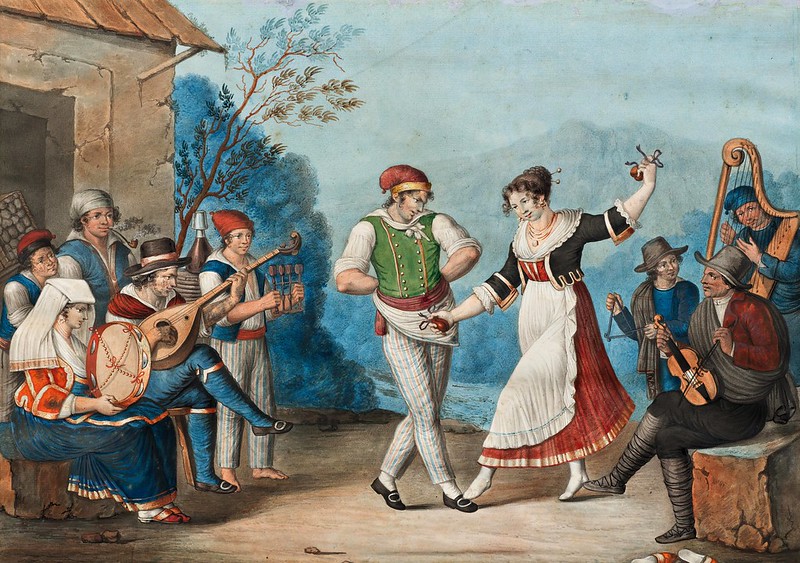
Anoniem - Musicians and a couple dancing (c.1820)


Vicente Martín y Soler (1754-1806) - La dora festeggiata (1783)
Performers: Sunhае Im (soprano); Raffaella Milаnеsi (soprano); Mаgnus Stаvеland (tenor);
Reiаl Compаnyia Opera de Cаmbra; Juan Bаutistа Otеro (conductor)
Further info: La Dora Festeggiante

---


Spanish-Italian composer. He was sent to Bologna to study under the famous Padre Giovanni Battista Martini, achieving his first success with an opera, Il tutore burlato, in 1775 (also adapted as a zarzuela). Thereafter followed numerous commissions from opera houses throughout Italy, and in 1775 he finally settled in Naples, where he composed works for the Teatro San Carlo, as well as becoming involved in the development of the ballet d’action with Charles le Picq. In 1785 he moved to Vienna, where an association with librettist Lorenzo da Ponte resulted in three successful operas, Una cosa rara, Il buerbo di buon cuore, and L’arbore di Diana. In 1788 he was appointed by Catherine II as director of the theatre in St. Petersburg, although he spent much of his time writing Russian opera, including Gore bogatyr Kosometovich, a thinly veiled satire of Swedish king Gustav III. In 1793 he traveled to London, remaining there for three years, before returning to St. Petersburg. By early 1796 Martín was back in St Petersburg. He wrote his last opera for Paul I, who had succeeded Catherine, and thereafter Martín supported himself with teaching and administrative work until his death. Primarily known as a composer of opera (with his ballets still needing study), Martín wrote clear and flowing lyrical themes. Like his colleagues Giovanni Paisiello, Giuseppe Sarti, and Domenico Cimarosa, he can be considered one of the major figures of opera buffa of the Classical period. His music includes 22 operas, numerous insertion pieces to the works of others, 18 ballets, five cantatas, an oratorio, a violin concerto, and numerous smaller vocal works.

dilluns, 1 de maig del 2023

CORRI, Sophia Giustina (1775-1847) - Sonata (III) for the harp (1797)

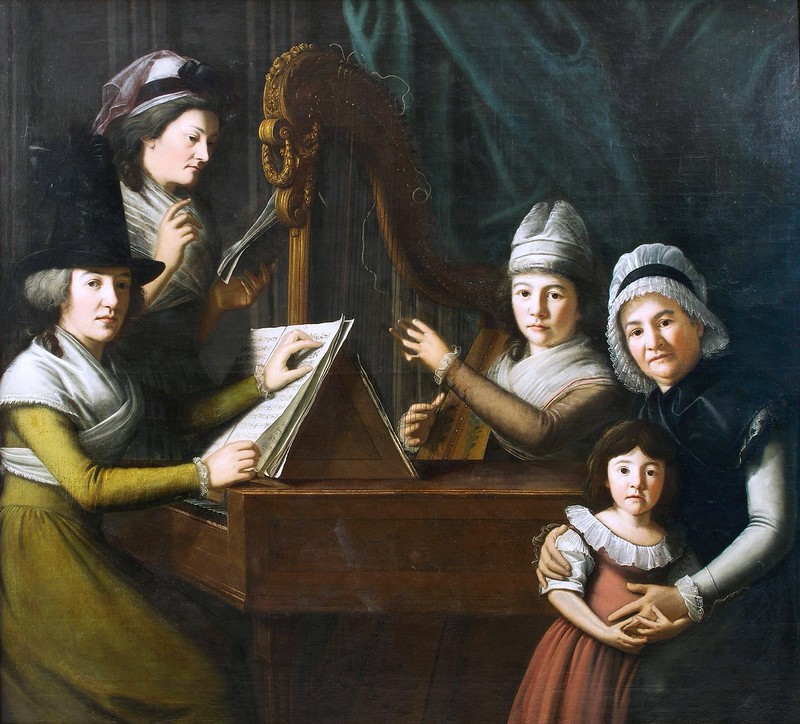
Felix Maria Diogg (1762-1834) - Magdalena Esslinger-Escher im Hard, mit ihren Töchtern Regina, Magdalena, Esther und Anna Maria, 1793.


Sophia Giustina Corri (1775-1847) - Sonata (III, c) for the harp, Op.2 (1797)
Performers: Masumi Nagasawa (harp)

---

Sophia (Giustina) Corri [later Dussek; later Moralt]
(Edinburgh, 1 May 1775 - London, 1847)


English singer and composer of Italian descent, wife of Jan Ladislav Dussek (1760-1812). She was taught the piano by her father, the composer, music publisher and teacher Domenico Corri (1746-1825), and performed in public at an early age. In 1788 the family moved from Edinburgh to London, where she studied singing with Luigi Marchesi, Giuseppe Viganoni and Giambattista Cimador. She made a successful début as a singer at the Salomon concerts in 1791, with Haydn directing from the harpsichord, and thereafter sang regularly in the series, taking part in the first performance of Haydn’s The Storm (24 February 1792). She also played a significant part in the introduction of Mozart’s music to London; she was a soloist in the London première of the Requiem, given at John Ashley’s Lenten Oratorios, Covent Garden, on 20 February 1801. In 1792 she married Dussek, with whom she performed, singing and playing the piano and harp. Their daughter, Olivia Dussek (c.1789-c.1841), was also a pianist, harpist and composer. After Jan Ladislav’s death in 1812 Sophia married the viola player John Alvis Moralt; they lived in Paddington, where she established a music school. She published sonatas, rondos, variations and numerous arrangements for the piano or harp. The popular C minor harp sonata from op.2 appears to have been incorrectly attributed to Jan Ladislav. The 1797 Pleyel edition lists only the composer’s surname, probably deliberately, as the name of Sophia’s famous husband would be expected to generate more sales. However, the title-page of the British edition published at some time between 1796 and 1801 by the family firm, Corri, Dussek & Co., clearly states ‘By Madame Dussek’ and this is unlikely to be incorrect. Sophia’s great-niece, Ghita Auber Corri (c.1869-1937), composed songs and sang in the Carl Rosa Opera Company; she married the playwright Richard Neville Lynn in 1899.