dilluns, 8 de gener del 2024

KEISER, Reinhard (1674-1739) - Concerto per il Flauto Traverso (c.1731)

Arnold Boonen (1669-1729) - Young Boy Playing a Flute to a Young Woman Weaving a Chaplet of Flowers


Reinhard Keiser (1674-1739) - Concerto (in Re maggiore) per il Flauto Traverso (c.1731)
Performers: Maurice Steger (traverso); Musica Antiqua Köln; Reinhard Goebel (conductor)

---


German composer. He was the son of Gottfried Keiser (? - before 1732), an organist and composer, and Agnesa Dorothea von Etzdorff (1657-1732), who had married only four months before his birth. The elder Keiser seems to have lost or given up his position as organist at Teuchern in 1674 or 1675 and departed, leaving his wife and two sons behind. On 13 July 1685 Keiser enrolled at the Thomasschule, Leipzig, for seven years, and it was there presumably that he received his principal musical education, studying under Johann Schelle and perhaps Johann Kuhnau. Mattheson observed, however, that he owed his composing skill almost entirely to natural ability and the study of the best Italian music. After leaving the Thomasschule, Keiser probably soon made his way to Brunswick, where the court opera was flourishing under the leadership of Johann Kusser; by 1694 he had obtained an appointment as ‘Cammer-Componist’. His opera Procris und Cephalus, on a text by the court poet F.C. Bressand, was performed in Brunswick that year, while another opera, Basilius, was done in Hamburg. Between 1695 and 1698 Keiser produced five more operas for the Brunswick-Wolfenbüttel court, all with Bressand, but in 1696 or 1697 he moved to Hamburg as Kusser’s successor at the Opera. There he found one of his most sympathetic literary collaborators in C.H. Postel, with whom he wrote eight operas, including Adonis (1697), Janus (1698) and the lost Iphigenia (1699). Beginning in 1703 Keiser also tried his hand at managing the opera house, in partnership with a literary man named Drüsicke. According to Mattheson their administration got off to a good start but was soon beset by financial difficulties, at least partly precipitated by riotous living by Keiser and his friends. In spring 1704 the theatre was temporarily closed, and Keiser left briefly for Weissenfels, where he gave the first performance of his Almira, originally intended for Hamburg.

Drüsicke apparently passed on the Almira libretto to the youthful Handel, a member of the opera orchestra, who scored a great success with his own setting in January 1705, leading to strained relations between the two composers that no doubt contributed to Handel’s decision shortly afterwards to leave for Italy. Octavia (1705), Keiser’s first opera after returning from Weissenfels, inaugurated an important series of eight historical dramas with librettos by Barthold Feind. Following the final collapse of his administration in 1707, Keiser appears to have absented himself from the opera house for more than a year, passing much of his time visiting the estates of noble friends. He may not have participated in the highly successful première of Der Carneval von Venedig in summer 1707, and he composed no new work for 1708. Whatever rift may have existed between him and the new director, J.H. Sauerbrey, seems to have been healed by 1709, and his dominance over the Hamburg repertory became more complete than ever. In 1721 he may have conducted a performance of Tomyris in Durlach before returning to Hamburg, where his arrival was celebrated on 9 August with a performance of his oratorio Der siegende David. In 1725 and 1726, while Telemann composed relatively little for that theatre, Keiser turned out five major new works, two revised versions, and parts of two intermezzos. On 2 December 1728 Keiser succeeded Mattheson as Kantor of Hamburg Cathedral, an important post which nonetheless brought him meagre remuneration. He never again composed a wholly new opera, though he did revise Croesus in 1730. His diminished productivity probably had less to do with the demands of his ecclesiastical duties than with the increasingly sorry state of the Hamburg Opera, which finally closed its doors in 1738. After the death of his wife in 1735, he ‘found reason’ (in Mattheson’s words) ‘to remain completely in retirement’ until his own death four years later. 

diumenge, 7 de gener del 2024

MARTIN RAMOS, Juan (1709-1789) - Aleph quomodo (1749)

Anoniem - Sancta Cecilia


Juan Martín Ramos (1709-1789) - Lamentacion de el sábado 'Aleph quomodo' (1749)
Performers: María Espada (soprano); Orquesta Barroca de la Universidad de Salamanca; Enrico Onofri (conductor)
Further info: No available

---


Spanish composer. In 1721 he was admitted as choirboy at the Cathedral of Salamanca where he received music lessons from Antonio de Yanguas. From 1724 he was under the supervision of Juan Francés de Iribarren, organist there. It was precisely Martín Ramos who succeeded his teacher Iribarren as first organist during which time he unsuccessfully applied for the positions of chapel master at the cathedrals of Zamora and Santiago de Compostela. In 1754, a few months after Master Yanguas death, he won the official post of chapel master at the Cathedral of Salamanca in a post he held the rest of his life. He also spent whole of his life in Salamanca almost with no traveling anywhere and composing at least 700 works, most of them sacred music.

divendres, 5 de gener del 2024

SCHOORMANS, Leander (b. 1999) - Symfonie in F (2020)

Reinier Vinkeles (1741-1816) - Amsterdam, de Dam met het Stadhuis en de Waag (c.1766)


Leander Schoormans (b.1999) - Symfonie in F (2020)
Performers: Sibelius + Instruments samples (edited by Leander Schoormans and Pau NG)

---


Dutch composer and organist. He was born in Germany but now living in Holland. When he was 3 years old he took drum lessons but very soon he discovered his deep passion for organ and church music. Until the age of 14, he sang in the choir of Breda Cathedral where he performed with the Amsterdam Baroque Orchestra and the Royal Concertgebouw Orchestra. Since 2016, he combines his organ lessons with his studies for Music Education in Tilburg (Netherlands). He also studied at the Royal Conservatoire in The Hague for music teaching according to the Kodaly concept. As a composer, he wrote a few orchestral works as well as chamber and organ pieces in a mix-up styles; baroque, classical and modern. As a researcher, he is developing a project about recovering neglected music by 18th Century Dutch composers. 

dimecres, 3 de gener del 2024

SCHNEIDER, Friedrich (1786-1853) - Academische Ouverture (1829)

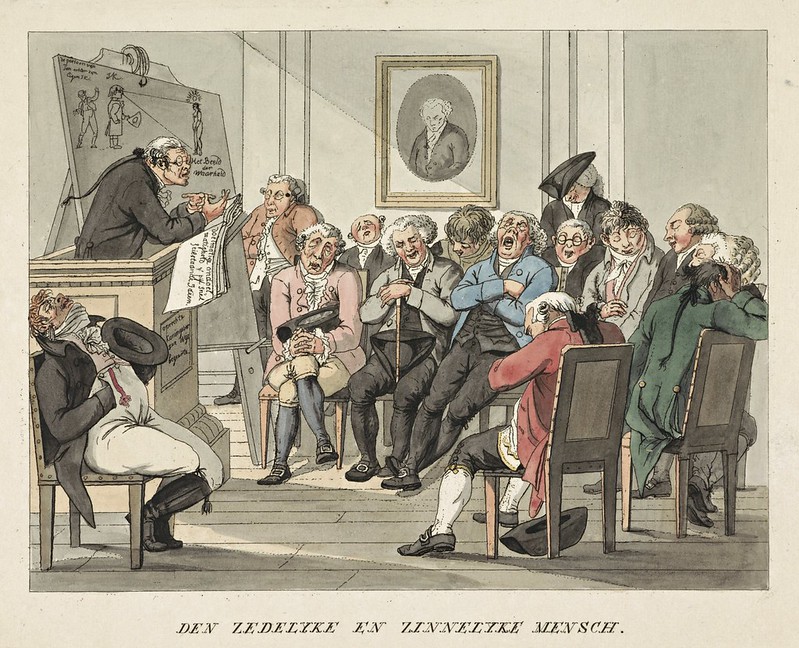
Jacob Ernst Marcus (1774-1826) - Wijsgeer houdt een redevoering voor een slapend publiek


Friedrich Schneider (1786-1853) - Academische Ouverture in D-Dur, Op.84 (1829)
Performers: Anhaltische Philharmonie Dessau; Markus L. Frank (conductor)

---


German composer, organist, conductor and teacher. He learnt the piano from his father, Johann Gottlob Schneider (1753-1840), and then at the Zittau Gymnasium with Johann Schönfelder and Unger. In 1804 he published his first works, a set of three piano sonatas, and in the following year he entered the University of Leipzig to continue his musical studies; here he came into contact with August Eberhard Müller, Johann Gottfried Schicht and Johann Friedrich Rochlitz. In 1806 he became singing teacher at the Ratsfreischule, in 1807 organist of the Universitätskirche, in 1810 director of the Secondaschen Opera Company, in 1812 organist of the Thomaskirche, in 1816 conductor of the Singakademie, and in 1817 musical director of the city theatre. His performance of Beethoven’s Fifth Piano Concerto in Leipzig on 28 November 1811 is believed to have been the work’s première. In 1820 he became Hofkapellmeister at Anhalt-Dessau, where he contributed much to improve musical life: he founded a Singakademie, a schoolmasters’ choral society, a Liedertafel and a music school, which was successful for about 15 years and had a number of excellent pupils, among them Robert Franz and Robert Volkmann. Between 1820 and 1851 he directed more than 80 German music and singing festivals, most of which included a performance of one of his oratorios. He belonged to numerous musical societies and received honorary doctorates from the universities of Halle and Leipzig in 1830. The highpoint of his wide-ranging compositional activity while at Leipzig came with his oratorio Das Weltgericht, first performed on 6 March 1820 at the Gewandhaus and widely performed thereafter. As a composer, he wrote seven operas, four masses, six oratorios, 25 cantatas, 23 symphonies, seven piano concertos, sonatas for violin, flute, and cello, and a great many shorter instrumental pieces, some of them for piano, some for organ. He also left numerous solo songs and part songs. His brothers Johann Schneider (1789-1864) and Gottlieb Schneider (1797-1856) were also organists and composers. His son Theodor Schneider (1827-1909) was a cellist and conductor.

dilluns, 1 de gener del 2024

PFEIFFER, Johann (1697-1761) - Sonata für Traverso

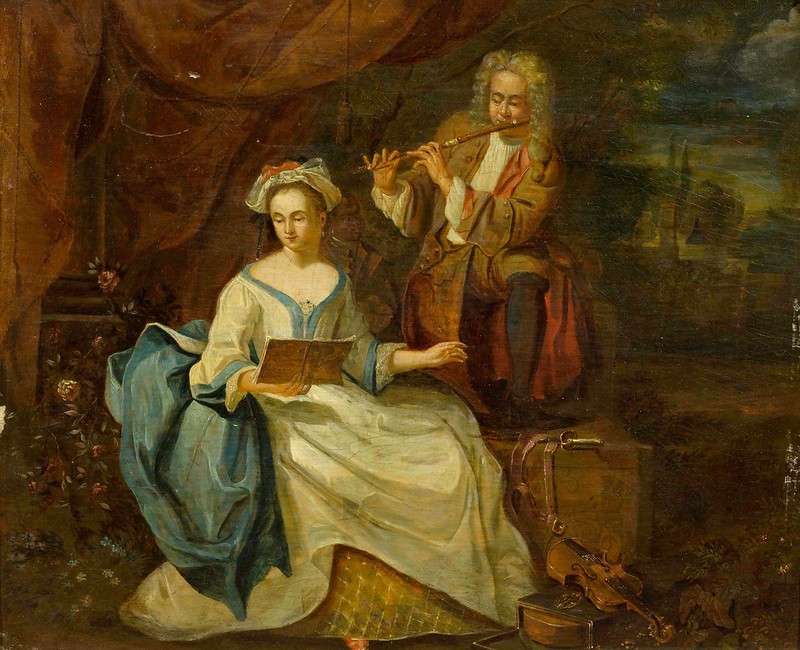
Circle of Nicolas Lancret (1690-1743) - A couple playing music


Johann Pfeiffer (1697-1761) - Sonata (G-Dur) à Traversiero Primo, Traversiero Secondo (violine) e Violoncello
Performers: Sabine Dreier (traverso); Ulla Schneider (violine); Tilmann Stiehler (violoncello); Irene Hegen (cembalo)

---


German composer and violinist. He studied at the university of Halle and Leipzig. He spent six months as director of music for Count Heinrich XI von Reuss at Schleiz before entering the Weimar court orchestra as a violinist in 1720. In 1726 he was made Konzertmeister, a post apparently left vacant since J.S. Bach's departure in 1717. From 1734 he served as Kapellmeister in Bayreuth, and also was music teacher to Margravine Wilhelmine, sister of Friedrich II the Great. On 20 September 1752 he married the widowed Dorothea Hagin, by whom he had two sons, Friederich Pfeiffer (1754-1816), a lawyer by profession and an able violinist, and Johann Heinrich Pfeiffer, who died in infancy. In 1752 or 1753 Pfeiffer was awarded the honorary title of ‘Hofrat’ (privy councillor), and his salary was increased; by the time of his death it stood at 1375 Reichsthaler. As a composer, he wrote 3 symphonies, 18 concertos for Violin and Strings, 9 concertos for Violino Picolo and Orchestra, 2 concertos for Lute and Strings, a Flute Concerto, chamber music and vocal pieces.