divendres, 31 de març del 2023

DURANTE, Francesco (1684-1755) - Concerto Per Cembalo con VV.ni e Basso

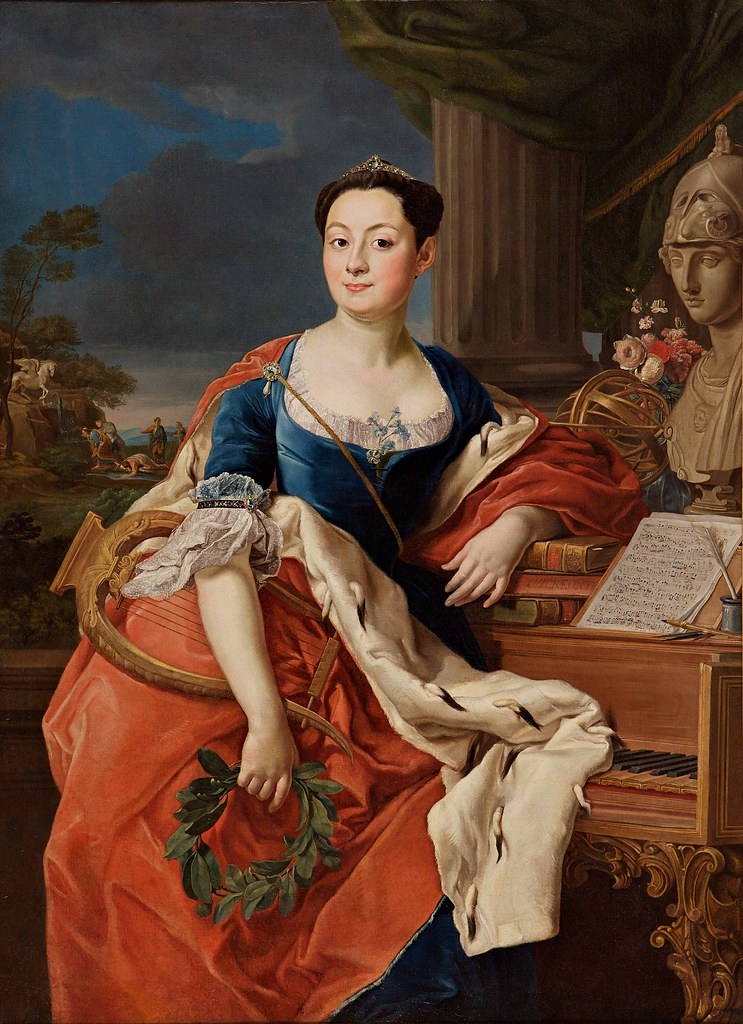
Pompeo Batoni (1708-1787) - Portrait of Princess Giacinta Orsini Buoncampagni Ludovisi (c.1758)


Francesco Durante (1684-1755) - Concerto (in Si bemolle maggiore) Per Cembalo con VV.ni e Basso
Performers: Antonеlla Cristiаno (pianoforte); I Solisti Pаrtеnopеi; Ivаno Cаiаzzа (conductor)

---


Italian composer. He was the seventh of 11 children of Gaetano Durante and Orsola Capasso. His father, a woolcomber, served as sexton and singer at S Maria degli Angeli e S Sossio, Frattamaggiore, where he and his wife had married on 31 October 1674 and where all their children were baptized. His uncle, Don Angelo Durante (c.1650-after 1704), was a priest and musician who in 1690 succeeded Cristoforo Caresana as primo maestro of the Neapolitan Conservatorio di S Onofrio a Capuana, of which he was rector until 1699. Nothing is known of Francesco’s education until after his father’s death on 18 March 1699, when his uncle took over his musical training. Don Angelo left Naples to assist his widowed sister-in-law and her children, and Nicola Sabini assumed his duties at the conservatory; but in 1702 he returned to his post at S Onofrio and Francesco enrolled as a convittore to study with his uncle and the violinist Gaetano Francone. Three years later Francesco left the conservatory, and on 13 June 1705 his first known creative effort, a scherzo drammatico entitled Prodigii della divina misericordia verso I devoti del glorioso S Antonio di Padova, was performed in Naples. Little is known about Durante’s life between then and 1728, when he was appointed primo maestro of the Neapolitan Conservatorio dei Poveri di Gesù Cristo. Choron and Fayolle (1810) stated that he studied with Pasquini and Pitoni in Rome for five years, and although that was later disavowed (by Villarosa and Florimo), circumstantial evidence seems to support them. Girolamo Chiti, in a letter to Padre Martini of 10 September 1746, identified Durante as a ‘scolaro di Pitoni’. Durante could have been in Rome either between 1705 and 1710, which would have allowed studies with Pasquini (who died in 1710), or between 1711 and 1719. The only dated composition by Durante from the first period, his Missa S Ildefonsi of 1709, could have been written for the Spanish church in Rome or Naples. By July 1710 he was in Naples, where he began teaching at the Conservatorio di S Onofrio. 

He remained there for only six months, leaving the institution on 12 January 1711, perhaps to return to Rome or to study there with Pitoni for the first time. He was, however, in Naples on 4 January 1714, when he married Orsola de Laurentis, 12 years his senior, and is certain to have been present in the city at the first performance of his sacred drama La cerva assetata ovvero L’anima nelle fiamme on 18 February 1719. Thereafter, nothing is known of Durante’s whereabouts until 1728. In October 1728 the governors of the Conservatorio dei Poveri di Gesù Cristo appointed Durante, now aged 44, primo maestro replacing the elderly Gaetano Greco: his election attests to his high reputation. After ten years of service, Durante resigned from the conservatory, and in September 1739 he was succeeded by Francesco Feo. The reasons for his resignation are unknown, and there is no information about his activities until 1742, when he was called to the Neapolitan Conservatorio di S Maria di Loreto. This oldest and largest of the four Neapolitan conservatories had been without a primo maestro since October 1741, when Porpora went on leave to Venice and did not return; with the death of Giovanni Veneziano on 13 April 1742 it had lost its secondo maestro. On 25 April 1742 the governors elected Durante primo maestro, at the same time appointing P.A. Gallo to assist him as secondo maestro. Under Durante’s directorship the Loreto conservatory regained stability and quality of education. During his 13 years’ service such later masters as Pasquale Anfossi, Tommaso Traetta, Pietro Guglielmi, Alessandro Speranza, Antonio Sacchini and Fedele Fenaroli received their musical education there. Durante continued to hold his positions at both S Maria di Loreto and S Onofrio, and during the last ten years of his life was venerated as the most distinguished of all Neapolitan teachers. According to tradition Nicolo Piccinni became Durante’s favourite pupil, of whom he is supposed to have said: ‘The others are my pupils, but Nicolo alone is my son’. He was buried in S Lorenzo Maggiore in Naples. 

dimecres, 29 de març del 2023

TRAETTA, Tommaso (1727-1779) - Overtura 'Antigona' (1772)

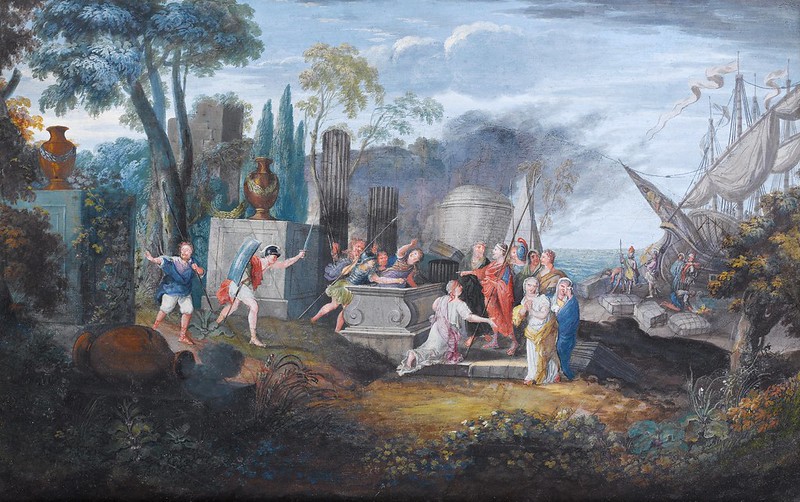
French School (18th Century) - The Abduction of Helen of Troy


Tommaso Traetta (1727-1779) - Overtura 'Antigona' (1772)
Performers: Volаntеs Orchestra; Jаkubа Kydlíčkа (conductor)

---


Italian composer. He was trained between 1740 and 1750 at the Conservatorio di S Maria di Loreto, Naples, where his teachers were Porpora (until 1741) and Durante. His Stabat Mater, probably written around 1750, shows contrapuntal mastery and a penchant for sombre, chromatic choral writing. In accordance with local custom, he presumably proved his talents for the stage by writing comic operas for the smaller Neapolitan theatres before receiving a commission to write Il Farnace for S Carlo in 1751. He continued to write both serious and comic opera throughout his life. In Rome and Naples during the early 1750s he came into contact with the commanding figure of Jommelli. In 1757-58 he had no fewer than five Metastasian operas performed in Rome and northern Italian cities including Venice, which became his base. The crucial phase of Traetta's career began with his appointment in 1758 to the court at Parma, where the intendant Du Tillot proposed to unite some features of French tragédie lyrique with the reigning ideals of Italian aria opera, and to this end had the text of Rameau's Hippolyte et Araicie translated and adapted by the court poet C.I. Frugoni. This solidified his reputation as a reformer, leading to two other significant works, Sofonisba for Mannheim in 1762 and Ifigenie for Vienna the following year. In 1765 he was appointed as director of the Conservatorio dell’Ospedale in Venice, which allowed him to be resident in one of the most active opera-producing centers in Europe. His fame brought him to the attention of Catherine II of Russia, who brought him to St. Petersburg in 1768. There he composed one of his most advanced and successful works, Antigona, in 1772. Traetta left Russia in ill-health during the summer of 1775 and settled again in Venice. He tried his fortunes for a time in London, among other places, with a serious opera, Germondo. Burney related that the great English success of Sacchini at the time prevented Traetta from becoming popular. In 1777 he was briefly in Paris, where he presumably sought new opportunities, just as Mozart would the following year; Il cavaliere errante was given posthumously at the Opéra in 1779. In autumn 1777 he returned to Venice, where his son Filippo (also a composer) was born; his last two completed works were comic operas for the Venetian carnivals of 1778 and 1779. By the latter date he was already suffering from his final illness. He was a celebrated man at his death, and was buried with honours near the Ospedaletto. Traetta’s music is characterized by a depth of emotion and life given to his characters. He has a fluidity with respect to melody, as well as using both ensembles and choruses with good effect. Indeed, his music was regarded as “always beautiful and sometimes sublime.” During his life he wrote 44 operas, as well as an oratorio (Rex Salomon), two Masses, a Stabat mater, a St. John Passion, a Miserere, and a number of smaller motets. He can be regarded as one of the principal composers of Italian opera in the middle of the 18th century.

dilluns, 27 de març del 2023

ANDRE, Johann (1741-1799) - Flötenquartett D-Dur (c.1793)

Louis Gabriel Moreau (1740-1806) - A village pantomime


Johann André (1741-1799) - Flötenquartett D-Dur (c.1793) after Mozart's Violin Sonata K378
 [attributed but probably by his son Johann Anton André (1775-1842)]
Performers: Ensemble Sans Souci Berlin

---


German composer and publisher. His peasant grandfather, a Huguenot, fled persecution in Languedoc and settled in 1688 in Frankfurt, where he became a manufacturer of silks. When only ten years old Johann succeeded to the family firm, which was directed during his minority by his mother and an uncle. His early education in music came through a friend who took lessons in Frankfurt; from 1756, while he learnt business management in the family firm, he had lessons in thoroughbass for several months from a transient musician, apparently the only regular instruction he ever received. Around 1758 he went to Mannheim to further his business training. The decisive stimulus to André’s artistic career occurred when he was a volunteer clerk in Frankfurt (1760-61), where, during the French occupation, a French troupe presented the opéras comiques of Philidor for the first time to a German public. The removal of Theobald Marchand’s renowned theatrical troupe to Frankfurt in 1770 made André’s efforts particularly timely. Marchand, apparently drawn by the literary finesse of these translations, seems to have proposed André’s close collaboration with the troupe; in any case André translated more than a dozen French plays and operettas in 1771-72, all of which appeared in Marchand’s repertory. In addition Marchand cultivated German Singspiel, as represented by Georg Benda, Hiller, Neefe and others. André made adept use of the many-sided theatrical experiences and stimuli of these years in the libretto and score of his first work, Der Töpfer (1773), dedicated to Marchand. Goethe wrote at length in appreciation of this work (letter of 23 November 1773 to Johanna Fahlmer): 

"The piece exists for the sake of its music, bears witness to the good, gregarious soul of its creator, and fully meets our theatre’s particular need that actors and audience be able to follow it. Now and then there are good conceits; yet its uniformity would not exist but for the music. This music is composed with understanding of the present capabilities of our theatres. The author has sought to combine correct declamation with light, flowing melody, and no further art is required to sing his ariettas than is demanded by the beloved compositions of Messrs Hiller and Wolf. So as not to leave the ear entirely empty, he has directed all his industry to the accompaniment, which he sought to render as full-voiced and harmonious as is possible without disadvantage to the sung parts. To this end he often used wind instruments, sometimes putting these in unison with the voice parts to make them strong and agreeable, as accomplished for instance by a single flute in the first duet. One cannot reproach him for copying or pilfering. And there is still more to be hoped from him." 

Der Töpfer, first performed on 22 January 1773 in Hanau, was a success; and, as was characteristic of André’s enterprise and practicality, he tried to turn this into a material success too. The artistic and apparent financial success of Der Töpfer determined André’s subsequent career and encouraged him to further undertakings both as a dilettante composer and as a music publisher. André withdrew from the family silk concern in 1774 to found his own ‘Notenfabrique’ and music publishing house. In 1776 he was appointed conductor at Theophil Döbbelin’s theatre in Berlin. There André disclosed his full talent as a composer in a period of extraordinary productivity. André’s mother died in 1784, and his publishing firm was faring poorly under the administration of his uncle J.B. Pfaltz. As the removal of the firm from Offenbach to Berlin was made impossible by J.J. Hummel’s exclusive privilege in that city, André, by then bearing the honorary title of Kapellmeister to Margrave Schwedt, accordingly chose to return to Offenbach, where he immediately took over the direction of his firm. By virtue of its circumspect treatment of authors and many technical improvements the firm flourished considerably, reaching its 1000th item in 1797. André apparently composed little after 1784, his Singspiel Der Bräutigam in der Klemme for the Frankfurt stage (1796) being a solitary late addition to his output. In 1798 he fell ill while on a business journey to Bamberg and he died the next year.

diumenge, 26 de març del 2023

RÖSLER, Gregor (1714-1775) - Missa Solemnis (1749)

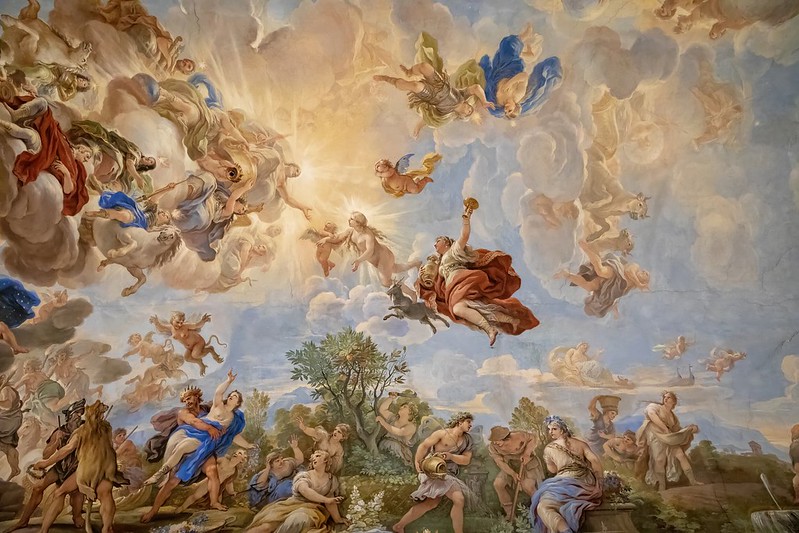
Unknown artist (18th Century) - Fresco del Palazzo Medici


Gregor Rösler (1714-1775) - Missa Solemnis A-Dur, Nr.3 (1749)
Performers: Arnt Autenrieth (soprano); Manfred Hohenleitner (alto); Reinhard Salamansberger (tenor); Heinz Haggenmuller (bass) Tölzer Knabenchor; Convivium Musicum München; Gerhard Schmidt-Gaden (conductor)
Further info: Rott Am Inn

---


German Augustinian monk, organist and composer. Almost nothing is known about his life despite several of his works are extant and preserved in archives of Germany, Switzerland and Austria. He was active as musician in Bettbrunn, Regensburg, München, Ramsau bei Berchtesgaden and Seemannshausen. He was also subprior in the Seemannshausen monastery. As a composer he wrote, among others, 15 Offertoires Op.1 (1748), Oves octo harmonicae in ovile fraternum receptae seu VIII. Synphoniae a II Op.2 (A, C, D, G, F, Eb, Bb, A), VI Litaniis Lauretanis Op.3 (1749), VI Missae Solemniores, quarum ultima de Requiem a 4 Voc. et 6 Instr. Op.4 (1749). His style is mostly classical and close to the 18th Century Bavarian masters. Even he is currently forgotten, his music was praised and disseminated through the Bavarian monasteries. 

divendres, 24 de març del 2023

HANSEL, Carl August (1799-c.1867) - Hornkonzert in F-dur, Op.80

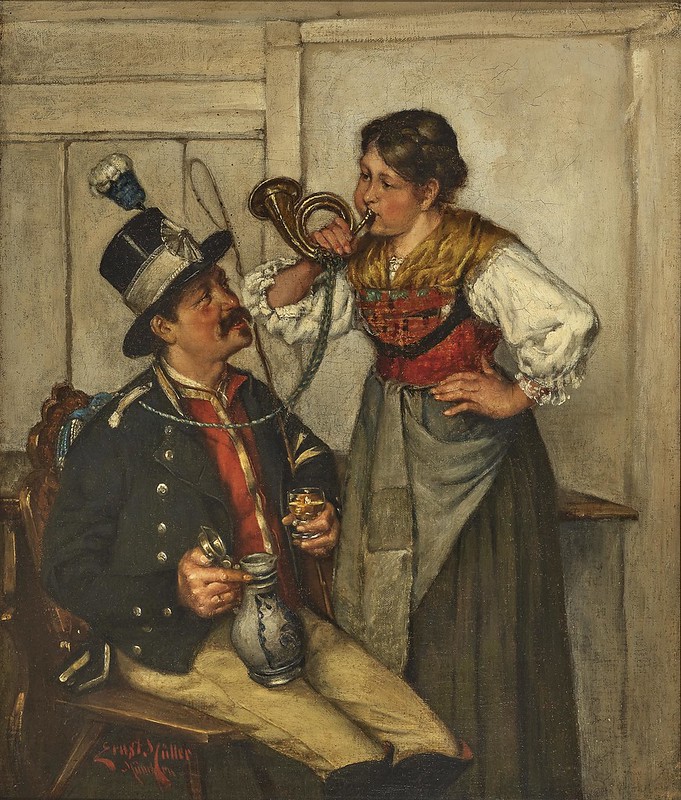
Ernst Immanuel Müller (1844-1915) - Coachman and woman wearing a dirndl


Carl August Hänsel (1799-c.1867) - Hornkonzert in F-dur, Op.80
Performers: Isrаеl Philarmonic Orchestra; Meir Rimon (1946-1991, horn/conductor)
Further info: Horn music

---


German composer and cellist. Almost nothing is known about his life and career. From 1836 to 1867 he was cellist at the Saxon court chapel in Dresden where, among others, he was fellow of the hornist Carl Heinrich Hübler. As a composer, he published several works among them a Horn Concerto in F, Op.80 and Quatuors Originaux Für Vier Hörner in F, Op.75.