dimecres, 8 de desembre del 2021

LOMBARDINI, Maddalena Laura (1745-1818) - Concerto di Violino con' Diversi Istrumenti Obbligati (c.1772)

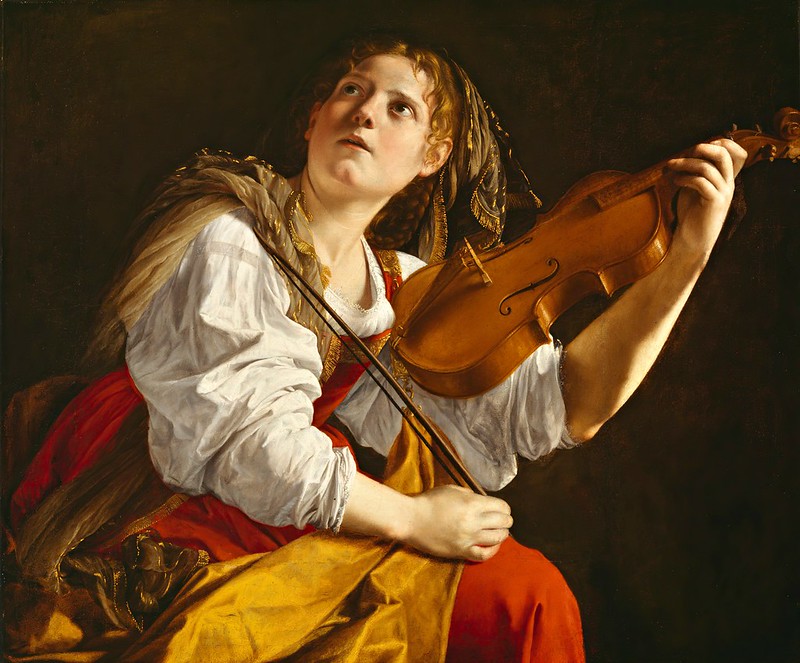
Orazio Gentileschi (1563-1639) - Young woman with a violin (Saint Cecilia) (c.1612)


Maddalena Laura Lombardini [Sirmen] (1745-1818) - Concerto di Violino con' Diversi Istrumenti Obbligati (c.1772)
Performers: Angélica Gámez (violin); Orquesta Sinfónica Nacional de Colombia; Lina González Granados (dirección)

---


Italian composer, violinist and singer. Unusually for a woman composer at that time, there appear to have been no other musicians in her family and she became famous entirely through her own efforts. In 1753 she was admitted to the Ospedale dei Mendicanti in Venice, not as an orphan but as a musician who would be an asset to their all-female choir and orchestra. She must have been an outstanding violinist since in 1760 she was allowed to go to Padua to study with Tartini; as the lessons were delayed, Tartini wrote her a long letter explaining his violin playing methods and the best way to practise. It was copied in Padua before it was sent and by 1770 it was in print in Italy, shortly followed by translations into English (by Charles Burney), German and French. Sirmen was probably taught composition by the maestro di coro at the Ospedale, Ferdinando Bertoni, and probably also by Tartini. The dates of her compositions are unknown, but as most of them were in print before 1774 they may have been composed while she was still at the Ospedale. In 1766, after 13 years at the Ospedale, she wanted to leave. Tartini tried unsuccessfully to find her a husband, but in the next year she married the violinist and composer Lodovico Sirmen (1738-1812). In 1768 the couple started a highly successful European tour, playing in Turin and several times at the Concert Spirituel in Paris, where six of her string quartets were published in 1769. Although the title page says ‘Composta Da Lodovico, E Madelena Laura Syrmen’, stylistic evidence indicates that they are entirely her own work. 

In January 1771 Lodovico was settled in Ravenna with their daughter and Maddalena was in London, advertised as ‘the celebrated Mrs Lombardini Sirmen’. She had two very successful seasons there as a violinist, playing in various concert series (including the Bach-Abel concerts) and at the theatres, followed by a third when she became a singer. Her six violin concertos were published in 1772-73, followed in 1773 by keyboard arrangements of them by Tommaso Giordani. After London she played or sang in various Italian cities, in Paris, Dresden and as principal woman singing at St Petersburg (1783). In 1785 she appeared again at the Concert Spirituel, playing her own violin concertos, but was criticized for her old-fashioned manner. She then settled in Venice and Ravenna, where she spent the rest of her life. Sirmen's music was widely known during her lifetime. A violin concerto was played in Stockholm in 1774, and in a letter from Salzburg of 12 April 1778, to his wife and son Wolfgang, Leopold Mozart said: ‘After the symphony Count Czernin played a beautifully written concerto by Sirmen’. The string quartets, mostly in two movements, are notable for their interesting inner parts. The first movements of the violin concertos are generally in an embryonic sonata form, the slow movements in binary and the finales in rondo form. Her music was widely published and frequently reprinted by several different publishers in Paris, the Low Countries, Germany and London.

dilluns, 6 de desembre del 2021

FORSTER, Johann Christoph (1693-1745) - Concerto ex Dis dur

Cornelius Norbertus Gijsbrechts (c.1630-c.1675) - Trompe L’oeil With Christian V’s Equipment For Riding To Hounds (1671)


Johann Christoph Förster (1693-1745) - Concerto ex Dis dur
Performers: Bruce Atwell (horn); St. Petersburg Chamber Philharmonic

---


 German composer. He studied first with the organist Pitzler, then left Bibra for Weissenfels where he learnt thoroughbass and composition from Heinichen. When Heinichen went to Italy, Förster became a pupil of Georg Friedrich Kauffmann at Merseburg. In 1717 he was appointed violinist in the Merseburg court orchestra and later became Konzertmeister there. While employed at the court Förster dedicated six sonatas, six cantatas and 12 concertos to the duchess; he also learnt Italian, the predominant language for secular vocal music. Förster was granted leave of absence from Merseburg on several occasions: in 1719 he visited Heinichen at Dresden and in 1723 went to Prague where he met Fux, Caldara, Conti and other eminent musicians involved in the coronation celebrations of Charles VI. In August 1742 he played a leading part (under Johann Graf) in the birthday festivities of Prince Friedrich Anton of Schwarzburg-Rudolstadt, and the following year was appointed vice-Kapellmeister at Rudolstadt. Among works written for this court is a birthday cantata dedicated to Princess Bernhardine (5 May 1745). When Graf died in 1745 Förster succeeded him as Kapellmeister, but held this post for only a few weeks before his own death. There is some confusion surrounding Förster’s activities between 1739 and 1743. Loewenberg stated that he held an appointment at Sondershausen during this period, but in Förster’s application for the post at Rudolstadt (3 March 1743) he merely said he had been Kammermusikus and Konzertmeister at Merseburg ‘for a long time’.

In his own day Förster was greatly respected as a composer of church music. Gerber thought highly of the cantatas; when a boy he had sung many ‘agreeable’ arias by Förster in the local church at Sondershausen. In his instrumental music, Förster has been described as one of the leading exponents of the French overture: the overture in A major (ed. Riemann) shows a fine sense of form and a keen appreciation of instrumental colour. Whereas the orchestral suites are indebted to French models, the sinfonias and concertos display the influence of the Italian style. Förster’s chamber music invites comparison with Telemann’s. Both composers show the same ability to combine learned counterpoint and melodious themes, the same predilection for voice change and love of short melodic phrases in the galant manner. Few of Förster’s works were printed in the 18th century. The two main publications were a set of six symphonies published by Haffner (Nuremberg, 1747) and six Duetti oder Trii for two violins and optional continuo engraved by Telemann (see Mattheson). Förster was an extremely prolific composer. According to Walther he had written over 300 pieces by 1732, and the Breitkopf catalogues mention numerous works by him. It is obvious that existing work-lists are far from complete. Unfortunately many manuscripts lack the distinguishing Christian name so that authorship is open to dispute.

diumenge, 5 de desembre del 2021

FASCH, Johann Friedrich (1688-1758) - Missa Brevis (B-Dur) à 4 voci

Gabriel-François Doyen (1726-1806) - Allégorie de la ville de Paris (1765)


Johann Friedrich Fasch (1688-1758) - Missa Brevis (B-Dur) à 4 voci
Performers: Solists, choir and orchestra Linden; Walter Reiter (conductor)

---


German composer and Kapellmeister. He was one of the most significant German contemporaries of Bach, and his orchestral works are characteristic of the transition from the late Baroque style to the Classicism of Haydn and Mozart. Fasch was descended from a line of Lutheran Kantors and theologians. His earliest musical studies were as a boy soprano in Suhl and Weissenfels, and at 13 he was enlisted by J.P. Kuhnau for the Leipzig Thomasschule; his first compositions followed the style of his friend Telemann. While a student at the University of Leipzig he founded a collegium musicum which rivalled the eminence of the Thomasschule in the city's musical life. In this cosmopolitan city he encountered the concertos of Vivaldi, which greatly influenced his whole generation. Although he had no regular instruction in composition, he soon became so well known as a composer that his sovereign Duke Moritz Wilhelm of Saxe-Zeitz commissioned him to write operas for the Naumburg Peter-Paul festivals in 1711 and 1712. For purposes of study Fasch undertook a long journey through several courts and cities, eventually arriving at Darmstadt, where he studied composition with Graupner and Grünewald. He then held several positions, including those of violinist in Bayreuth (1714), court secretary and organist in Greiz (until 1721) and Kapellmeister to the Bohemian Count Wenzel Morzin in Prague, whose accomplished chapel orchestra earned Vivaldi’s praise. In 1722 Fasch reluctantly accepted the position of court Kapellmeister in Zerbst. In the same year he was twice invited to apply for the position of Thomaskantor in Leipzig, but withdrew from the competition shortly after Telemann did so, deciding that it was too soon to leave Zerbst. 

In 1727 Fasch spent some time at the Saxon court in Dresden, where his friends Pisendel and Heinichen were in charge of orchestral music and the Catholic chapel respectively. Heinichen's death in 1729 is a 'terminus ante quem' for several of Fasch's surviving liturgical pieces, which were performed by the chapel choir under Heinichen, who noted the duration of pieces on the manuscripts (as well as rewriting sections, which Pfeiffer has taken as an indication that the Dresden experience was another learning venture). Surviving correspondence, particularly with Nikolaus Ludwig, Reichsgraf von Zinzendorf, head of the Pietist Brotherhood in Herrnhut, reveals Fasch's unhappiness in strictly Lutheran Zerbst. Only one further application for a formal position is recorded (Freiberg, 1755), but it was unsuccessful, and Fasch remained at Zerbst for the rest of his life. During his 36 years there Fasch was primarily occupied with the composition of church cantatas and festival music for the count. His fame as a composer spread far beyond Saxony: his works were familiar to numerous courts and city churches, from Hamburg (where in 1733 Telemann performed a cycle of his church cantatas) to as far afield as Prague and Vienna. He enjoyed especially close relations with the famed Hofkapelle in Dresden, at which the Kapellmeister Pisendel performed many of his concertos (to some extent in arrangements), and likewise with the court at Cöthen, which attracted him by its Pietist leanings. Through his son C.F.C. Fasch, harpsichordist at the court of Frederick the Great in Berlin from 1756, he was connected with C.P.E. Bach.

divendres, 3 de desembre del 2021

HUBLER, Carl Heinrich (1822-1893) - Concertstück für Vier Waldhörner

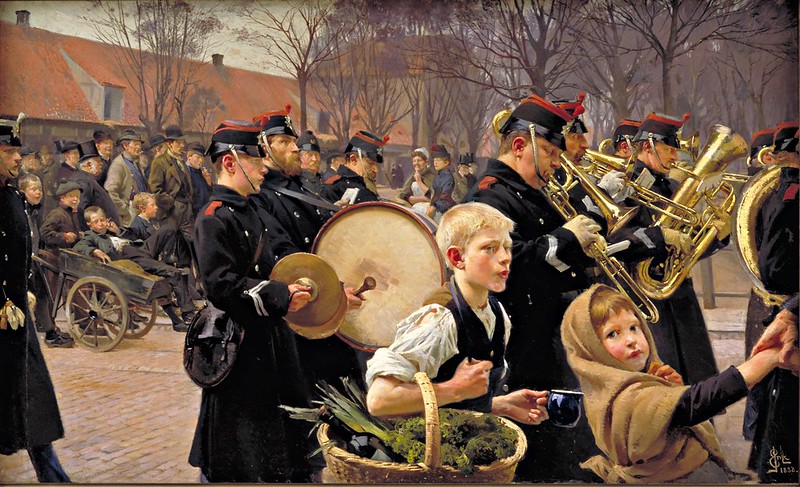
Erik Henningsen (1855-1930) - Changing of the Guard (1888)


Carl Heinrich Hübler (1822-1893) - Concertstück für Vier Waldhörner (c.1855)
Performers: Peter Arnold (horn); Charles Tibbets (horn); Ulrike Guggenberger (horn);
Matthias Stier (horn); Rundfunk-Orchester Kaiserslautern

---


German hornist and composer. After studying with hornist August Haase, he joined the Dresden Hofkapelle in 1844, where he served as a hornist until his retirement in 1891. In October 1849 he engaged in a private performance in the apartment of Johann Rudolph Lewy in Dresden of Robert Schumann's Konzertstück for four horns and orchestra (op. 86) with the composer in attendance. The event inspired Hübler to compose his own Konzertstück for four horns and orchestra, written c.1855, the single piece for which he is remembered. He was appointed royal chamber musician in 1851, and in 1886 was given the title chamber virtuoso, in recognition of his merits. Hübler was a founder of the Dresden Tonkünstler-Verein and remained a member of its governing board for more than two decades.

dimecres, 1 de desembre del 2021

GREENE, Maurice (1696-1755) - Magnificat & Nunc Dimittis (c.1735)

Federico Barocci (1528-1612) - The Head of Saint John the Evangelist (c.1580)


Maurice Greene (1696-1755) - Morning Service (in C); Magnificat & Nunc Dimittis (c.1735) 
Performers: Choir of Ely Cathedral

---


English composer and organist. He came of a well-to-do family which, claiming descent from the medieval Greenes of Green's Norton, had held estates in Essex since the end of the 16th century. His grandfather, John Greene (1616-1659), had been Recorder of the City of London; his father, the Rev. Thomas Greene DD (1648-1720), a chaplain of the Chapel Royal and canon of Salisbury, was vicar of the London parishes of St Olave Jewry and St Martin Pomeroy. As the youngest of seven children, Maurice is said to have been brought up in the choir of St Paul's Cathedral under Jeremiah Clarke and Charles King, and in 1710, to have been articled to Richard Brind, organist of the cathedral since Clarke's death. In March 1714 he took up his first appointment as organist of St Dunstan-in-the-West and in February 1718 he also became organist of St Andrew's, Holborn. A month later Brind died, and he was immediately chosen to succeed him at St Paul's. Though technically a vicar-choral, he was responsible, as organist, not only for the daily round of cathedral services but also for the music at the annual Festival of the Sons of the Clergy, and in that capacity he composed many large-scale orchestral anthems and occasional settings of the Te Deum. By this time too, he had become intimate with Handel who, it appears, had a particular liking for the organ of St Paul's and was a frequent visitor to the cathedral. Later they fell out so violently that, to quote Burney, ‘for many years of his life, [Handel] never spoke of [Greene] without some injurious epithet’. Greene's marriage to Mary Dillingham (1699-1767), a cousin of Jeremiah Clarke, must have taken place shortly after his appointment to St Paul's, for the first of their five children was born in May of the following year. In addition to his duties at the cathedral and his work as a teacher – Travers, Boyce and Stanley were among his first pupils – he was also involved in a good deal of secular music-making, as a founder-member of the Castle Society, and also of the Academy of Ancient Music, at whose weekly meetings some at least of Greene's own works were performed. 

Before long, however, he was caught up in the celebrated Bononcini affair which, in 1731, split the ranks of the academicians and, according to Hawkins, ‘made a great noise in the musical world’. As the agent of the deception by which Giovanni Bononcini sought to pass off a Lotti madrigal as his own, Greene found himself on the losing side and promptly withdrew from the academy, taking the boys of St Paul’s and many of the society’s best performers with him. They then set up a rival body, the Apollo Academy, at the Devil Tavern in Fleet Street, which was apparently devoted mainly to the interests of its three leading composer-members, Greene, Boyce and Festing. In 1738, together with Festing, he was also instrumental in establishing the Fund for the Support of Decay'd Musicians and their Families (later the Royal Society of Musicians). On Croft's death in August 1727, he was appointed organist and composer of the Chapel Royal. On 6 July 1730 the new Senate House in Cambridge was opened with a performance of his setting of Pope's Ode on St Cecilia's Day, specially adapted for the occasion by the poet himself. The next day the composer was formally admitted ‘Doctor in Musica’ and, ‘in compliment to his performance’, was shortly afterwards made professor of music, a purely honorary position which had been vacant since the death of Tudway in November 1726. The Mastership of the King's Musick followed in January 1735. Greene, not yet 40, now held every major musical appointment in the land. In January 1750 Katharine Greene (1729-1797), the composer's only surviving child, married the Rev. Michael Festing, son of one of Greene's oldest friends and professional associates. About this time, his health began to deteriorate: the Apollo Academy was disbanded and the conductorship of the Sons of the Clergy festival passed to Boyce. His last years were largely occupied with preparations for a projected collection of church music, ancient and modern, copies of which he apparently intended to present to every cathedral in England.