diumenge, 31 d’octubre del 2021

MOSONY, Mihály (1815-1870) - 3. F-dúr Mise (1849)

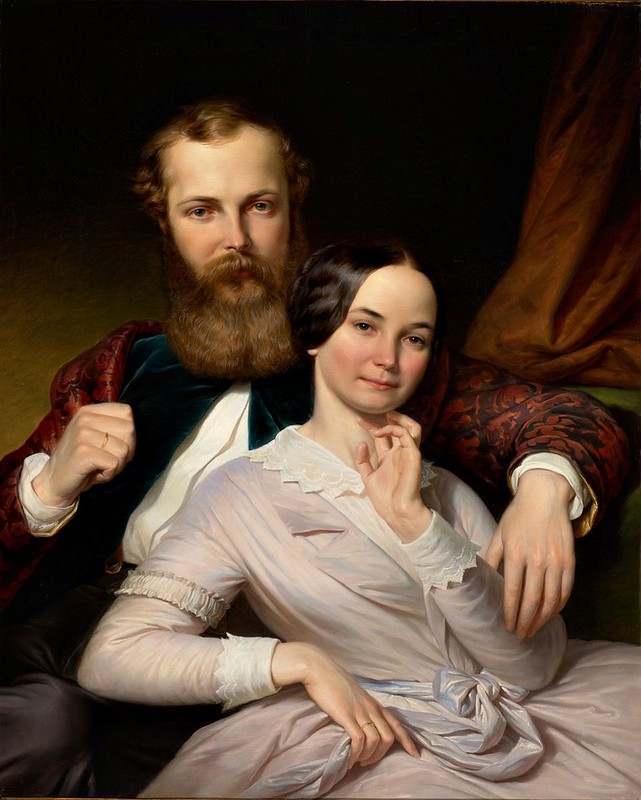
Henrik Weber (1818-1866) - The Composer Mihály Mosonyi and His Wife (c.1845)


Mihály Mosonyi (1815-1870) - 3. F-dúr Mise (1849)
Performers: Vanessa del Riego Ledo (soprano); Simone Veder (alto); Lars Terray (bariton);
Liszt Ferenc Chorus and Orchestra; Péter Scholz
Further info: Mosony - Mass No.3

---


Hungarian composer, teacher and writer on music. Like Liszt, he was born in the border region between Hungary and Austria at the meeting-point of several cultures. His name was originally Michael Brand, the same as his father and grandfather, and his first language was German. The fourth of 11 children in a family of furriers, he learnt the usual wind instruments of peasant life. Boldogasszonyfalva was a famous place of pilgrimage, and in its church, built by Prince Pál Esterházy, he had the opportunity to practise the organ and, between the ages of 10 and 12, to deputize for the cantor. In 1829 he left home to work as a church officer in Magyaróvár, where he taught himself music by copying Hummel's manual of exercises for the piano. About 1832 he moved to Pozsony (now Bratislava), at that time the capital of the Hungarian kingdom. Its cultural life was dominated by the nearby imperial city of Vienna, and became acquainted with the great works of Viennese masters and resolved to devote himself to music. He earned a living by teaching calligraphy, copying music, and working as a newsboy, later and typesetter for a printing firm, while he studied the piano and music theory with Károly Turányi, who later became Kapellmeister in Aachen. Turányi and another patron, Count Károly Keglevich, obtained for Mosonyi a position as a piano teacher at the residence of Count Péter Pejachevich in the Slavonian village of Rétfalu. There he spent seven years (1835-42), becoming an accomplished pianist and, with the help of Reicha's theoretical works, a composer. The compositions he finished in Rétfalu reveal a diligent pupil of the Classical style. In 1842 he moved to Pest, where he worked until his death. He never held a public, municipal or ecclesiastical position, nor was he in the service of a theatre, teaching institute or aristocratic household. One of the first independent musicians in Hungary to earn a living by teaching the piano and composition, his most famous pupils were Kornél Ábrányi (the elder), Gyula and Sándor Erkel (sons of Ferenc), Sándor Bertha, and the future director of the Budapest Academy of Music, Ödön Mihalovich. 

He was encouraged to compose by the stimulating intellectual atmosphere in Pest in the decade before the Hungarian War of Independence (1848-49). On 3 October 1846 he married Paulina Weber, sister of the famous portrait painter Henrik Weber. In the same year he began writing his Second Symphony, which was not performed until ten years later. He took part in the War of Independence as a member of the National Guard. In 1849 he wrote a mass (his third) in memory of his benefactor and godfather Peter Piller. The early death of his wife (13 July 1851) brought on an emotional crisis, making it impossible for him to compose for two years. The elegiac autumnal lyricism of the German songs (1853-54), which were published by Breitkopf & Härtel, reflect his grief and show him a fully fledged Romantic. In 1857, on the occasion of the first visit to Hungary by the Empress (later Queen) Elisabeth, he composed a piano piece in Hungarian style, Pusztai élet (‘Puszta Life’). A whole year of compositional activity followed its favourable reception, and from about 1859 he wrote a series of new works in the national style. To give an outward gesture of his stylistic transformation, he took the Hungarian name of Mosonyi in 1859, after his place of birth (the county of Moson). In 1865 he went to Munich to attend the first performance of Tristan und Isolde. In the same year he played the double bass in the first performance in Pest of Liszt's Legende der heiligen Elisabeth. In his last years he composed noteworthy Hungarian art songs and ballads, and a series of choral works and cantatas of less importance. In 1870, a few months before his death, he was appointed to the programme selection committee of the Pest National Theatre and was also a member of the committee to prepare the Hungarian Beethoven centenary festival. He died with many ambitious hopes for a Hungarian national music.

divendres, 29 d’octubre del 2021

FUCHS, Johann Nepomuk (1766-1839) - Concerto in B [per] fagotho (1802)

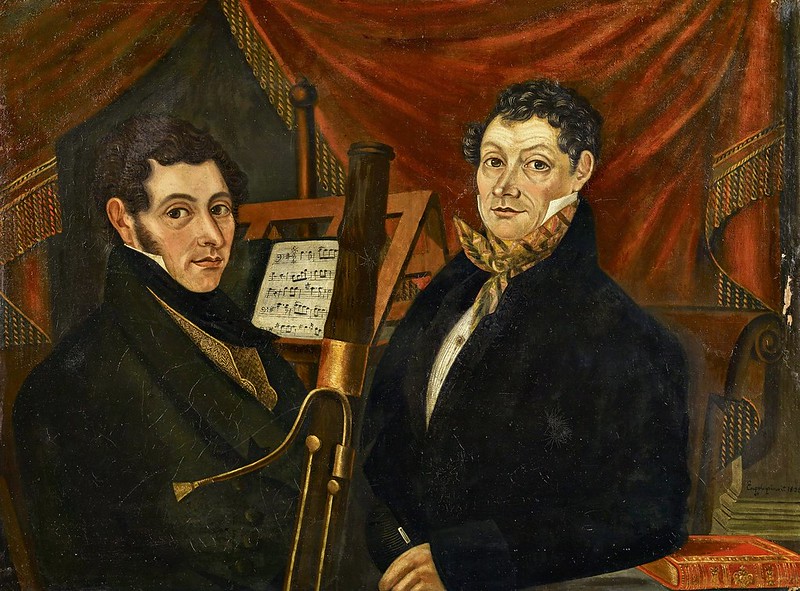
Engel (fl. 1825) - Pianiste et bassoniste (1825)


Johann Nepomuk Fuchs (1766-1839) - Concerto in B [per] fagotho [!] principale (1802)
(live recording, piano reduction)
Performers: Kevin Sleno (bassoon); Stephanie Mara (piano)

---


Austrian composer and conductor. He was a pupil of Joseph Haydn and from 1784 worked first as a violinist in the Esterházy chapel, then as a music teacher in the princely family and finally advanced to vice-director and, after Haydn's death in 1809, to court conductor. He worked in this capacity until his death. Fuchs composed instrumental works and chamber music, operas, but he mainly was praised as a sacred music composer. He was considered one of the most important composers of church music of his time. His works include 28 masses (among them the Missa Solenni in E dur), 51 offertories and graduals, 31 litanies and Vespers, 62 Salve Regina, 20 operas (among them Der Feldtrompeter), two overtures, three symphonies, serenatas, a bassoon concerto (1802) and 15 quartets for male voices. Fuchs must not be confused with the Austrian composer and conductor Johann Nepomuk Fuchs (1842-1899) of the same name.

dimecres, 27 d’octubre del 2021

EBERWEIN, Traugott Maximilian (1775-1831) - Concertante (F-Dur), Op.67

Lovro Janša (1749-1812) - Pogled na rezidenco kölnskega volilnega kneza v Bonnu (1798)


Traugott Maximilian Eberwein (1775-1831) - Sinfonia concertante (F-Dur), Op.67 (1820)
Performers: Wally Hase (flöte); Brigitte Horlitz (oboe); Jan Doormann (klarinette); Michael Abé (fagott); Ralf Ludwig (horn); Thüringisches Kammerorchester Weimar

---


German violinist and composer, elder brother of Carl Eberwein. He was the eldest of three sons of Alexander Bartholomäus Eberwein (1751-1811), the Weimar ducal court and town musician whose brother Christian was violinist at Frankfurt before becoming violinist (1794) and musical director (1811) of the Rudolstadt court orchestra. After taking violin lessons from his father, Traugott studied theory with F.L.A. Kunzen in Frankfurt and the violin with Ernst Schick in Mainz. He had some further instruction from J.C. Kittel (counterpoint) in Erfurt and, stopping at Naples on a concert tour through Germany, France and Italy (1803), with Fedele Fenaroli. After a visit to Hamburg (1796), he was engaged as court musician to Prince Ludwig Friedrich von Schwarzburg-Rudolstadt in the following year, later becoming chamber musician (1810) and Kapellmeister (1817) at Rudolstadt. Traugott's reputation rests largely on the standard of performance attained under his direction at Rudolstadt and his work as an early founder of music festivals in Germany, in addition to his many compositions. His settings of Goethe, with whom he was on friendly terms, include the Tafellied Mich ergreift, ich weiss nicht wie and dramatic works, among them the Singspiele Claudine von Villa Bella (1815) and Der Jahrmarkt zu Plundersweilen (1818). Although his songs are modelled on those of Berlin composers such as J.F. Reichardt, Neapolitan elements in them show the influence of Fenaroli. Some of Traugott's more popular songs appeared in student and choral songbooks; he also composed operas, Singspiele and incidental music for the theatre; cantatas, a mass, an oratorio and a Te Deum; concertos, chamber and orchestral music. He also wrote reviews for music journals.

dilluns, 25 d’octubre del 2021

DITERS VON DITTERSDORF, Joannes Carolus (1739-1799) - Sinfonia in A

Bernardo Bellotto (1721-1780) - Der Lobkowitzplatz in Wien


Joannes Carolus Diters von Dittersdorf (1739-1799) - Sinfonia in A (c.1788)
Performers: Arsatius Consort

---


Austrian composer and violinist. After promising early success in Vienna, he settled for a modest career as a provincial Kapellmeister and administrator. He composed voluminously despite the official responsibilities that occupied him for much of his life, and his generally high standard of craftsmanship earned him recognition as a leading figure of the Viennese Classical school. Born to Paul Ditters, costumier at the imperial court and theatre in Vienna, and his wife Anna (née Vandelin), Ditters enjoyed the benefits of a Jesuit school education, private tutoring and, from the age of seven, violin lessons. About 1750 he began studies with the violinist J.P. Ziegler, and before long he was accepted into the orchestra of the Schottenkirche. Soon afterwards he was recruited as a Kammerknabe by Prince Joseph Friedrich von Sachsen-Hildburghausen, whose Kapelle was one of the best in Vienna; from 1 March 1751 he played in the orchestra, performed menial duties, and was instructed in music and other subjects. With the violinist Trani he learnt Italian works and was groomed as a soloist, while Giuseppe Bonno taught him Fuxian counterpoint and composition. By the late 1750s Ditters had earned a reputation as a composer of instrumental music and had begun to receive commissions for symphonies and concertos. Then he came to the attention of Giueseppe Bonno and Christoph Willibald von Gluck, the latter of whom took him with him to Italy in 1763. There Ditters achieved success as a virtuoso, and by 1765 he had been hired by Archbishop Adam Patachich as Michael Haydn’s successor at Großwerdein. He improved the quality of the ensemble, but in 1769 it was dissolved and Ditters relieved of his duties. He found other employment with the Archbishop of Breslau, Count Philipp Gotthard von Schaffgotsch as a state administrative functionary at Schloss Johannesberg (now Janský vrch, Poland), and in 1773 he was appointed as chief forester at nearby Javernig (Javornik). This appointment required aristocratic rank, and Ditters was ennobled as von Dittersdorf at Freiwaldau (Jeseník). In 1784 he returned to Vienna where he participated actively in the musical life of the city. 

His rank allowed him access to all levels of the court society, and his abilities earned him the friendship of colleagues such as Joseph Haydn and Wolfgang Amadeus Mozart, with whom he performed in a string quartet (the cellist was his student Jan Křtitel Vanhal). In 1790, however, he returned to music as Kapellmeister to Duke Carl Christian Erdmann zu Württemberg-Oels, a post that also included governmental administrative duties. He moved to Oels (Olésnice) and then Karlsruhe in Upper Silesia. A reversal of fortune caused him to retire in 1796, and he moved to the small town of Neuhof (Červená Lhota), where he died only a couple of days after completing his autobiography. Dittersdorf was a prolific and progressive composer, particularly with respect to his use of the characteristic symphony, sometimes based upon Classical stories. He was conventional in terms of his harmony, but his skill in contrasting instruments demonstrates a good sense of color. His formal structures are often conventional, and his textures mainly homophonic, but he was considered one of the foremost composers of Vienna during his day. He can be considered one of the most popular composers of Singspiels of his day, with one work, Doktor und Apotheker, achieving international success. The number of works composed demonstrates an almost inexhaustible creativity and includes: 127 symphonies (with another 90 likely, making him the most prolific composer in the genre of all time, if true), 18 violin concertos, five viola concertos, eight oboe concertos, four keyboard concertos, nine other concertos, four sinfonia concertantes, four serenades, five cassations, 16 divertimentos, 18 string trios, seven string quartets, six horn quintets, six string quintets, 35 partitas, 72 preludes, 31 keyboard sonatas, 136 solo keyboard works, 16 violin sonatas, 32 operas, three concert arias, 16 secular cantatas, 16 Masses, a Requiem, four oratorios, 11 offertories, eight litanies, and 170 smaller sacred works such as Psalms, motets, and so forth.

diumenge, 24 d’octubre del 2021

RIGATTI, Giovanni Antonio (c.1613-1648) - Messa concertata à 8 vocibus

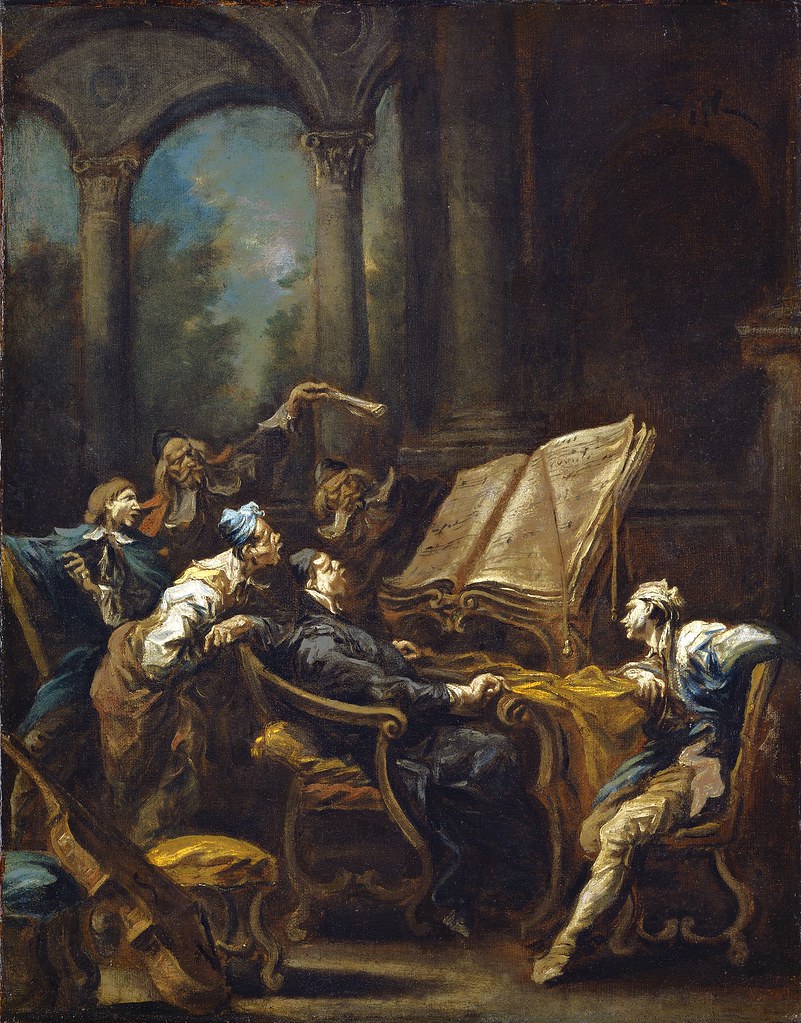
Alessandro Magnasco (1667-1749) - The Choristers (c.1743)


Giovanni Antonio Rigatti (c.1613-1648) - Messa concertata à 8 vocibus (1640)
Performers: Singers of Vancouver

---


Italian composer and singer. He became a choirboy at S Marco, Venice, in September 1621 and later trained as a priest at the Patriarchal Seminary. From September 1635 until March 1637 he was maestro di cappella of Udine Cathedral; his reputation was already so high that he was awarded a salary twice that of his predecessor, Orindio Bartolini. In August 1639 he was appointed maestro d'organo e musica alle figliole at the Ospedale dei Mendicanti; by 1642 he had also started teaching at the Incurabili, apparently without the permission of the Mendicanti authorities, who appointed a commission to observe his movements and dismiss him if necessary. His teaching was thenceforward confined to the Incurabili, where his pupils included Francesco Lucio, one of whose psalm settings he included in his 1646 collection. In 1642 he was appointed chaplain to Gian Francesco Morosini, who became Patriarch of Venice in 1644 and a procurator of S Marco in 1645, and whose influence led to Rigatti's appointment as a sottocanonico of S Marco in July 1647. The high esteem in which he was held at Udine while still in his early twenties is entirely consistent with his being, together with men such as Giovanni Rovetta and Gasparo Casati, one of the outstanding Italian composers of church music working in the 1630s and 40s. Nine of his eleven surviving collections are of church music: two books of solo motets, three of small-scale concertato motets (one including a messa breve) and no fewer than four of psalm settings (three including a mass each). Most of this music includes parts for obbligato instruments, usually violins, and much of it is adaptable, either to an intimate chamber-like medium with solo voices and perhaps violins, or to grander occasions by the addition of a ripieno chorus and sometimes extra instruments. The 1640 Messa e salmi, dedicated to the Emperor Ferdinand III, is the most impressive collection. It maintains a consistently high level of invention and rivals Monteverdi’s Selva morale of the same year in its comprehensive range of contents: one mass and several psalms in the grand concertato manner, psalms for smaller combinations of voices and instruments, and others marked ‘da cappella’ (denoting not the stile antico but the absence of soloists and the instrumental doubling of voices).